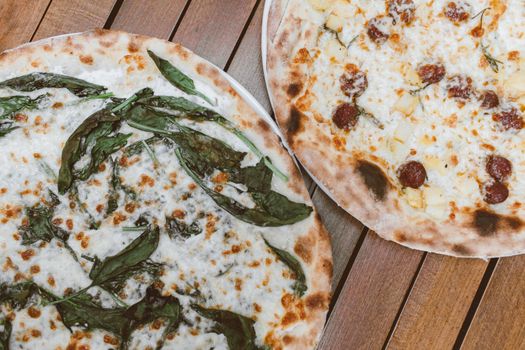
Photo: ROMAN ODINTSOV / Pexels
Italian
Pizza Quattro Formaggi
The diets react (see scores below)
Common Ingredients
- pizza dough
- mozzarella
- Gorgonzola
- fontina
- Parmesan
- olive oil
- black pepper
Specific recipes may vary.
Incompatible with 9 of 11 diets
Diet Ratings
Pizza Quattro Formaggi is built on a traditional wheat-flour pizza dough, which is a grain-based, high-carbohydrate foundation that alone contains 30-40g+ of net carbs per slice. A standard pizza serving (2-3 slices) would easily push 60-100g of net carbs, far exceeding the entire daily keto allowance of 20-50g. While the four-cheese topping (mozzarella, Gorgonzola, fontina, Parmesan) and olive oil are individually keto-friendly ingredients high in fat and low in carbs, the pizza dough makes this dish categorically incompatible with ketosis in its traditional form. There is no portion size small enough to make standard pizza dough acceptable on keto.
Pizza Quattro Formaggi is defined by four dairy cheeses — mozzarella, Gorgonzola, fontina, and Parmesan — all of which are animal-derived dairy products and therefore strictly excluded under vegan dietary rules. Dairy is one of the most unambiguous non-vegan ingredients, placing this dish firmly in the 'avoid' category with no meaningful debate within the vegan community. The pizza dough and olive oil are plant-based, but the dish's identity is built entirely around cheese, making a vegan version a fundamentally different dish.
Pizza Quattro Formaggi is fundamentally incompatible with the paleo diet. The base is pizza dough, made from wheat flour — a grain that is categorically excluded from paleo. The dish is then topped with four cheeses (mozzarella, Gorgonzola, fontina, and Parmesan), all of which are dairy products explicitly excluded under paleo rules. While olive oil and black pepper are paleo-approved, they are minor components that cannot redeem a dish whose two defining elements — grain-based dough and dairy cheese — are core paleo exclusions. There is no meaningful version of this dish that could be considered paleo-compatible without fundamentally changing its nature.
Pizza Quattro Formaggi presents a mixed Mediterranean diet profile. The olive oil base is a positive element, and pizza originated in Mediterranean cuisine, but this version is heavily loaded with four types of cheese (mozzarella, Gorgonzola, fontina, Parmesan), making it very high in saturated fat and sodium. The refined white flour pizza dough lacks fiber and nutrients compared to whole grain alternatives. Dairy is acceptable in moderation in the Mediterranean diet, but four cheeses in one dish far exceeds moderate consumption. There are no vegetables, legumes, or other plant-based foods to balance the dish. Occasional consumption is acceptable, but this should not be a regular meal.
Traditional Italian Mediterranean cuisine does include pizza as a culturally embedded food, and some Mediterranean diet researchers (particularly those studying the traditional Southern Italian diet) acknowledge pizza with modest toppings as part of the dietary pattern. A smaller portion paired with a large salad dressed with olive oil could bring the overall meal closer to Mediterranean principles.
Pizza Quattro Formaggi is fundamentally incompatible with the carnivore diet. The base is pizza dough — a grain-based, plant-derived food that is explicitly excluded from any tier of carnivore eating. Olive oil is a plant-derived oil, also prohibited. Black pepper is a plant spice. While the four cheeses (mozzarella, Gorgonzola, fontina, Parmesan) are animal-derived dairy products that would be debated within the carnivore community on their own, they are entirely overshadowed by the dominant plant-based components. This dish is a quintessential processed grain product with plant oils and spices — exactly what the carnivore diet is designed to eliminate.
Pizza Quattro Formaggi violates Whole30 rules on multiple levels. First, pizza dough is made from grains (wheat flour), which are explicitly excluded from the Whole30 program. Second, all four cheeses — mozzarella, Gorgonzola, fontina, and Parmesan — are dairy products, which are also excluded (only ghee and clarified butter are permitted as dairy exceptions). Third, even if one were to imagine grain-free, dairy-free substitutes for these ingredients, the dish itself — pizza — is explicitly named as a prohibited 'junk food recreation' under Rule 4 of the Whole30 program. This dish fails on at least three independent grounds: grains, dairy, and the spirit/letter prohibition on recreating pizza.
Pizza Quattro Formaggi contains two major high-FODMAP ingredients that make it unsuitable during the elimination phase. First, standard pizza dough is made with wheat flour, which is high in fructans — a key FODMAP oligosaccharide — at any normal serving size. A typical pizza slice contains far more wheat than the small 'safe' threshold. Second, Gorgonzola is a soft, creamy blue cheese with significant lactose content, rated high-FODMAP by Monash University. Fontina is also a semi-soft cheese that retains moderate lactose. While Parmesan and mozzarella (if firm/low-moisture) are generally low-FODMAP aged or harder cheeses with minimal lactose, they cannot redeem this dish. Olive oil and black pepper are low-FODMAP. The combination of wheat-based dough plus high-lactose soft cheeses creates a double FODMAP burden, making this dish a clear avoid during elimination.
Pizza Quattro Formaggi is built around four full-fat cheeses — mozzarella, Gorgonzola, fontina, and Parmesan — making it extremely high in saturated fat and sodium, both of which DASH guidelines explicitly limit. A typical serving easily delivers 800–1,200mg of sodium and 10–16g of saturated fat from cheese alone, before accounting for the refined white flour pizza dough which offers little fiber. Full-fat dairy is specifically discouraged under NIH/NHLBI DASH guidelines, which call for fat-free or low-fat dairy products. The absence of vegetables, lean protein, or meaningful fiber sources means this dish provides none of the nutrients DASH emphasizes (potassium, magnesium, calcium from low-fat sources, dietary fiber). While olive oil is a DASH-compatible fat and black pepper is benign, these elements are nutritionally insignificant in context. This dish fundamentally conflicts with DASH principles across multiple dimensions simultaneously.
Pizza Quattro Formaggi presents significant Zone Diet challenges. The foundation is pizza dough — a high-glycemic refined carbohydrate that Sears classifies as 'unfavorable' and advises limiting to at most 1 serving of grains per day. More critically, the entire protein and fat profile comes from four full-fat cheeses (mozzarella, Gorgonzola, fontina, Parmesan), all of which are high in saturated fat. This creates a macro imbalance that is very difficult to Zone-balance: the carb load from the dough is high-glycemic, the fat load is heavy and predominantly saturated rather than monounsaturated, and there is no lean protein source to anchor a proper 30% protein block without the accompanying fat burden of the cheeses. The olive oil is a positive monounsaturated element, but it is minor relative to the saturated fat from four cheese varieties. A standard slice would deliver far too many carb blocks from the dough and far too many fat blocks skewed toward saturated fat, with no lean protein offset. While technically a very small portion could be incorporated into a Zone day, the dish as designed is structurally misaligned with Zone principles — it lacks lean protein, features high-GI carbs, and is dominated by saturated fat. It scores low within 'caution' because it is not pure sugar or nutritionally empty, but it is one of the harder foods to incorporate into a Zone meal.
Pizza Quattro Formaggi is dominated by four full-fat cheeses — mozzarella, Gorgonzola, fontina, and Parmesan — making saturated fat the defining nutritional characteristic of this dish. The anti-inflammatory framework consistently places full-fat dairy and high saturated fat intake in the 'limit' to 'avoid' category due to their role in promoting inflammatory markers such as CRP and IL-6. Gorgonzola and fontina are particularly high in saturated fat. The pizza dough is a refined carbohydrate with a high glycemic load, which drives insulin spikes and is associated with increased inflammatory signaling. Together, the combination of refined white flour dough and a heavy cheese topping creates a strongly pro-inflammatory profile. The small amount of olive oil and black pepper provide negligible anti-inflammatory benefit in this context and cannot offset the dominant saturated fat and refined carbohydrate load. There is no meaningful source of omega-3s, antioxidants, fiber, or polyphenols in this dish. This is one of the least anti-inflammatory preparations in Italian cuisine.
Pizza Quattro Formaggi is a poor fit for GLP-1 patients. The dish is built around four high-fat cheeses — mozzarella, Gorgonzola, fontina, and Parmesan — layered on refined white dough, making it simultaneously high in saturated fat, high in calories, low in fiber, and low in lean protein relative to its caloric load. High-fat meals are a primary driver of GLP-1 side effects including nausea, bloating, and reflux, because slowed gastric emptying means fatty food sits in the stomach far longer than usual. The refined pizza dough offers minimal fiber and spikes blood sugar rapidly. While the four cheeses do contribute some protein, the protein-to-fat and protein-to-calorie ratios are unfavorable — a typical slice delivers more saturated fat than usable lean protein. Olive oil and black pepper are benign, but they don't offset the dish's core problems. This is not a food that works well in small servings either, as a single slice is calorically dense with limited nutritional return per calorie.
*See how scores were generated at our methodology page.
Nutritional profile
Six traits that cut across every diet.
Fiber & Plants
How much whole-plant food and fiber it delivers.
Healthy Fats
The quality of its fats (unsaturated, omega-3).
Whole / Unprocessed
How close it is to its natural, unprocessed form.
Gut Gentle
How easy it is on digestion (low FODMAP, few irritants).
Low Glycemic
How little it spikes your blood sugar.
Protein Density
How much protein it packs per calorie.
Controversy Index
Higher controversy = more disagreement between diets.
Diet-Specific Tips
 Mediterranean — 4/10
View tips
- Four cheeses create excessive saturated fat load well beyond moderate dairy consumption
- Refined white flour dough contradicts whole grain preference
- No vegetables, legumes, or plant-based foods present
- Olive oil is a positive and authentic Mediterranean element
- High sodium content from multiple aged and blue cheeses
- Occasional indulgence acceptable but not suitable as a regular staple
- Portion size and frequency are critical moderating factors
 Zone — 5/10
View tips
- Pizza dough is a high-glycemic refined carbohydrate, classified 'unfavorable' by Sears — should be limited to 0-1 grain servings daily
- No lean protein source present — all four cheeses deliver protein bundled with high saturated fat, making it impossible to hit 30% protein without also overshooting saturated fat
- Four full-fat cheeses (mozzarella, Gorgonzola, fontina, Parmesan) create a heavy saturated fat load, contrary to Zone's monounsaturated fat emphasis
- Olive oil is the only Zone-favorable fat, but is a minor component relative to the dairy fat volume
- The dish's macro ratio skews toward high-carb + high-saturated-fat — nearly the inverse of the Zone ideal
- Very small portions could technically fit within a Zone day but would provide minimal nutritional value relative to the unfavorable macro profile