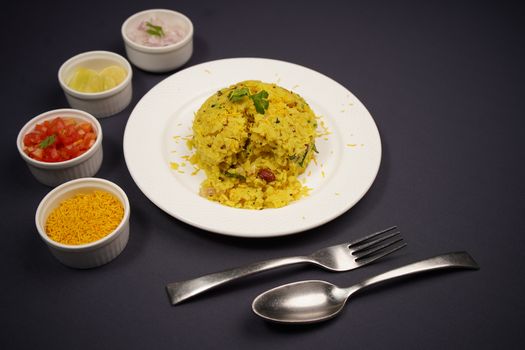
Photo: Jack Baghel / Pexels
The diets react (see scores below)
Common Ingredients
- flattened rice
- onion
- peanuts
- mustard seeds
- curry leaves
- turmeric
- lime
- cilantro
Specific recipes may vary.
Incompatible with 4 of 11 diets
Diet Ratings
Poha is made primarily from flattened rice, which is a processed grain with extremely high net carbs. A standard serving (1 cup, ~180g cooked) contains approximately 35-40g of net carbs from the rice alone, easily exceeding the daily keto limit in a single meal. Flattened rice is essentially parboiled rice that has been rolled flat — it retains virtually all of the carbohydrate content of regular rice with no meaningful fiber offset. The remaining ingredients (onion, peanuts, lime) are minor contributors and cannot redeem this dish for ketogenic purposes.
Poha is a traditional Indian breakfast dish made entirely from plant-based ingredients. Flattened rice (poha) is a minimally processed whole grain product. Peanuts provide plant-based protein and healthy fats. Mustard seeds, curry leaves, turmeric, onion, lime, and cilantro are all whole plant foods. There are no animal products, dairy, eggs, or animal-derived ingredients of any kind. This is a nutritious, minimally processed, whole-food plant-based meal that aligns excellently with vegan dietary principles.
Poha is fundamentally a grain-based dish. Flattened rice (poha) is simply rice that has been parboiled and rolled flat — it remains a grain and is explicitly excluded from the paleo diet. Additionally, peanuts are legumes, which are also a clear paleo exclusion. The remaining ingredients — onion, mustard seeds, curry leaves, turmeric, lime, and cilantro — are all paleo-approved, but the two core components of the dish are non-paleo. There is no meaningful way to make this dish paleo-compliant without replacing both the flattened rice and the peanuts, which would fundamentally change what the dish is.
Poha is a plant-based dish with many Mediterranean-friendly elements: onion, peanuts (a legume/nut), and aromatic vegetables like curry leaves and cilantro align well with plant-forward principles. Lime and turmeric add anti-inflammatory value. However, the base ingredient — flattened rice — is a refined grain, which Mediterranean guidelines discourage in favor of whole grains. The dish has no olive oil (typically made with neutral vegetable oil), and while it is minimally processed overall, the refined rice base keeps it from a full approval. It is acceptable as an occasional meal, especially if prepared with olive oil substituted for the cooking fat.
Some Mediterranean diet practitioners, particularly those drawing on traditional Middle Eastern and North African grain traditions, are more permissive about white and refined rice dishes when the overall meal is plant-rich and low in added sugars or saturated fat — in that reading, Poha's vegetable and nut content could edge it toward approval. Conversely, stricter modern clinical guidelines (e.g., PREDIMED-based recommendations) would flag the refined grain base as a meaningful concern.
Poha is entirely plant-based and incompatible with the carnivore diet. Every single ingredient — flattened rice (grain), onion (vegetable), peanuts (legume), mustard seeds (seed/spice), curry leaves (plant), turmeric (spice), lime (fruit), and cilantro (herb) — is explicitly excluded from the carnivore diet. There is no animal product whatsoever in this dish. It contains grains, a legume, multiple plant-based spices, and produce, making it one of the most carnivore-incompatible dishes possible.
Poha is made from flattened rice (also called beaten rice or rice flakes), which is a rice-derived grain product. Rice is explicitly excluded on the Whole30 program. Regardless of the other ingredients — peanuts (also excluded as a legume), onion, mustard seeds, curry leaves, turmeric, lime, and cilantro (all compliant) — the two primary components of this dish (flattened rice and peanuts) are both disqualifying. Flattened rice is simply rice that has been parboiled and rolled, making it a grain in every sense of the program's rules. Peanuts are legumes and also explicitly excluded.
Poha contains several low-FODMAP ingredients (flattened rice, mustard seeds, turmeric, curry leaves, lime, cilantro) but is problematic due to two key ingredients: onion and peanuts. Onion is a high-FODMAP food (fructans) at any meaningful quantity and is a core flavor component of traditional poha — it cannot simply be omitted without significantly altering the dish. Peanuts are low-FODMAP at a small serving (~32g/28 peanuts per Monash) but become high-FODMAP at larger quantities due to GOS. Flattened rice (poha/beaten rice) itself is a low-FODMAP grain. The dish could theoretically be modified by replacing onion with the green tops of spring onion and keeping peanuts to a small portion, but as traditionally prepared with onion, it poses significant FODMAP risk during the elimination phase.
Monash University has not specifically tested 'poha' as a dish, and onion is clearly high-FODMAP per Monash data — many clinical FODMAP practitioners would rate this dish as 'avoid' during elimination given that onion is a primary ingredient and typically cannot be reduced to a trace amount. A modified version substituting spring onion greens for onion would shift the verdict to approve.
Poha (flattened rice with vegetables and spices) aligns reasonably well with DASH principles. Flattened rice is a whole-grain-adjacent carbohydrate that is naturally low in sodium and fat. Onion, turmeric, curry leaves, lime, and cilantro contribute antioxidants and flavor without added sodium. Peanuts add heart-healthy unsaturated fats, plant protein, magnesium, and fiber — all DASH-positive nutrients — though they should be portion-controlled due to caloric density. Mustard seeds are a negligible-sodium spice. The dish contains no added salt as listed, no saturated fat sources, no added sugar, and no processed ingredients, making it a clean, plant-forward breakfast. The main limitation is that flattened rice is a refined grain (not a whole grain in the traditional fiber-rich sense), which tempers the score slightly. When prepared without added salt or oil excess, this dish fits comfortably in a DASH breakfast pattern.
NIH DASH guidelines prioritize whole grains over refined grains, and flattened rice (poha) is a processed grain with lower fiber content than brown rice or oats — some DASH clinicians would rate it only as 'caution' for this reason. However, updated interpretations note that poha's low sodium, low fat, and inclusion of vegetables and legumes (peanuts) make it preferable to many common Western breakfast options, and its glycemic impact is moderate when combined with protein and fat from peanuts.
Poha is a traditional Indian breakfast made primarily from flattened rice (beaten rice), which is a moderate-to-high glycemic carbohydrate and the dominant macronutrient in the dish. In Zone terms, flattened rice is classified as an 'unfavorable' carbohydrate — similar to white rice — as it lacks fiber to substantially lower its glycemic impact and would require careful block portioning. A typical serving is heavily carb-dominant with no direct protein source listed, making it difficult to hit the 40/30/30 Zone ratio without significant additions. The peanuts provide some fat (though omega-6 heavy, not ideal Zone fat) and modest protein, and the anti-inflammatory spices (turmeric, mustard seeds, curry leaves) and lime are positives from a polyphenol and anti-inflammatory standpoint. The onion adds a favorable low-glycemic vegetable component. However, as served, this dish lacks adequate lean protein and is carbohydrate-dominant, making Zone balance challenging. To make it Zone-compatible, one would need to add a lean protein source (e.g., egg whites, tofu, or lean chicken) and reduce the portion of flattened rice significantly while increasing vegetables.
Some Zone practitioners note that flattened rice, while higher-glycemic than vegetables, has a lower glycemic load than equivalent portions of white rice due to its lighter texture and typical serving sizes. The presence of peanuts, lime, and anti-inflammatory spices aligns with Sears' later anti-inflammatory dietary focus. A small portion of poha paired with a protein source could serve as a reasonable 'unfavorable' carbohydrate block within a broader Zone-balanced meal, similar to how Sears treats other grain-based carbs in Mastering the Zone.
Poha is a traditional Indian breakfast with a largely favorable anti-inflammatory profile. The dish is anchored by several strongly anti-inflammatory ingredients: turmeric (curcumin), curry leaves (rich in flavonoids and antioxidants), mustard seeds (omega-3 ALA, glucosinolates), lime (vitamin C, polyphenols), cilantro (quercetin, antioxidants), and onion (quercetin, sulfur compounds). Peanuts contribute some healthy fats, protein, and resveratrol, though their omega-6 content is notable — they are generally considered acceptable rather than ideal. The primary concern is flattened rice (poha), a refined grain with a moderate-to-high glycemic index, which can trigger modest pro-inflammatory insulin spikes. However, it retains some fiber compared to white rice, and the dish's overall spice and vegetable composition meaningfully offsets the glycemic burden. Cooked with a small amount of oil (typically mustard oil or a neutral oil), preparation method matters — mustard oil or olive oil would be preferred. As a light, plant-forward breakfast with meaningful anti-inflammatory spicing, this dish fits well within anti-inflammatory dietary principles despite its refined grain base.
Some anti-inflammatory practitioners, particularly those following stricter glycemic or autoimmune protocols (e.g., AIP-adjacent or low-GI frameworks), would flag flattened rice as a refined carbohydrate that elevates blood sugar and promotes inflammatory cascades — a concern echoed in research linking high-glycemic diets to elevated CRP and IL-6. Dr. Weil's pyramid and mainstream anti-inflammatory guidance, however, do not exclude white rice or flattened rice outright, particularly when consumed in modest portions within a spice-rich, vegetable-inclusive dish.
Poha is a light, easy-to-digest Indian breakfast made primarily from flattened rice — a refined grain that is low in protein and moderate on the glycemic index. The peanuts add a meaningful boost of protein and healthy unsaturated fat, but a standard serving still falls well short of the 15-30g protein per meal target critical for GLP-1 patients. On the positive side, poha is low in saturated fat, gentle on the stomach (an asset given slowed gastric emptying on GLP-1s), and the onion, curry leaves, turmeric, and lime contribute micronutrients and anti-inflammatory compounds. The mustard seeds and lime support digestibility. Fiber content is modest — flattened rice is not a high-fiber grain, though onion adds a small amount. The dish is portion-friendly and unlikely to worsen nausea or reflux. The main drawbacks for GLP-1 patients are low protein density and relatively low fiber, meaning it doesn't maximize nutritional value per calorie eaten. It is acceptable as an occasional breakfast if paired with a high-protein side (e.g., a boiled egg, paneer, or a small cup of Greek yogurt) to close the protein gap.
Some GLP-1-focused dietitians in South Asian clinical contexts accept poha as a culturally appropriate, easy-to-tolerate breakfast given its light texture and digestibility, particularly in the first weeks on medication when GI side effects are worst — prioritizing food tolerance over protein optimization. Others flag the refined carbohydrate base as a concern for patients with concurrent insulin resistance or type 2 diabetes, recommending it be limited or replaced with higher-protein alternatives even if tolerated well.
*See how scores were generated at our methodology page.
Nutritional profile
Six traits that cut across every diet.
Fiber & Plants
How much whole-plant food and fiber it delivers.
Healthy Fats
The quality of its fats (unsaturated, omega-3).
Whole / Unprocessed
How close it is to its natural, unprocessed form.
Gut Gentle
How easy it is on digestion (low FODMAP, few irritants).
Low Glycemic
How little it spikes your blood sugar.
Protein Density
How much protein it packs per calorie.
Controversy Index
Higher controversy = more disagreement between diets.
Diet-Specific Tips
 Vegan — 9/10
View tips
- Flattened rice is a minimally processed whole grain — fully plant-based
- Peanuts serve as a plant-based protein and fat source
- All aromatics and spices (mustard seeds, curry leaves, turmeric, onion) are plant-derived
- Lime and cilantro are whole plant foods
- No animal products, dairy, eggs, or animal-derived additives present
- Minimal processing makes this a strong whole-food vegan option
 Mediterranean — 5/10
View tips
- Flattened rice is a refined grain, not a whole grain — a notable drawback under Mediterranean guidelines
- Peanuts and onion are Mediterranean-compatible plant foods
- No red meat, processed ingredients, or added sugar
- Typically cooked in neutral vegetable oil rather than extra virgin olive oil
- Anti-inflammatory spices (turmeric, mustard seeds) align with Mediterranean dietary patterns
- Plant-forward, low in saturated fat overall
 Low-FODMAP — 5/10
View tips
- Onion is high-FODMAP (fructans) at any standard serving and is a primary ingredient in poha
- Flattened rice is low-FODMAP and a safe grain base
- Peanuts are low-FODMAP at ~32g but portion control is important
- Curry leaves, mustard seeds, turmeric, lime, and cilantro are all low-FODMAP
- Traditional preparation makes onion substitution unlikely in restaurant or home versions
- Dish can be made low-FODMAP by substituting spring onion greens for onion
 DASH — 7/10
View tips
- Flattened rice is low in sodium and fat but is a refined grain with modest fiber content
- Peanuts contribute heart-healthy unsaturated fats, magnesium, and plant protein — DASH-positive
- No added salt listed keeps sodium very low, consistent with DASH goals
- Onion, lime, cilantro, and turmeric add nutrients and flavor without sodium
- No saturated fat, added sugar, or processed ingredients
- Portion control of peanuts advised due to caloric density
- A small amount of cooking oil (commonly used in preparation but not listed) could add saturated fat if coconut oil is used — vegetable oil preferred
 Zone — 4/10
View tips
- Flattened rice is a high-glycemic, 'unfavorable' Zone carbohydrate with limited fiber
- No direct lean protein source — severely imbalances the 40/30/30 ratio as served
- Peanuts provide some fat and protein but are omega-6 heavy, not ideal Zone monounsaturated fat
- Anti-inflammatory spices (turmeric, curry leaves) and lime are Zone-positive polyphenol sources
- Onion is a favorable low-glycemic Zone carbohydrate
- Dish is carbohydrate-dominant and would require added lean protein and reduced grain portion to fit Zone blocks
 Anti-Inflammatory — 7/10
View tips
- Turmeric provides curcumin, a well-researched anti-inflammatory compound
- Curry leaves and mustard seeds add flavonoids and glucosinolates with anti-inflammatory properties
- Onion contributes quercetin, a potent anti-inflammatory flavonoid
- Peanuts offer some healthy fats and resveratrol, though their omega-6 content is moderate
- Flattened rice (poha) is a refined grain with moderate-to-high glycemic index — a mild pro-inflammatory concern
- Lime and cilantro add vitamin C and polyphenols that support antioxidant activity
- No added sugars, processed additives, or trans fats
- Light, plant-forward profile with no red meat or high-fat dairy
 GLP-1 Friendly — 5/10
View tips
- Low protein — flattened rice and peanuts combined fall short of the 15-30g per meal target; needs a protein-rich accompaniment
- Peanuts contribute unsaturated fat and partial protein, improving the dish's nutritional profile modestly
- Refined grain base (flattened rice) is low in fiber and moderate-to-high glycemic, not ideal for blood sugar stability
- Very easy to digest — light texture is a genuine advantage for GLP-1 patients dealing with nausea or slowed gastric emptying
- Low saturated fat — no fried or fatty ingredients in the standard preparation
- Anti-inflammatory spices (turmeric, curry leaves, mustard seeds) add micronutrient value with negligible caloric cost
- Small portion-friendly — works well as a light meal but nutrient density per calorie is moderate at best