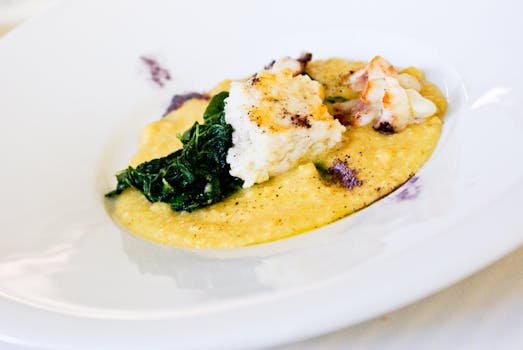
Photo: Alex Favali / Pexels
The diets react (see scores below)
Common Ingredients
- coarse cornmeal
- water
- butter
- Parmesan
- salt
- black pepper
Specific recipes may vary.
Incompatible with 5 of 11 diets
Diet Ratings
Polenta is made from coarse cornmeal, which is a high-carbohydrate grain product fundamentally incompatible with ketogenic eating. A standard serving of polenta (about 1 cup cooked, ~240g) contains roughly 30-35g of net carbs, and even a modest portion easily consumes or exceeds the entire daily carb allowance for strict keto. Cornmeal is a refined starchy grain with a high glycemic index that will spike blood sugar and disrupt ketosis. While the recipe includes keto-friendly additions like butter and Parmesan, the base ingredient (cornmeal) is the dominant macronutrient contributor and cannot be mitigated by portion control to any meaningful extent. This dish is structurally incompatible with ketosis regardless of preparation method.
This polenta recipe contains two clear animal-derived ingredients: butter (dairy fat) and Parmesan cheese (dairy, and notably Parmesan by definition contains animal rennet). Both are unambiguously excluded under vegan rules. The base ingredients — coarse cornmeal, water, salt, and black pepper — are fully plant-based, meaning a vegan version of polenta is easily achievable by substituting olive oil or vegan butter for the butter and omitting or replacing the Parmesan with nutritional yeast or a plant-based cheese alternative. The dish as listed, however, cannot be considered vegan.
Polenta is made primarily from coarse cornmeal, which is a grain and explicitly excluded from the Paleolithic diet. Corn is a domesticated grain unavailable to Paleolithic hunter-gatherers in its cultivated form, and all grains are excluded due to their anti-nutrient content (lectins, phytates) and the fact that grain agriculture postdates the Paleolithic era. Compounding the problem, this dish also contains butter and Parmesan cheese (both dairy, excluded), and added salt (excluded). There is virtually no paleo-compatible ingredient in this dish beyond water and black pepper.
Polenta made from coarse cornmeal is a traditional northern Italian staple (particularly in Lombardy, Veneto, and Piedmont) and represents a whole grain product, which is broadly consistent with Mediterranean diet principles. However, it is a refined/processed grain product with a high glycemic index, and modern Mediterranean diet guidelines favor whole grains like farro, barley, and whole wheat over corn-based products. The addition of butter and Parmesan further distances this dish from core Mediterranean principles — butter is not the canonical fat (extra virgin olive oil is), and dairy is meant to be consumed in moderation. If prepared with olive oil instead of butter and reduced cheese, this would score higher. As presented, it sits in cautious moderation territory.
Traditional northern Italian culinary practice — a recognized regional variation of Mediterranean eating — has long centered polenta as a dietary staple, and some Mediterranean diet authorities acknowledge regional grain diversity beyond wheat. A more permissive interpretation would accept polenta as a legitimate whole grain side, particularly when the rest of the meal is plant- and fish-forward.
Polenta is made almost entirely from coarse cornmeal, a plant-derived grain product that is completely incompatible with the carnivore diet. Corn is a grain and therefore excluded under all tiers of carnivore eating. While the dish does contain butter and Parmesan — both animal-derived dairy products — they are minor components that do not redeem a dish whose primary base is a plant grain. Black pepper is also a plant-derived spice. There is no animal protein source present. This dish is fundamentally a grain-based side dish and would be universally rejected by every variant of the carnivore diet, from the strictest Lion Diet to the most inclusive animal-based approaches.
Polenta is made from coarse cornmeal, which is corn — a grain explicitly excluded on the Whole30. Additionally, this recipe includes butter (regular dairy, not ghee) and Parmesan cheese (dairy), both of which are also excluded. Three separate Whole30-prohibited ingredients disqualify this dish entirely.
Polenta made from coarse cornmeal is generally well-tolerated on a low-FODMAP diet. Cornmeal (polenta) is low-FODMAP per Monash University at standard serving sizes (around 100g cooked). Water, salt, and black pepper are FODMAP-free. Butter is low-FODMAP at typical serving amounts (up to ~1 tablespoon per serve). Parmesan is a hard, aged cheese with very low lactose content and is rated low-FODMAP by Monash at standard portions (up to 40g). There are no high-FODMAP ingredients in this recipe at typical serving sizes, making it a generally safe choice during the elimination phase.
Monash University rates cornmeal/polenta as low-FODMAP, but some clinical FODMAP practitioners note that very large servings could potentially be problematic, and the butter quantity should be monitored — stacked fats aren't a FODMAP issue per se, but if butter exceeds roughly 1 tablespoon per serve, digestive discomfort unrelated to FODMAPs may occur in sensitive individuals. Parmesan is reliably low-lactose at standard portions, but individuals with significant lactose sensitivity sometimes react even to trace amounts.
Polenta's base ingredient — coarse cornmeal — is a whole grain that aligns reasonably well with DASH principles, providing fiber, potassium, and magnesium. However, this traditional Italian preparation includes butter (saturated fat), Parmesan cheese (high sodium, saturated fat), and added salt, which collectively undermine its DASH compatibility. The combination of butter and Parmesan introduces meaningful saturated fat content, and the salt plus Parmesan can push sodium levels well above DASH targets per serving. Cornmeal itself is a DASH-friendly whole grain, but as prepared here, the dish is not a core DASH food. It could become more DASH-compatible with olive oil instead of butter, reduced or eliminated Parmesan, and minimal added salt.
NIH DASH guidelines emphasize whole grains as a foundation, and cornmeal qualifies — some DASH-oriented clinicians would view plain or lightly seasoned polenta as an acceptable whole grain side dish. However, the standard preparation with butter and Parmesan introduces saturated fat and sodium that stricter DASH interpretations flag as problematic, creating some clinician-level debate about whether the dish is acceptable in moderate portions.
Polenta is made primarily from coarse cornmeal, which is a high-glycemic, grain-based carbohydrate. In Zone terminology, corn and corn-derived products like cornmeal are considered 'unfavorable' carbohydrates due to their relatively high glycemic index and glycemic load, similar to white rice or pasta. A typical serving of polenta (about 1/2 cup cooked) delivers roughly 15-20g of net carbs, making it block-heavy on the carb side with little fiber to offset the glycemic impact. The butter and Parmesan add saturated fat rather than preferred monounsaturated fats, and there is essentially no lean protein contribution. As a side dish with no protein component, polenta alone would throw a Zone meal significantly out of the 40/30/30 ratio, requiring very careful portioning and pairing with substantial lean protein and monounsaturated fat sources to compensate. It is not categorically excluded from the Zone — small portions can be incorporated as a carb block — but it is clearly an 'unfavorable' carbohydrate source and the fat profile works against Zone ideals. Reserve scores of 1-3 for pure junk foods; polenta at least provides some micronutrients and can technically be portion-controlled, warranting a 4.
This classic polenta preparation sits in neutral-to-mildly-problematic territory from an anti-inflammatory standpoint. The base ingredient — coarse cornmeal — is a whole grain, which is generally acceptable in the anti-inflammatory framework (better than refined white flour), providing some fiber and carotenoids like lutein and zeaxanthin. However, the traditional additions of butter and Parmesan cheese introduce saturated fat, which anti-inflammatory guidelines consistently recommend limiting. Butter is explicitly in the 'limit' category (full-fat dairy, saturated fat), and Parmesan, while a hard aged cheese with some fermentation benefits, is still a high-fat dairy product. The combination means this dish provides a moderate saturated fat load that could contribute to inflammatory signaling (elevated LDL, arachidonic acid pathway activation) when consumed regularly or in large portions. Salt and black pepper are neutral to mildly beneficial (piperine in black pepper has mild anti-inflammatory properties). The dish lacks meaningful anti-inflammatory positives — no omega-3s, no significant antioxidants, no polyphenols — making it a starchy side that's acceptable occasionally but doesn't contribute to an anti-inflammatory eating pattern. A modified version using extra virgin olive oil instead of butter and omitting the cheese would score considerably higher.
Polenta made with coarse cornmeal, butter, Parmesan, water, and seasoning is a refined-carbohydrate-dominant side dish with minimal protein and moderate fat from the butter and cheese. A standard serving (~1 cup cooked) provides roughly 145-170 calories, 3-4g protein, 1-2g fiber, and 4-6g fat depending on butter and Parmesan quantities. For GLP-1 patients, the core problem is poor nutrient density per calorie: the dominant macronutrient is starchy carbohydrate, protein contribution is negligible, and fiber is low. The butter adds saturated fat, which can worsen GI side effects. On the positive side, polenta is soft, easy to digest, and gentle on the stomach — a meaningful advantage when GI side effects are active. It is also small-portion friendly and unlikely to cause nausea on its own. As an occasional side dish paired with a high-protein main (e.g., grilled chicken or fish), it is acceptable, but it should not displace protein or fiber-rich foods in a meal where total volume and appetite are already limited.
Some GLP-1-focused dietitians view plain or lightly dressed polenta more favorably for patients experiencing significant nausea, vomiting, or gastroparesis-like symptoms, where soft, bland, low-fat carbohydrates are temporarily prioritized over protein density for tolerability. Others flag that the butter and Parmesan in traditional preparations meaningfully raise the saturated fat load, recommending a leaner preparation (olive oil in place of butter, reduced cheese) if polenta is used at all.
*See how scores were generated at our methodology page.
Nutritional profile
Six traits that cut across every diet.
Fiber & Plants
How much whole-plant food and fiber it delivers.
Healthy Fats
The quality of its fats (unsaturated, omega-3).
Whole / Unprocessed
How close it is to its natural, unprocessed form.
Gut Gentle
How easy it is on digestion (low FODMAP, few irritants).
Low Glycemic
How little it spikes your blood sugar.
Protein Density
How much protein it packs per calorie.
Controversy Index
Higher controversy = more disagreement between diets.
Diet-Specific Tips
 Mediterranean — 5/10
View tips
- Cornmeal is a whole grain but not a traditional Mediterranean grain; higher glycemic index than farro, barley, or whole wheat
- Butter used as fat instead of extra virgin olive oil contradicts the primary fat principle
- Parmesan is acceptable dairy in moderation, but combined with butter increases saturated fat load
- Traditional northern Italian dish — regionally authentic within the broader Mediterranean basin
- No added sugars or highly processed ingredients; minimal processing of the grain itself
- Could be improved significantly by substituting olive oil for butter
 Low-FODMAP — 8/10
View tips
- Cornmeal/polenta is low-FODMAP per Monash University at standard serving sizes
- Butter is low-FODMAP at up to ~1 tbsp per serving
- Parmesan is a hard aged cheese with negligible lactose — low-FODMAP up to 40g
- No onion, garlic, or other high-FODMAP ingredients present
- Water, salt, and black pepper are FODMAP-free
- Portion size matters — very large servings of any grain can increase FODMAP load
 DASH — 4/10
View tips
- Cornmeal is a whole grain, aligning with DASH's whole grain emphasis
- Butter adds saturated fat, which DASH limits
- Parmesan is high in sodium and saturated fat — a double DASH concern
- Added salt further elevates sodium, conflicting with DASH's <2,300mg/day (or <1,500mg/day) sodium targets
- No lean protein, fruits, or vegetables present in the dish
- DASH-friendly modification possible: substitute olive oil for butter, reduce or omit Parmesan, minimize salt
 Zone — 4/10
View tips
- Cornmeal is a high-glycemic, unfavorable Zone carbohydrate — similar to white rice in Zone classification
- Butter and Parmesan contribute saturated fat rather than preferred monounsaturated fats (olive oil, avocado, almonds)
- No lean protein present — as a side dish it must be carefully paired to achieve 40/30/30 balance
- High glycemic load per typical serving makes block management difficult
- Coarse grind provides slightly more fiber than fine polenta, modestly reducing net carb impact but not enough to upgrade classification
- Small portions (2-3 tablespoons cooked) can technically fit as a partial carb block in a Zone meal
 Anti-Inflammatory — 4/10
View tips
- Coarse cornmeal is a whole grain — preferable to refined starches but still a high-glycemic base
- Butter is a saturated fat explicitly in the anti-inflammatory 'limit' category
- Parmesan adds more saturated fat; full-fat dairy is flagged as pro-inflammatory in anti-inflammatory protocols
- No significant anti-inflammatory components: lacks omega-3s, polyphenols, antioxidants, or beneficial spices in meaningful quantity
- Black pepper (piperine) offers trace anti-inflammatory benefit
- Dish is acceptable occasionally but does not support an anti-inflammatory dietary pattern
 GLP-1 Friendly — 4/10
View tips
- Very low protein (~3-4g per serving) — fails the #1 GLP-1 dietary priority
- Low fiber (~1-2g per serving) — minimal contribution to the 25-30g daily target
- Butter adds saturated fat, which may worsen nausea and GI side effects
- Soft texture and easy digestibility are genuine advantages for GLP-1 patients with active GI symptoms
- High glycemic index refined carbohydrate — poor nutrient density per calorie
- Acceptable only as a small side portion alongside a high-protein, high-fiber main
- Preparation matters: olive oil substitution for butter and reduced Parmesan would improve the fat profile