Photo: Oleg Mishkalenko / Pexels
Italian
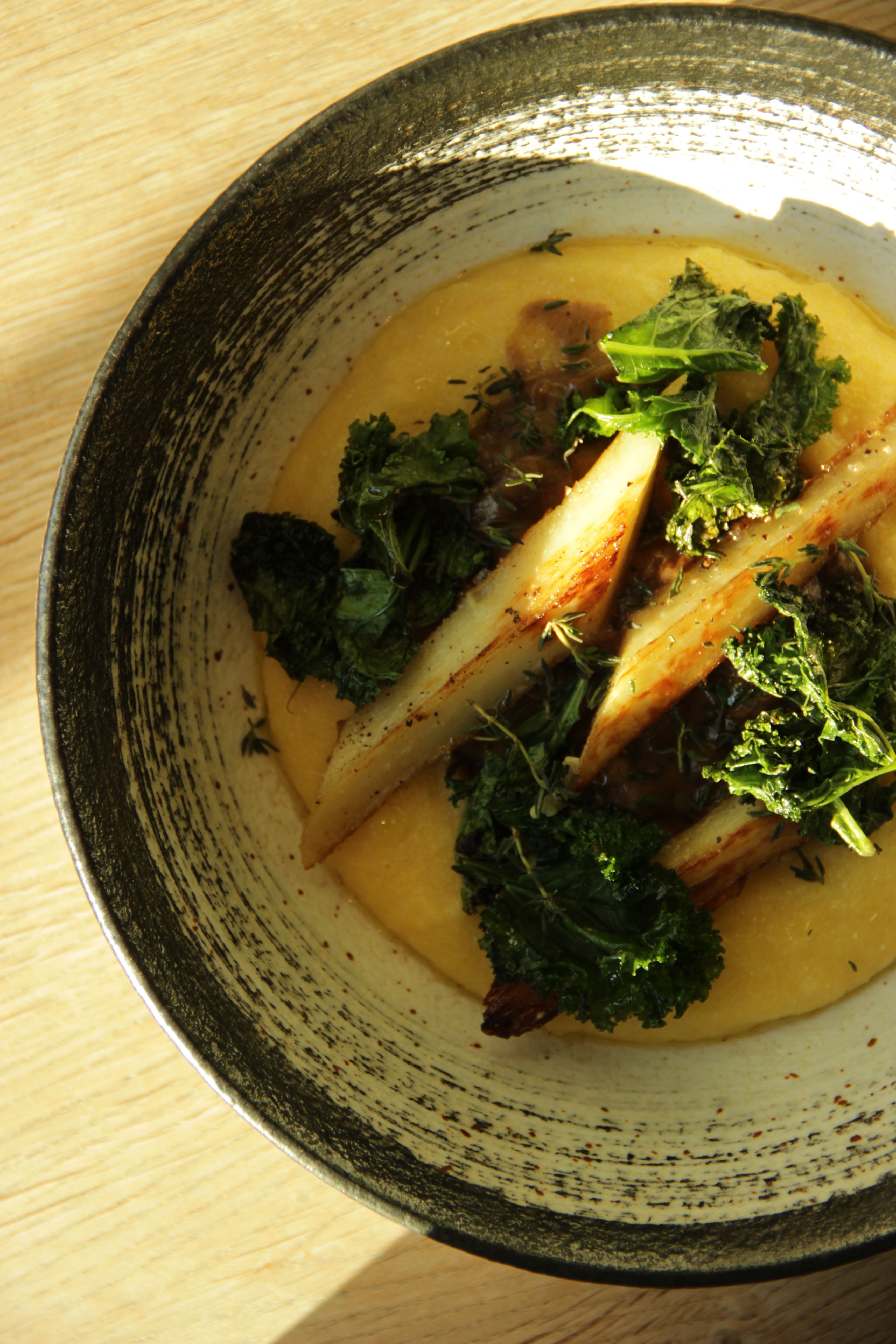
Polenta with Mushrooms
The diets react (see scores below)
Common Ingredients
- coarse cornmeal
- mixed mushrooms
- butter
- garlic
- thyme
- Parmesan
- white wine
- parsley
Specific recipes may vary.
Incompatible with 6 of 11 diets
Diet Ratings
Polenta is made from coarse cornmeal, which is a grain and one of the highest net-carb foods possible. A standard serving of polenta (about 1 cup cooked) contains approximately 30-35g of net carbs, and a typical side dish portion can easily exceed 40g — consuming the entire daily keto carb budget in a single side dish. The mushrooms, butter, garlic, Parmesan, and thyme are all keto-friendly, but they cannot offset the fundamental incompatibility of cornmeal. White wine adds a small additional carb load. This dish is built on a grain base and is structurally incompatible with ketogenic eating.
This dish contains two clear animal-derived ingredients: butter (a dairy product made from cow's milk) and Parmesan (a hard cheese also made from cow's milk, traditionally made with animal rennet). Both are unambiguously non-vegan. The base of coarse cornmeal, mixed mushrooms, garlic, thyme, white wine, and parsley are all fully plant-based, meaning the dish could be made vegan with substitutions (e.g., olive oil or vegan butter, nutritional yeast or vegan Parmesan), but as listed it is not vegan-compatible.
Polenta with Mushrooms is fundamentally incompatible with the Paleo diet. The base ingredient, coarse cornmeal, is a grain (corn) — explicitly excluded from Paleo. Beyond the cornmeal, butter and Parmesan are dairy products, also excluded. White wine, while a gray-area item in some contexts, is a processed/fermented product not prioritized in Paleo. The only Paleo-compliant ingredients in this dish are the mixed mushrooms, garlic, thyme, and parsley. The dish's foundation is built on multiple core Paleo exclusions, making it firmly an 'avoid.'
Polenta with mushrooms is a traditional Northern Italian dish with a mixed Mediterranean diet profile. The mixed mushrooms are excellent — vegetables are core to the diet. However, coarse cornmeal (polenta) is a refined grain that lacks the fiber of whole grains preferred by Mediterranean guidelines. Butter is used as the primary fat instead of extra virgin olive oil, which is a clear departure from Mediterranean principles. Parmesan is an aged dairy used in moderation, which is acceptable. White wine in cooking is consistent with Mediterranean traditions. Overall, the dish is plant-forward in spirit but the butter and refined grain base pull it away from core Mediterranean ideals.
Traditional Northern Italian cuisine (Lombardy, Veneto) has used polenta and butter for centuries as legitimate regional Mediterranean expressions, and some Mediterranean diet researchers recognize these Northern Italian traditions as part of the broader diet pattern. Substituting olive oil for butter and using whole-grain polenta would elevate this dish significantly under modern clinical guidelines.
Polenta with Mushrooms is almost entirely plant-based and directly violates every core principle of the carnivore diet. The primary ingredient, coarse cornmeal (polenta), is a grain and a major source of carbohydrates — completely excluded on carnivore. Mushrooms are fungi/plant kingdom foods, also excluded. Garlic, thyme, parsley, and white wine are all plant-derived ingredients. The only marginally carnivore-compatible ingredient is butter (a dairy fat), but it is a minor component in an otherwise wholly plant-based dish. This dish has no animal protein whatsoever and is built around a grain base, making it one of the least compatible foods possible for a carnivore practitioner.
Polenta with Mushrooms contains multiple excluded ingredients. Coarse cornmeal is corn, which is a grain explicitly banned on Whole30. Butter (not ghee or clarified butter) is a dairy product and is excluded. Parmesan is a dairy product (cheese) and is excluded. White wine is alcohol and is excluded. Any one of these four ingredients would individually disqualify this dish, making this a clear avoid with high confidence.
This dish contains multiple high-FODMAP ingredients that make it problematic during the elimination phase. Garlic (a whole clove) is one of the highest-FODMAP foods — rich in fructans — and is a definitive avoid. Mixed mushrooms are high in polyols (mannitol), and most common varieties (button, cremini, portobello) are high-FODMAP at standard serving sizes; only certain mushrooms like oyster mushrooms are low-FODMAP in limited quantities, but 'mixed mushrooms' almost certainly includes high-FODMAP types. White wine is low-FODMAP in small amounts (150ml) but adds to cumulative FODMAP load. The remaining ingredients are generally safe: coarse cornmeal/polenta is low-FODMAP, butter is low-FODMAP, thyme is low-FODMAP in culinary amounts, Parmesan is low-FODMAP (aged hard cheese, minimal lactose), and parsley is low-FODMAP. However, the combination of garlic and mixed mushrooms as primary flavor components makes this dish essentially unavoidable during elimination without significant recipe modification.
Garlic-infused oil could theoretically replace garlic cloves (FODMAPs are water-soluble and don't transfer to fat), and substituting exclusively oyster mushrooms at a controlled 75g serving could bring this dish into low-FODMAP territory — some FODMAP practitioners would advise modification rather than outright avoidance, but as written with whole garlic and mixed mushrooms, most clinical dietitians would classify this as avoid during the strict elimination phase.
Polenta with mushrooms has a mixed DASH profile. The base ingredients — coarse cornmeal (a whole grain) and mixed mushrooms — are genuinely DASH-friendly: cornmeal provides fiber and potassium, while mushrooms are low in sodium, fat-free, and rich in potassium and B vitamins. However, the dish is finished with butter and Parmesan cheese, both of which introduce saturated fat and sodium that DASH guidelines limit. Parmesan is particularly sodium-dense (~330–450mg per ounce), and butter adds saturated fat. The white wine is a minor concern but negligible in a cooked dish. As commonly prepared in Italian cuisine, this dish is acceptable in moderate portions but not a core DASH food due to the butter and Parmesan load. Substituting olive oil for butter and reducing or omitting Parmesan (or using a small amount of a lower-sodium hard cheese) would bring this squarely into 'approve' territory.
NIH DASH guidelines categorically limit saturated fat and full-fat dairy, which would flag butter and Parmesan as problematic ingredients. However, updated clinical interpretations note that small amounts of full-fat dairy used as flavoring (rather than a primary dairy serving) may be acceptable within an otherwise DASH-compliant meal pattern, and recent cardiovascular nutrition research has softened the position on full-fat dairy's impact on outcomes.
Polenta with mushrooms presents a mixed Zone profile. Coarse cornmeal (polenta) is the dominant carbohydrate source and is considered an 'unfavorable' carb in Zone terminology — it has a moderate-to-high glycemic index and lacks the low-glycemic profile of preferred Zone carbs like non-starchy vegetables. However, it is not as extreme as white bread or sugar, and can technically fit into a Zone meal in carefully controlled portions (roughly 1/3 cup cooked per block). The mushrooms are genuinely Zone-favorable — low glycemic, high in polyphenols, and they contribute negligible carb blocks. The fat profile is problematic: butter and Parmesan both contribute saturated fat, which early Zone strictly limited in favor of monounsaturated sources like olive oil. White wine adds minor sugar/carb load. The dish has no significant lean protein source, making it difficult to build a balanced Zone meal around without adding a separate protein component. As a side dish, it would need to be portioned very carefully alongside a lean protein and ideally replacing or reducing the butter with olive oil. The 40/30/30 ratio cannot be achieved from this dish alone — the macro split runs heavily toward carbs and saturated fat with minimal protein.
Sears' later anti-inflammatory writing (The Anti-Inflammation Zone, Zone Perfect Meals in Minutes) is somewhat more flexible about saturated fat in context, particularly from whole-food sources like Parmesan and butter in small amounts. Some Zone practitioners note that coarse cornmeal has a lower glycemic impact than refined cornmeal or grits, and when portioned as a small side alongside adequate lean protein and monounsaturated fat, polenta can function as an 'unfavorable' carb block rather than an outright avoid. The mushrooms' polyphenol content also aligns with Sears' later emphasis on anti-inflammatory eating.
This Italian classic has a genuinely mixed anti-inflammatory profile. On the positive side, mushrooms are explicitly emphasized in Dr. Weil's Anti-Inflammatory Food Pyramid and contain beta-glucans and ergothioneine with notable anti-inflammatory and immunomodulatory properties. Garlic and thyme are both anti-inflammatory herbs with polyphenol content. Parsley adds antioxidants. Coarse cornmeal (whole-grain polenta) provides fiber and some carotenoids (lutein, zeaxanthin), and whole grains are generally supported by the anti-inflammatory framework. The negatives center on butter and Parmesan: butter is a saturated fat explicitly in the 'limit' category per anti-inflammatory guidelines, and Parmesan is a full-fat, high-sodium cheese that adds inflammatory load. White wine is a minor concern — the framework tolerates small amounts of wine but generally favors red wine (resveratrol content) over white. The dish is salvageable and can be made more anti-inflammatory by substituting extra virgin olive oil for butter and reducing cheese, but as written, the butter and Parmesan pull it into caution territory.
Dr. Weil's framework would likely treat this dish more favorably given the mushroom emphasis and whole-grain base, potentially scoring it as moderate-to-acceptable with portion awareness on the cheese and butter. However, stricter anti-inflammatory protocols and AIP-adjacent practitioners would flag the saturated fat from butter and full-fat dairy as meaningful pro-inflammatory contributors, particularly for individuals with elevated CRP or autoimmune conditions.
Polenta with mushrooms is a low-protein, moderate-fiber side dish that falls squarely in the caution zone for GLP-1 patients. The base ingredient — coarse cornmeal — is a refined-starchy carbohydrate with modest fiber and negligible protein. Mushrooms add some fiber, micronutrients, and a small protein contribution, but not enough to meaningfully shift the nutritional profile. Butter and Parmesan introduce saturated fat, which can worsen GLP-1 side effects like nausea and reflux, particularly if portions are generous. White wine adds minimal concern at cooking quantities (most alcohol cooks off), but the overall dish remains calorie-dense relative to its nutritional payoff. The dish is easy to digest and soft in texture — a genuine plus for GLP-1 patients struggling with GI side effects — and garlic, thyme, and parsley are fine. As a side dish in a small portion paired with a high-protein main (grilled chicken, fish, or legumes), this is acceptable. Eaten as a standalone or in large portions, it uses up limited caloric bandwidth without delivering adequate protein or fiber.
Some GLP-1-focused dietitians view polenta favorably as a soft, easily digestible comfort food that supports adherence during nausea-heavy early weeks on the medication, accepting the low protein density as a trade-off. Others caution that the butter and Parmesan make it a higher-saturated-fat choice than it appears, and recommend preparing it with olive oil and skipping or reducing the cheese to better align with GLP-1 dietary goals.
*See how scores were generated at our methodology page.
Nutritional profile
Six traits that cut across every diet.
Fiber & Plants
How much whole-plant food and fiber it delivers.
Healthy Fats
The quality of its fats (unsaturated, omega-3).
Whole / Unprocessed
How close it is to its natural, unprocessed form.
Gut Gentle
How easy it is on digestion (low FODMAP, few irritants).
Low Glycemic
How little it spikes your blood sugar.
Protein Density
How much protein it packs per calorie.
Controversy Index
Higher controversy = more disagreement between diets.
Diet-Specific Tips
 Mediterranean — 5/10
View tips
- Mushrooms are an excellent plant-based component strongly encouraged by Mediterranean principles
- Cornmeal/polenta is a refined grain; whole grains are preferred in Mediterranean guidelines
- Butter replaces extra virgin olive oil as the primary fat — a key departure from Mediterranean ideals
- Parmesan used as a moderate dairy component is acceptable
- White wine in cooking aligns with traditional Mediterranean cooking practices
- No red meat or highly processed ingredients present
- Traditional Northern Italian dish — regionally authentic but not classically Mediterranean
 DASH — 5/10
View tips
- Coarse cornmeal (whole grain) is a DASH-positive base — provides fiber and some potassium
- Mixed mushrooms are DASH-friendly: low sodium, potassium-rich, no saturated fat
- Butter adds saturated fat, which DASH guidelines limit
- Parmesan cheese is high in sodium (~400mg/oz) and saturated fat — a notable DASH concern
- Garlic, thyme, and parsley are DASH-positive flavor enhancers that reduce need for added salt
- White wine contributes minimally to sodium/fat after cooking
- Dish can be made more DASH-compatible by substituting olive oil for butter and reducing Parmesan quantity
 Zone — 4/10
View tips
- Coarse cornmeal is an 'unfavorable' high-glycemic carb in Zone terminology, requiring strict portioning
- Mushrooms are Zone-favorable: low glycemic, polyphenol-rich, anti-inflammatory
- Butter and Parmesan contribute saturated fat, conflicting with Zone's preference for monounsaturated fats
- No lean protein source — cannot achieve 40/30/30 ratio without a separate protein addition
- White wine adds minor carbohydrate load
- Dish is carbohydrate and fat dominant, making Zone balancing difficult
- As a small side portion paired with lean protein, it can technically be incorporated with careful block counting
 Anti-Inflammatory — 5/10
View tips
- Mixed mushrooms: strongly anti-inflammatory (beta-glucans, ergothioneine) — a key positive
- Butter: saturated fat in the 'limit' category per anti-inflammatory guidelines
- Parmesan: full-fat dairy adds saturated fat and sodium — limit category
- Garlic and thyme: anti-inflammatory herbs with polyphenol and organosulfur compounds
- Coarse cornmeal (whole grain): provides fiber and carotenoids — acceptable whole grain
- White wine: minor concern; red wine preferred over white in anti-inflammatory protocols
- Parsley: antioxidant contribution, minor positive
 GLP-1 Friendly — 5/10
View tips
- Low protein — no meaningful protein source in this dish; poor fit for GLP-1 priority #1
- Moderate starchy carbohydrate base (cornmeal) with limited fiber relative to calories
- Butter and Parmesan add saturated fat, which can worsen nausea and reflux on GLP-1s
- Soft texture and easy digestibility are genuine positives for GLP-1 patients with GI side effects
- Mushrooms contribute some fiber and micronutrients but insufficient to elevate the dish
- White wine at cooking quantities is not a significant concern
- Works only as a small-portion side paired with a high-protein main — portion-sensitive
- Empty caloric bandwidth risk: limited appetite means this dish crowds out more nutrient-dense choices