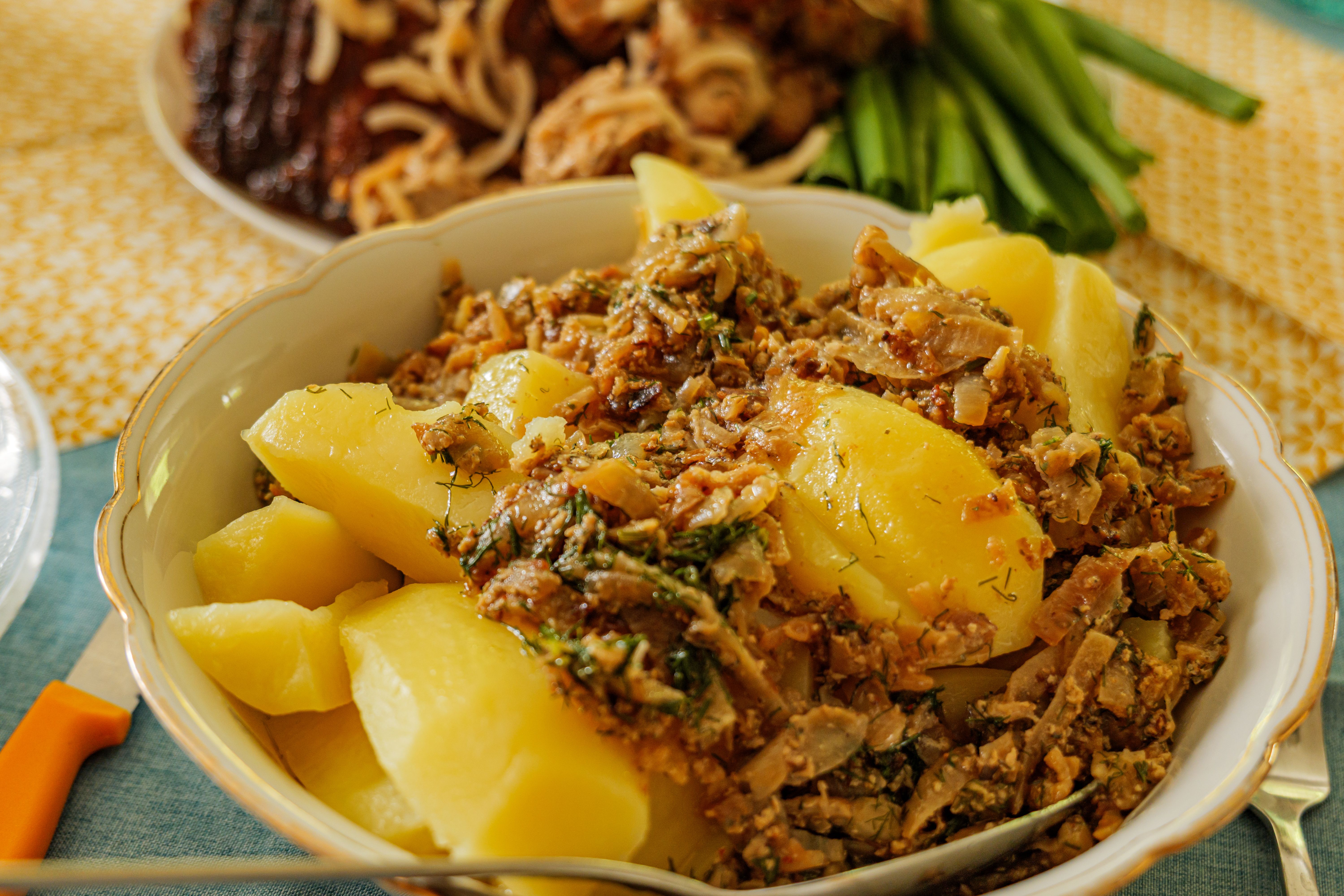
Photo: Serg Karpow / Pexels
Eastern-European
Bigos
The diets react (see scores below)
Common Ingredients
- sauerkraut
- cabbage
- kielbasa
- pork shoulder
- bacon
- prunes
- mushrooms
- onion
Specific recipes may vary.
Incompatible with 7 of 11 diets
Diet Ratings
Bigos is a hearty Polish hunter's stew with a strong keto-friendly base: sauerkraut, cabbage, kielbasa, pork shoulder, and bacon are all low-carb, high-fat ingredients well-suited to ketogenic eating. However, the traditional inclusion of prunes (dried plums) is a significant problem — even a modest amount adds meaningful sugar and net carbs (prunes run ~18g net carbs per 30g serving). Mushrooms and onion add modest carbs but are generally manageable. The dish as traditionally prepared with prunes is borderline; with prunes omitted or drastically reduced, it would easily be an 'approve.' A standard serving of traditional bigos could push 10-15g net carbs depending on prune quantity, making it caution territory requiring portion awareness.
Some lazy keto and flexible keto practitioners argue that bigos can be approved as-is, citing the dominant meat and fermented cabbage base and noting that a small amount of prunes across a large batch of stew may dilute to an acceptable per-serving carb load. Strict keto and carnivore-adjacent practitioners, however, would flag the prunes as disqualifying due to their sugar content.
Bigos is a traditional Eastern European hunter's stew that contains multiple animal products as core ingredients: kielbasa (pork sausage), pork shoulder, and bacon. These are all direct animal flesh products, making this dish entirely incompatible with a vegan diet. There is no ambiguity here — the dish is defined by its meat content and cannot be considered vegan in its traditional form.
Bigos contains multiple paleo-incompatible ingredients. Kielbasa and bacon are processed meats that typically contain added salt, preservatives, nitrates, and other additives — disqualifying them under paleo rules regardless of their pork base. While pork shoulder, mushrooms, onion, cabbage, and prunes are paleo-friendly, and sauerkraut (fermented cabbage) is generally accepted, the processed meat components are central to the dish rather than incidental. There is no realistic version of traditional Bigos that omits kielbasa and bacon while remaining true to the dish. The combination of processed meats as primary protein sources makes this a clear avoid.
Bigos is a traditional Eastern European hunter's stew that fundamentally conflicts with Mediterranean diet principles. The dish is dominated by multiple forms of red and processed meat — pork shoulder, kielbasa (processed sausage), and bacon — which are the foods most restricted in the Mediterranean dietary pattern. Processed meats like kielbasa and bacon are specifically discouraged due to high saturated fat, sodium, and preservative content. While sauerkraut, cabbage, mushrooms, onion, and prunes are Mediterranean-friendly ingredients, they are clearly secondary components in a meat-heavy dish. There is no olive oil, the primary fat appears to be animal fat rendered from the meats, and the protein sources represent the opposite end of the Mediterranean spectrum from the preferred fish, legumes, and plant proteins.
Bigos is a traditional Polish hunter's stew that is fundamentally incompatible with the carnivore diet. While it contains carnivore-approved animal proteins (pork shoulder, bacon, kielbasa), the dish is dominated by plant-based ingredients that are strictly excluded: sauerkraut and cabbage (fermented/raw plant matter), prunes (fruit — sugar-heavy), mushrooms (fungi), and onion (vegetable). The animal proteins are essentially a minor component of what is largely a plant-based stew. Prunes in particular are a red flag, adding significant plant sugars. There is no version of this dish that can be made carnivore-compliant without fundamentally deconstructing it into an entirely different meal. The verdict is avoid with high confidence — no serious carnivore authority would consider this dish acceptable in any carnivore protocol.
Bigos is a hearty Polish hunter's stew that is largely Whole30-compatible in concept — sauerkraut, cabbage, pork shoulder, mushrooms, and onion are all compliant ingredients. Prunes (dried plums with no added sugar) are also allowed as whole fruit. However, two ingredients present significant label-reading challenges: kielbasa and bacon. Most commercial kielbasa contains added sugar, soy, and sometimes fillers or grains, making it a likely violation unless a compliant brand (no sugar, no soy, no non-compliant additives) is specifically sourced. Similarly, most commercial bacon contains added sugar and often nitrates/sulfites — though sulfites are no longer excluded per the 2024 rule change, sugar remains excluded. Compliant versions of both kielbasa and bacon do exist but require careful sourcing. If made with verified compliant kielbasa and bacon (e.g., sugar-free, soy-free), this dish would be fully approvable.
Some Whole30 practitioners argue that relying on processed sausage products like kielbasa — even in compliant form — conflicts with the program's whole-food philosophy and its guidance to minimize dependence on processed meats. Melissa Urban has noted that while compliant processed meats are technically allowed, the program encourages cooking with whole, unprocessed cuts as the primary protein source.
Bigos contains multiple high-FODMAP ingredients that make it unsuitable during the elimination phase. Onion is one of the highest-fructan foods and is a primary flavoring in this dish — even small amounts pose a significant FODMAP load. Prunes (dried plums) are high in sorbitol/polyols and are a well-established high-FODMAP food. Mushrooms (commonly button or mixed varieties) are high in mannitol/polyols. Together, these three ingredients alone would disqualify the dish regardless of portion size. Additionally, cabbage in larger servings can contribute fructans, and processed meats like kielbasa and bacon may contain garlic and onion powder as undeclared high-FODMAP additives. Sauerkraut is borderline — Monash rates it as low-FODMAP at 75g due to fermentation reducing fructan content, but combined with the other high-FODMAP ingredients it is irrelevant here. The pork shoulder and bacon (plain) are fine from a FODMAP standpoint, but the overall dish is not salvageable without major reformulation.
Bigos is a traditional Polish hunter's stew that combines multiple DASH-unfriendly ingredients simultaneously. Sauerkraut contributes extremely high sodium (roughly 700-900mg per half-cup serving), kielbasa is a processed meat with high sodium and saturated fat content, bacon is explicitly a food DASH guidelines flag as high in saturated fat and sodium, and pork shoulder adds significant saturated fat. The combination of processed meats (kielbasa + bacon) plus cured/fermented high-sodium ingredients (sauerkraut) stacks sodium and saturated fat well beyond DASH limits in a single dish. A typical serving could easily contain 1,500-2,000mg+ of sodium alone. The mushrooms, onions, cabbage, and prunes are DASH-positive ingredients, but they are overwhelmed by the problematic components. DASH guidelines explicitly limit processed meats, high-sodium foods, bacon, and red meat with high saturated fat — all of which are structural, non-optional elements of authentic Bigos.
Bigos is a traditional Polish hunter's stew that presents a mixed Zone profile. On the positive side, sauerkraut and cabbage are excellent low-glycemic, high-fiber Zone-favorable carbohydrates rich in polyphenols and fermentation benefits. Mushrooms and onion are also Zone-approved vegetables. However, the protein sources are problematic from a Zone perspective: kielbasa, bacon, and pork shoulder are all high in saturated fat and processed meat components, far from the lean protein ideal (skinless chicken, fish, egg whites). Bacon is particularly high in saturated fat and sodium. The prunes add moderate glycemic load but are manageable in small quantities. The overall fat profile skews heavily toward saturated fat rather than the preferred monounsaturated fats. While the dish does provide a rough carb-protein-fat structure, the protein-to-fat ratio within the protein sources is unfavorable — you're getting far more fat calories than the 30% target from protein sources alone. Portioning a small serving alongside a large vegetable base could bring it closer to Zone ratios, but the dish as traditionally prepared runs high in saturated fat and processed meats. A Zone adaptation would replace bacon and kielbasa with leaner meats and reduce overall fat content significantly.
Some Zone practitioners and Sears' later anti-inflammatory writings (particularly 'The OmegaRx Zone') acknowledge that traditional whole-food preparations — even those with moderate saturated fat — can be incorporated when overall meal ratios are managed. The cabbage and sauerkraut base is genuinely excellent Zone food, and if portioned carefully (small meat serving, generous vegetable ratio) with a favorable fat source adjusted elsewhere in the day, bigos can fit within a Zone eating pattern. The fermented sauerkraut also provides probiotic and polyphenol benefits consistent with Sears' later anti-inflammatory focus.
Bigos (Polish hunter's stew) presents a mixed anti-inflammatory profile. On the positive side, sauerkraut is a fermented food providing probiotics and beneficial organic acids that may reduce gut-driven inflammation; cabbage is a cruciferous vegetable with anti-inflammatory glucosinolates and vitamin C; mushrooms (likely dried or fresh porcini/forest mushrooms in traditional bigos) contain beta-glucans and polysaccharides with immune-modulating properties; prunes supply polyphenols, fiber, and antioxidants linked to reduced inflammatory markers; and onion contains quercetin, a well-studied anti-inflammatory flavonoid. However, the dish is anchored by multiple pro-inflammatory protein sources: kielbasa is a processed meat high in saturated fat, sodium, and often containing nitrates/nitrites — all associated with increased inflammatory markers; bacon is similarly processed and high in saturated fat; and pork shoulder and beef together represent a significant red meat load. The combination of processed meats and high saturated fat content pushes this dish into caution territory despite its genuinely beneficial plant-based components. Occasional consumption in a broader anti-inflammatory diet is acceptable, but the processed meat content makes this unsuitable for regular consumption.
Some traditional food advocates argue that the fermentation from sauerkraut, the fiber from cabbage and prunes, and the long slow-cooking process that renders fat may partially offset the processed meat concerns — and that modest portions alongside an otherwise anti-inflammatory diet pose little problem. However, mainstream anti-inflammatory nutrition research consistently flags processed meats (kielbasa, bacon) as pro-inflammatory due to nitrosamines, advanced glycation end-products, and saturated fat, making frequent consumption difficult to justify under most anti-inflammatory frameworks.
Bigos is a poor fit for GLP-1 patients. The dish is built on a foundation of high-saturated-fat meats — kielbasa, bacon, and pork shoulder — all of which are fatty processed or fatty red meats that directly worsen GLP-1 side effects including nausea, bloating, and reflux. High-fat meals are particularly problematic because GLP-1 medications slow gastric emptying, meaning fatty food sits in the stomach even longer than usual, dramatically increasing GI distress. While the dish does contain some redeeming ingredients — sauerkraut and cabbage provide fiber and probiotics, mushrooms add nutrients and umami, prunes add fiber — these positives are overwhelmed by the fat load from the protein sources. The dish is also calorie-dense relative to its protein quality, since much of the caloric contribution comes from fat rather than lean protein. Bacon in particular is a near-categorical avoid on GLP-1 dietary guidance. A heavily sauced, slow-cooked stew format also tends to be rich and heavy, which is difficult for slowed gastric emptying to handle comfortably.
*See how scores were generated at our methodology page.
Nutritional profile
Six traits that cut across every diet.
Fiber & Plants
How much whole-plant food and fiber it delivers.
Healthy Fats
The quality of its fats (unsaturated, omega-3).
Whole / Unprocessed
How close it is to its natural, unprocessed form.
Gut Gentle
How easy it is on digestion (low FODMAP, few irritants).
Low Glycemic
How little it spikes your blood sugar.
Protein Density
How much protein it packs per calorie.
Controversy Index
Higher controversy = more disagreement between diets.
Diet-Specific Tips
 Keto — 5/10
View tips
- Prunes are the primary keto concern — high in sugar and net carbs, traditional to the recipe
- Sauerkraut and cabbage are keto-friendly fermented/fibrous vegetables
- Kielbasa, pork shoulder, and bacon provide excellent fat and protein macros
- Onions add moderate carbs — portion size of onion in the dish matters
- Mushrooms are low-carb and fine in typical amounts
- Dish is easily modified to be keto-friendly by omitting or minimizing prunes
- Net carbs per serving highly variable depending on prune quantity used
 Whole30 — 5/10
View tips
- Most commercial kielbasa contains added sugar and/or soy — a compliant brand must be verified
- Most commercial bacon contains added sugar — a sugar-free, compliant version is required
- Sauerkraut is compliant if it contains only cabbage and salt (check labels for additives)
- Pork shoulder, cabbage, mushrooms, onion, and prunes (no added sugar) are fully compliant
- Prunes are whole dried fruit and are Whole30 compatible
- Dish is compliant with ingredient substitutions/careful sourcing but not in its default commercial form
 Zone — 4/10
View tips
- Sauerkraut and cabbage are excellent Zone-favorable, low-glycemic carbohydrates
- Kielbasa and bacon are processed meats high in saturated fat — unfavorable Zone protein sources
- Pork shoulder is fatty and not lean protein by Zone standards
- Mushrooms and onion are Zone-approved low-glycemic vegetables
- Prunes add moderate glycemic load and should be limited to small quantity
- Overall saturated fat content is high, conflicting with Zone's monounsaturated fat preference
- Dish lacks omega-3 fatty acids; no fish or favorable fat sources present
- Small portions over a large vegetable base can partially align with Zone ratios
 Anti-Inflammatory — 4/10
View tips
- Kielbasa and bacon are processed meats — high in sodium, saturated fat, and nitrates, consistently flagged as pro-inflammatory
- Pork shoulder and beef represent a substantial red meat load in a single dish
- Sauerkraut provides probiotics and fermentation-derived anti-inflammatory compounds
- Cabbage is a cruciferous vegetable with glucosinolates and antioxidants
- Mushrooms contribute beta-glucans with immune-modulating and anti-inflammatory effects
- Prunes supply polyphenols and fiber linked to reduced CRP
- Onion provides quercetin, a potent anti-inflammatory flavonoid
- High saturated fat content from multiple animal sources