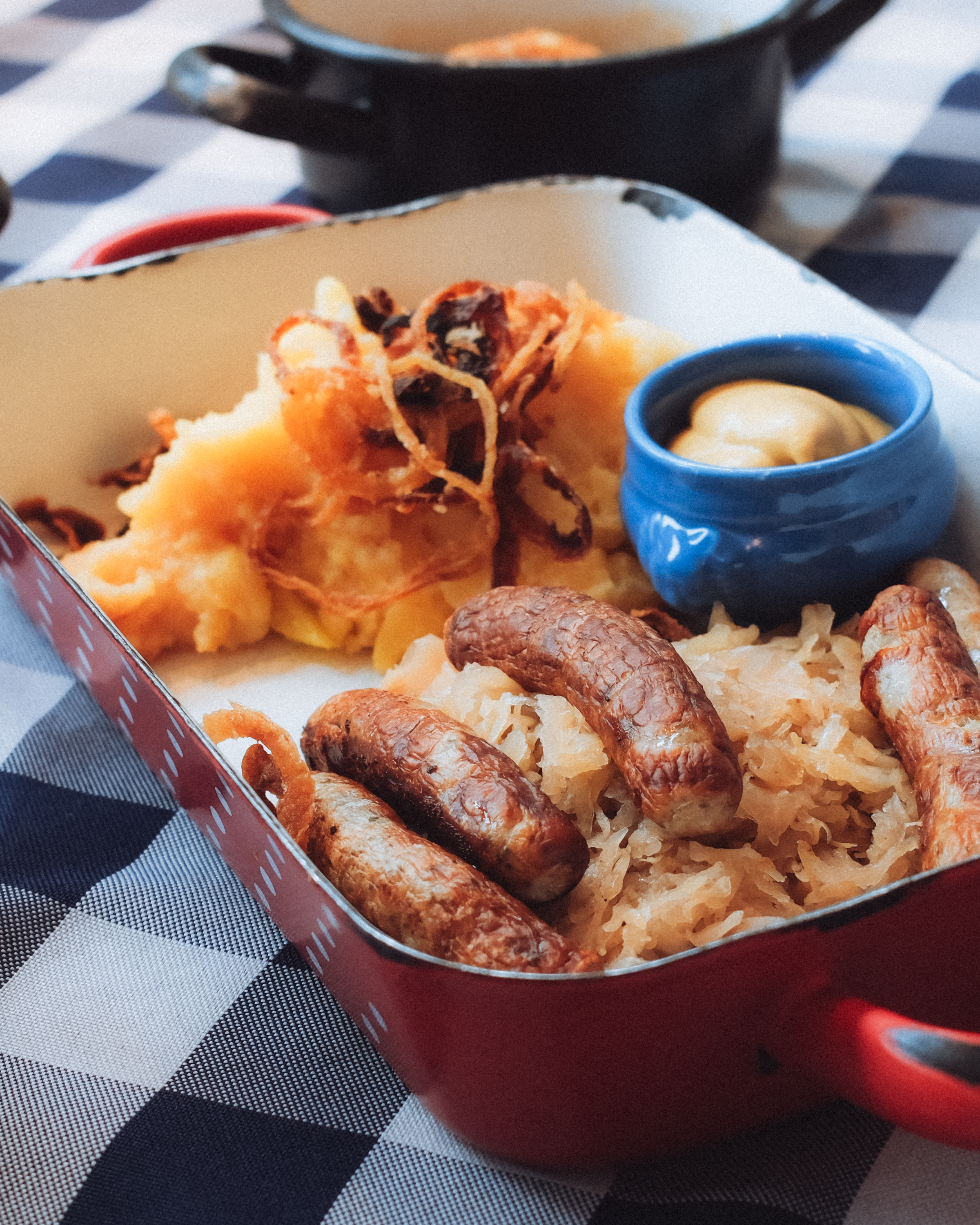
Photo: Anh Nguyen / Pexels
Eastern-European
Kielbasa and Cabbage
The diets react (see scores below)
Common Ingredients
- kielbasa
- cabbage
- onion
- caraway seeds
- garlic
- butter
- apples
- black pepper
Specific recipes may vary.
Incompatible with 9 of 11 diets
Diet Ratings
Kielbasa and cabbage is largely keto-friendly, but the inclusion of apples is the primary concern. Kielbasa is a high-fat, moderate-protein sausage with minimal carbs (though some commercial brands contain added sugars or fillers — label-checking is essential). Cabbage is a low-carb vegetable that works well in keto. Onion adds a small carb load (~3-4g net carbs per serving). Butter, garlic, caraway seeds, and black pepper are all keto-compatible. However, apples are a high-sugar fruit (~19g net carbs per medium apple) that can easily push a serving over the daily carb threshold. If apples are used sparingly (e.g., a small wedge for flavor) and the portion is modest, the dish may fit within limits. The dish as typically prepared with a full apple is problematic for strict keto.
Some lazy keto or flexible keto practitioners argue that a small amount of apple used for flavor in a large batch recipe results in negligible carbs per serving and is acceptable. Strict keto adherents counter that any high-glycemic fruit has no place in a ketogenic dish and should be replaced with a low-carb alternative like a splash of apple cider vinegar.
Kielbasa and Cabbage contains multiple animal-derived ingredients that are strictly excluded from a vegan diet. Kielbasa is a pork sausage — a direct animal flesh product. Butter is a dairy product derived from cow's milk. These two ingredients alone make this dish fundamentally incompatible with vegan eating. There is no ambiguity here: pork and dairy are unequivocally non-vegan under all recognized vegan standards.
This dish is disqualified primarily by kielbasa, which is a heavily processed meat containing added salt, preservatives (typically sodium nitrate/nitrite), and often fillers or additives that are firmly outside paleo guidelines. Butter is a dairy product excluded by strict paleo (and specifically discouraged by The Paleo Diet's guide). The remaining ingredients — cabbage, onion, caraway seeds, garlic, apples, and black pepper — are all paleo-approved whole foods. However, the two main disqualifying ingredients (kielbasa and butter) are foundational to the dish and cannot simply be omitted without fundamentally changing it.
Kielbasa and Cabbage is a traditional Eastern European dish that conflicts significantly with Mediterranean diet principles. Kielbasa is a highly processed pork sausage — it is both red meat and a processed meat product, both of which are strongly discouraged. Processed meats are arguably the most problematic category in Mediterranean diet guidelines, associated with high sodium, nitrates, saturated fat, and preservatives. While cabbage, onion, garlic, apples, and caraway seeds are plant-based positives, and butter is a minor concern, the centerpiece protein (kielbasa) is a disqualifying ingredient. Red meat is already limited to a few times per month; processed red meat sits even further outside the diet's boundaries. This dish is not Mediterranean in origin or composition.
Kielbasa and Cabbage is fundamentally incompatible with the carnivore diet. The dish is dominated by plant-based ingredients: cabbage (a vegetable), onion, garlic, caraway seeds, and apples are all entirely excluded from carnivore. Even the kielbasa itself is suspect — commercial kielbasa typically contains sugar, fillers, and plant-based spices beyond just meat and salt. Butter is the only ingredient that even approaches carnivore-acceptable (and is itself debated). There is no version of this dish that can be made carnivore-compliant without removing nearly every defining ingredient. It is essentially a vegetable dish with sausage added.
This dish has two non-compliant ingredients. First, butter is excluded on Whole30 — only ghee or clarified butter is permitted as a dairy exception. Second, kielbasa (Polish sausage) as commonly sold almost universally contains added sugar, corn syrup, or other excluded additives in its seasoning blend. The remaining ingredients — cabbage, onion, caraway seeds, garlic, apples, and black pepper — are all fully Whole30-compliant. The dish could be made compliant by substituting ghee for butter and sourcing a sugar-free, compliant kielbasa (which is difficult to find but not impossible).
This dish contains multiple high-FODMAP ingredients that make it unsuitable during the elimination phase. Onion is one of the highest-fructan foods and is problematic at any amount. Garlic is similarly high in fructans and must be avoided entirely during elimination. Apples contain excess fructose and polyols (sorbitol), making them high-FODMAP at standard serving sizes. Kielbasa often contains garlic and onion powder as seasonings, adding further fructan load. Cabbage is low-FODMAP at a small serving (75g) but becomes high-FODMAP at larger portions. Butter is low-FODMAP. Caraway seeds are low-FODMAP in small culinary amounts. Black pepper is low-FODMAP. However, the combination of onion, garlic, apples, and likely garlic/onion-seasoned kielbasa creates a dish with several unavoidable high-FODMAP triggers that cannot be mitigated by portion control alone.
Kielbasa is a heavily processed pork sausage with very high sodium content (typically 700-900mg per 3.5oz serving) and significant saturated fat, both of which are directly contrary to DASH diet principles. NIH/NHLBI DASH guidelines explicitly limit processed meats, high-sodium foods, and saturated fat. The dish's remaining ingredients — cabbage, onion, garlic, apples, caraway seeds — are DASH-friendly vegetables and fruits, but they cannot offset the dominant problematic ingredient. Butter adds additional saturated fat. The overall dish, as traditionally prepared, represents a combination of two DASH-restricted elements (processed meat + saturated fat) in meaningful quantities, placing it firmly in the avoid category.
Kielbasa and Cabbage presents a mixed Zone Diet profile. On the positive side, cabbage is an excellent low-glycemic, high-fiber Zone-favorable vegetable, and onion, garlic, and caraway seeds are all acceptable Zone ingredients. However, several components create challenges. Kielbasa (Polish sausage) is a processed, fatty pork product — it contains significant saturated fat and sodium, and is far from the lean protein ideal the Zone prescribes. A typical 3 oz serving of kielbasa delivers only moderate protein (~10-12g) but comes with substantial saturated fat (~8-10g), making the fat block math unfavorable for monounsaturated fat goals. Butter adds more saturated fat on top. Apples introduce moderate-glycemic carbohydrates (Zone classifies most apples as 'favorable' but the portion matters, and in a savory dish they can be difficult to block-measure accurately). The overall fat profile skews toward saturated rather than monounsaturated, and the protein source is processed rather than lean. With careful portioning — using a small amount of kielbasa as a flavoring rather than the primary protein, emphasizing the cabbage, and balancing with a cleaner fat source — this dish can be made to work, but as traditionally prepared it struggles to hit Zone ratios cleanly.
Some Zone practitioners in later Sears anti-inflammatory writing would note that traditional Eastern European pork products, while high in saturated fat, are not industrially processed with trans fats or seed oils, and fermented or smoked meats have a different inflammatory profile than seed-oil-heavy processed foods. The cabbage component is highly favorable and polyphenol-rich. A more lenient Zone reading might score this a 5-6 if kielbasa portions are kept small and the dish is heavy on the cabbage side.
Kielbasa and Cabbage has a predominantly pro-inflammatory profile driven by its primary ingredients. Kielbasa is a heavily processed pork sausage — exactly the type of food anti-inflammatory frameworks consistently flag: it is high in saturated fat, sodium, and often contains nitrates/nitrites and artificial preservatives, all of which are associated with elevated inflammatory markers (CRP, IL-6). Processed meats are among the most consistently pro-inflammatory foods across anti-inflammatory nutrition literature. Butter adds additional saturated fat. On the other side, cabbage is a genuinely anti-inflammatory brassica vegetable rich in vitamin C, glucosinolates, and fiber; onion and garlic provide quercetin and allicin with well-established anti-inflammatory properties; caraway seeds and black pepper offer modest anti-inflammatory phytochemicals; and apples contribute polyphenols and fiber. However, these beneficial ingredients are outweighed by the central role of a processed, high-fat, nitrate-containing meat and the additional saturated fat from butter. The dish as constructed is not rescued by its vegetable components — the kielbasa is not a minor flavoring but the primary protein and structural center of the dish. Substituting with a leaner, unprocessed protein (chicken sausage, turkey, or legumes) alongside these vegetables would shift the profile considerably.
Kielbasa is a highly processed pork sausage with significant saturated fat content (typically 8-12g fat per 2 oz serving, much of it saturated) and high sodium, making it a poor fit for GLP-1 patients on multiple fronts. The fat load worsens nausea, bloating, and reflux — core GLP-1 side effects. It is also low in fiber and nutrient-poor per calorie. Butter adds additional saturated fat with no compensating nutritional benefit. The cabbage, onion, apple, and caraway seeds are genuinely positive elements — cabbage and onion are high-fiber, easy-to-digest vegetables, and caraway seeds may actually support GI motility — but they cannot offset the kielbasa's fat density and processed meat profile. The dish also scores poorly on protein quality per calorie: while kielbasa contains protein (~7-8g per 2 oz), the accompanying fat load makes it a poor trade compared to lean protein sources. This is a portion-insensitive dish — even a small serving delivers a meaningful saturated fat hit.
*See how scores were generated at our methodology page.
Nutritional profile
Six traits that cut across every diet.
Fiber & Plants
How much whole-plant food and fiber it delivers.
Healthy Fats
The quality of its fats (unsaturated, omega-3).
Whole / Unprocessed
How close it is to its natural, unprocessed form.
Gut Gentle
How easy it is on digestion (low FODMAP, few irritants).
Low Glycemic
How little it spikes your blood sugar.
Protein Density
How much protein it packs per calorie.
Controversy Index
Higher controversy = more disagreement between diets.
Diet-Specific Tips
 Keto — 5/10
View tips
- Apples are high in sugar (~19g net carbs each) and are the main keto concern in this dish
- Kielbasa is high in fat and protein but must be checked for added sugars or grain fillers in commercial varieties
- Cabbage is low in net carbs and keto-friendly in moderate portions
- Onion adds moderate carbs (~3-4g net per serving) and should be used sparingly
- Butter, garlic, caraway seeds, and black pepper are fully keto-compatible
- Overall carb count is highly portion- and recipe-dependent; apple quantity is the critical variable
 Zone — 4/10
View tips
- Kielbasa is a processed, high-saturated-fat pork product — not a lean Zone protein
- Cabbage is a highly favorable Zone carbohydrate: low-glycemic, high-fiber, polyphenol-rich
- Butter adds additional saturated fat, compounding the unfavorable fat profile
- Apples are Zone-acceptable carbs but add sugar; portion control is important
- Onion and garlic are favorable Zone ingredients
- Dish lacks monounsaturated fat — no olive oil, avocado, or almonds present
- Protein quantity per serving may fall short of the ~25g Zone meal target depending on kielbasa portion
- Overall fat-to-protein ratio skews unfavorably compared to Zone ideals