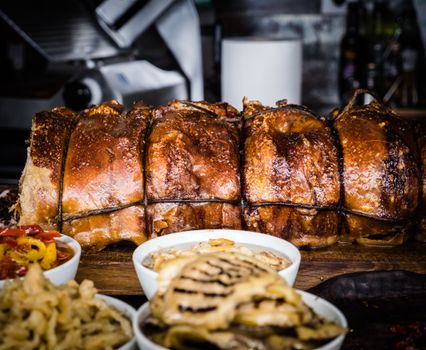
Photo: Jose Prada / Pexels
The diets react (see scores below)
Common Ingredients
- pork belly
- pork loin
- garlic
- rosemary
- fennel seed
- sage
- red pepper flakes
- sea salt
Specific recipes may vary.
Incompatible with 6 of 11 diets
Diet Ratings
Porchetta is an excellent ketogenic dish. The combination of pork belly and pork loin delivers a high-fat, moderate-protein profile perfectly aligned with keto macros. Pork belly is rich in healthy animal fats, while pork loin adds quality protein. All seasonings — garlic, rosemary, fennel seed, sage, red pepper flakes, and sea salt — are used in small culinary quantities that contribute negligible net carbs (garlic and fennel seed are the only minor contributors, but in typical seasoning amounts they add less than 2g net carbs per serving). There are no grains, sugars, starches, or high-carb ingredients. This is a whole, minimally processed food prepared traditionally, making it a near-ideal keto main course.
Porchetta is a traditional Italian roast made from pork belly and pork loin — both are direct animal flesh from a pig. These are unambiguously animal products and are entirely incompatible with a vegan diet. The aromatics (garlic, rosemary, fennel seed, sage, red pepper flakes, sea salt) are all plant-based, but the dish is fundamentally defined by its pork components, which constitute the primary and irreplaceable ingredients. There is no vegan version of porchetta in its traditional form, though plant-based adaptations using jackfruit or seitan exist as separate preparations.
Porchetta is made from whole, unprocessed pork cuts (belly and loin) seasoned with paleo-approved herbs and spices — all ingredients that would have been available or are naturally occurring. However, sea salt is listed as an ingredient, which falls under 'added salt' and is excluded under strict paleo rules. Most modern paleo practitioners and communities (Whole30, Mark Sisson) are permissive about small amounts of natural salt like sea salt or Himalayan salt, but strict Cordain-school paleo discourages added salt entirely. The dish is otherwise clean: no grains, no legumes, no dairy, no seed oils, no refined sugar, no preservatives. The fennel seed, rosemary, sage, garlic, and red pepper flakes are all paleo-compliant. The primary concern is the added sea salt and, in practice, the risk of commercial porchetta containing curing agents, preservatives, or nitrates — though homemade porchetta avoids this. Evaluated in its traditional homemade form, this is a near-approve dish held back by the salt question.
Strict Cordain-school paleo (as outlined in Loren Cordain's 'The Paleo Diet') excludes all added salt, arguing Paleolithic humans consumed sodium through whole foods rather than added salt. Under this interpretation, the sea salt seasoning disqualifies porchetta from full approval. Most modern paleo frameworks, however, accept minimal use of natural salt as a reasonable culinary concession.
Porchetta is a fatty roasted pork dish centered on pork belly and pork loin — both red/processed-style meats high in saturated fat. Red meat is limited to a few times per month in Mediterranean diet guidelines, and pork belly in particular is among the fattiest cuts available. While the aromatics (garlic, rosemary, fennel seed, sage) are quintessentially Mediterranean and praiseworthy, the protein base fundamentally conflicts with Mediterranean diet principles. This is an occasional indulgence at best, not a regular feature of the diet.
Traditional central Italian cuisine — particularly from Lazio, Umbria, and Abruzzo — has long featured porchetta as a culturally embedded dish. Some Mediterranean diet scholars who adopt a broad, traditional Italian dietary lens argue that whole-cut, minimally processed pork prepared with fresh herbs fits better than industrially processed meats, and that occasional enjoyment within an otherwise plant-forward diet is consistent with the spirit of the Mediterranean lifestyle.
Porchetta is made from good carnivore-friendly base ingredients (pork belly and pork loin), but the traditional recipe heavily incorporates multiple plant-derived herbs and spices: garlic, rosemary, fennel seed, sage, and red pepper flakes. These are all strictly excluded on a carnivore diet. While sea salt is acceptable, the dish as prepared is fundamentally a spiced/herbed pork roast where plant compounds are integral to the recipe — it cannot be considered carnivore-compliant in its traditional form. A stripped-down version (pork belly + pork loin + salt only) would be fully approved, but that would no longer be porchetta.
Porchetta as described contains only whole, unprocessed, Whole30-compliant ingredients. Pork belly and pork loin are unprocessed meats, and garlic, rosemary, fennel seed, sage, red pepper flakes, and sea salt are all herbs and spices explicitly allowed on the program. There are no excluded ingredients — no grains, legumes, dairy, added sugars, alcohol, or any other prohibited substances. This is a straightforward roasted meat dish that aligns perfectly with the Whole30 spirit of whole, minimally processed foods.
Porchetta is fundamentally incompatible with the low-FODMAP elimination phase due to the inclusion of garlic, which is one of the highest-FODMAP foods tested by Monash University. Garlic contains very high levels of fructans and is a 'avoid' food even in tiny quantities. There is no safe serving size for garlic during elimination. Additionally, while pork belly and pork loin are themselves low-FODMAP proteins, garlic is typically rubbed directly into the meat and infused throughout during the long roasting process. Unlike garlic-infused oil (where FODMAPs don't transfer into fat), when garlic is physically embedded in the meat and roasted with water-containing juices, fructans can leach into the surrounding flesh. Rosemary, fennel seed, sage, red pepper flakes, and sea salt are all low-FODMAP at typical culinary quantities. However, the garlic alone disqualifies this dish during the elimination phase.
Porchetta is fundamentally incompatible with DASH diet principles. The dish is built around pork belly, one of the fattiest cuts of pork, combined with pork loin. Pork belly is extremely high in saturated fat, which DASH explicitly limits to reduce cardiovascular risk. The preparation is also heavily salted — sea salt is applied generously during curing and roasting, resulting in very high sodium content per serving, well exceeding DASH thresholds. Red meat and high-fat pork are among the foods DASH specifically advises limiting or avoiding. While the herbs (rosemary, sage, fennel seed, garlic) are DASH-friendly flavor enhancers, they do nothing to offset the core nutritional liabilities of this dish. The combination of high saturated fat from pork belly and high sodium from the curing salt makes porchetta a clear avoid under both standard (2,300mg) and low-sodium (1,500mg) DASH targets.
Porchetta presents a mixed Zone Diet profile. The dish combines pork loin (a lean, Zone-favorable protein) with pork belly (a high-fat, high-saturated-fat cut), resulting in a protein source that is simultaneously acceptable and problematic. The herb-heavy seasoning (garlic, rosemary, fennel seed, sage) adds polyphenols and anti-inflammatory compounds, which aligns well with Sears' later anti-inflammatory emphasis. However, pork belly is predominantly fat — much of it saturated — which throws off the 30/30/40 block ratio significantly. A typical porchetta serving will deliver far more fat calories than the Zone target of ~1.5g per fat block, and the saturated fat load conflicts with Zone's preference for monounsaturated fats. Technically, a small portion of porchetta (2-3 oz) could be incorporated into a Zone meal with careful balancing: pair with a large low-GI vegetable base (no added fat) and a modest fruit serving to hit carb blocks, while omitting additional fat blocks entirely. The practical challenge is that porchetta is served as a slab, making precise block control difficult. The pork loin component salvages some Zone compatibility, but the pork belly integration makes this an 'unfavorable' protein-fat source rather than a favorable one.
Dr. Sears' later writings, particularly 'The Zone Diet' and his anti-inflammatory protocol work, took a somewhat more nuanced view of saturated fat, acknowledging that not all saturated fat is equally inflammatory. Some Zone practitioners argue that high-quality pork fat, especially in the context of a herb-rich, minimally processed preparation like porchetta, is more acceptable than processed meats. Additionally, the Zone's block system technically allows high-fat proteins — they simply consume more fat blocks, requiring fat to be eliminated elsewhere in the meal. A strict early-Zone interpretation would rate this lower (closer to 3), while a modern Zone practitioner might accept small portions more readily.
Porchetta presents a mixed anti-inflammatory profile. The primary concern is pork belly, which is high in saturated fat — a pro-inflammatory macronutrient that anti-inflammatory frameworks consistently recommend limiting. Pork belly is essentially one of the fattiest cuts available, and its prominent role here (along with pork loin) places this dish firmly in the 'limit' category for frequency and portion size. On the positive side, the herb and spice profile is genuinely excellent from an anti-inflammatory standpoint: rosemary, garlic, sage, fennel seed, and red pepper flakes all contain meaningful concentrations of anti-inflammatory phytochemicals (rosmarinic acid, allicin, flavonoids, capsaicin). These ingredients don't neutralize the saturated fat load, but they do meaningfully offset the overall inflammatory burden compared to plain fatty pork preparations. The dish contains no refined carbohydrates, added sugars, trans fats, or artificial additives — which keeps it out of the 'avoid' category. Pork loin itself is a lean cut and would be acceptable in moderation; the issue is the pork belly wrapping and fat that bastes the roast throughout cooking. Occasional consumption of porchetta in moderate portions — appreciated as a traditional whole-food preparation without industrial additives — is consistent with the anti-inflammatory diet's more flexible real-food philosophy, but it should not be a dietary staple.
Porchetta is a classic Italian roast made by wrapping pork loin inside a layer of pork belly, which is one of the fattiest cuts available. Even though the loin itself is lean, the belly wrapping means every slice carries a very high fat load — predominantly saturated fat. The slow-roasting process renders much of the fat but leaves the meat heavily marbled and rich. High-fat meals are among the most problematic foods for GLP-1 patients: fat slows gastric emptying further on top of what the medication already does, significantly worsening nausea, bloating, reflux, and upper GI discomfort. The red pepper flakes add an additional concern, as spicy ingredients can aggravate reflux and nausea that are already common GLP-1 side effects. While the dish does provide meaningful protein, the fat-to-protein ratio is unfavorable — there are far leaner ways to get equivalent protein without the GI risk. The crispy skin typically served with porchetta is essentially pure saturated fat, making it especially problematic. This is not a portion-sensitivity issue that can be managed by eating less; even a small serving delivers a concentrated fat hit.
*See how scores were generated at our methodology page.
Nutritional profile
Six traits that cut across every diet.
Fiber & Plants
How much whole-plant food and fiber it delivers.
Healthy Fats
The quality of its fats (unsaturated, omega-3).
Whole / Unprocessed
How close it is to its natural, unprocessed form.
Gut Gentle
How easy it is on digestion (low FODMAP, few irritants).
Low Glycemic
How little it spikes your blood sugar.
Protein Density
How much protein it packs per calorie.
Controversy Index
Higher controversy = more disagreement between diets.
Diet-Specific Tips
 Keto — 9/10
View tips
- Pork belly provides high fat content ideal for keto macros
- Pork loin contributes quality moderate protein
- All seasonings are used in trace amounts with negligible net carbs
- No grains, sugars, or starchy ingredients
- Whole unprocessed meat preparation aligns with keto principles
- Garlic and fennel seed in large commercial quantities could add minor carbs but are trivial in standard recipes
 Paleo — 5/10
View tips
- Pork belly and pork loin are unprocessed, whole animal proteins — paleo approved
- Garlic, rosemary, sage, fennel seed, and red pepper flakes are all paleo-compliant herbs and spices
- Sea salt is excluded under strict Cordain-school paleo rules as 'added salt'
- No grains, legumes, dairy, seed oils, or refined sugars present
- Homemade preparation avoids common commercial additives, nitrates, and preservatives that would push this firmly to avoid
- Traditional porchetta in this form is otherwise one of the cleaner meat preparations in Italian cuisine
 Whole30 — 9/10
View tips
- Pork belly and pork loin are compliant unprocessed meats
- All seasonings (garlic, rosemary, fennel seed, sage, red pepper flakes, sea salt) are Whole30-approved herbs and spices
- No excluded ingredients present
- Whole, unprocessed preparation consistent with Whole30 philosophy
- No added sugars, dairy, grains, or legumes in the ingredient list
 Zone — 4/10
View tips
- Pork belly is very high in saturated fat, conflicting with Zone's monounsaturated fat preference
- Pork loin component provides lean Zone-favorable protein
- Herb seasoning (rosemary, garlic, fennel, sage) adds polyphenols aligned with anti-inflammatory Zone goals
- Fat-to-protein ratio in combined porchetta is far above Zone block targets
- Small portions (~2 oz) could technically fit Zone blocks with zero additional fat in the meal
- No carbohydrate component — requires pairing with low-GI vegetables and fruit to complete Zone blocks
- Processed/rolled preparation retains more fat than standalone pork loin
 Anti-Inflammatory — 4/10
View tips
- Pork belly is high in saturated fat — pro-inflammatory and flagged for limitation by all major anti-inflammatory frameworks
- Pork loin is a lean cut and broadly acceptable in moderation
- Rosemary contains rosmarinic acid and carnosic acid with demonstrated anti-inflammatory activity
- Garlic provides allicin and organosulfur compounds associated with reduced CRP and IL-6
- Fennel seed, sage, and red pepper flakes add polyphenols and capsaicin with anti-inflammatory properties
- No refined carbohydrates, added sugars, trans fats, or artificial additives
- Whole-food preparation with traditional ingredients supports occasional inclusion despite saturated fat content