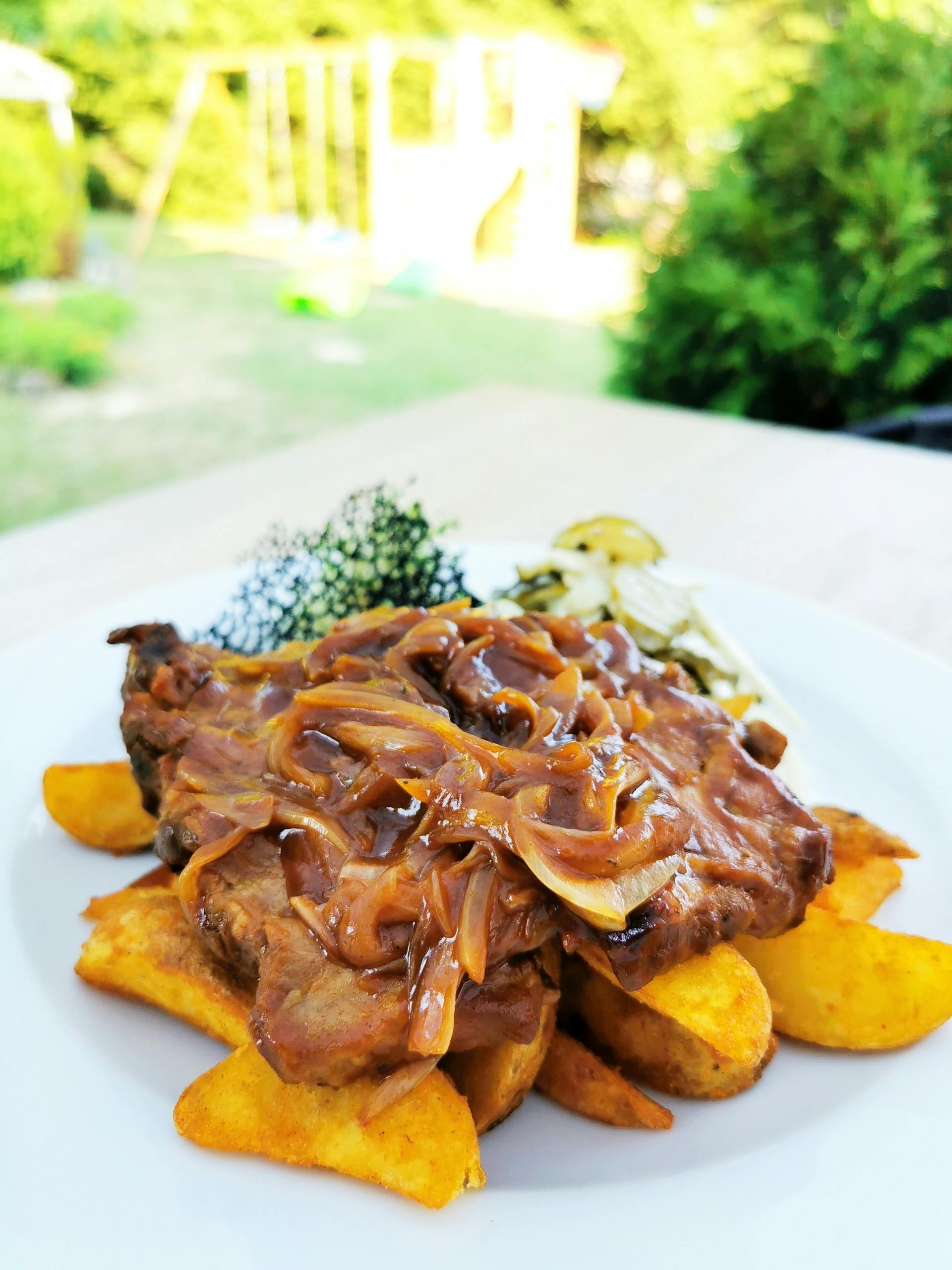
Photo: Rafał Nawrocki / Pexels
American
Pork Chops with Applesauce
The diets react (see scores below)
Common Ingredients
- bone-in pork chops
- applesauce
- butter
- garlic
- thyme
- salt
- black pepper
- apple cider
Specific recipes may vary.
Incompatible with 6 of 11 diets
Diet Ratings
Bone-in pork chops and butter are excellent keto foods — high fat, zero carbs, quality protein. However, the dish as traditionally prepared includes two significant carb sources: applesauce and apple cider. Standard applesauce contains roughly 14g net carbs per 1/4 cup serving, and apple cider adds another 7-14g per serving, making the combined carb load from these two ingredients easily push a single serving over or near the 20-50g daily limit. The dish could be adapted for keto by eliminating or drastically reducing these apple components and replacing them with a low-carb alternative (e.g., a small amount of apple cider vinegar for flavor), but as traditionally prepared and described, it poses a real risk to ketosis due to the fruit-derived sugars.
Pork Chops with Applesauce contains multiple animal-derived ingredients that disqualify it entirely from a vegan diet. Bone-in pork chops are the primary protein and a direct animal product (meat), and butter is a dairy derivative. These are unambiguous violations of vegan principles with no debate within the vegan community.
This dish contains three non-paleo ingredients that push it into avoid territory. Butter is a dairy product excluded under strict paleo guidelines. Salt (added) is explicitly excluded. Applesauce, while made from apples, is typically a commercially processed product that may contain added sugar, preservatives, or other additives — and even unsweetened store-bought versions involve processing that contradicts paleo philosophy. The pork chops, garlic, thyme, black pepper, and apple cider are paleo-compliant, but the combination of butter, salt, and processed applesauce makes this dish non-compliant as commonly prepared.
Pork chops are red meat, which the Mediterranean diet limits to a few times per month. This dish also uses butter as a cooking fat rather than the recommended extra virgin olive oil, adding saturated fat that contradicts Mediterranean principles. The applesauce and apple cider are relatively benign, but the overall dish is centered on a large portion of red meat cooked in butter — a combination that runs counter to the plant-forward, olive-oil-based ethos of the Mediterranean diet. Occasional consumption is technically permissible under the 'few times per month' allowance, but as a regular meal choice this dish conflicts with core guidelines.
Some broader interpretations of the Mediterranean diet acknowledge that pork is consumed in certain Mediterranean regions (e.g., southern Spain, Italy, Greece) in modest portions, and a small, infrequent pork serving could fit within the diet's flexibility. Swapping butter for olive oil and pairing with vegetables would significantly improve compatibility.
Pork Chops with Applesauce is fundamentally incompatible with the carnivore diet. While the bone-in pork chops and butter are animal-derived and would be acceptable on their own, the dish is defined by multiple plant-based components that disqualify it entirely. Applesauce is a fruit-based condiment — a core exclusion on carnivore. Apple cider is a plant-derived liquid. Garlic and thyme are plant-based aromatics excluded from all carnivore tiers. Black pepper is a plant spice, also excluded in strict practice. The pork itself is a fine carnivore protein, but this preparation is built around plant ingredients that cannot be separated from the dish as presented.
This dish contains butter, which is a dairy product explicitly excluded from the Whole30 program. Regular butter is not permitted — only ghee and clarified butter are allowed as the sole dairy exception. All other ingredients (bone-in pork chops, applesauce with no added sugar, garlic, thyme, salt, black pepper, and apple cider) are Whole30-compatible, but the presence of butter makes the dish non-compliant as written. A simple substitution of ghee for butter would render this dish fully compliant.
This dish contains two high-FODMAP ingredients that make it unsuitable during the elimination phase. Garlic is one of the highest-FODMAP foods tested by Monash University, containing significant fructans even in very small amounts — it should be strictly avoided during elimination. Applesauce is derived from apples, which are high in fructose and sorbitol (polyols); applesauce is high-FODMAP at a standard serving (roughly 1/2 cup or 120g). Apple cider similarly derives from apples and is high-FODMAP. The combination of garlic, applesauce, and apple cider creates multiple FODMAP hits across fructans and polyols. The remaining ingredients — bone-in pork chops, butter, thyme, salt, and black pepper — are all low-FODMAP and safe. However, the dish cannot be approved given the core problematic ingredients. Modifications such as replacing garlic with garlic-infused oil, omitting apple cider, and using a very small portion of blueberry or strawberry-based sauce instead of applesauce could make a compliant version.
Pork chops with applesauce sits in a gray zone for DASH. Pork is classified as a lean protein under DASH guidelines when trimmed and prepared as loin cuts, but bone-in pork chops — especially rib chops — can carry meaningful saturated fat, particularly if skin-on or fatty cuts are used. DASH allows lean pork in moderation (up to 6 oz cooked lean meat/poultry/fish per day), so the protein itself is not categorically excluded. However, the addition of butter adds saturated fat, which DASH explicitly limits. The applesauce and apple cider are DASH-friendly components (fruit-based, potassium-containing). Salt is flagged as a concern since DASH targets <2,300mg sodium/day (or <1,500mg for low-sodium DASH) — added salt during cooking of an already moderate-sodium protein pushes this dish in the wrong direction. Garlic and thyme are positive DASH-compatible seasonings. Overall, this dish is acceptable in moderate portions with trimmed lean pork chops, minimal butter, and restrained salt use, but as commonly prepared it requires meaningful modification to align well with DASH principles.
NIH DASH guidelines categorize pork cautiously due to saturated fat and sodium concerns, recommending lean cuts in limited quantities. However, updated clinical interpretations note that trimmed pork loin/chops are compositionally similar to skinless chicken breast and some DASH-oriented dietitians now include lean pork more liberally, provided butter and added salt are minimized.
Pork chops with applesauce is a classic American dish that requires careful portioning to fit Zone parameters. Bone-in pork chops provide a reasonable lean protein source, though they carry more fat than skinless chicken breast or fish — particularly saturated fat from the bone-in cut. The applesauce is the primary carbohydrate source: unsweetened applesauce is a moderate-glycemic fruit carb that Zone classifies as 'unfavorable' (apples themselves are borderline acceptable, but processed into sauce they lose fiber and hit faster). Sweetened applesauce would push the glycemic load higher and should be avoided. Butter adds saturated fat, which early Zone methodology strictly limited in favor of monounsaturated fats like olive oil. Apple cider contributes additional sugar/carbohydrate load. Garlic and thyme are polyphenol-rich and anti-inflammatory, which Sears would approve. The dish as classically prepared is protein-heavy and fat-heavy relative to carbohydrates, meaning it would need to be plated as a smaller protein portion (~3 oz cooked pork) alongside much larger vegetable servings to achieve the 40/30/30 ratio. The butter should ideally be replaced or minimized in favor of olive oil. With those adjustments, this dish can work in a Zone meal, but as traditionally served it skews toward protein and saturated fat with a high-glycemic fruit sauce.
Later Sears anti-inflammatory writings (The Zone Diet and OmegaRx Zone) are somewhat more permissive about saturated fat in whole-food contexts, acknowledging that pork in moderation is acceptable. Some Zone practitioners treat unsweetened applesauce as a reasonable fruit carb block, especially given its pectin fiber content — arguing it is closer to eating a whole apple than a high-GI processed carb. In this view, the dish scores closer to a 6 with careful portioning, provided applesauce is unsweetened and served in a controlled 1-block portion alongside low-GI vegetables.
Pork chops with applesauce is a mixed dish from an anti-inflammatory standpoint. On the positive side, it includes garlic and thyme — both recognized anti-inflammatory herbs — along with apple cider and applesauce, which contribute polyphenols and some antioxidant value. Black pepper enhances bioavailability of certain anti-inflammatory compounds. However, pork is a red/processed-adjacent meat that sits in the 'limit' category under most anti-inflammatory frameworks, particularly fattier cuts like bone-in chops, which carry saturated fat and arachidonic acid. Butter is a saturated fat that most anti-inflammatory protocols recommend limiting. The dish lacks omega-3 fatty acids, colorful vegetables, or other strongly anti-inflammatory components. Overall, the dish is neither strongly pro-inflammatory nor anti-inflammatory — it's a moderate-quality meal with a few beneficial herbs offset by a fatty protein source and butter. Swapping butter for extra virgin olive oil and serving with a vegetable side would meaningfully improve its profile.
Some anti-inflammatory practitioners (e.g., those following a more paleo-aligned or ancestral approach) would view pork chops more favorably as an unprocessed, nutrient-dense animal protein with B vitamins and selenium. Dr. Weil's framework, by contrast, places pork in the same limited category as red meat due to saturated fat content. Mainstream nutrition science (AHA guidelines) is less concerned about lean pork but still flags high saturated fat intake.
Bone-in pork chops provide meaningful protein (roughly 25-30g per chop), but the cut is moderately fatty compared to leaner proteins like chicken breast or fish, and butter adds saturated fat that can worsen GLP-1 side effects such as nausea, bloating, and reflux. The applesauce and apple cider contribute added sugars with minimal fiber or protein value, lowering the dish's nutrient density per calorie. Garlic and thyme are fine. The overall fat load from the pork fat and butter together is the primary concern — GLP-1 patients with slowed gastric emptying are more sensitive to high-fat meals sitting heavily in the stomach. The dish is not inherently disqualifying, but as typically prepared it falls short of the lean-protein, low-fat ideal. Modifications — trimming visible fat from the chop, replacing butter with a small amount of olive oil, using unsweetened applesauce in a modest portion — would meaningfully improve the rating.
Some GLP-1-focused registered dietitians consider center-cut or loin pork chops a reasonable lean protein source comparable to chicken thighs, and would approve a trimmed chop with a small applesauce portion as a satisfying, whole-food meal. Others flag that even moderate saturated fat from pork plus butter is disproportionately problematic for GLP-1 patients given their reduced gastric motility, and would steer patients toward consistently leaner options until GI side effects stabilize.
*See how scores were generated at our methodology page.
Nutritional profile
Six traits that cut across every diet.
Fiber & Plants
How much whole-plant food and fiber it delivers.
Healthy Fats
The quality of its fats (unsaturated, omega-3).
Whole / Unprocessed
How close it is to its natural, unprocessed form.
Gut Gentle
How easy it is on digestion (low FODMAP, few irritants).
Low Glycemic
How little it spikes your blood sugar.
Protein Density
How much protein it packs per calorie.
Controversy Index
Higher controversy = more disagreement between diets.
Diet-Specific Tips
 Keto — 4/10
View tips
- Pork chops are keto-friendly: high protein, moderate-to-high fat, zero net carbs
- Butter adds healthy saturated fat, fully compatible with keto
- Applesauce is a concentrated fruit sugar source (~14g net carbs per 1/4 cup), a core keto-incompatible ingredient
- Apple cider adds additional fruit-derived sugars and carbohydrates
- Garlic, thyme, salt, and pepper are negligible in carb content
- As served, a standard portion likely contains 20-30g+ net carbs from the apple components alone
- Dish can be made keto-compliant by removing/replacing applesauce and apple cider
 DASH — 5/10
View tips
- Bone-in pork chops can be moderate-to-high in saturated fat depending on cut — DASH limits saturated fat
- Butter adds saturated fat, a nutrient DASH explicitly restricts
- Added salt during cooking conflicts with DASH sodium targets (<2,300mg/day standard, <1,500mg low-sodium)
- Applesauce and apple cider are fruit-based, DASH-friendly ingredients providing potassium and natural sweetness
- Lean trimmed pork is permitted under DASH as a lean protein source in controlled portions (≤6 oz/day cooked)
- Garlic and thyme are DASH-compatible herb/spice seasonings with no sodium concern
- Dish can be improved for DASH by using a very lean trimmed chop, replacing butter with olive oil, and omitting added salt
 Zone — 5/10
View tips
- Bone-in pork chop has higher saturated fat than ideal Zone proteins like chicken breast or fish
- Applesauce is a processed fruit carb — unsweetened is preferable but still moderate-to-high glycemic index versus whole vegetables
- Butter contributes saturated fat; Zone favors monounsaturated fat sources like olive oil
- Apple cider adds additional sugar and carbohydrate load that must be counted
- Garlic and thyme are polyphenol-rich and anti-inflammatory — Zone positives
- Dish as traditionally served is protein/fat-heavy; needs added low-GI vegetables to achieve 40/30/30 balance
- Portion control is essential: ~3 oz pork, small applesauce serving, with vegetable-heavy sides
 Anti-Inflammatory — 4/10
View tips
- Pork is a red/fatty meat — limited in most anti-inflammatory frameworks due to saturated fat and arachidonic acid
- Butter adds saturated fat, a flagged ingredient in anti-inflammatory diets
- Garlic and thyme are recognized anti-inflammatory herbs — a positive contribution
- Applesauce and apple cider provide polyphenols and modest antioxidant value
- No omega-3 fatty acids, colorful vegetables, or strongly anti-inflammatory components present
- Moderate portion and preparation matters — a grilled lean chop is less inflammatory than a pan-fried fatty one with heavy butter
 GLP-1 Friendly — 5/10
View tips
- Moderate-to-good protein content from pork chop (~25-30g), supporting the #1 GLP-1 dietary priority
- Bone-in chop retains more fat than loin cuts — saturated fat load is a concern with slowed gastric emptying
- Butter adds unnecessary saturated fat and worsens nausea and reflux risk
- Applesauce and apple cider add sugar with low fiber and no protein — reduces nutrient density per calorie
- Dish is low in fiber with no vegetables or whole grains present
- Garlic and thyme are GLP-1 safe and add flavor without risk
- Improvable: trimming fat, swapping butter for olive oil, using unsweetened applesauce in small portion, adding a vegetable side would elevate this to an approve