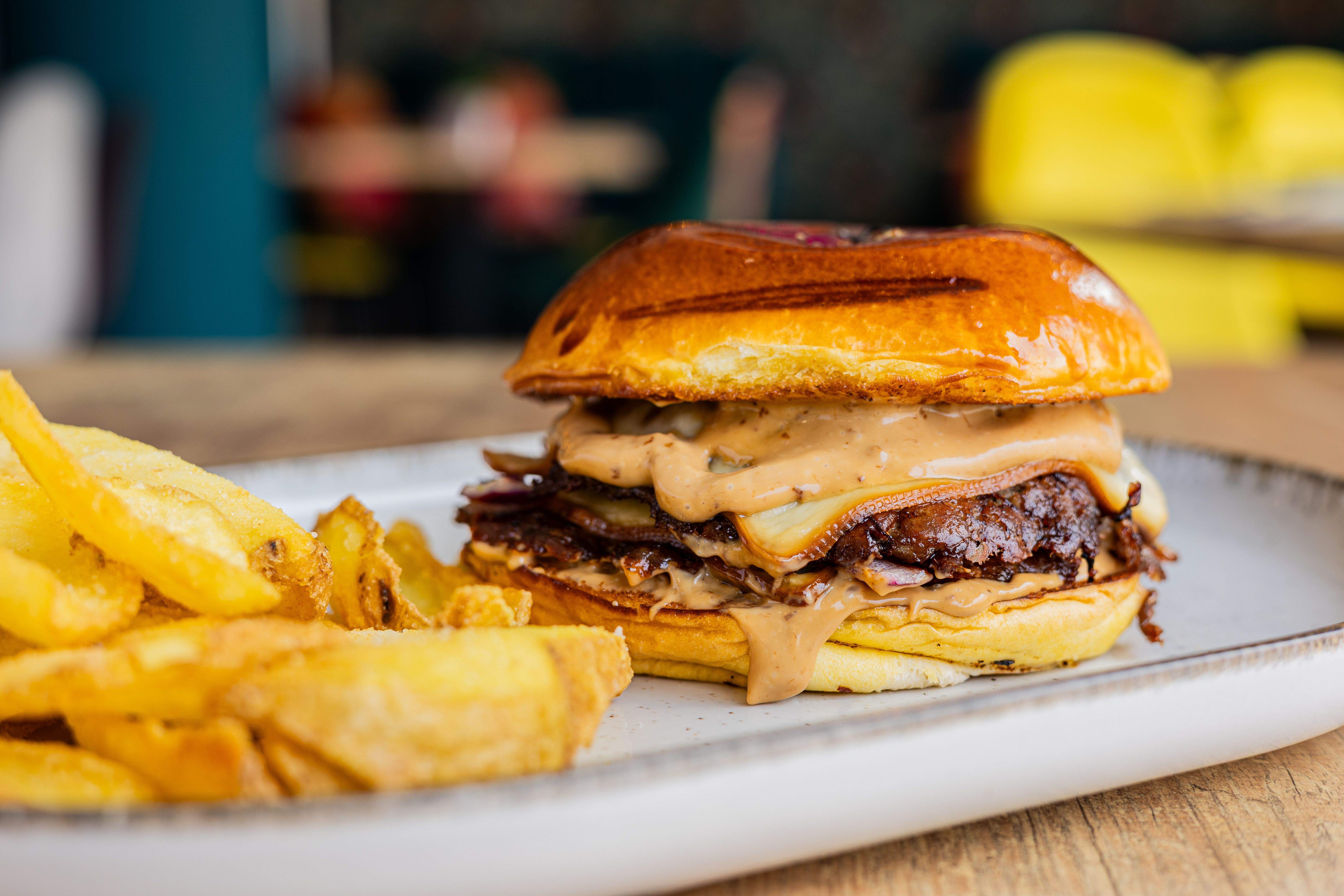
Photo: Pablo Rodríguez / Pexels
American
Portobello Mushroom Burger
The diets react (see scores below)
Common Ingredients
- portobello mushrooms
- balsamic vinegar
- olive oil
- brioche bun
- lettuce
- tomato
- red onion
- provolone
Specific recipes may vary.
Incompatible with 6 of 11 diets
Diet Ratings
The Portobello Mushroom Burger as described is incompatible with a ketogenic diet primarily due to the brioche bun, which is a refined grain product containing approximately 30-40g of net carbs on its own — enough to exceed or meet the entire daily keto carb limit in a single component. Balsamic vinegar also adds a modest but notable sugar load (roughly 2-3g net carbs per tablespoon due to grape must). While the portobello mushrooms, olive oil, lettuce, provolone, and even tomato and red onion in small amounts are individually manageable, the brioche bun is a hard disqualifier. This dish, in its standard form, would immediately knock most people out of ketosis. A keto-friendly adaptation would require replacing the bun with lettuce wraps or a portobello cap 'bun,' and swapping balsamic vinegar for a lower-sugar alternative like red wine vinegar or lemon juice.
This dish contains provolone cheese, which is a dairy product derived from cow's milk and is therefore not vegan. Additionally, brioche buns are traditionally made with eggs and butter, making them non-vegan as well. The remaining ingredients — portobello mushrooms, balsamic vinegar, olive oil, lettuce, tomato, and red onion — are all fully plant-based. However, the presence of provolone alone is sufficient to disqualify this dish from vegan compatibility, and the brioche bun compounds the issue. With simple substitutions (vegan cheese or no cheese, and a standard or vegan brioche bun), this could easily be made vegan.
This dish contains multiple non-paleo ingredients that make it clearly incompatible with the Paleolithic diet. The brioche bun is a wheat-based grain product — one of the most strictly excluded food categories in paleo. Provolone cheese is dairy, also firmly excluded. Balsamic vinegar, while made from grapes, is heavily processed and often contains added sugars and sulfites, placing it in avoid territory for strict paleo. The paleo-compliant ingredients — portobello mushrooms, olive oil, lettuce, tomato, and red onion — are perfectly acceptable, but the foundational structural elements of this dish (the bun and cheese) are hard disqualifiers. Even deconstructed, this dish as presented cannot be considered paleo-friendly.
This dish has strong Mediterranean elements — portobello mushrooms as the plant-based protein, olive oil, balsamic vinegar, and fresh vegetables (lettuce, tomato, red onion) are all well-aligned with Mediterranean principles. However, the brioche bun is a refined, enriched bread (made with butter and eggs) rather than a whole-grain option, which conflicts with the diet's emphasis on whole grains and minimal refined carbohydrates. Provolone cheese is acceptable in moderation as a dairy product. The overall dish leans plant-forward but is held back by the brioche bun, keeping it in the 'caution' range rather than an approval.
Some Mediterranean diet interpretations, particularly those rooted in traditional Italian practice, would view modest cheese and bread consumption as culturally appropriate and acceptable. A more lenient reading might score this higher, emphasizing the plant-forward protein and olive oil while treating the bread as an occasional indulgence rather than a disqualifier.
The Portobello Mushroom Burger is entirely plant-based and fundamentally incompatible with the carnivore diet. Every single ingredient violates carnivore principles: portobello mushrooms are fungi (not animal products), balsamic vinegar and olive oil are plant-derived, the brioche bun is a grain-based processed food, and lettuce, tomato, and red onion are vegetables. The only borderline ingredient is provolone cheese, which is dairy and would be debated within the carnivore community, but it is a minor component in an otherwise completely non-carnivore dish. There is no animal protein source whatsoever — the primary protein is a mushroom. This dish represents the antithesis of carnivore eating.
This dish contains two clearly excluded ingredients: (1) brioche bun — a grain-based bread product, which is excluded both because grains (wheat) are prohibited and because bread/buns fall squarely under the 'no recreating baked goods' rule; (2) provolone — a dairy cheese, which is explicitly excluded on Whole30. Either violation alone would disqualify the dish.
This dish contains multiple high-FODMAP ingredients that make it unsuitable during the elimination phase. Portobello mushrooms are high in polyols (mannitol) and are high-FODMAP even at small servings — a whole portobello cap as the burger 'patty' far exceeds any safe threshold. The brioche bun is made with wheat flour, making it high in fructans, and brioche also typically contains honey and milk, adding excess fructose and lactose concerns. Red onion is one of the highest-FODMAP foods tested by Monash, rich in fructans and GOS, and is high-FODMAP even in very small amounts. Balsamic vinegar is moderate-FODMAP and becomes high-FODMAP at standard serving sizes (>2 tablespoons). Provolone is a lower-lactose aged cheese and is generally low-FODMAP. Lettuce, tomato, and olive oil are low-FODMAP. However, the combination of portobello mushroom (high polyols), brioche bun (high fructans), and red onion (high fructans) creates a dish that is definitively high-FODMAP with no practical modifications that would preserve its identity.
The Portobello Mushroom Burger has several DASH-friendly components — portobello mushrooms are low in sodium, rich in potassium and B vitamins, and serve as an excellent plant-based protein alternative to red meat. Olive oil aligns well with DASH's emphasis on heart-healthy fats, and balsamic vinegar adds flavor without significant sodium. The fresh vegetables (lettuce, tomato, red onion) are core DASH foods. However, two ingredients temper the overall rating: (1) Provolone cheese is a full-fat, moderately high-sodium cheese (~200-250mg sodium per slice, ~5g saturated fat) — DASH calls for low-fat dairy and sodium limitation; substituting a reduced-fat, lower-sodium cheese would improve the rating. (2) Brioche bun is made with enriched white flour, butter, and eggs — it is not a whole grain product, and DASH strongly emphasizes whole grains over refined carbohydrates. A whole-grain bun would significantly improve DASH alignment. The dish is a reasonable choice compared to a beef burger but falls short of full DASH approval due to the refined bun and full-fat cheese.
NIH DASH guidelines specify low-fat dairy and whole grains as core components, which this dish partially violates. However, updated clinical interpretations note that full-fat cheese in modest portions may not significantly harm cardiovascular outcomes per emerging dairy research, and some DASH-oriented clinicians prioritize the overall dietary pattern over individual food swaps — in that context, this burger compares favorably to most American fast-food options.
The Portobello Mushroom Burger has several Zone-friendly elements but is fundamentally undermined by the brioche bun and its protein deficit. Portobello mushrooms, while nutrient-dense and low-glycemic, provide negligible protein (roughly 3-4g per large cap) — far short of the ~25g lean protein target per Zone meal. This is a vegetarian protein source, and a poor one at that, meaning fat blocks would need to be doubled to account for the vegetarian protein rule, yet the overall protein macro will still fall dramatically short. The olive oil is an ideal monounsaturated fat choice, and the vegetables (lettuce, tomato, red onion) are favorable Zone carb sources. Balsamic vinegar is acceptable in small amounts. However, the brioche bun is a high-glycemic refined carbohydrate with added fat and sugar — Dr. Sears categorizes enriched white flour products as 'unfavorable' carbs that spike insulin. Provolone adds some protein but also saturated fat. The 40/30/30 ratio is essentially unachievable here without significant modification: replacing brioche with a low-glycemic wrap or open-face on one slice of whole grain bread, adding a substantial lean protein source (egg whites, tofu, additional dairy), and keeping olive oil as the fat base. As served, this dish skews heavily toward carbohydrates with insufficient protein, making Zone balancing very difficult.
This burger has a genuinely strong anti-inflammatory foundation that is held back by a couple of moderating factors. On the positive side: portobello mushrooms, while not among the most emphasized Asian varieties (shiitake, maitake, oyster), are still whole mushrooms with meaningful antioxidant and ergothioneine content. Olive oil is a cornerstone anti-inflammatory fat rich in oleocanthal. Balsamic vinegar provides polyphenols. Lettuce, tomato, and red onion contribute antioxidants, quercetin, and lycopene (especially tomato). The overall profile skews plant-forward and whole-food. The limiting factors: brioche bun is a refined, enriched white flour product — likely with added butter, eggs, and sugar — representing refined carbohydrates that mildly promote inflammatory signaling. Provolone cheese is a full-fat dairy product, adding saturated fat in amounts worth noting. Neither ingredient is catastrophic, but together they meaningfully dilute the dish's anti-inflammatory score. If swapped for a whole-grain bun and omitted or reduced cheese, this would score closer to 8. As constructed, it earns a solid 6 — net neutral to mildly beneficial for most people.
Tomatoes and other nightshades (present here) are well-regarded in mainstream anti-inflammatory nutrition for their lycopene and polyphenol content, but AIP (Autoimmune Protocol) frameworks and practitioners like Dr. Tom O'Bryan flag solanine and lectins as potentially pro-inflammatory for individuals with autoimmune conditions or gut permeability issues — so this dish's score could be lower for that population.
The Portobello Mushroom Burger is a nutritionally mixed option for GLP-1 patients. The biggest problem is protein: portobello mushrooms deliver only about 3-4g of protein per large cap, and provolone adds roughly 5g, putting total meal protein well below the 15-30g per meal target. This is a significant deficiency given that muscle preservation is the top dietary priority on GLP-1 therapy. The brioche bun compounds the issue — it is a refined, enriched grain product with low fiber, moderate sugar, and empty calories that crowd out nutrient-dense foods in an already appetite-suppressed patient. On the positive side, portobello mushrooms are easy to digest, low in fat, and have reasonable water content. Olive oil and balsamic vinegar are acceptable fats used in modest amounts. Lettuce, tomato, and red onion contribute micronutrients and some fiber. Provolone adds modest saturated fat. Overall, this meal fails the protein density test and uses a low-nutrient-density vehicle (brioche) that is counterproductive when caloric intake is severely limited. It would be more appropriate with a lettuce wrap or whole grain bun substitution and a significant protein addition such as a fried egg, white beans, or a side of cottage cheese.
*See how scores were generated at our methodology page.
Nutritional profile
Six traits that cut across every diet.
Fiber & Plants
How much whole-plant food and fiber it delivers.
Healthy Fats
The quality of its fats (unsaturated, omega-3).
Whole / Unprocessed
How close it is to its natural, unprocessed form.
Gut Gentle
How easy it is on digestion (low FODMAP, few irritants).
Low Glycemic
How little it spikes your blood sugar.
Protein Density
How much protein it packs per calorie.
Controversy Index
Higher controversy = more disagreement between diets.
Diet-Specific Tips
 Mediterranean — 5/10
View tips
- Portobello mushroom is an excellent plant-based protein, strongly encouraged
- Olive oil and balsamic vinegar are core Mediterranean ingredients
- Fresh vegetables (lettuce, tomato, red onion) add plant-forward value
- Brioche bun is a refined, butter-enriched bread — not whole grain, contradicts Mediterranean principles
- Provolone is acceptable dairy in moderation
- No red meat or highly processed ingredients present
 DASH — 5/10
View tips
- Portobello mushroom is an excellent plant-based, low-sodium, potassium-rich DASH-friendly protein
- Olive oil is heart-healthy and DASH-approved
- Fresh vegetables (lettuce, tomato, red onion) are core DASH foods
- Brioche bun is a refined grain, not a whole grain — DASH emphasizes whole grains
- Provolone is full-fat and moderately high in sodium and saturated fat — DASH calls for low-fat dairy
- Balsamic vinegar adds minimal sodium
- Substituting a whole-grain bun and reduced-fat, lower-sodium cheese would raise this to an 'approve' rating
 Zone — 4/10
View tips
- Portobello mushroom provides negligible protein (~3-4g), making the 30% protein target nearly impossible without significant additions
- Brioche bun is a high-glycemic refined carbohydrate — classified as 'unfavorable' in Zone terminology, spikes insulin
- Olive oil is an ideal Zone fat source (monounsaturated), a genuine positive
- Vegetables (lettuce, tomato, red onion) are favorable low-glycemic Zone carb blocks
- Provolone adds modest protein but introduces saturated fat, acceptable in small amounts
- Overall macro ratio skews heavily carbohydrate-dominant with protein severely deficient — antithetical to Zone 40/30/30 balance
- Could be rescued by swapping brioche for whole grain bread and adding a lean protein supplement, but as served falls short
 Anti-Inflammatory — 6/10
View tips
- Portobello mushrooms provide antioxidants and ergothioneine — positive but less potent than emphasized Asian mushrooms
- Olive oil is a top-tier anti-inflammatory fat (oleocanthal, monounsaturated)
- Tomato and red onion contribute lycopene and quercetin
- Balsamic vinegar adds polyphenols
- Brioche bun is a refined carbohydrate with likely added sugar and butter — mildly pro-inflammatory
- Provolone is a full-fat dairy cheese contributing saturated fat — moderate concern
- No processed meats, trans fats, seed oils, or added sugars beyond the bun
 GLP-1 Friendly — 4/10
View tips
- Very low protein — portobello mushroom plus provolone delivers roughly 8-10g total, far below the 15-30g per meal target
- Brioche bun is a refined grain with low fiber and low nutrient density — poor use of limited caloric budget
- Portobello mushrooms are easy to digest and gentle on GI tract, a positive for GLP-1 patients
- Olive oil and balsamic vinegar are acceptable in small amounts and do not significantly worsen side effects
- Provolone adds modest saturated fat — not ideal but not a major concern at one slice
- Vegetables (lettuce, tomato, onion) contribute micronutrients and minor fiber but not enough to meet daily targets
- Overall nutrient density per calorie is poor given the brioche base and low-protein main component