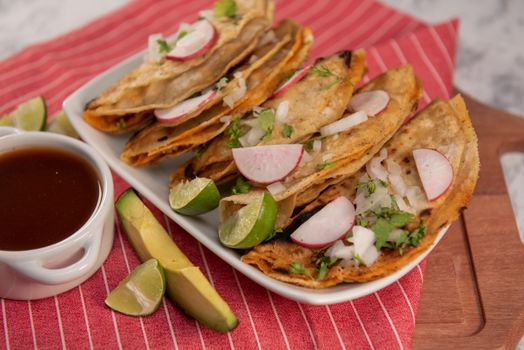
Photo: Los Muertos Crew / Pexels
Mexican
Quesabirria Tacos
The diets react (see scores below)
Common Ingredients
- beef chuck
- guajillo chiles
- Oaxaca cheese
- corn tortillas
- onion
- cilantro
- lime
- cumin
Specific recipes may vary.
Incompatible with 9 of 11 diets
Diet Ratings
Quesabirria tacos are fundamentally built on corn tortillas, which are high in net carbs — a standard corn tortilla contains roughly 10-12g net carbs each, and tacos are typically served in multiples (2-3), easily delivering 25-35g net carbs from the tortillas alone before accounting for other ingredients. This pushes the dish well beyond the 20-50g daily keto carb ceiling in a single meal. The remaining components are largely keto-friendly: beef chuck is an excellent high-fat protein, Oaxaca cheese adds fat with minimal carbs, guajillo chiles and aromatics (onion, cilantro, lime) contribute minor carbs, and cumin is negligible. However, the corn tortilla is the defining structural element of a taco and cannot be meaningfully reduced without fundamentally changing the dish. The birria stew itself (without tortillas) would be keto-compatible, but as served in taco form, this dish is incompatible with ketosis.
Quesabirria tacos contain two clear animal-derived ingredients: beef chuck (mammal flesh) and Oaxaca cheese (dairy). Both are unambiguously excluded under vegan principles. There is no meaningful debate within the vegan community about either ingredient. The remaining components — guajillo chiles, corn tortillas, onion, cilantro, lime, and cumin — are fully plant-based, but the presence of beef and dairy makes this dish entirely incompatible with a vegan diet.
Quesabirria Tacos contain two clear paleo violations that are non-negotiable across virtually all paleo frameworks. Corn tortillas are a grain product — corn is explicitly excluded from the paleo diet as it was not part of the Paleolithic human diet and contains anti-nutrients. Oaxaca cheese is a dairy product, also excluded under standard paleo guidelines. The remaining ingredients — beef chuck, guajillo chiles, onion, cilantro, lime, and cumin — are all paleo-approved. However, the dish is fundamentally defined by its tortillas and cheese; without them, it is no longer quesabirria. The two violations are load-bearing to the dish's identity, pushing the overall verdict firmly to avoid.
Quesabirria tacos are built around beef chuck as the primary protein, which is a red meat that the Mediterranean diet restricts to only a few times per month. The dish is also rich in Oaxaca cheese, adding significant saturated fat. While several individual components have Mediterranean-friendly qualities — corn tortillas are a whole grain, guajillo chiles are a vegetable-based ingredient, and the aromatics (onion, cilantro, lime, cumin) are plant-based and welcome — the overall dish is dominated by fatty braised red meat and full-fat cheese, with no olive oil as the primary fat. The combination of frequent red meat consumption and high saturated fat load from cheese places this dish firmly outside Mediterranean diet principles when consumed regularly.
Quesabirria Tacos are fundamentally incompatible with the carnivore diet. While beef chuck is an excellent carnivore-approved protein, the dish is built around multiple plant-based ingredients that are strictly excluded: corn tortillas (grain), guajillo chiles (plant/spice), onion (vegetable), cilantro (herb), lime (fruit), and cumin (spice). The Oaxaca cheese is a debated dairy item, but it is irrelevant here because the overall dish cannot be adapted — it is structurally a plant-forward Mexican preparation. The combination of grains, vegetables, fruits, and spices makes this a clear avoid with high confidence.
Quesabirria tacos contain two explicitly excluded ingredient categories. First, corn tortillas are grains (corn is listed as an excluded grain on Whole30), making the tortilla shell non-compliant. Second, Oaxaca cheese is a dairy product, which is explicitly excluded (only ghee and clarified butter are allowed as dairy exceptions). Additionally, the dish is a taco — a wrap/tortilla-based format that falls squarely into the 'no recreating junk food/comfort food formats' rule (tortillas and wraps are explicitly listed as prohibited formats). Even if one were to substitute compliant ingredients, the taco format itself would remain a violation of the spirit of the program.
Quesabirria tacos contain several high-FODMAP ingredients that make this dish problematic during the elimination phase. Onion is one of the highest-FODMAP foods tested by Monash University, containing significant fructans at any standard serving — even small amounts cooked into the birria broth or used as a topping are typically high-FODMAP. Guajillo chiles have limited Monash testing data, but dried chiles used in quantity for a sauce/braise may contribute fructans. Oaxaca cheese is a fresh, stretchy cheese similar to mozzarella; while some fresh cheeses are lower in lactose, Oaxaca cheese is not definitively tested by Monash and could contribute moderate lactose depending on serving size. On the positive side, beef chuck is a protein and entirely FODMAP-free, corn tortillas are low-FODMAP (certified by Monash at ~2 tortillas), cilantro and lime are low-FODMAP, and cumin is low-FODMAP at culinary doses. However, the onion content alone — especially stewed into the birria consommé — makes this dish high-FODMAP as traditionally prepared. Modifications (omitting onion, substituting garlic-infused oil, using lactose-free or aged cheese) could potentially make a version safer, but the classic dish as listed is not suitable for the elimination phase.
Monash University has not specifically tested guajillo chiles or Oaxaca cheese, creating some uncertainty around their exact FODMAP contribution. Some clinical FODMAP practitioners suggest that long-simmered onion in a broth that is then strained may reduce fructan content slightly, but this is not supported by Monash data and most elimination-phase protocols still advise avoiding onion in any cooked form.
Quesabirria tacos present multiple red flags for the DASH diet. Beef chuck is a fatty red meat high in saturated fat, which DASH explicitly limits. Oaxaca cheese is a full-fat dairy product with significant saturated fat and sodium content, both restricted on DASH. The preparation method typically involves frying the tortillas in the rendered beef fat (consommé tallow), dramatically increasing saturated fat content. The dish as commonly consumed is likely high in sodium from the braising liquid, spices, and cheese. While some individual ingredients — corn tortillas, guajillo chiles, onion, cilantro, lime, and cumin — are DASH-compatible, the dominant protein and cheese components make this dish incompatible with DASH guidelines. The combination of red meat, full-fat cheese, and fat-frying places this firmly in the 'avoid' category.
Quesabirria tacos present several Zone Diet challenges. Beef chuck is a fatty cut with significant saturated fat, not the lean protein Zone prefers (skinless chicken, fish, or lean beef). Oaxaca cheese adds both protein and saturated fat, further skewing the fat profile away from monounsaturated sources. Corn tortillas are a moderate-glycemic carbohydrate that Zone classifies as 'unfavorable' — usable in small blocks but not ideal. On the positive side, guajillo chiles are polyphenol-rich and anti-inflammatory, onion and cilantro are favorable Zone vegetables, and lime adds minimal carbs. A typical serving of 2-3 tacos would likely be carb-heavy relative to protein, with too much saturated fat and not enough monounsaturated fat, making the 40/30/30 ratio difficult to achieve. However, with careful portioning — limiting to 1-2 small tacos, trimming beef fat, reducing cheese, and pairing with a large vegetable side — this dish can be worked into a Zone meal. The consommé dipping broth, common with this dish, adds collagen and minimal calories and is Zone-neutral. The dish is not categorically excluded but requires significant modification to approach Zone balance.
Some Zone practitioners following Sears' later anti-inflammatory work (notably 'The Zone Diet' updates emphasizing omega-3s and polyphenols) would note that guajillo chiles are exceptionally rich in polyphenols and capsaicinoids, which align with Sears' broader anti-inflammatory mission. Additionally, Sears' later writings softened the strict stance on saturated fat somewhat, acknowledging that small amounts in context are acceptable. A stricter early-Zone reading would rate this lower (score 3) due to beef chuck's fat content, corn tortillas as unfavorable carbs, and the high-sat-fat cheese.
Quesabirria tacos present a mixed anti-inflammatory profile. On the positive side, the dish includes several genuinely anti-inflammatory ingredients: guajillo chiles are rich in capsaicin and carotenoids with documented anti-inflammatory activity; onion contains quercetin and other flavonoids; cilantro provides antioxidants; lime adds vitamin C; cumin contributes anti-inflammatory phytochemicals; and corn tortillas offer whole-grain fiber with a moderate glycemic load. These collectively provide meaningful antioxidant and polyphenol support. On the negative side, beef chuck is a red meat high in saturated fat and arachidonic acid, both of which are associated with elevated inflammatory markers (CRP, IL-6) in research. It is the primary protein and likely present in substantial quantity. Oaxaca cheese is a full-fat dairy product, adding saturated fat. Traditional preparation also involves frying the tortillas in the birria fat/consommé, which is predominantly beef tallow — a significant source of saturated fat. The combined red meat + full-fat cheese + frying fat load pushes this dish into the 'limit' category under anti-inflammatory guidelines. It is not an 'avoid' because the spice and vegetable components are genuinely beneficial and the dish is not heavily processed or reliant on seed oils, trans fats, or refined sugar. A moderate, occasional serving is acceptable within an anti-inflammatory framework, especially if portion-controlled and served with the consommé (which concentrates the anti-inflammatory spices).
Some anti-inflammatory nutrition perspectives, particularly those aligned with Dr. Weil's more flexible pyramid, would note that traditionally prepared beef dishes with heavy spice use and minimal processed ingredients are meaningfully different from industrial red meat products, and the guajillo-cumin-onion braise may partially offset the inflammatory load. Conversely, stricter anti-inflammatory or autoimmune-oriented protocols (e.g., AIP) would flag both red meat frequency and dairy as consistently pro-inflammatory and recommend avoiding this dish or substituting with a leaner protein and dairy-free cheese alternative.
Quesabirria tacos present multiple challenges for GLP-1 patients. Beef chuck is a high-fat, fatty cut of red meat with significant saturated fat content — the opposite of the lean proteins prioritized on GLP-1 regimens. The preparation method (slow-braised in chile broth, then the tortillas are dipped in the rendered beef fat/consommé and pan-fried) dramatically increases the total fat load per serving. Oaxaca cheese adds additional saturated fat. The combination of high fat content and the greasy, pan-fried tortilla is likely to worsen GLP-1 side effects including nausea, bloating, reflux, and delayed gastric emptying discomfort. While corn tortillas and guajillo chiles offer some fiber and micronutrient value, and beef chuck does contain protein, the overall fat density per serving makes this a poor fit. The consommé dipping step — a defining feature of quesabirria — is specifically the kind of greasy, high-fat preparation flagged as problematic. Protein yield exists but is not efficient relative to fat load.
Some GLP-1-aware dietitians note that beef chuck, despite being fatty, delivers meaningful protein and iron, and that small-portion consumption (one taco) with broth sipped slowly could be tolerable for patients without significant GI sensitivity. However, the consensus among obesity medicine RDs is that the high saturated fat load and greasy pan-fried preparation method make quesabirria a high-risk choice for most GLP-1 patients, particularly in the first several months on the medication.
*See how scores were generated at our methodology page.
Nutritional profile
Six traits that cut across every diet.
Fiber & Plants
How much whole-plant food and fiber it delivers.
Healthy Fats
The quality of its fats (unsaturated, omega-3).
Whole / Unprocessed
How close it is to its natural, unprocessed form.
Gut Gentle
How easy it is on digestion (low FODMAP, few irritants).
Low Glycemic
How little it spikes your blood sugar.
Protein Density
How much protein it packs per calorie.
Controversy Index
Higher controversy = more disagreement between diets.
Diet-Specific Tips
 Zone — 4/10
View tips
- Beef chuck is a fatty cut — high saturated fat, not the lean protein Zone recommends; leaner beef options like sirloin would be preferred
- Oaxaca cheese adds saturated fat, compounding the unfavorable fat profile for Zone
- Corn tortillas are classified as 'unfavorable' carbohydrates in Zone — moderate glycemic index, limited fiber
- Typical serving size (2-3 tacos) likely exceeds Zone carbohydrate block targets and skews macros toward carbs and fat
- Guajillo chiles are polyphenol-rich and anti-inflammatory, strongly aligned with Sears' later nutritional philosophy
- Onion, cilantro, and lime are favorable Zone ingredients contributing minimal glycemic load
- No monounsaturated fat source present — Zone would recommend adding avocado or olive oil
- Can be portioned into Zone compliance (1-2 small tacos + vegetable side) but requires deliberate modification
 Anti-Inflammatory — 4/10
View tips
- Beef chuck is a red meat high in saturated fat and arachidonic acid — a consistent 'limit' food in anti-inflammatory frameworks
- Oaxaca cheese adds full-fat dairy saturated fat load
- Traditional frying in beef tallow further raises saturated fat content
- Guajillo chiles provide capsaicin and carotenoids with documented anti-inflammatory properties
- Cumin, onion, cilantro, and lime contribute antioxidants and polyphenols
- Corn tortillas are a whole grain option with moderate fiber
- No processed additives, trans fats, refined sugar, or seed oils identified
- Dish is whole-food and traditionally prepared — a positive structural factor