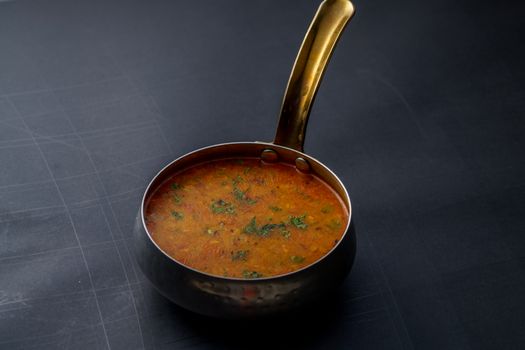
Photo: Kunal Lakhotia / Pexels
The diets react (see scores below)
Common Ingredients
- tamarind
- tomatoes
- toor dal
- black pepper
- cumin seeds
- curry leaves
- garlic
- cilantro
Specific recipes may vary.
Incompatible with 4 of 11 diets
Diet Ratings
Rasam is a thin, tangy South Indian soup whose carb load comes primarily from tamarind (moderately high in sugars/carbs), tomatoes (moderate carbs), and toor dal (split pigeon peas — a legume with significant net carbs). A standard serving of rasam (~1 cup/240ml) would likely contribute 8–14g net carbs depending on the amount of dal and tamarind used. Toor dal is the most problematic ingredient: legumes are generally excluded on strict keto due to their starch content. However, rasam uses dal mainly for flavor and body (the dal water, not whole dal), which reduces the actual carb load somewhat. Tamarind paste adds sweetness and carbs but is used in small quantities. The spices (black pepper, cumin, curry leaves, garlic, cilantro) are keto-friendly and metabolically beneficial. With a small portion and reduced dal/tamarind, rasam can be consumed cautiously, but it is not a freely consumable keto food.
Strict keto practitioners would categorize rasam as 'avoid' due to the inclusion of toor dal (a legume) and tamarind, arguing that even the liquid from legumes contains enough carbs and antinutrients to be excluded. Conversely, lazy keto or targeted keto followers may consider a half-cup serving acceptable given the diluted nature of the soup.
Rasam as prepared with these ingredients is entirely plant-based. Tamarind provides the characteristic sourness, tomatoes add body and acidity, toor dal (split pigeon peas) contributes protein and thickness, and the aromatics — black pepper, cumin seeds, curry leaves, garlic, and cilantro — are all whole plant-based spices and herbs. No animal products or animal-derived ingredients are present. This version of rasam is a whole-food, minimally processed legume-based soup, which scores highly even by whole-food plant-based standards. Note that some traditional rasam recipes include ghee as a finishing fat or use it to temper the spices — that preparation would make it non-vegan, but the listed ingredients contain no such addition.
Rasam contains toor dal (split pigeon peas), which is a legume — a clear and unambiguous exclusion in the paleo diet. Legumes are rejected due to their lectin and phytic acid content and their absence from the presumed Paleolithic diet. All other ingredients (tamarind, tomatoes, black pepper, cumin seeds, curry leaves, garlic, cilantro) are paleo-approved. However, the inclusion of toor dal as a core structural ingredient makes this dish incompatible with paleo. A paleo-modified rasam could be made by omitting the dal entirely, as the spice base is otherwise excellent.
Rasam is a South Indian tamarind-based soup that aligns strongly with Mediterranean diet principles. Its ingredient profile is almost entirely plant-based: tamarind and tomatoes provide antioxidants and acidity, toor dal (split pigeon peas) contributes plant protein and fiber as a legume, and the aromatics — black pepper, cumin, curry leaves, garlic, and cilantro — are all whole-food spices and herbs. Legumes, vegetables, and herbs are core staples of the Mediterranean diet, emphasized daily. The dish is minimally processed, low in saturated fat, and nutrient-dense. The only minor caveat is that traditional rasam preparation may use ghee as a tempering fat rather than olive oil, which is not the canonical Mediterranean fat source.
Some traditional rasam recipes use ghee (clarified butter) for tempering, which is a saturated animal fat inconsistent with the Mediterranean diet's emphasis on extra virgin olive oil as the primary fat. However, the small quantity of tempering fat used does not significantly undermine the dish's overall plant-forward profile, and olive oil can easily substitute.
Rasam is an entirely plant-based Indian soup with zero animal-derived ingredients. Every single component — tamarind, tomatoes, toor dal (lentils), black pepper, cumin seeds, curry leaves, garlic, and cilantro — is plant-derived and explicitly excluded from the carnivore diet. Toor dal is a legume, making it doubly problematic as both a plant food and an antinutrient-rich food carnivore practitioners specifically warn against. There is no animal protein, no animal fat, no eggs, no dairy, and no bone broth component whatsoever. This dish is incompatible with carnivore principles at every level.
Rasam contains toor dal (split pigeon peas), which is a legume. Legumes are explicitly excluded on the Whole30 program. While all other ingredients — tamarind, tomatoes, black pepper, cumin seeds, curry leaves, garlic, and cilantro — are fully compliant, the inclusion of toor dal disqualifies this dish. A modified rasam omitting the dal would be compliant.
Rasam contains two significant high-FODMAP ingredients that make it problematic during the elimination phase. First, garlic is one of the highest-FODMAP foods (fructans) and is a core flavoring in rasam — even small amounts cause issues. Second, toor dal (split pigeon peas) is high in GOS (galacto-oligosaccharides) and is typically used in meaningful quantities to provide body to the soup. Together, these two ingredients make standard rasam unsuitable for the elimination phase. Tamarind is low-FODMAP in small servings (approximately 10g or less) but can become problematic at larger amounts. Tomatoes are low-FODMAP at standard servings (one medium tomato). Black pepper, cumin seeds, curry leaves, and cilantro are all low-FODMAP and safe. The dish could theoretically be modified by omitting garlic and toor dal, but as traditionally prepared, it is not elimination-phase safe.
Monash University rates garlic as clearly high-FODMAP at any culpable serving, but some clinical FODMAP practitioners allow garlic-infused oil as a substitute — if rasam were made with garlic-infused oil rather than garlic cloves, the fructan issue would be resolved. However, the toor dal content remains a GOS concern that most practitioners would not overlook during strict elimination, and the combination of both problematic ingredients in a traditional recipe pushes this firmly into the avoid category.
Rasam is a South Indian thin soup made with tamarind, tomatoes, toor dal (split pigeon peas), and spices. This ingredient profile aligns well with DASH principles: toor dal provides plant-based protein, fiber, potassium, and magnesium; tomatoes and tamarind supply potassium and antioxidants; and the spices (black pepper, cumin, garlic, curry leaves, cilantro) are sodium-free flavor enhancers that support the DASH strategy of using herbs and spices instead of salt. The dish contains no saturated fat, no added sugar, no high-sodium processed ingredients, and no red meat. As listed, the sodium content is naturally low since no salt is specified in the ingredients — homemade versions can be kept very low in sodium. However, restaurant or packaged versions often include added salt, and tamarind paste can contribute some sodium, so preparation method matters. Overall, this is a nutrient-dense, plant-forward soup well-suited to the DASH eating plan.
NIH DASH guidelines strongly support legume- and vegetable-based soups, making this a natural fit. However, some DASH-oriented clinicians note that tamarind's high tartaric acid content and the typical addition of salt in real-world preparation can push sodium levels higher than expected, and would recommend explicitly verifying low-sodium preparation before fully endorsing it for strict low-sodium DASH (<1,500mg/day) adherents.
Rasam is a thin, tangy South Indian soup built primarily from tamarind, tomatoes, toor dal (split pigeon peas), and anti-inflammatory spices. From a Zone perspective, this dish has several strengths: the spice base (black pepper, cumin, garlic, curry leaves, cilantro) is rich in polyphenols and fits Dr. Sears' anti-inflammatory emphasis perfectly. Tomatoes are a favorable low-glycemic carbohydrate. Tamarind contributes some carbohydrates and has a moderate glycemic load in typical soup quantities. Toor dal provides some plant-based protein and fiber, which lowers the net carb impact. However, the dish is listed with 'no primary protein,' which is the main Zone concern — it is essentially a carbohydrate-and-spice broth with modest protein from the dal. As a standalone meal it fails the 40/30/30 ratio significantly, being heavily carb-skewed with minimal protein and fat. As a soup component or side dish paired with lean protein (e.g., fish or chicken) and a healthy fat source (e.g., a drizzle of olive oil or a few almonds on the side), it integrates reasonably well into a Zone meal. The toor dal contributes legume-based protein blocks but would need to be portioned carefully as legumes count as both carb and protein blocks in Zone methodology.
Zone practitioners differ on how to classify traditional thin lentil soups like rasam. Some treat the toor dal content as contributing meaningful protein blocks (legumes serve dual carb+protein roles in Zone), making a small bowl a workable Zone-friendly side. Others, following Sears' stricter 'favorable carb' framework, note that the tamarind and tomato base with minimal fat makes this hard to balance without pairing. Sears' later anti-inflammatory writings would likely view the spice profile (black pepper, cumin, garlic) very favorably as polyphenol-rich additions.
Rasam is a South Indian soup with an exceptionally strong anti-inflammatory profile. Every major ingredient contributes positively: black pepper contains piperine, which activates curcumin absorption and has independent anti-inflammatory effects; cumin seeds are rich in antioxidants and have demonstrated anti-inflammatory activity; garlic contains allicin and organosulfur compounds that suppress NF-κB inflammatory signaling; curry leaves are high in flavonoids and carbazole alkaloids with antioxidant properties; cilantro provides quercetin and other polyphenols; tomatoes contribute lycopene and vitamin C; tamarind offers tartaric acid and polyphenols with antioxidant capacity; and toor dal (split pigeon peas) is a legume providing plant protein, fiber, and isoflavones. The combination of multiple anti-inflammatory spices in a legume-based broth with no refined ingredients, seed oils, or added sugars makes this dish exemplary within the anti-inflammatory framework. Traditional rasam preparation uses minimal fat (sometimes a small tempering of ghee or coconut oil, which are moderate-status items but not concerning in small amounts). The dish has virtually no pro-inflammatory components and aligns strongly with Dr. Weil's emphasis on spices, legumes, and colorful vegetables.
Rasam is a thin, tangy South Indian soup made primarily from tamarind, tomatoes, toor dal, and spices. It is very low in fat, low in calories, and contains modest fiber from the tamarind, tomatoes, and dal. The black pepper and cumin provide digestive support, which is a modest benefit for GLP-1 patients dealing with slowed gastric emptying. However, rasam scores only a caution because its protein contribution is minimal — toor dal is present but typically in very small quantities in rasam (it is used more for flavor than substance), meaning this dish does not meaningfully advance the #1 GLP-1 dietary priority. It also has high water content, which supports hydration. The spice profile — particularly black pepper in larger amounts — may irritate the GI tract in some GLP-1 patients prone to reflux or nausea. It functions best as a warm, easy-to-digest accompaniment rather than a standalone meal, and should be paired with a higher-protein dish to make nutritional sense in a GLP-1 eating plan.
Some GLP-1-focused dietitians would view rasam positively as a gentle, warming broth that supports hydration and digestion on difficult nausea days, similar to how bone broth is sometimes recommended — the low fat and easy digestibility outweigh the low protein in this context. Others would flag the black pepper and tamarind acidity as potential reflux triggers in patients already experiencing GLP-1-related GI sensitivity, particularly at higher medication doses.
*See how scores were generated at our methodology page.
Nutritional profile
Six traits that cut across every diet.
Fiber & Plants
How much whole-plant food and fiber it delivers.
Healthy Fats
The quality of its fats (unsaturated, omega-3).
Whole / Unprocessed
How close it is to its natural, unprocessed form.
Gut Gentle
How easy it is on digestion (low FODMAP, few irritants).
Low Glycemic
How little it spikes your blood sugar.
Protein Density
How much protein it packs per calorie.
Controversy Index
Higher controversy = more disagreement between diets.
Diet-Specific Tips
 Keto — 4/10
View tips
- Toor dal is a legume with notable net carbs, even when used primarily for its starchy water
- Tamarind contributes natural sugars and net carbs
- Tomatoes add moderate carbs but are manageable in small quantities
- Spice blend (pepper, cumin, curry leaves, garlic) is fully keto-compatible
- Standard serving (~1 cup) estimated at 8–14g net carbs — near the boundary for strict keto
- No added sugars or grains, and the dish is unprocessed and whole-food based
 Vegan — 9/10
View tips
- All listed ingredients are whole plant foods
- Toor dal provides plant-based protein and fiber
- Tamarind, tomatoes, and spices are fully vegan
- No ghee or other animal-derived fat listed (common in some traditional preparations)
- No dairy, eggs, or animal-derived additives present
 Mediterranean — 8/10
View tips
- Toor dal is a legume — a core Mediterranean diet staple
- All ingredients are whole, minimally processed plant foods
- Rich in herbs, spices, and aromatics aligned with Mediterranean eating
- Tamarind and tomatoes provide antioxidants and beneficial plant compounds
- Potential use of ghee as tempering fat is the only concern
- No added sugars, refined grains, or processed ingredients
 DASH — 8/10
View tips
- Toor dal provides plant-based protein, fiber, potassium, and magnesium — core DASH nutrients
- Tomatoes contribute potassium and lycopene with no sodium
- Spices and herbs replace salt as flavoring, consistent with DASH sodium-reduction strategy
- No saturated fat, cholesterol, added sugar, or processed ingredients
- Naturally low sodium as listed, but real-world preparation often includes added salt — score assumes minimal added salt
- Tamarind adds potassium and antioxidants but may contribute minor sodium in paste form
- Restaurant versions may significantly increase sodium content
 Zone — 6/10
View tips
- No primary protein source — fails Zone 40/30/30 ratio as a standalone meal
- Toor dal provides modest plant protein but counts as both carb and protein blocks
- Tamarind and tomatoes are low-to-moderate glycemic, acceptable Zone carb sources
- Exceptionally rich polyphenol and anti-inflammatory spice profile (black pepper, cumin, curry leaves, garlic, cilantro) aligns with Sears' anti-inflammatory focus
- Minimal fat content — would need pairing with monounsaturated fat source
- Best used as a Zone meal component/side dish, not a standalone meal
- Small serving portions help keep carbohydrate load manageable
 Anti-Inflammatory — 9/10
View tips
- Black pepper (piperine) — potent anti-inflammatory and bioavailability enhancer
- Garlic — allicin and organosulfur compounds reduce inflammatory cytokines
- Cumin seeds — antioxidant-rich, supports digestive and inflammatory health
- Curry leaves — flavonoids and carbazole alkaloids with antioxidant activity
- Toor dal — plant protein, fiber, and legume-based anti-inflammatory nutrition
- Tomatoes — lycopene and vitamin C (lycopene bioavailability increased by cooking)
- Tamarind — polyphenols and tartaric acid with antioxidant properties
- No refined carbohydrates, seed oils, added sugars, or processed ingredients
 GLP-1 Friendly — 5/10
View tips
- Very low protein — toor dal present but in quantities too small to contribute meaningfully to daily protein targets
- Low fat — no concerning fat sources, easy to digest
- High water content supports hydration, beneficial given reduced thirst on GLP-1s
- Black pepper and tamarind acidity may worsen reflux or nausea in sensitive GLP-1 patients
- Good as a light accompaniment but nutritionally incomplete as a standalone meal
- Modest fiber from tomatoes, tamarind, and dal — not a significant fiber source at typical serving size