Photo: Anthony Rahayel / Pexels
American
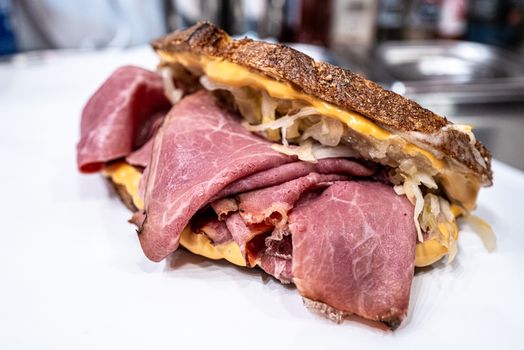
Reuben Sandwich
The diets react (see scores below)
Common Ingredients
- corned beef
- rye bread
- Swiss cheese
- sauerkraut
- Russian dressing
- butter
Specific recipes may vary.
Incompatible with 10 of 11 diets
Diet Ratings
The Reuben Sandwich is fundamentally incompatible with a ketogenic diet, primarily due to rye bread, which is a grain-based product delivering roughly 30-35g of net carbs per two slices alone — enough to exceed many people's entire daily keto carb budget in a single component. Russian dressing also typically contains added sugars and high-carb ingredients like ketchup, contributing additional net carbs. While several individual components — corned beef, Swiss cheese, sauerkraut, and butter — are actually keto-friendly or even keto-approved on their own, the rye bread is a disqualifying ingredient that cannot be portioned down meaningfully. The dish as traditionally constructed is incompatible with maintaining ketosis.
The Reuben Sandwich contains multiple animal products, making it entirely incompatible with a vegan diet. Corned beef is cured beef (red meat), Swiss cheese is a dairy product, Russian dressing typically contains mayonnaise (made with eggs), and butter is a dairy product. Every major component of this sandwich except the sauerkraut and rye bread is derived from animals. This is unambiguously non-vegan with no meaningful debate within the vegan community.
The Reuben Sandwich is deeply incompatible with the paleo diet across nearly every ingredient. Rye bread is a grain and a clear paleo violation. Swiss cheese is dairy, excluded under paleo rules. Corned beef is a heavily processed meat, cured with salt and nitrates, making it a processed food rather than a whole, unprocessed protein. Russian dressing typically contains ketchup (added sugar), mayonnaise (often made with seed oils), and other additives. Butter is dairy. Even sauerkraut, which is fermented cabbage and technically the most paleo-friendly ingredient here, is traditionally made with added salt. There is no realistic paleo adaptation of this dish without replacing virtually every component — at which point it is no longer a Reuben Sandwich.
The Reuben Sandwich is fundamentally at odds with Mediterranean diet principles on multiple fronts. Corned beef is a processed, cured red meat — high in saturated fat and sodium — which is the antithesis of the Mediterranean approach where red meat is limited to a few times per month. Butter is used as the cooking fat rather than extra virgin olive oil, the canonical Mediterranean fat. Rye bread, while better than white bread, is typically refined in this context. Russian dressing is a processed condiment high in added sugars and refined oils. Swiss cheese, while acceptable in small amounts in Mediterranean eating, is present in a non-trivial quantity. The only redeeming element is sauerkraut, a fermented vegetable that aligns with Mediterranean emphasis on plant-based foods and fermented foods. Overall, this dish is a highly processed, red-meat-centered American deli sandwich with no meaningful grounding in Mediterranean dietary traditions.
The Reuben Sandwich is fundamentally incompatible with the carnivore diet. While corned beef is an animal product (though often cured with sugar and spices, making it a 'caution' item on its own), the dish is built around multiple plant-based and processed ingredients that are strictly excluded. Rye bread is a grain-based product — a clear avoid. Sauerkraut is fermented cabbage — a plant food. Russian dressing contains plant oils, ketchup, and various plant-derived ingredients. Even the Swiss cheese, while animal-derived, is debated in strict carnivore circles. As a complete dish, the overwhelming presence of grains, fermented vegetables, and plant-based condiments makes this a definitive avoid with no ambiguity in the carnivore community.
The Reuben Sandwich contains multiple excluded ingredients that make it clearly non-compliant with Whole30. Rye bread is a grain-based product and is excluded. Swiss cheese is dairy and is excluded. Butter (regular, not ghee) is dairy and is excluded. Russian dressing typically contains mayonnaise with non-compliant additives, sugar, and other excluded ingredients. Additionally, as a sandwich, it falls squarely into the 'no recreating bread/junk food' rule (wraps, sandwiches on bread are excluded). Even if some individual components like corned beef and sauerkraut could theoretically be compliant, the dish as a whole is fundamentally incompatible with Whole30 on multiple levels.
The Reuben Sandwich contains multiple high-FODMAP ingredients that make it unsuitable during the elimination phase. Rye bread is high in fructans and is a primary offender — a standard serving of rye bread well exceeds safe FODMAP thresholds. Swiss cheese is a harder, aged cheese and is generally low-FODMAP in small portions (lactose is reduced during aging), but other components dominate the problem. Russian dressing typically contains ingredients like ketchup (often with onion/garlic), mayonnaise with additives, and relish — collectively contributing fructans and potentially excess fructose. Sauerkraut, while fermented, is only low-FODMAP at very small servings (about 2 tablespoons per Monash); a standard Reuben contains significantly more. The combination of high-fructan rye bread plus borderline sauerkraut portions plus FODMAP-containing dressing makes this dish clearly high-FODMAP at any standard restaurant or home serving size. Corned beef itself is low-FODMAP as a plain protein, and butter is low-FODMAP, but these cannot offset the other ingredients.
The Reuben Sandwich is highly incompatible with the DASH diet across nearly every ingredient. Corned beef is a cured, processed red meat with extremely high sodium content (typically 800–1,200mg per 3oz serving), high saturated fat, and is explicitly the type of food DASH guidelines advise against. Sauerkraut, while a fermented vegetable, adds another significant sodium load (200–400mg per half cup). Russian dressing contributes additional sodium, saturated fat, and added sugars. Swiss cheese adds saturated fat and more sodium. Butter used for grilling adds saturated fat. Even the rye bread, which is the least problematic ingredient, is typically made from refined rye in deli-style preparations rather than whole grain. A single Reuben sandwich commonly contains 1,500–2,500mg of sodium — exceeding or nearly meeting the entire daily sodium allowance for standard DASH (2,300mg) and far exceeding the low-sodium DASH target (1,500mg). The combination of processed red meat, full-fat cheese, high-sodium condiments, and butter makes this sandwich one of the most DASH-incompatible foods in American cuisine.
The Reuben Sandwich presents significant challenges for Zone compliance but isn't categorically impossible to incorporate. Corned beef is a fatty, sodium-heavy red meat — not a lean Zone protein like chicken breast or fish, though it does provide usable protein blocks. Rye bread is a moderate-glycemic carb that Zone classifies as 'unfavorable' but usable in limited quantities (one slice = roughly 1-2 carb blocks). Swiss cheese adds saturated fat rather than preferred monounsaturated fat. Russian dressing is typically high in sugar and omega-6 seed oils, creating an anti-inflammatory problem. Butter used for grilling adds saturated fat. The one genuine Zone-friendly element is sauerkraut — a fermented low-glycemic vegetable that Sears has endorsed for its polyphenol and probiotic content. As traditionally prepared, this sandwich is macro-imbalanced: too high in fat (especially saturated), moderate-to-high glycemic load from the bread, and the protein-to-fat ratio skews unfavorably. A Zone practitioner could deconstruct it — using one slice of rye, lean corned beef in controlled portion (~1 oz), sauerkraut freely, minimal Swiss, and replacing Russian dressing with olive oil-based mustard — but the traditional preparation is quite far from Zone ideals. It scores a 4 because it's workable with heavy modification but problematic as standardly served.
Some Zone practitioners argue that rye bread's lower glycemic index compared to white bread makes the Reuben more workable than other sandwiches, and that corned beef's protein content can anchor a Zone meal if portions are tightly controlled (1 oz corned beef ≈ 1 protein block). Dr. Sears' later anti-inflammatory writings also softened somewhat on moderate saturated fat intake in context, which could make Swiss cheese less disqualifying than early Zone doctrine suggested. A modified half-Reuben open-face on one rye slice with extra sauerkraut and a side salad could approach Zone ratios.
The Reuben Sandwich is a heavily pro-inflammatory meal by anti-inflammatory standards. Corned beef is processed, cured red meat — high in saturated fat, sodium, and nitrates/nitrites, all of which are associated with elevated inflammatory markers. It is the opposite of the lean, omega-3-rich proteins emphasized in anti-inflammatory eating. Swiss cheese and butter add saturated fat, which is in the 'limit' to 'avoid' category. Russian dressing typically contains mayonnaise (made with omega-6-heavy seed oils), ketchup (often with added sugar or HFCS), and other processed condiments, contributing further inflammatory load. Rye bread is a modest positive — whole rye has a lower glycemic index than white bread and contains some fiber — but in a typical deli Reuben it is often made from refined or semi-refined rye flour, limiting this benefit. The one genuine bright spot is sauerkraut: fermented cabbage provides probiotics and vitamin C, and fermented foods are increasingly recognized for their gut-health and anti-inflammatory benefits. However, a single ingredient cannot redeem a sandwich built on cured processed meat, saturated fat, seed-oil-based dressing, and butter. The cumulative profile is strongly pro-inflammatory and this dish conflicts with nearly every core principle of the anti-inflammatory diet.
The Reuben Sandwich is a poor fit for GLP-1 patients across nearly every priority category. Corned beef is a fatty, heavily processed red meat high in saturated fat and sodium, which can worsen nausea, bloating, and reflux — all common GLP-1 side effects. Swiss cheese adds additional saturated fat. Russian dressing is calorie-dense and high in fat with minimal nutritional value. Butter used for grilling further raises the saturated fat load. Rye bread offers modest fiber but refined enough that it doesn't offset the overall poor nutritional profile. The dish is large-portioned, heavy, and greasy, which is particularly problematic given that GLP-1 medications slow gastric emptying — this meal will sit in the stomach for an extended period, significantly increasing the risk of nausea, indigestion, and reflux. Sauerkraut is the one redeeming ingredient, offering some fiber and probiotics, but it cannot rescue this sandwich. Total fat per serving is high, protein-to-fat ratio is poor, and the calorie density is not justified by nutrient density. This is a textbook example of a food category to avoid on GLP-1 therapy.
*See how scores were generated at our methodology page.
Nutritional profile
Six traits that cut across every diet.
Fiber & Plants
How much whole-plant food and fiber it delivers.
Healthy Fats
The quality of its fats (unsaturated, omega-3).
Whole / Unprocessed
How close it is to its natural, unprocessed form.
Gut Gentle
How easy it is on digestion (low FODMAP, few irritants).
Low Glycemic
How little it spikes your blood sugar.
Protein Density
How much protein it packs per calorie.
Controversy Index
Higher controversy = more disagreement between diets.
Diet-Specific Tips
 Zone — 4/10
View tips
- Corned beef is fatty, high-sodium red meat — not a lean Zone-preferred protein
- Rye bread is an 'unfavorable' moderate-glycemic carb in Zone terminology
- Swiss cheese and butter add saturated fat, conflicting with monounsaturated fat preference
- Russian dressing typically contains sugar and omega-6 seed oils — anti-inflammatory concern
- Sauerkraut is a Zone-positive ingredient: low-glycemic, fermented, polyphenol-rich
- Traditional preparation is calorie-dense with poor 40/30/30 macro balance
- Heavy modification required to approach Zone compliance