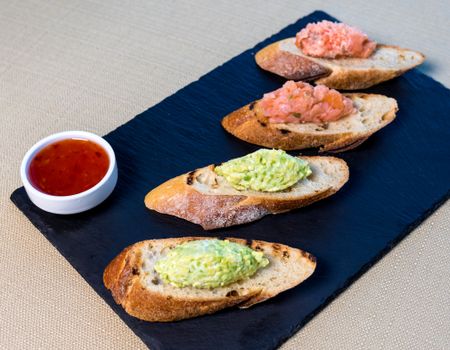
Photo: Farhad Ibrahimzade / Pexels
The diets react (see scores below)
Common Ingredients
- pork shoulder
- pork fat
- thyme
- bay leaves
- black pepper
- salt
- white wine
- cornichons
Specific recipes may vary.
Incompatible with 7 of 11 diets
Diet Ratings
Rillettes is an excellent keto food. The dish is primarily pork shoulder slow-cooked and preserved in its own fat (pork fat), making it very high in fat and moderate in protein — perfectly aligned with keto macros. The seasoning ingredients (thyme, bay leaves, black pepper, salt) contribute negligible carbs. The white wine used in cooking loses most of its alcohol and residual sugars during the long, slow cooking process, leaving only trace amounts. Cornichons are pickled gherkins with minimal net carbs per typical serving (1-2g per few pieces). Overall net carbs per standard serving are very low, and the fat content is ideal for ketosis.
Strict keto practitioners may flag the white wine as a concern, since even trace residual sugars and the general principle of avoiding alcohol-derived ingredients is upheld in clinical or carnivore-adjacent keto protocols. Some may also caution that commercial rillettes can include added sugars or starch as binders, making homemade versions strongly preferred.
Rillettes is a French charcuterie preparation made by slow-cooking pork shoulder and pork fat until the meat can be shredded and preserved in its own rendered fat. Both pork shoulder and pork fat are direct animal flesh and animal-derived fat, making this dish entirely incompatible with a vegan diet. There is no ambiguity here — this is a meat-based dish at its core.
Rillettes is a classic French slow-cooked pork preparation, and most of its core ingredients are paleo-friendly: pork shoulder, pork fat, thyme, bay leaves, and black pepper are all approved. However, two ingredients disqualify the dish under strict paleo rules. Salt is explicitly excluded as an added/refined ingredient. More significantly, white wine — while derived from grapes — is an alcoholic, processed product; even under lenient paleo interpretations it would fall into the 'caution' category, but here it serves as a cooking medium integrated throughout the dish rather than an optional condiment. Cornichons (pickled gherkins) are also problematic: the pickling process typically involves added salt and vinegar brine, making them a processed food. The combination of added salt, alcohol used in cooking, and processed pickled condiments pushes this dish firmly into 'avoid' territory, even though the foundational pork and fat components are excellent paleo proteins.
Rillettes is a French charcuterie preparation made primarily from pork shoulder slow-cooked and preserved in pork fat. This dish fundamentally contradicts Mediterranean diet principles on multiple fronts: it is red meat (pork) as the primary ingredient, uses large quantities of saturated animal fat (pork fat) as the preservation medium rather than olive oil, and is a processed/cured meat product. Red meat is limited to a few times per month in the Mediterranean diet, and high-saturated-fat animal products are strongly discouraged. The heavy reliance on rendered pork fat as both cooking and preservation medium is the antithesis of the Mediterranean approach, which uses extra virgin olive oil as the primary fat. While the dish contains some acceptable flavoring ingredients (thyme, bay leaves, black pepper, white wine), these do not redeem its core composition.
Rillettes as traditionally prepared contains multiple non-carnivore ingredients that disqualify it. White wine is a plant-derived fermented beverage, cornichons are pickled cucumbers (plant food), thyme and bay leaves are plant-based herbs, and black pepper is a plant spice. While the core of pork shoulder and pork fat is carnivore-approved, the dish as presented cannot be considered carnivore-compatible. The white wine and cornichons are particularly problematic — cornichons especially are a pure plant food that would be rated 'avoid' on their own. Even a strict-but-lenient carnivore who tolerates spices like salt and black pepper would still need to eliminate the wine and cornichons entirely. This dish would require a near-complete reformulation (pork shoulder + pork fat + salt only) to qualify as carnivore-approved.
Rillettes as described uses all Whole30-compliant ingredients: pork shoulder, pork fat, thyme, bay leaves, black pepper, salt, white wine (alcohol cooks off in slow preparation, and wine used as a cooking ingredient/flavoring is generally accepted), and cornichons (small pickles typically made with vinegar, which is allowed). None of the listed ingredients fall into excluded categories. However, there are a few caution points: (1) Cornichons commonly contain added sugar in commercial preparations, so label-reading is essential. (2) White wine used as a cooking liquid is generally considered compliant when used in small amounts as a flavoring/cooking medium rather than as a drink, but some practitioners debate this. (3) Rillettes is a rich, spreadable, preserve-style preparation — while it doesn't technically recreate a baked good or junk food, it is a charcuterie-style snack that some Whole30 practitioners view as the type of processed/indulgent snack the program discourages relying on. The dish itself does not violate any explicit Whole30 rule, but the cornichon ingredient requires verification.
Official Whole30 guidelines permit cooking with wine as a flavoring agent and allow vinegar-based pickles without added sugar. However, some community members and coaches argue that rillettes — as a rich, indulgent spread typically paired with bread — represents the kind of comfort-food mindset the program aims to disrupt, even if the standalone ingredients are compliant.
Rillettes is a slow-cooked French pork spread made primarily from pork shoulder and pork fat, both of which are naturally free of FODMAPs. The seasoning ingredients — thyme, bay leaves, black pepper, and salt — are all low-FODMAP at culinary quantities. White wine used in cooking is generally considered low-FODMAP, as the small residual amount per serving is negligible and Monash lists wine as low-FODMAP at standard servings (150ml). Cornichons (small pickled gherkins) are low-FODMAP; Monash has tested pickles and found them safe at standard servings. Crucially, this recipe contains no garlic or onion, which are the most common high-FODMAP offenders in French charcuterie. Assuming a standard serving of rillettes (approximately 40–60g as a snack spread), all ingredients remain within low-FODMAP thresholds.
Some commercial rillettes recipes and restaurant preparations include onion, garlic, or shallots as aromatics, which would make the dish high-FODMAP. Clinical FODMAP practitioners would advise confirming the recipe carefully, as these alliums are extremely common in French cooking and may not always be listed explicitly. For homemade rillettes using this exact ingredient list, the risk is low.
Rillettes is a traditional French charcuterie preparation that is fundamentally incompatible with DASH diet principles. The dish is made by slow-cooking pork shoulder in large amounts of rendered pork fat, then shredding and preserving the meat in that same fat. This results in extremely high saturated fat content, as pork fat is one of the primary ingredients by volume. Additionally, rillettes are heavily salted as a preservation method, contributing very high sodium levels — a single serving can easily contain 400–600mg or more of sodium. DASH guidelines explicitly limit saturated fat, total fat, and sodium, and specifically call for limiting red meat and full-fat animal products. Pork shoulder itself is a moderately fatty cut of red meat, which DASH already recommends limiting. The combination of red meat, preserved in saturated animal fat, with significant added salt, makes this dish one of the most DASH-incompatible foods possible. Cornichons add additional sodium. There are no redeeming nutritional features (no significant fiber, potassium, calcium, or magnesium) that would offset these concerns.
Rillettes is a French charcuterie preparation made by slow-cooking pork shoulder in its own fat (pork fat), resulting in a rich, spreadable meat paste. From a Zone Diet perspective, rillettes presents several challenges. The protein source (pork shoulder) is not lean — it contains significant intramuscular fat and is cooked with additional pork fat, making the saturated fat content very high. Zone Diet protocol favors lean proteins and monounsaturated fats, explicitly discouraging heavy saturated fat sources. A typical serving of rillettes will deliver disproportionately high fat calories (mostly saturated) relative to protein, making it very difficult to hit the 30% protein / 30% fat (monounsaturated-dominant) targets without dramatically restricting portion size. The fat-to-protein ratio in rillettes skews heavily toward fat, disrupting Zone block balance. However, it is not a zero-protein food — the pork does contribute protein blocks — and the white wine and cornichons add negligible carbs/polyphenols. If consumed in very small amounts (e.g., 1 tablespoon as a flavoring rather than a primary protein source), it could be incorporated into a Zone meal, but it cannot realistically serve as a primary Zone protein block without severely unbalancing the fat macros. The cornichons are a Zone-friendly low-glycemic accompaniment, but they don't compensate for the core fat imbalance.
Rillettes is a classic French charcuterie preparation that is fundamentally at odds with anti-inflammatory dietary principles. The dish is built on two core ingredients — pork shoulder and pork fat — that together make it extremely high in saturated fat. Pork fat (lard) is specifically listed among the saturated fats to limit or avoid in anti-inflammatory frameworks. The cooking process involves slow-rendering the meat in its own fat, meaning the final product is essentially a fat-saturated paste with very high saturated fat density per serving. Pork shoulder itself falls into the 'red meat' category, which anti-inflammatory guidelines recommend limiting. The combination of high saturated fat content and red meat protein creates a strongly pro-inflammatory profile. Thyme and bay leaves offer minor anti-inflammatory contributions from their polyphenols, but these are negligible against the dominant fat load. Cornichons are fermented and mildly beneficial, and white wine in cooking quantities is trivial. The overall dish is essentially the opposite of what anti-inflammatory eating emphasizes: it prioritizes rendered animal fat as the primary medium and feature, with no omega-3s, minimal antioxidants, high saturated fat, and no fiber. This is not a moderate indulgence in red meat — it is a concentrated delivery of animal fat by design.
Rillettes is a classic French charcuterie preparation where pork shoulder is slow-cooked and shredded in large quantities of pork fat, then packed and preserved in that fat. The finished product is extremely high in saturated fat — typically 30-40g of fat per 100g serving, with the majority being saturated. This directly violates the core GLP-1 dietary principles: high fat content will significantly worsen nausea, bloating, and reflux because GLP-1 medications already slow gastric emptying, meaning a fat-heavy food like rillettes will sit in the stomach for an extended, uncomfortable period. Nutrient density per calorie is very poor — the protein contribution is modest relative to the enormous caloric load from fat. While pork shoulder itself contains protein, the ratio is buried under the fat content of the final dish. The cornichons are the only redeeming element (low calorie, adds acidity), and white wine contributes minimal residual alcohol. This dish is not portion-rescuable — even a small serving delivers a significant saturated fat hit that is likely to trigger GI side effects in GLP-1 patients.
*See how scores were generated at our methodology page.
Nutritional profile
Six traits that cut across every diet.
Fiber & Plants
How much whole-plant food and fiber it delivers.
Healthy Fats
The quality of its fats (unsaturated, omega-3).
Whole / Unprocessed
How close it is to its natural, unprocessed form.
Gut Gentle
How easy it is on digestion (low FODMAP, few irritants).
Low Glycemic
How little it spikes your blood sugar.
Protein Density
How much protein it packs per calorie.
Controversy Index
Higher controversy = more disagreement between diets.
Diet-Specific Tips
 Keto — 9/10
View tips
- High fat content from pork shoulder and rendered pork fat — ideal keto macros
- Pork is a high-quality keto protein source
- White wine contributes negligible residual carbs after slow cooking
- Cornichons add minimal net carbs at standard serving sizes
- Herbs and spices are carb-free
- No grains, sugars, or starchy ingredients in the traditional recipe
- Commercial versions may contain fillers — homemade or artisan versions preferred
 Whole30 — 5/10
View tips
- Pork shoulder and pork fat are fully Whole30-compliant proteins and fats
- Thyme, bay leaves, black pepper, and salt are all approved herbs and seasonings
- White wine used as a cooking ingredient is generally accepted, not consumed as a beverage
- Cornichons must be verified to contain no added sugar — many commercial brands do include sugar
- Vinegar used in cornichon pickling is Whole30-compatible
- No grains, dairy, legumes, or other excluded ingredients present in the listed recipe
- Rillettes as a charcuterie-style indulgent snack may conflict with the program's spirit of avoiding comfort-food reliance
 Low-FODMAP — 8/10
View tips
- Pork shoulder and pork fat are FODMAP-free proteins and fats
- No garlic or onion in the listed ingredients — key high-FODMAP risks are absent
- Thyme, bay leaves, black pepper, and salt are all low-FODMAP at culinary amounts
- White wine is low-FODMAP at typical culinary serving residuals
- Cornichons (pickled gherkins) are low-FODMAP at standard servings
- Commercial or restaurant versions may contain hidden alliums — homemade with this recipe is safest
 Zone — 4/10
View tips
- Very high saturated fat from pork fat — conflicts with Zone's monounsaturated fat preference
- Pork shoulder is not a lean protein; fat-to-protein ratio is unfavorable for Zone blocks
- Difficult to hit 40/30/30 ratio using rillettes as a primary protein source
- Small portions could technically fit as a flavoring/accent protein with very careful block counting
- Cornichons are Zone-friendly low-glycemic accompaniments
- No carbohydrate component in the dish itself — requires pairing with low-GI carbs to build a Zone meal
- White wine adds minimal carbs and polyphenols — negligible Zone impact