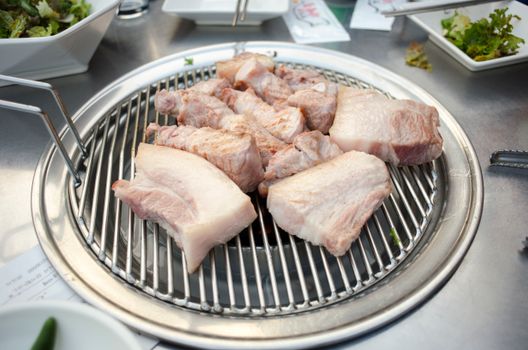
The diets react (see scores below)
Common Ingredients
- pork belly
- lettuce
- ssamjang
- garlic
- scallions
- sesame oil
- kimchi
- gochujang
Specific recipes may vary.
Incompatible with 8 of 11 diets
Diet Ratings
Samgyeopsal is built around pork belly, one of the most keto-friendly proteins due to its high fat content. Lettuce wraps, garlic, scallions, sesame oil, and kimchi are all low-carb or moderate in small amounts. However, two condiments are problematic: ssamjang is a fermented soybean paste with added sugar and gochujang is a fermented chili paste that is notably high in sugar and carbs (roughly 10-15g net carbs per 2 tbsp). In a typical Korean BBQ serving, these condiments are used liberally and can easily push net carbs beyond keto limits. The dish can be made keto-compatible with strict portion control on the condiments or by substituting/eliminating gochujang and ssamjang, but as traditionally consumed, it warrants caution.
Some strict keto practitioners would rate this closer to 'avoid' due to gochujang being a sugar-laden paste that is difficult to portion reliably in a social dining context, arguing that any meaningful amount of these condiments breaks ketosis. Conversely, lazy keto practitioners may approve it, treating the pork belly as the dominant macronutrient and using minimal condiments.
Samgyeopsal is a Korean grilled pork belly dish. Pork belly is the primary ingredient and central component of the dish — it is unambiguously an animal product and therefore incompatible with a vegan diet. No substitution or preparation method changes this fundamental fact. The remaining ingredients (lettuce, ssamjang, garlic, scallions, sesame oil, gochujang) are plant-based, but the dish cannot be considered vegan when its defining ingredient is meat.
Samgyeopsal contains several non-paleo ingredients that disqualify it. Ssamjang is a fermented paste made from doenjang (fermented soybean paste) and gochujang, both of which contain soybeans and/or grains — legumes and grains are explicitly excluded from paleo. Gochujang itself is a fermented chili paste typically made with glutinous rice flour and soybeans, making it grain- and legume-based. Sesame oil is a seed oil, which is excluded under paleo guidelines. Kimchi, while made from vegetables, is traditionally fermented with fish sauce or shrimp paste and often contains added salt and sugar — but more critically, it is typically served alongside or included with the dish as prepared. The pork belly, lettuce, garlic, and scallions are themselves paleo-compliant, but the core condiments (ssamjang, gochujang) and sesame oil make this dish non-paleo as traditionally prepared.
Samgyeopsal is centered on pork belly, one of the fattiest cuts of red meat, which the Mediterranean diet restricts to only a few times per month. Pork belly is high in saturated fat and is the antithesis of the diet's emphasis on lean proteins, fish, and plant-based foods. While the dish does include some favorable components — lettuce wraps, garlic, scallions, and fermented kimchi align well with plant-forward Mediterranean principles, and sesame oil is a plant-based fat — these do not offset the core issue of a large portion of fatty pork belly as the primary protein. The cooking method (grilled at the table) is relatively neutral, but the overall dish composition contradicts Mediterranean dietary guidelines.
While samgyeopsal is centered on pork belly — a fatty, carnivore-approved cut — the dish as traditionally served is overwhelmingly plant-based in its accompaniments. Lettuce wraps, ssamjang (fermented soybean paste), garlic, scallions, sesame oil (plant oil), kimchi (fermented vegetables), and gochujang (chili paste) are all plant-derived and strictly excluded on a carnivore diet. The pork belly itself would score highly in isolation, but the dish as a whole cannot be approved. Even a 'caution' rating would be misleading given the sheer volume and centrality of plant-based components.
Samgyeopsal as listed contains multiple non-compliant ingredients. Ssamjang is a fermented paste made from doenjang (fermented soybean paste) and gochujang, both of which contain soy and often added sugar — soy is a legume and therefore excluded. Gochujang (listed separately) is also a fermented chili paste that nearly universally contains rice, sugar, and soy, all of which are excluded on Whole30. Kimchi, while the base vegetables are fine, commercially prepared kimchi frequently contains sugar, fish sauce with additives, or other non-compliant ingredients. The pork belly, lettuce, garlic, scallions, and sesame oil are all individually Whole30-compliant, but the dish as traditionally constructed cannot be considered compliant due to ssamjang and gochujang being core, non-negotiable components of the dish.
Samgyeopsal as traditionally prepared contains multiple high-FODMAP ingredients that make it unsuitable during the elimination phase. Garlic is one of the highest-FODMAP foods tested by Monash University, containing significant fructans even in small amounts. Ssamjang is a fermented paste made from doenjang (fermented soybean paste) and gochujang, both of which typically contain garlic and onion as core ingredients, adding further fructan load. Kimchi, a staple accompaniment, is traditionally made with garlic, onion, and sometimes scallion bulbs, making it high-FODMAP. Scallions (spring onions) are FODMAP-dependent on which part is used — the green tops are low-FODMAP, but the white bulb portion is high in fructans. Pork belly itself is low-FODMAP (plain protein and fat), lettuce is low-FODMAP, sesame oil is low-FODMAP, and gochujang in small amounts may be tolerated, but the combination of garlic, ssamjang, and kimchi creates an unavoidable high-FODMAP load that cannot be mitigated by portion control in this dish as traditionally served.
Samgyeopsal is centered on pork belly, one of the fattiest cuts of pork, which is high in saturated fat and total fat — both explicitly limited by DASH guidelines. The accompanying condiments compound the problem: ssamjang and gochujang are fermented, high-sodium pastes, and kimchi adds additional sodium. Together these components can easily push a single serving well above the DASH sodium thresholds (both the 2,300mg/day standard and 1,500mg/day low-sodium targets). While some DASH-friendly elements are present — lettuce provides fiber and micronutrients, garlic and scallions offer potassium and antioxidants, and sesame oil is an unsaturated fat — these do not offset the core concerns. Pork belly is not a lean protein as defined by DASH; lean pork options (loin, tenderloin) are acceptable, but belly is explicitly the type of fatty red meat DASH recommends avoiding or strictly limiting. The dish as commonly consumed represents a combination of high saturated fat and high sodium that directly conflicts with DASH's primary cardiovascular goals.
Samgyeopsal is a Korean grilled pork belly dish that presents significant Zone Diet challenges primarily due to pork belly being one of the fattiest cuts of meat available, with a high saturated fat content that disrupts the Zone's 30/30/40 macro ratio. A typical 3-oz serving of pork belly contains roughly 30g fat (much of it saturated) and only 15g protein, making it difficult to hit the Zone's target of ~25g lean protein per meal without dramatically overshooting fat intake. The wrap components — lettuce, garlic, scallions — are excellent low-glycemic Zone-favorable carbohydrates. Kimchi is an anti-inflammatory, polyphenol-rich fermented food that Sears would endorse. Ssamjang and gochujang add some sugar and sodium but in small quantities are manageable. Sesame oil is an omega-6 fat (not the preferred monounsaturated fat), though used in small amounts. The fundamental problem is the pork belly itself: to get a full protein block, you accumulate far more saturated fat than Zone guidelines permit, throwing the 30/30/40 ratio significantly off balance. This dish could be made more Zone-compatible by substituting a leaner protein (chicken, tofu, lean pork loin) while keeping all the favorable vegetable and condiment components.
Some later Zone practitioners and Sears' post-2000 anti-inflammatory writings take a less rigid stance on saturated fat, acknowledging that the inflammatory index of the overall meal matters more than isolated fat type. Under this view, the polyphenol-rich kimchi, garlic, and gochujang, combined with the fermented benefits of kimchi, partially offset concerns about pork belly's fat profile. Portion control — eating smaller amounts of pork belly with larger quantities of lettuce wraps and kimchi — can bring the meal closer to Zone ratios, making it a 'caution' rather than 'avoid' in practice.
Samgyeopsal presents a genuinely mixed anti-inflammatory profile. The primary concern is pork belly itself — it is a high-fat cut with significant saturated fat content, which anti-inflammatory guidelines consistently recommend limiting. However, the dish is surrounded by a constellation of strongly anti-inflammatory accompaniments: garlic is one of the most well-researched anti-inflammatory alliums (organosulfur compounds reduce NF-κB signaling); kimchi provides probiotic fermentation benefits and chili-derived capsaicin, both associated with reduced inflammatory markers; gochujang adds capsaicin and fermented bioactives; sesame oil contains sesamol and sesamin, lignans with antioxidant properties; lettuce wrapping adds fiber and polyphenols; and scallions contribute quercetin. Ssamjang (fermented soybean and chili paste) adds fermented whole soy benefits. The Korean barbecue eating pattern — where protein is wrapped in fresh greens and consumed with fermented sides — meaningfully offsets some of the pork belly's inflammatory burden compared to eating the meat alone. That said, pork belly remains a fatty, saturated-fat-dense cut that sits squarely in the 'limit' category. The dish is acceptable in moderation, particularly when the ratio of vegetables, kimchi, and wraps is generous relative to the meat.
Some anti-inflammatory practitioners (aligned with Dr. Weil's pyramid and Mediterranean-pattern thinking) would be more lenient here, noting that the overall dietary pattern — fermented foods, alliums, capsaicin, fiber-rich wraps — is consistent with anti-inflammatory eating and that occasional high-fat cuts are permissible. Others, particularly those following stricter protocols (e.g., AIP or functional medicine practitioners focused on saturated fat and arachidonic acid from pork), would rate this lower, citing pork belly's fat profile as genuinely problematic for inflammatory load regardless of the accompaniments.
Samgyeopsal is built around pork belly, one of the fattiest cuts of meat available — typically 35-45g of fat per 100g serving, with a high proportion of saturated fat. This directly conflicts with GLP-1 dietary priorities: high-fat foods worsen nausea, bloating, and reflux by interacting poorly with already-slowed gastric emptying. The dish is also typically griddled or pan-fried at the table in its own rendered fat, adding further fat load. While the lettuce wraps (ssam) add some fiber and the accompaniments (garlic, scallions, kimchi) offer micronutrients and probiotic value, these do not offset the core problem. Ssamjang and gochujang add spice and sodium, both of which can worsen GI side effects on GLP-1 medications. Sesame oil, though an unsaturated fat, adds additional fat density to an already very high-fat dish. Protein content is moderate but comes at a prohibitively high fat cost per serving. This is not a small-portion-friendly dish — the social eating format encourages repeated servings. Overall, this dish is a near-textbook example of what GLP-1 patients are advised to avoid.
*See how scores were generated at our methodology page.
Nutritional profile
Six traits that cut across every diet.
Fiber & Plants
How much whole-plant food and fiber it delivers.
Healthy Fats
The quality of its fats (unsaturated, omega-3).
Whole / Unprocessed
How close it is to its natural, unprocessed form.
Gut Gentle
How easy it is on digestion (low FODMAP, few irritants).
Low Glycemic
How little it spikes your blood sugar.
Protein Density
How much protein it packs per calorie.
Controversy Index
Higher controversy = more disagreement between diets.
Diet-Specific Tips
 Keto — 5/10
View tips
- Pork belly is highly keto-friendly — very high fat, zero carbs
- Gochujang is high in sugar and net carbs (~10-15g per 2 tbsp), a significant concern
- Ssamjang contains fermented soybean paste and sugar, adding moderate carbs
- Lettuce wraps, sesame oil, and small amounts of garlic/scallions are low-carb
- Kimchi is generally low-carb in typical serving sizes
- Condiment quantities in traditional dining can be hard to control and may spike carbs
 Zone — 4/10
View tips
- Pork belly is extremely high in saturated fat, making it one of the least Zone-favorable protein sources
- High fat-to-protein ratio in pork belly disrupts the 30% protein / 30% fat caloric targets
- Lettuce wraps, garlic, scallions, and kimchi are all Zone-favorable low-glycemic carbohydrates
- Kimchi provides anti-inflammatory polyphenols and probiotics aligned with Sears' later anti-inflammatory focus
- Sesame oil is omega-6 dominant rather than the preferred monounsaturated fat (olive oil, avocado)
- Ssamjang and gochujang add modest sugar/sodium but are manageable in typical serving quantities
- Portion reduction of pork belly and increasing vegetable wrap volume can partially rescue Zone ratios
- Substituting lean pork loin or chicken would make this meal architecture highly Zone-compatible
 Anti-Inflammatory — 5/10
View tips
- Pork belly is high in saturated fat — a pro-inflammatory fat source to be limited per anti-inflammatory guidelines
- Garlic contains organosulfur compounds (allicin, diallyl disulfide) with well-documented anti-inflammatory properties
- Kimchi provides probiotic fermentation benefits and capsaicin, both linked to reduced CRP and gut inflammation
- Gochujang and chili components contribute capsaicin, associated with reduced inflammatory markers
- Sesame oil contains sesamol and sesamin, antioxidant lignans with modest anti-inflammatory evidence
- Fermented soybean component in ssamjang aligns with whole soy food emphasis in anti-inflammatory diets
- Lettuce wrapping adds fiber, polyphenols, and modulates glycemic impact of the meal
- Scallions contribute quercetin, a flavonoid with anti-inflammatory activity
- Eating pattern (small portions of meat wrapped in greens with fermented sides) partially offsets the pork belly's inflammatory burden