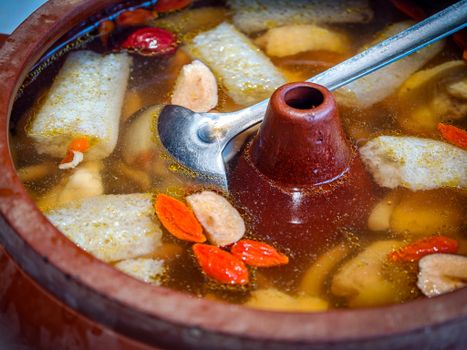
Photo: Teresa Wang / Pexels
Korean
Samgyetang (Ginseng Chicken Soup)
The diets react (see scores below)
Common Ingredients
- whole chicken
- ginseng
- glutinous rice
- jujube
- garlic
- scallions
- salt
- white pepper
Specific recipes may vary.
Incompatible with 6 of 11 diets
Diet Ratings
Samgyetang is fundamentally incompatible with a ketogenic diet due to the glutinous rice stuffed inside the whole chicken, which is the dish's defining ingredient. Glutinous (sticky) rice is a high-glycemic refined starch that can contribute 30-50g or more of net carbs per serving, easily exceeding the entire daily keto carb allowance. Jujube (red dates) also adds simple sugars. While the whole chicken and broth components are keto-friendly, the rice and jujube cannot be separated from the dish as traditionally prepared without fundamentally changing its identity. The remaining ingredients — garlic, scallions, ginseng, salt, pepper — are minor contributors but the core carb load from rice alone disqualifies this dish.
Samgyetang contains whole chicken as its primary ingredient, which is unambiguously an animal product. Poultry is explicitly excluded under all vegan definitions. The remaining ingredients (ginseng, glutinous rice, jujube, garlic, scallions, salt, white pepper) are entirely plant-based, but the dish cannot be considered vegan due to the central and defining inclusion of chicken. There is no meaningful debate within the vegan community on this point.
Samgyetang is disqualified from a paleo perspective primarily due to glutinous rice (sweet rice), which is stuffed inside the chicken cavity before cooking. Rice is a grain and is explicitly excluded from the paleo diet. Additionally, salt is an added ingredient, which is also discouraged under strict paleo rules. The remaining ingredients — whole chicken, ginseng, jujube, garlic, and scallions — are all paleo-compatible and nutritionally excellent. However, the glutinous rice is a core, structural component of this dish, not a trace or optional ingredient, making the dish as traditionally prepared non-paleo. White pepper is acceptable as a spice.
Samgyetang is a nutrient-dense, whole-food soup centered on lean poultry, which aligns reasonably well with Mediterranean principles. Chicken is a permitted protein (moderate consumption), and the supporting ingredients — garlic, scallions, jujube (a fruit), and ginseng — are all whole, plant-based components with no added sugars or unhealthy fats. The main concern is glutinous rice, a refined/starchy grain that lacks the fiber of whole grains preferred in the Mediterranean diet. The dish contains no olive oil (a Mediterranean staple) and is not part of any Mediterranean culinary tradition, but its clean, whole-food preparation and lean protein base make it broadly compatible. It fits best as an occasional meal rather than a dietary staple.
Some Mediterranean diet interpreters, particularly those applying broader 'anti-inflammatory' or 'whole food' frameworks, might rate this more favorably — noting that the dish is minimally processed, low in saturated fat, and rich in vegetables and legume-adjacent ingredients. Others following stricter traditional Mediterranean guidelines would note the absence of olive oil, legumes, and whole grains as meaningful gaps.
Samgyetang is fundamentally incompatible with the carnivore diet. While the whole chicken is an acceptable animal protein, the dish is defined by multiple plant-based ingredients that are all excluded on carnivore: ginseng (root/herb), glutinous rice (grain), jujube (fruit), garlic (allium vegetable), and scallions (vegetable). White pepper is also a plant-derived spice. The dish is essentially a plant-stuffed chicken soup where the non-animal components are central to the recipe's identity, not incidental additives. Only the chicken and salt would pass carnivore scrutiny. This is not a borderline case — the majority of the ingredient list is explicitly prohibited.
Samgyetang contains glutinous rice (also known as sweet rice or sticky rice), which is a grain and explicitly excluded on the Whole30 program. All grains are eliminated during the 30 days, and rice in any form — including glutinous/sticky rice — falls squarely in this category. The remaining ingredients (whole chicken, ginseng, jujube, garlic, scallions, salt, white pepper) are all Whole30-compliant on their own, but the glutinous rice stuffed inside the chicken is a defining, structural component of this dish and cannot simply be omitted while still calling it Samgyetang. The dish as traditionally prepared cannot be made Whole30-compliant without fundamentally altering its character.
Samgyetang contains multiple high-FODMAP ingredients that make it unsuitable during the elimination phase. Garlic is one of the highest-FODMAP foods tested by Monash University, rich in fructans, and is stuffed inside the whole chicken in significant quantities — even small amounts of garlic render a dish high-FODMAP. Scallions (green onions) are high-FODMAP in their white bulb portions due to fructans, and traditional preparation uses the whole scallion. Jujube (Chinese dates) is high-FODMAP due to excess fructose and polyols (sorbitol). Glutinous rice itself is low-FODMAP, as are whole chicken, ginseng, salt, and white pepper. However, the garlic alone is disqualifying — it is a core structural ingredient in Samgyetang, not a garnish, and cannot be removed without fundamentally altering the dish. The combination of garlic, whole scallions, and jujube makes this dish clearly avoid-rated for the elimination phase.
Samgyetang is a nutrient-rich Korean soup featuring whole chicken, ginseng, glutinous rice, jujubes, and garlic — a largely wholesome profile that aligns reasonably well with DASH principles. The lean protein from chicken, potassium and antioxidants from ginseng and jujube, and anti-inflammatory properties of garlic are all DASH-friendly. However, several factors introduce caution: (1) The whole chicken includes skin, which adds saturated fat and cholesterol — DASH recommends skinless poultry. (2) Glutinous rice (sticky rice) is a refined starch rather than a whole grain, contributing refined carbohydrates without much fiber. (3) Salt is added during preparation, and restaurant or traditional versions can be moderately high in sodium — estimates range from 600–1,200mg per serving depending on preparation, which requires monitoring within DASH's daily sodium budget. If prepared at home with the skin removed, low-sodium broth approach, minimal added salt, and brown rice substituted for glutinous rice, this dish could approach 'approve' territory. As commonly served in restaurants or traditional preparation, it warrants moderation.
NIH DASH guidelines specify skinless poultry and whole grains, which would flag the skin-on chicken and glutinous rice in this dish. However, updated clinical interpretations note that the overall dietary pattern — lean protein, vegetables, minimal processed ingredients, no added sugars — is consistent with DASH goals, and moderate sodium in the context of an otherwise clean dish may be acceptable for non-severely hypertensive individuals.
Samgyetang is a nutritious, whole-food Korean dish that aligns well with Zone principles in several respects but contains a few elements requiring attention. The primary protein — whole chicken — is lean and Zone-favorable, though the skin (typically left on in traditional preparation) adds saturated fat that needs to be managed. Ginseng, garlic, and scallions are excellent low-glycemic, anti-inflammatory, polyphenol-rich ingredients that Sears would strongly endorse. The problematic element is glutinous (sticky) rice stuffed inside the chicken cavity, which is a high-glycemic carbohydrate — Zone's 'unfavorable' carb category. Glutinous rice has a high glycemic index and provides dense starch that can disrupt the insulin balance the Zone aims to control. Jujubes add a modest sugar load as well. The overall dish is protein-forward with a good broth base, but the glutinous rice throws off the 40/30/30 macro ratio significantly. A Zone practitioner could adapt this dish by removing or drastically reducing the rice stuffing, discarding the chicken skin, and relying primarily on the lean chicken meat, ginseng, garlic, and scallion broth — which would then approach a Zone-favorable profile. As traditionally prepared, however, the glutinous rice component prevents a straightforward approval.
Some Zone practitioners and later Sears anti-inflammatory writings emphasize the overall food quality and polyphenol content of a dish over strict glycemic indexing. Ginseng is a notable polyphenol source, and the broth-based, whole-food nature of samgyetang — with minimal processed ingredients — is far preferable to many Western alternatives. A small serving where the rice portion is modest could arguably be managed within Zone blocks, especially in the context of an otherwise low-carb day. The dish's anti-inflammatory ingredient profile (ginseng, garlic, scallions) is strongly aligned with Sears' later Zone emphasis on polyphenols and omega-3 balance.
Samgyetang is a nutrient-dense, whole-food Korean medicinal soup with a strong anti-inflammatory profile. The whole chicken (lean protein, collagen-rich bone broth) provides a moderate base — it falls into the 'lean poultry' category that anti-inflammatory frameworks endorse. The standout anti-inflammatory contributors are ginseng (ginsenosides are well-documented modulators of NF-κB and inflammatory cytokines like TNF-α and IL-6), garlic (allicin and organosulfur compounds with robust anti-inflammatory evidence, explicitly recommended by Dr. Weil), and scallions (quercetin, antioxidant flavonoids). Jujube (red dates) contribute polyphenols, flavonoids, and vitamin C — consistent with the 'colorful fruits' emphasis of anti-inflammatory guidelines. The broth-based cooking method avoids frying or seed oils entirely. Minor concerns: glutinous rice is a refined, high-glycemic carbohydrate that lacks the fiber of whole grains, which the anti-inflammatory framework de-emphasizes compared to brown rice or whole grains; and the whole chicken includes skin and some saturated fat, though the quantity per serving is modest. Salt and white pepper are neutral to mildly beneficial. Overall, the dish is built around whole, minimally processed ingredients with multiple clinically recognized anti-inflammatory compounds, making it a strong approve with a slight score deduction for the glutinous rice and the moderate saturated fat content.
Most anti-inflammatory protocols and Dr. Weil's framework would approve this dish given its herb-rich, broth-based, whole-food composition. However, strict glycemic-focused anti-inflammatory practitioners (e.g., those aligned with Perricone or Zone Diet principles) might caution against the glutinous rice due to its high glycemic index, which can transiently raise blood glucose and insulin — both linked to inflammatory signaling. Additionally, AIP (Autoimmune Protocol) adherents would note that ginseng, while generally anti-inflammatory, is an adaptogenic herb with immunomodulatory effects that could theoretically stimulate immune activity in autoimmune conditions, though this is a fringe concern not reflected in mainstream anti-inflammatory nutrition guidance.
Samgyetang is a nutrient-dense Korean chicken soup that aligns well with GLP-1 dietary priorities. The whole chicken provides substantial protein, and the broth-based format supports hydration — a key concern given reduced thirst sensation on GLP-1 medications. The soup is easy to digest, warm, and gentle on the GI tract, making it well-suited for patients experiencing nausea or slowed gastric emptying. Glutinous rice adds some starchy carbohydrates and modest fiber, contributing to satiety without being a heavy glycemic load in a typical serving. Ginseng, jujube, and garlic are functional ingredients with anti-inflammatory properties and no meaningful drawbacks for GLP-1 patients. The main caution is fat content: a whole chicken includes skin and dark meat, which carry saturated fat that can worsen nausea or reflux. If consumed with skin removed and portioned to a modest bowl, the fat concern is substantially reduced. White pepper is a mild spice unlikely to trigger reflux in most patients. Overall, a small-to-moderate portion of skinless samgyetang is a strong GLP-1-compatible meal.
Some GLP-1 nutrition practitioners express caution with whole-chicken preparations because patients may not reliably remove the skin, and the rendered fat in the broth can concentrate during cooking — potentially worsening nausea or reflux in sensitive individuals. Others note that glutinous rice has a higher glycemic index than whole grains, which may be a consideration for patients managing blood sugar alongside weight.
*See how scores were generated at our methodology page.
Nutritional profile
Six traits that cut across every diet.
Fiber & Plants
How much whole-plant food and fiber it delivers.
Healthy Fats
The quality of its fats (unsaturated, omega-3).
Whole / Unprocessed
How close it is to its natural, unprocessed form.
Gut Gentle
How easy it is on digestion (low FODMAP, few irritants).
Low Glycemic
How little it spikes your blood sugar.
Protein Density
How much protein it packs per calorie.
Controversy Index
Higher controversy = more disagreement between diets.
Diet-Specific Tips
 Mediterranean — 5/10
View tips
- Lean poultry as primary protein — acceptable in moderation per Mediterranean guidelines
- Glutinous rice is a refined starch, not a preferred whole grain
- Whole-food, minimally processed preparation with no added sugars
- Garlic, scallions, and jujube are plant-forward supporting ingredients
- No olive oil — the canonical Mediterranean fat source is absent
- Not part of Mediterranean culinary tradition, but structurally compatible
 DASH — 6/10
View tips
- Chicken skin adds saturated fat — DASH recommends removing skin from poultry
- Glutinous rice is a refined grain; whole grain substitution (brown rice) would improve DASH alignment
- Sodium from added salt can reach moderate-to-high levels depending on preparation
- Jujube, ginseng, and garlic provide potassium, antioxidants, and micronutrients consistent with DASH
- No processed ingredients, added sugars, or tropical oils — clean ingredient profile
- Home preparation with skin removed and salt minimized significantly improves DASH compatibility
 Zone — 5/10
View tips
- Lean chicken protein is Zone-favorable but skin adds saturated fat
- Glutinous rice stuffing is high-glycemic — an 'unfavorable' Zone carbohydrate
- Jujubes contribute additional sugar load
- Ginseng, garlic, and scallions are excellent polyphenol-rich, low-glycemic Zone ingredients
- Broth-based preparation with no seed oils or processed ingredients is anti-inflammatory
- Dish can be adapted for Zone by removing skin and minimizing rice portion
- Traditional preparation significantly skews the macro ratio away from 40/30/30
 Anti-Inflammatory — 8/10
View tips
- Ginseng (ginsenosides) — potent NF-κB inhibitor and cytokine modulator with strong research support
- Garlic — allicin and organosulfur compounds are explicitly emphasized in anti-inflammatory guidelines
- Jujube — polyphenols, flavonoids, and vitamin C contribute antioxidant load
- Scallions — quercetin and flavonoids with anti-inflammatory activity
- Whole chicken in broth — lean poultry endorsed; collagen-rich bone broth supports gut lining
- Glutinous rice — refined, high-GI carbohydrate; deviates from whole grain recommendation
- No seed oils, no refined sugar, no processed ingredients — clean preparation method
- Moderate saturated fat from chicken skin — acceptable in context of lean poultry category
 GLP-1 Friendly — 8/10
View tips
- High protein from chicken — supports muscle preservation during weight loss
- Broth-based format aids hydration, which is critical on GLP-1 medications
- Soft texture and warm broth are easy to digest and GI-friendly
- Glutinous rice adds carbohydrates with modest fiber; higher glycemic index than whole grains
- Whole chicken preparation includes skin and dark meat — saturated fat risk if not trimmed
- Broth may concentrate cooking fat — skimming fat from broth is advisable
- Mild seasoning (salt, white pepper, garlic, scallions) unlikely to worsen reflux or nausea
- Small-portion friendly as a soup — satisfying in modest servings
- Ginseng and jujube are functional ingredients