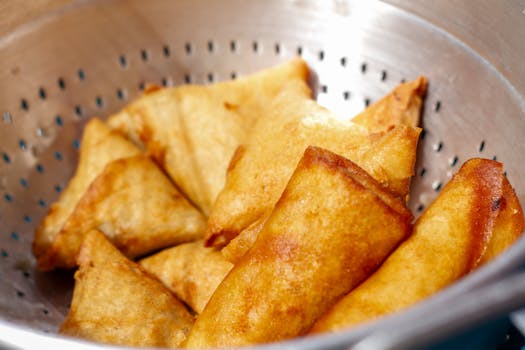
Photo: Hashtag Melvin / Pexels
The diets react (see scores below)
Common Ingredients
- all-purpose flour
- ground lamb
- peas
- onion
- cumin
- ginger
- garam masala
- cilantro
Specific recipes may vary.
Incompatible with 9 of 11 diets
Diet Ratings
Meat samosas are fundamentally incompatible with ketogenic eating. The primary issue is the pastry shell made from all-purpose flour (refined wheat), which is a high-carb grain-based ingredient that delivers a significant carbohydrate load per serving. A standard samosa contains roughly 20-30g of net carbs from the dough alone, which could consume or exceed an entire day's keto carb budget in a single snack. Additionally, peas are a starchy legume adding further net carbs. While the ground lamb filling and spices (cumin, ginger, garam masala, cilantro) are keto-friendly, the overall dish structure is built around high-carb components that cannot be portioned around — you cannot eat a samosa without consuming the flour-based shell.
Meat Samosa contains ground lamb as its primary protein, which is unambiguously an animal product (red meat). Lamb is slaughtered livestock, making this dish entirely incompatible with a vegan diet. All other ingredients (flour, peas, onion, cumin, ginger, garam masala, cilantro) are plant-based, but the presence of lamb renders the dish non-vegan regardless. A vegan version of samosa could be made by substituting lamb with spiced potatoes, lentils, or chickpeas.
Meat samosas are firmly non-paleo. The pastry shell is made from all-purpose flour, a refined wheat grain product — one of the clearest exclusions in the paleo diet. Peas are legumes, also explicitly excluded. These two ingredients alone are sufficient to disqualify the dish regardless of the otherwise paleo-friendly components (ground lamb, onion, cumin, ginger, garam masala, cilantro). There is no version of a traditional samosa that avoids these core non-paleo ingredients without fundamentally reconstructing the dish.
Meat samosas conflict with Mediterranean diet principles on multiple fronts. The wrapper is made from refined all-purpose flour (a refined grain the diet discourages), the dish is deep-fried (contradicting the olive oil-as-primary-fat principle), and the primary protein is ground lamb, a red meat that should be consumed only a few times per month. The combination of refined carbohydrates, deep-frying in unspecified oils, and frequent red meat use places this firmly in the 'avoid' category. While peas, onion, and spices are positive elements, they are insufficient to offset the core incompatibilities.
Meat Samosa is fundamentally incompatible with the carnivore diet. While ground lamb is an approved animal protein, it is vastly outnumbered by prohibited plant-based ingredients. The pastry shell is made from all-purpose flour (a grain product), and the filling contains peas (legume), onion (vegetable), cumin (seed spice), ginger (root spice), garam masala (spice blend), and cilantro (herb). Every ingredient except the lamb violates carnivore principles. This is a plant-heavy processed snack food wrapped in grain-based dough — the antithesis of a carnivore meal.
Meat samosas are excluded from Whole30 on two distinct grounds. First, all-purpose flour (wheat) is a grain and explicitly excluded from the program. Second, even if a grain-free flour substitute were used, samosas are a fried pastry/dough shell — a form of bread/wrap — which falls squarely under the 'no recreating baked goods or junk food' rule that prohibits tortillas, wraps, crackers, and similar dough-based items. The filling ingredients (ground lamb, peas, onion, cumin, ginger, garam masala, cilantro) are themselves Whole30-compliant, but the dish as a whole cannot be made compliant.
Meat samosas contain multiple high-FODMAP ingredients that make them unsuitable during the elimination phase. All-purpose flour (wheat) is high in fructans — one of the most significant FODMAP sources — and forms the pastry shell. Onion is among the highest-FODMAP foods known, rich in fructans at any serving size. Peas (green peas) become high-FODMAP above about 1/4 cup (Monash rates them as high-FODMAP at standard serving sizes due to GOS and fructans). Garlic is not listed but garam masala blends frequently contain it. Even without garlic, the combination of wheat pastry, onion, and peas makes this dish clearly high-FODMAP. Ground lamb itself is low-FODMAP, and spices like cumin, ginger, and cilantro are low-FODMAP in typical culinary quantities. However, the problematic ingredients are structural and central to the dish — not incidental — and cannot be reduced to safe portions without fundamentally changing the recipe.
Meat samosas are problematic for the DASH diet on multiple fronts. The pastry shell is made with all-purpose flour (refined, not whole grain) and is deep-fried, introducing substantial saturated fat and trans fat from frying oil — both explicitly limited by DASH guidelines. Ground lamb is a red meat with relatively high saturated fat content (DASH limits red meat and emphasizes lean poultry and fish instead). The combination of deep-frying, refined flour, and fatty red meat makes this a food the DASH diet clearly discourages. While the peas, onions, and spices are DASH-friendly components, they are minor contributors relative to the overall nutritional profile. Samosas are also typically high in sodium depending on seasoning and any accompanying chutneys. This dish conflicts with DASH principles around saturated fat, refined carbohydrates, frying methods, and red meat consumption.
Meat samosas present several Zone Diet challenges. The primary wrapper is all-purpose flour (white refined flour), which is a high-glycemic carbohydrate that Sears classifies as 'unfavorable' — it spikes insulin and contributes little nutritional value. The fat profile is also problematic: samosas are deep-fried, adding significant saturated and potentially omega-6-heavy fats depending on frying oil, and ground lamb itself carries higher saturated fat than lean Zone-approved proteins like skinless chicken or fish. On the positive side, the filling contains favorable Zone-compatible ingredients: peas provide low-glycemic carbs with fiber, onion is a favorable vegetable, and the spices (cumin, ginger, garam masala, cilantro) are anti-inflammatory and polyphenol-rich — highly consistent with Zone's anti-inflammatory focus. However, the macronutrient ratio is badly skewed: high in refined carbs and saturated fat, with moderate protein. Portioning a single small samosa into a Zone block structure is theoretically possible but impractical — the refined flour crust and frying method make it very difficult to achieve the 40/30/30 target without significant dietary offsetting. This food falls into the 'unfavorable' Zone category, usable only with careful and limited portioning.
Meat samosas present a mixed anti-inflammatory profile. On the positive side, the spice blend is genuinely beneficial: cumin, ginger, garam masala (typically containing turmeric, coriander, cardamom, cinnamon, cloves, and black pepper), and cilantro all carry meaningful anti-inflammatory compounds including gingerols, curcuminoids, and various polyphenols. Peas and onion add fiber, quercetin, and plant-based nutrients. However, several elements pull in the other direction. Ground lamb is red meat with a relatively high saturated fat content, which anti-inflammatory frameworks consistently flag as pro-inflammatory when consumed regularly. All-purpose flour is a refined carbohydrate with a high glycemic index, contributing to inflammatory signaling. The traditional deep-frying method (almost universal for samosas) adds a significant concern: frying at high temperatures introduces oxidized fats and often uses high-omega-6 seed oils (sunflower, vegetable oil), which anti-inflammatory guidelines advise limiting. If baked, the oil concern is reduced but not eliminated. The dish is not inherently disqualifying — the spice profile is genuinely valuable and occasional consumption is not alarming — but as a regularly consumed snack it leans pro-inflammatory due to the combination of refined flour, red meat, and frying.
Some anti-inflammatory practitioners would rate this more harshly, emphasizing that red meat plus refined flour plus deep-frying creates a triple inflammatory burden that outweighs the spice benefits. Conversely, those who follow a more whole-foods-permissive approach might note that lamb in modest quantities provides zinc and B12, and that the richness of anti-inflammatory spices offers meaningful offset — particularly if baked rather than fried.
Meat samosas are deep-fried pastries made with all-purpose flour (refined, low-fiber) and ground lamb (high saturated fat), making them a poor fit for GLP-1 patients on multiple fronts. The frying method dramatically increases fat content and caloric density, while the refined flour shell offers negligible fiber and minimal nutritional value per calorie. Ground lamb is one of the higher-fat red meats, and the combined fat load from both the filling and the fried shell is likely to worsen GLP-1 side effects including nausea, bloating, reflux, and prolonged gastric discomfort given the medication's already-slowed gastric emptying. Protein content is moderate but not sufficient to offset the drawbacks. The spice blend (garam masala, cumin, ginger) is generally well-tolerated in moderate amounts, but the overall dish profile — fried, high-fat, refined carbohydrate shell, low fiber — places it firmly in the avoid category.
*See how scores were generated at our methodology page.
Nutritional profile
Six traits that cut across every diet.
Fiber & Plants
How much whole-plant food and fiber it delivers.
Healthy Fats
The quality of its fats (unsaturated, omega-3).
Whole / Unprocessed
How close it is to its natural, unprocessed form.
Gut Gentle
How easy it is on digestion (low FODMAP, few irritants).
Low Glycemic
How little it spikes your blood sugar.
Protein Density
How much protein it packs per calorie.
Controversy Index
Higher controversy = more disagreement between diets.
Diet-Specific Tips
 Zone — 4/10
View tips
- All-purpose flour wrapper is a high-glycemic, refined carbohydrate — classified as 'unfavorable' in Zone methodology
- Deep-frying adds significant saturated and potentially omega-6-heavy fat, disrupting the Zone's preferred monounsaturated fat profile
- Ground lamb is higher in saturated fat than Zone-preferred lean proteins (chicken breast, fish, egg whites)
- Peas and onion are favorable low-glycemic Zone carbohydrates with fiber value
- Spices (ginger, cumin, garam masala, cilantro) are anti-inflammatory and polyphenol-rich, aligning well with Zone's anti-inflammatory emphasis
- Overall macronutrient ratio skews toward high carb/high fat with insufficient lean protein relative to Zone's 40/30/30 target
 Anti-Inflammatory — 4/10
View tips
- Ground lamb is red meat with higher saturated fat content — flagged as pro-inflammatory by anti-inflammatory diet guidelines
- All-purpose flour is a refined carbohydrate with high glycemic load, promoting inflammatory signaling
- Traditional deep-frying likely introduces oxidized fats and high-omega-6 seed oils
- Ginger, cumin, garam masala, and cilantro provide notable anti-inflammatory phytochemicals (gingerols, curcuminoids, polyphenols)
- Peas and onion contribute fiber, quercetin, and plant-based nutrients
- Baked preparation would meaningfully improve the inflammatory profile versus deep-fried