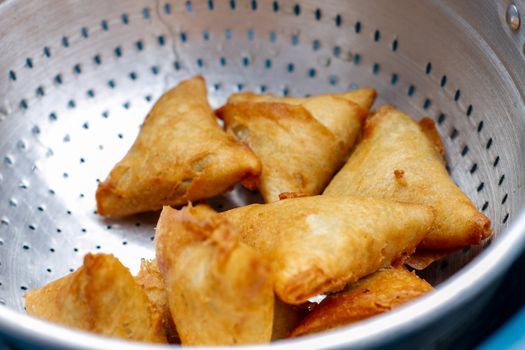
Photo: Hashtag Melvin / Pexels
Indian
Vegetable Samosa
The diets react (see scores below)
Common Ingredients
- all-purpose flour
- potatoes
- peas
- cumin seeds
- coriander
- garam masala
- ginger
- cilantro
Specific recipes may vary.
Incompatible with 8 of 11 diets
Diet Ratings
Vegetable samosas are fundamentally incompatible with a ketogenic diet on multiple levels. The pastry shell is made from all-purpose flour (refined wheat), a high-glycemic grain that alone disqualifies the dish. The filling is dominated by potatoes and peas, both starchy, high-net-carb vegetables. A single samosa can contain 20-30g of net carbs, potentially consuming or exceeding an entire day's keto carb allowance in one snack. There is no meaningful fat content, no significant protein, and every primary ingredient works against ketosis.
All listed ingredients are fully plant-based. The dough is made from all-purpose flour (no eggs or dairy in this formulation), and the filling consists of potatoes, peas, and a classic Indian spice blend — all whole plant foods. Traditional vegetable samosas are commonly made without any animal products, and this ingredient list confirms that. The dish scores well as it incorporates whole vegetables and legumes alongside spices, though the deep-frying typically used in preparation (not listed but standard) slightly limits the whole-food score.
Vegetable Samosa contains multiple non-paleo ingredients that place it firmly in the 'avoid' category. All-purpose flour (wheat) is a grain and one of the most clearly excluded foods in the paleo diet. Peas are legumes, also excluded by all mainstream paleo frameworks. The pastry shell — the defining element of a samosa — is entirely grain-based and typically deep-fried in seed oils. While potatoes, cumin, coriander, garam masala, ginger, and cilantro are individually paleo-compatible or debated, the foundational ingredients (wheat flour and peas) make this dish incompatible with paleo principles. There is no paleo-friendly version of a traditional samosa without fundamentally reconstructing the dish.
Vegetable samosas present a mixed picture. The filling of potatoes, peas, and spices is largely compatible with Mediterranean principles — vegetables and legumes are staples. However, the wrapper is made from all-purpose flour (refined white flour), which contradicts Mediterranean guidelines that emphasize whole grains over refined grains. Critically, samosas are traditionally deep-fried, adding significant amounts of oil (typically not olive oil) and creating a highly processed snack format that Mediterranean dietary patterns discourage. The combination of refined flour pastry and deep frying pushes this dish into 'avoid' territory despite the wholesome filling ingredients.
Some Mediterranean diet interpreters might rate this as 'caution' rather than 'avoid,' arguing that the vegetable-forward filling aligns with plant-based principles, and that if baked instead of fried using olive oil, the dish could be adapted into a moderate-consumption snack. Traditional Mediterranean cuisines do include stuffed pastries (e.g., Greek spanakopita uses phyllo dough), suggesting the format is not entirely foreign to the pattern.
Vegetable Samosa is entirely plant-based and contains zero animal products. Every single ingredient — all-purpose flour (grain), potatoes (starchy vegetable), peas (legume), cumin seeds, coriander, garam masala, ginger, and cilantro (all plant-derived spices and herbs) — is explicitly excluded on the carnivore diet. The pastry shell is made from refined grain flour, and the filling is a combination of vegetables and legumes, all of which are categorically off-limits. There is no ambiguity here: this dish represents the antithesis of carnivore eating with no animal-derived components whatsoever.
Vegetable samosas are fundamentally incompatible with Whole30 for two distinct reasons. First, the wrapper/shell is made from all-purpose flour, which is a wheat-based grain product — grains are explicitly excluded from Whole30. Second, even setting aside the filling ingredients, a samosa is a fried pastry/dough shell that falls squarely into the 'no recreating baked goods or junk food' rule — it is essentially a fried dough snack analogous to crackers, chips, or wraps, all of which are explicitly prohibited. The filling ingredients (potatoes, peas, cumin, coriander, garam masala, ginger, cilantro) are individually compliant, but the dish as a whole cannot be made Whole30-compatible without fundamentally changing what it is.
Vegetable samosas contain two major high-FODMAP ingredients that make them unsuitable during the elimination phase. First, all-purpose flour (wheat) is high in fructans — a primary FODMAP concern — and forms the entire pastry shell. Second, green peas are high in GOS (galacto-oligosaccharides) and fructans, and are typically used in significant quantities as a core filling ingredient. Potatoes themselves are low-FODMAP, and spices like cumin, coriander, garam masala, ginger, and cilantro are generally safe at culinary amounts. However, the combination of a wheat-based shell and pea-heavy filling makes this dish high-FODMAP at any standard serving size. There is no realistic way to consume a samosa at a portion that avoids both the wheat pastry and the peas simultaneously.
Vegetable samosas present a mixed DASH diet profile. The filling contains DASH-friendly ingredients — potatoes provide potassium, peas offer fiber and plant protein, and the spices (cumin, coriander, garam masala, ginger, cilantro) are sodium-free flavor enhancers consistent with DASH's emphasis on herbs and spices over salt. However, the shell is made from refined all-purpose flour (not a whole grain), and samosas are traditionally deep-fried, adding substantial fat — though not necessarily saturated fat if fried in vegetable oil. The overall dish is calorie-dense and low in DASH-priority nutrients per calorie. Sodium content depends heavily on preparation; home-made versions with no added salt can be moderate, but restaurant or packaged versions may carry significant sodium. The refined flour and frying method are the primary concerns, not the ingredients categorically. Occasional consumption as part of an otherwise DASH-compliant diet is acceptable, but samosas should not be a staple snack.
NIH DASH guidelines emphasize whole grains and limit refined grains and added fats, which would place deep-fried white-flour pastries in the 'limit' category. However, some DASH-oriented dietitians note that if samosas are baked rather than fried and made with whole wheat flour, they can more comfortably fit DASH principles — the filling itself is largely vegetable-based and spice-forward, which aligns well with DASH's sodium-reduction strategy.
Vegetable samosas are highly problematic for the Zone Diet on multiple fronts. The two primary carbohydrate ingredients — all-purpose flour (refined, high-GI) and potatoes (explicitly listed by Sears as an unfavorable, high-glycemic carbohydrate to avoid) — are both among the worst choices in Zone methodology. The pastry shell is made from refined white flour, which causes rapid blood sugar spikes and is nutritionally empty from a Zone perspective. Potatoes are specifically called out by Dr. Sears as a food to eliminate, not just limit. The dish is also deep-fried, introducing a significant amount of omega-6-heavy seed oils (typically vegetable or canola oil), which directly conflicts with the Zone's anti-inflammatory, omega-3-focused fat protocol. There is no meaningful lean protein component, meaning the macronutrient ratio is wildly off — heavily carbohydrate-dominant with poor-quality fats and virtually no protein. While peas provide a small amount of protein and the spices (cumin, coriander, ginger, cilantro) are Zone-neutral or mildly beneficial as polyphenols, these minor positives cannot offset the structural problems. This dish cannot be portioned into a Zone-compatible snack without fundamentally changing what it is.
The vegetable samosa presents a mixed anti-inflammatory profile. On the positive side, the spice blend is genuinely impressive: cumin, coriander, garam masala, and ginger all carry meaningful anti-inflammatory compounds (gingerols, cuminaldehyde, polyphenols), and peas contribute plant-based fiber, vitamins, and modest anti-inflammatory phytonutrients. Potatoes, while a starchy vegetable, are a whole food with some antioxidant content (vitamin C, resistant starch when cooled). However, the all-purpose flour (refined white flour) is the primary drag — it's a refined carbohydrate with negligible fiber or nutritional value, and it drives a moderate glycemic response that can contribute to low-grade inflammation over time. Traditional samosas are also deep-fried, and while the oil type matters enormously (frying in seed oils like sunflower or cottonseed would worsen the profile considerably), even frying in more neutral oils increases overall caloric density and oxidized fat intake. The dish is not inherently pro-inflammatory — its spice base is genuinely protective — but the refined flour pastry shell and typical frying method prevent it from earning an 'approve' rating. As an occasional snack, it is acceptable, especially when the spice content is generous.
Some anti-inflammatory practitioners (e.g., those following Dr. Weil's less restrictive pyramid) might view this more favorably given the strong spice profile and whole-food vegetable filling, rating it closer to the lower end of 'approve' — particularly for a baked or air-fried version. Conversely, stricter anti-inflammatory and AIP-adjacent protocols would flag the refined flour more severely, and nightshade advocates might also flag the potato and certain garam masala spices.
Vegetable samosas are a poor fit for GLP-1 patients on nearly every key criterion. The pastry shell is made from all-purpose flour (refined grain, low fiber, low protein) and is deep-fried, which is one of the clearest avoid categories in GLP-1 dietary guidance. The filling — potatoes, peas, and spices — offers minimal protein and modest fiber, but these benefits are overwhelmed by the high fat content from frying and the refined carbohydrate-heavy shell. Deep-fried foods are well-established triggers for nausea, bloating, reflux, and prolonged gastric discomfort in GLP-1 patients due to slowed gastric emptying. Garam masala and other spices in typical samosa seasoning can further irritate the GI tract. The dish provides essentially empty calories relative to its fat load, with no meaningful protein contribution — the opposite of what GLP-1 patients need when appetite is suppressed and every calorie must work hard nutritionally.
*See how scores were generated at our methodology page.
Nutritional profile
Six traits that cut across every diet.
Fiber & Plants
How much whole-plant food and fiber it delivers.
Healthy Fats
The quality of its fats (unsaturated, omega-3).
Whole / Unprocessed
How close it is to its natural, unprocessed form.
Gut Gentle
How easy it is on digestion (low FODMAP, few irritants).
Low Glycemic
How little it spikes your blood sugar.
Protein Density
How much protein it packs per calorie.
Controversy Index
Higher controversy = more disagreement between diets.
Diet-Specific Tips
 Vegan — 8/10
View tips
- All-purpose flour dough contains no eggs or dairy as listed
- Potato and pea filling is entirely plant-based
- Cumin, coriander, garam masala, ginger, and cilantro are all vegan spices and herbs
- No animal-derived ingredients present in any component
- Traditional preparation may involve deep-frying in oil, which is vegan but reduces whole-food quality slightly
 DASH — 4/10
View tips
- Refined all-purpose flour shell — not a whole grain, conflicts with DASH grain recommendations
- Traditionally deep-fried — adds significant fat calories, though vegetable oil avoids saturated fat if used
- Filling ingredients (potatoes, peas, spices) are DASH-compatible and provide potassium and fiber
- No inherent high-sodium ingredients listed, but added salt during cooking could raise sodium
- Baked version with whole wheat flour would score considerably higher (6-7)
- Calorie density is high relative to nutrient contribution per DASH serving guidelines
 Anti-Inflammatory — 5/10
View tips
- All-purpose flour (refined carbohydrate) — pro-inflammatory; raises glycemic index and contributes to insulin-driven inflammation
- Ginger — strongly anti-inflammatory via gingerols and shogaols
- Cumin, coriander, garam masala — rich in polyphenols and anti-inflammatory volatile compounds
- Peas — beneficial fiber, plant protein, vitamins
- Potatoes — starchy but whole food; neutral to mildly positive
- Deep-frying method — increases oxidized fat intake; oil choice is critical (sunflower/cottonseed = worse; avocado/olive = better)
- No omega-3 sources present
- No added sugar or artificial additives — a positive distinction from many processed snacks