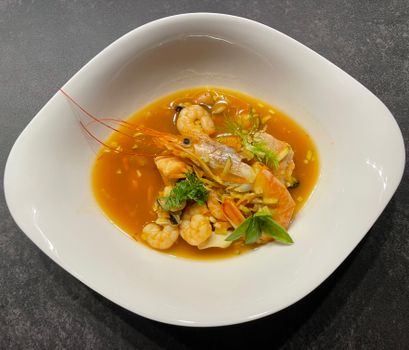
Photo: Rudi Kessler / Pexels
Mediterranean
Sardinian Fish Stew
The diets react (see scores below)
Common Ingredients
- mixed fish
- tomatoes
- white wine
- garlic
- onion
- saffron
- olive oil
- parsley
Specific recipes may vary.
Incompatible with 3 of 11 diets
Diet Ratings
Sardinian Fish Stew is built on a keto-friendly foundation of mixed fish and olive oil, but contains several moderate-carb ingredients that require attention. Mixed fish provides excellent high-quality protein and omega-3 fats. However, tomatoes contribute ~3-4g net carbs per 100g, onions add ~7g net carbs per 100g, and white wine introduces residual sugars (~1-2g per 100g). Garlic in small amounts is fine. Saffron and parsley are negligible. In a typical serving, the cumulative carbs from tomatoes, onion, and wine could reach 8-15g net carbs, which is workable within a daily keto budget but demands portion control and awareness. The dish lacks significant fat content beyond the olive oil, making the macronutrient ratio less ideal for strict keto. For those tracking carefully, a moderate portion fits; for strict or therapeutic keto practitioners, the tomato and wine base warrants caution.
Strict keto practitioners argue that tomatoes and white wine should be avoided entirely due to their sugar content and the risk of cumulative carb creep when combined with other daily meals. Some clinical keto protocols would flag this dish as incompatible due to the inability to precisely control carb content in the tomato-wine broth.
Sardinian Fish Stew contains mixed fish as its primary protein, which is unambiguously an animal product. Fish are excluded from a vegan diet under all recognized vegan standards. The remaining ingredients (tomatoes, white wine, garlic, onion, saffron, olive oil, parsley) are plant-based, but the presence of fish makes this dish entirely incompatible with veganism.
This Sardinian fish stew is largely paleo-friendly, with mixed fish, tomatoes, garlic, onion, saffron, olive oil, and parsley all being well-approved paleo ingredients. The main point of debate is the white wine. Alcohol is generally considered a gray area in the paleo community — it is a processed, fermented product not available to Paleolithic humans in its modern form, though fermentation itself is ancient. Dry wine in small culinary amounts (where much alcohol cooks off) is tolerated by many practical paleo practitioners but rejected by strict interpretations. Without the wine, this dish would score an 8-9 and earn a clear approve verdict.
Strict paleo authorities, including Loren Cordain's original framework, would exclude alcohol entirely as a non-Paleolithic processed product. However, many modern paleo practitioners (Mark Sisson, Robb Wolf) accept occasional dry wine as a realistic concession, and in cooking contexts where alcohol largely evaporates, the objection is further diminished.
Sardinian fish stew is a quintessential Mediterranean dish. Mixed fish provides lean protein and omega-3 fatty acids, fulfilling the Mediterranean recommendation of fish 2-3 times weekly. Every other ingredient — tomatoes, garlic, onion, parsley, olive oil, saffron, and white wine — is a cornerstone of Mediterranean cooking. Extra virgin olive oil serves as the primary fat. The dish is entirely whole-food based with no processed ingredients, refined grains, or added sugars. This is exactly the kind of preparation celebrated in traditional Sardinian cuisine, one of the original Blue Zone regions where longevity and adherence to Mediterranean principles are well-documented.
While the mixed fish base is carnivore-approved, Sardinian Fish Stew is fundamentally incompatible with the carnivore diet due to its heavy reliance on plant-based ingredients. Tomatoes, garlic, onion, parsley, saffron, and olive oil are all plant-derived and strictly excluded. White wine is also plant-derived and contains sugars and fermentation byproducts. The dish is essentially a plant-forward Mediterranean stew that happens to contain fish — the majority of its flavor profile and volume comes from excluded ingredients. No meaningful modification short of a complete recipe overhaul would make this carnivore-compatible.
All ingredients in this Sardinian Fish Stew are fully Whole30 compliant. Mixed fish is an approved protein, tomatoes and onion are vegetables, garlic and parsley are herbs/aromatics, saffron is an allowed spice, and olive oil is a compliant natural fat. White wine used in cooking is permitted — Whole30 allows wine-based vinegars and cooking with wine, and the alcohol largely cooks off. This is a whole-food, minimally processed dish with no excluded ingredients and no spirit-violating recreations of junk food. It is exactly the kind of nutrient-dense, real-food meal the Whole30 program encourages.
This Sardinian fish stew contains two significant high-FODMAP ingredients that make it unsuitable during the elimination phase: garlic and onion. Both are among the highest-fructan foods in the Monash system and are high-FODMAP at any typical culinary quantity. Even small amounts of garlic and onion cooked into a stew will leach fructans into the broth, making the entire dish high-FODMAP — there is no safe way to portion around these ingredients once incorporated. The remaining ingredients are low-FODMAP: mixed fish (protein, no FODMAPs), tomatoes (low-FODMAP at standard serving of ~65g), white wine (low-FODMAP at ~150ml), saffron (low-FODMAP), olive oil (fat, no FODMAPs), and parsley (low-FODMAP as a garnish). The dish could be made low-FODMAP by substituting garlic-infused oil for garlic and omitting onion entirely (substituting the green tops of spring onions if desired), but as written it must be avoided.
Sardinian Fish Stew aligns well with DASH dietary principles. Mixed fish provides lean protein, omega-3 fatty acids, and is low in saturated fat — exactly the type of protein DASH emphasizes over red meat. Tomatoes, garlic, and onion contribute potassium, fiber, and antioxidants (key DASH nutrients). Olive oil is a heart-healthy unsaturated fat endorsed by DASH guidelines. Saffron, parsley, and white wine add flavor without sodium, which is a DASH-friendly strategy for reducing salt dependence. The dish is notably free of added sodium sources, processed ingredients, full-fat dairy, or tropical oils. The primary uncertainty is preparation-dependent sodium: restaurant or canned-fish versions can add significant sodium, and white wine in larger quantities adds calories. As home-prepared with fresh fish, this dish is a strong DASH choice.
NIH DASH guidelines broadly endorse fish as a preferred lean protein and vegetable-rich stews as ideal meal formats, giving this dish strong approval. However, some DASH-oriented clinicians note that certain mixed fish preparations (e.g., using salted or canned fish) can significantly elevate sodium content, and white wine contributes calories that require portion awareness — these practitioners would assign a 'caution' rating unless fresh, unsalted fish is confirmed.
Sardinian Fish Stew is an excellent Zone Diet meal. Mixed fish provides lean, high-quality protein rich in omega-3 fatty acids — precisely the anti-inflammatory protein source Dr. Sears champions. Olive oil contributes monounsaturated fat, the preferred Zone fat source. Tomatoes, garlic, onion, and parsley are all low-glycemic, polyphenol-rich vegetables that align perfectly with Zone carbohydrate guidelines. White wine adds minimal carbohydrate load when used in cooking (most alcohol burns off). Saffron is nutritionally negligible but adds polyphenols. The dish's macro profile naturally trends toward the 40/30/30 Zone ratio: moderate low-GI carbs from vegetables, lean protein from fish, and quality fat from olive oil. The only minor consideration is ensuring the fish portion is sized to approximately 3 protein blocks (~21g protein) per serving and that olive oil quantity is controlled to stay within fat block targets (roughly 1-2 teaspoons). This dish reflects the Mediterranean eating pattern that Sears has consistently highlighted as the closest real-world expression of Zone eating.
Sardinian Fish Stew is a near-ideal anti-inflammatory dish. Mixed fish (especially if including fatty varieties like sardines, mackerel, or sea bass common to Sardinian cuisine) provides omega-3 fatty acids (EPA and DHA) that directly reduce inflammatory markers including CRP and IL-6. Olive oil contributes oleocanthal, a natural COX inhibitor with ibuprofen-like anti-inflammatory properties. Tomatoes supply lycopene and other carotenoids — bioavailability of lycopene is enhanced by cooking in olive oil, making this preparation particularly effective. Garlic contains allicin and organosulfur compounds with well-documented anti-inflammatory and immunomodulatory effects. Onion provides quercetin, a potent flavonoid. Saffron contains crocin and safranal, which have demonstrated antioxidant and anti-inflammatory activity in research. Parsley is rich in apigenin and vitamin C. White wine introduces a small amount of polyphenols, and at culinary quantities (much of the alcohol cooks off) poses minimal concern. The dish contains no refined carbohydrates, added sugars, seed oils, or processed ingredients. It aligns strongly with Dr. Andrew Weil's Anti-Inflammatory Food Pyramid across multiple food categories simultaneously: seafood, vegetables, herbs and spices, and extra virgin olive oil.
Sardinian Fish Stew is a strong GLP-1-friendly choice. Mixed fish provides high-quality lean protein with favorable protein-per-calorie density, supporting the 100-120g daily protein target. The tomato and vegetable base contributes fiber, antioxidants, and high water content — directly addressing the hydration and nutrient-density priorities. Olive oil is an unsaturated fat used in moderation as a cooking base, which aligns with the low-saturated-fat guidance. Garlic, onion, saffron, and parsley are low-calorie, anti-inflammatory aromatics with no meaningful GLP-1 side effect risk. The broth-based, non-fried preparation makes this easy to digest and stomach-friendly. Portion flexibility is excellent — a small bowl delivers meaningful nutrition without requiring large volume. The white wine introduces a modest concern: most of the alcohol cooks off during preparation, but residual alcohol and the general guidance to avoid alcohol on GLP-1s creates a minor flag. This is not a disqualifying factor for a cooked stew but worth noting.
The white wine ingredient creates mild disagreement among GLP-1-oriented clinicians — most consider residual alcohol in cooked dishes negligible and clinically acceptable. Individual tolerance to fish-based dishes also varies; some GLP-1 patients report heightened aversion to strong seafood aromas due to increased smell sensitivity on the medication.
*See how scores were generated at our methodology page.
Nutritional profile
Six traits that cut across every diet.
Fiber & Plants
How much whole-plant food and fiber it delivers.
Healthy Fats
The quality of its fats (unsaturated, omega-3).
Whole / Unprocessed
How close it is to its natural, unprocessed form.
Gut Gentle
How easy it is on digestion (low FODMAP, few irritants).
Low Glycemic
How little it spikes your blood sugar.
Protein Density
How much protein it packs per calorie.
Controversy Index
Higher controversy = more disagreement between diets.
Diet-Specific Tips
 Keto — 5/10
View tips
- Mixed fish is an excellent keto-friendly protein source
- Olive oil provides healthy monounsaturated fats
- Tomatoes contribute moderate net carbs (~3-4g per 100g) and are the primary concern
- Onions add meaningful net carbs and should be minimized in portion
- White wine introduces residual sugars; dry wine preferred and quantity matters
- Combined carb load per serving estimated at 8-15g net carbs — manageable but portion-sensitive
- Dish lacks high-fat density beyond olive oil, making macros suboptimal for strict keto
 Paleo — 6/10
View tips
- Mixed fish — strongly approved, nutrient-dense paleo protein
- Olive oil — approved paleo fat
- Tomatoes, garlic, onion, saffron, parsley — all approved paleo vegetables and spices
- White wine — the sole gray-area ingredient; alcohol is debated in the paleo community
- No grains, legumes, dairy, seed oils, or refined sugar present
- Dish is minimally processed and closely aligned with whole-food paleo principles
 Mediterranean — 10/10
View tips
- Mixed fish as primary protein aligns with Mediterranean fish 2-3x weekly guideline
- Olive oil is the sole fat source, consistent with Mediterranean principles
- All ingredients are whole, minimally processed foods
- Tomatoes, garlic, onion, and parsley provide abundant vegetables and phytonutrients
- Saffron and white wine are traditional Sardinian and broader Mediterranean culinary staples
- No red meat, processed ingredients, refined grains, or added sugars
- Sardinia is a recognized Blue Zone with strong adherence to traditional Mediterranean diet
 Whole30 — 9/10
View tips
- Mixed fish: approved seafood protein
- Tomatoes, onion, garlic, parsley: all compliant vegetables/herbs
- Saffron and olive oil: compliant spice and natural fat
- White wine in cooking: compliant per Whole30 guidelines (alcohol cooks off, used as a flavor ingredient not a drink)
- No grains, legumes, dairy, added sugar, or other excluded ingredients
- Whole, unprocessed dish — exemplifies the spirit of Whole30
 DASH — 8/10
View tips
- Mixed fish is a DASH-preferred lean protein rich in omega-3 fatty acids
- Tomatoes, garlic, and onion provide potassium, fiber, and antioxidants aligned with DASH goals
- Olive oil is a heart-healthy unsaturated fat consistent with DASH guidelines
- No added sodium, processed ingredients, or high saturated fat sources in the ingredient list
- White wine adds flavor with minimal sodium but contributes calories — portion control advisable
- Sodium content highly dependent on preparation: fresh fish scores much higher than canned or salted alternatives
- Saffron and parsley enhance flavor naturally, reducing need for added salt
 Zone — 8/10
View tips
- Mixed fish is a lean, omega-3-rich protein — ideal for Zone and anti-inflammatory eating
- Olive oil provides preferred monounsaturated fat
- Tomatoes, garlic, onion, and parsley are all low-glycemic, polyphenol-rich Zone-favorable carbohydrates
- No high-glycemic carbohydrates (no potatoes, pasta, white rice, or bread in the stew)
- White wine contributes negligible net carbs after cooking
- Mediterranean cuisine closely mirrors Zone Diet principles as described by Dr. Sears
- Portion control of fish (~85-100g per serving) and olive oil (~1-2 tsp) needed to hit Zone block targets
 Anti-Inflammatory — 9/10
View tips
- Mixed fish rich in omega-3 fatty acids (EPA/DHA) — core anti-inflammatory nutrient
- Extra virgin olive oil provides oleocanthal with COX-inhibiting anti-inflammatory activity
- Tomatoes cooked in olive oil maximize lycopene bioavailability
- Garlic delivers allicin and organosulfur anti-inflammatory compounds
- Saffron contains crocin and safranal with antioxidant properties
- Onion supplies quercetin flavonoids
- Parsley provides apigenin and vitamin C
- No refined carbohydrates, seed oils, added sugars, or processed ingredients
- Consistent with Mediterranean diet pattern strongly associated with reduced systemic inflammation
 GLP-1 Friendly — 8/10
View tips
- High lean protein from mixed fish supports daily protein targets
- Broth-based preparation is easy to digest and stomach-friendly
- High water content supports hydration — critical on GLP-1s
- Olive oil provides unsaturated fat in a moderated cooking role
- Tomatoes, onion, and garlic contribute fiber and micronutrients
- White wine introduces minor residual alcohol concern in a cooked dish
- No frying, no refined grains, no added sugar — clean ingredient profile
- Small-portion friendly: nutritionally dense without requiring high volume