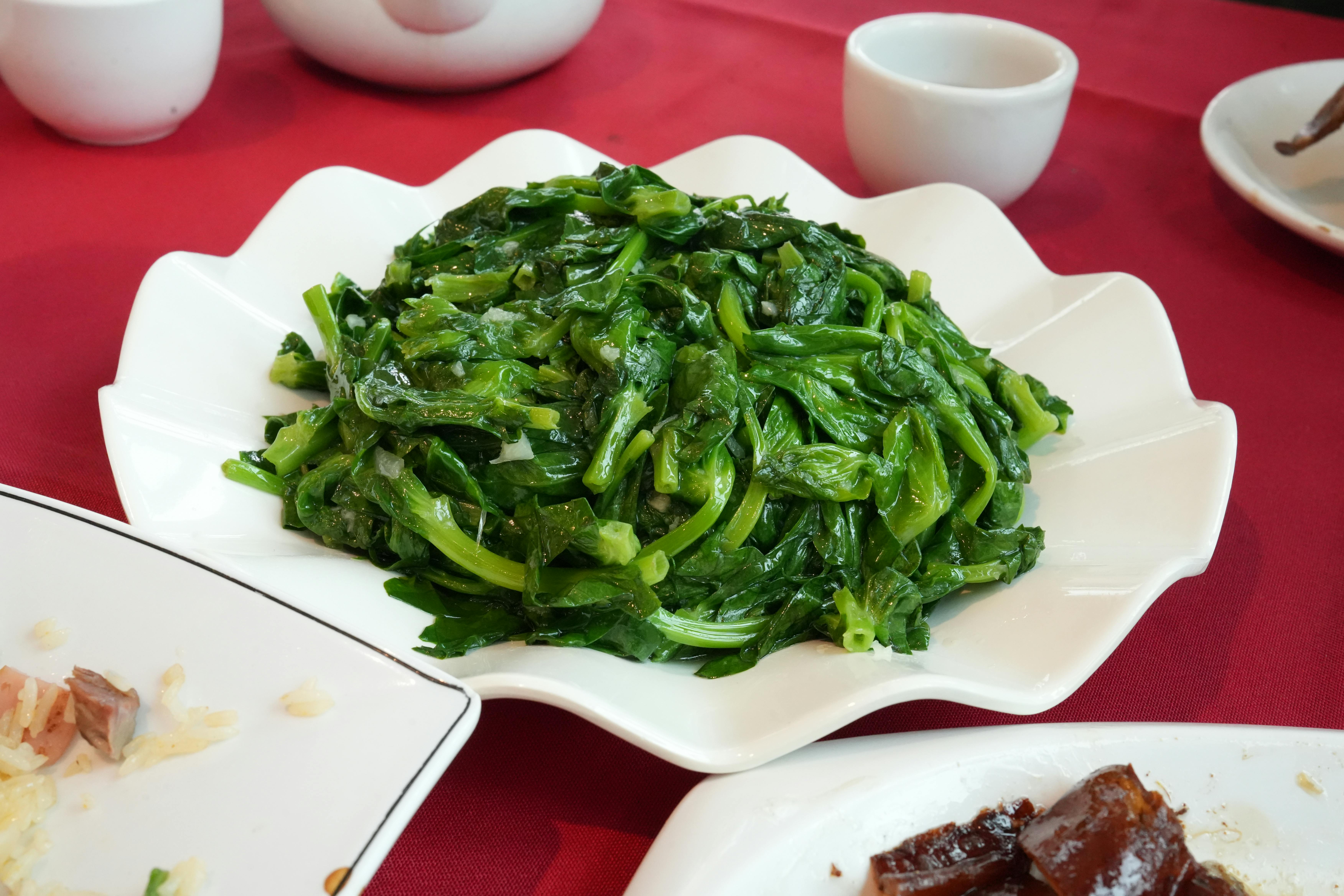
Photo: Yuen Tou Zan / Pexels
Italian
Sautéed Broccoli Rabe
The diets react (see scores below)
Common Ingredients
- broccoli rabe
- garlic
- olive oil
- red pepper flakes
- lemon juice
- salt
Specific recipes may vary.
Incompatible with 3 of 11 diets
Diet Ratings
Sautéed Broccoli Rabe is an excellent keto side dish. Broccoli rabe has approximately 1-2g net carbs per 100g serving after subtracting its fiber content, making it very low in net carbs. Olive oil adds healthy monounsaturated fats, aligning perfectly with keto macros. Garlic contributes minimal carbs at the small quantities used for flavoring. Red pepper flakes and salt are negligible. The lemon juice adds a small amount of carbs but in the typical squeeze used for finishing, it remains trivial (under 1g net carbs). All ingredients are whole and unprocessed, fitting strict keto principles. This dish is naturally high-fat (from olive oil), very low net carb, and free from grains, added sugars, and starchy vegetables.
Sautéed Broccoli Rabe is an exemplary whole-food, plant-based dish. Every ingredient — broccoli rabe, garlic, olive oil, red pepper flakes, lemon juice, and salt — is fully plant-derived with no animal products or animal-derived additives of any kind. This is a classic Italian preparation (rapini aglio e olio) that is naturally vegan without any modification. It is nutrient-dense, minimally processed, and aligns perfectly with both ethical vegan and whole-food plant-based dietary principles.
This dish is nearly paleo-compliant but is disqualified by the inclusion of added salt, which is excluded under paleo rules as a processed/refined additive not available to Paleolithic humans in purified form. The remaining ingredients — broccoli rabe, garlic, olive oil, red pepper flakes, and lemon juice — are all paleo-approved. Broccoli rabe is a nutrient-dense bitter green fully consistent with ancestral eating, garlic and red pepper flakes are natural spices, olive oil is a preferred paleo fat, and lemon juice is a whole fruit derivative. Remove the salt and this dish would score a 9.
Sautéed broccoli rabe is a quintessential Mediterranean dish, particularly rooted in Southern Italian (Pugliese and Neapolitan) culinary tradition. Every ingredient aligns perfectly with Mediterranean diet principles: broccoli rabe is a nutrient-dense leafy green vegetable, garlic is a celebrated Mediterranean staple with well-documented health benefits, extra virgin olive oil is the canonical fat of the diet, red pepper flakes and lemon juice are classic flavor enhancers with no dietary drawbacks, and salt is used in moderation. There are no processed ingredients, refined grains, added sugars, or animal products. This dish exemplifies the plant-forward, olive oil-based cooking style that defines Mediterranean eating.
Sautéed Broccoli Rabe is entirely plant-based and fundamentally incompatible with the carnivore diet. Every single ingredient — broccoli rabe, garlic, olive oil, red pepper flakes, and lemon juice — is plant-derived and explicitly excluded from carnivore eating. The dish contains no animal products whatsoever. Broccoli rabe is a cruciferous vegetable, garlic is a bulb, olive oil is a plant oil, red pepper flakes are a plant spice, and lemon juice is fruit-derived. Only the salt is acceptable. There is universal consensus across all carnivore practitioners and tiers — from the most lenient to the strictest Lion Diet — that this dish must be avoided entirely.
Sautéed Broccoli Rabe is fully compliant with the Whole30 program. Every ingredient is explicitly allowed: broccoli rabe is a vegetable, garlic is a vegetable/herb, olive oil is a natural fat, red pepper flakes are a compliant spice, lemon juice is a natural fruit juice, and salt is explicitly permitted. There are no excluded ingredients, no recreated junk foods, and no gray-area additives. This is exactly the type of whole, minimally processed food the Whole30 program is designed around.
This dish has two significant FODMAP concerns. First, garlic is one of the highest-FODMAP foods tested by Monash University — even small amounts contain high levels of fructans and must be avoided during elimination. Second, broccoli rabe (rapini) is a cruciferous vegetable that Monash rates as high-FODMAP even at modest servings due to fructans and GOS content. Unlike regular broccoli (which is low-FODMAP at florets up to 75g), broccoli rabe has not been cleared at any standard serving size for elimination. The combination of these two high-FODMAP ingredients makes this dish inappropriate for the elimination phase. Olive oil, lemon juice, red pepper flakes, and salt are all low-FODMAP and not problematic.
Some clinical FODMAP practitioners note that if garlic is used only to infuse the olive oil and then removed before cooking (garlic-infused oil technique), the fructan load drops to near zero since FODMAPs are water-soluble. However, broccoli rabe itself remains a high-FODMAP ingredient regardless of preparation, and Monash University has not established a safe serving size for it during elimination — so the dish would still require significant modification to be considered safe.
Sautéed broccoli rabe is an excellent DASH-compatible dish. Broccoli rabe is a nutrient-dense cruciferous vegetable rich in potassium, calcium, magnesium, and fiber — precisely the micronutrients DASH emphasizes. Olive oil is a heart-healthy unsaturated fat explicitly encouraged in the DASH eating plan. Garlic, red pepper flakes, and lemon juice add flavor with negligible sodium impact. The primary concern is the added salt: DASH limits sodium to under 2,300mg/day (or 1,500mg/day for the stricter version), so portion of salt used during cooking matters. Prepared with light salting, this dish is a model DASH side dish. Heavy salting would push it toward 'caution,' but as typically prepared in moderate amounts, it remains highly compatible.
Sautéed Broccoli Rabe is an excellent Zone-compatible side dish. Broccoli rabe is a low-glycemic, high-fiber cruciferous vegetable — exactly the type of colorful, favorable carbohydrate Dr. Sears prioritizes. Olive oil provides the ideal monounsaturated fat that anchors the Zone's fat recommendations and carries anti-inflammatory benefits. Garlic, lemon juice, and red pepper flakes are polyphenol-rich flavor enhancers that align with Sears' anti-inflammatory emphasis. The dish has no protein, so it functions as a carb-plus-fat component that needs to be paired with a lean protein source to complete a Zone meal. Portion control on the olive oil is worth noting — a tablespoon or two fits neatly into 1-2 fat blocks, so moderate drizzling keeps the ratios balanced. Overall, this is a near-ideal Zone vegetable side.
Sautéed Broccoli Rabe is an exemplary anti-inflammatory dish. Broccoli rabe (rapini) is a cruciferous vegetable rich in glucosinolates, vitamins K, C, and A, folate, and fiber — all compounds associated with reduced inflammatory markers. Garlic contains allicin and organosulfur compounds with well-documented anti-inflammatory and immunomodulatory effects. Extra virgin olive oil is a cornerstone of anti-inflammatory eating, providing oleocanthal (a natural COX inhibitor similar in mechanism to ibuprofen) and monounsaturated fats that support healthy inflammatory signaling. Red pepper flakes contribute capsaicin, which has been shown to reduce NF-κB activation and lower pro-inflammatory cytokines. Lemon juice adds vitamin C and flavonoids. There are no pro-inflammatory ingredients — no refined carbohydrates, added sugars, seed oils, or processed components. This dish aligns perfectly with Dr. Weil's Anti-Inflammatory Food Pyramid and mainstream anti-inflammatory nutrition principles.
Sautéed broccoli rabe is a nutrient-dense, high-fiber vegetable side dish that aligns well with GLP-1 dietary priorities. Broccoli rabe provides fiber, vitamins (K, A, C), folate, and modest plant-based protein. Olive oil contributes heart-healthy unsaturated fats and is used in a controlled amount typical of a sauté. Garlic and lemon juice add flavor with negligible caloric cost. The dish is low in saturated fat, easy to digest in moderate portions, and supports the nutrient-density-per-calorie priority critical for GLP-1 patients eating smaller volumes. The main limitation is that it carries no meaningful protein contribution, making it dependent on pairing with a strong protein source to meet meal targets. Red pepper flakes are present — typically in small amounts in this preparation — which is generally tolerable, but patients with GLP-1-related reflux or nausea sensitivity may need to reduce or omit them.
Most GLP-1-focused RDs would readily endorse this dish as a side, but some practitioners caution that broccoli rabe's bitterness and fibrous texture can trigger nausea or GI discomfort in patients already experiencing delayed gastric emptying, particularly early in dose escalation. Individual tolerance to cruciferous vegetables varies, and some clinicians recommend softer, lower-residue vegetables for patients in the acute side-effect phase.
*See how scores were generated at our methodology page.
Nutritional profile
Six traits that cut across every diet.
Fiber & Plants
How much whole-plant food and fiber it delivers.
Healthy Fats
The quality of its fats (unsaturated, omega-3).
Whole / Unprocessed
How close it is to its natural, unprocessed form.
Gut Gentle
How easy it is on digestion (low FODMAP, few irritants).
Low Glycemic
How little it spikes your blood sugar.
Protein Density
How much protein it packs per calorie.
Controversy Index
Higher controversy = more disagreement between diets.
Diet-Specific Tips
 Keto — 8/10
View tips
- Broccoli rabe: ~1-2g net carbs per 100g — very keto-friendly leafy green
- Olive oil: high in monounsaturated fats, ideal keto fat source
- Garlic: minimal net carbs at typical culinary quantities
- Lemon juice: negligible carbs in finishing-squeeze amounts
- No added sugars, grains, or starchy ingredients
- All whole, unprocessed ingredients — aligned with strict keto standards
 Vegan — 10/10
View tips
- All ingredients are 100% plant-based
- No animal products or animal-derived ingredients present
- Broccoli rabe is a nutrient-rich leafy green high in vitamins A, C, K, and calcium
- Olive oil is a minimally processed plant fat — the only non-whole ingredient, but widely accepted across all vegan frameworks
- No cross-contamination concerns with this ingredient list
- Dish requires zero substitutions to be vegan-compliant
 Mediterranean — 10/10
View tips
- Broccoli rabe is a nutrient-dense leafy green, core to Mediterranean plant-forward eating
- Extra virgin olive oil as the primary fat is the ideal Mediterranean fat source
- Garlic is a celebrated Mediterranean staple with antioxidant and cardiovascular benefits
- No processed ingredients, refined grains, added sugars, or animal products
- Deeply rooted in authentic Southern Italian (Pugliese, Neapolitan) culinary tradition
- Lemon juice and red pepper flakes add flavor without compromising dietary quality
 Whole30 — 10/10
View tips
- Broccoli rabe is a vegetable — fully compliant
- Olive oil is a natural fat — explicitly allowed
- Garlic and red pepper flakes are compliant herbs/spices
- Lemon juice is a natural fruit juice — allowed per Whole30 rules
- Salt is explicitly permitted on Whole30
- No excluded ingredients of any kind present
 DASH — 8/10
View tips
- Broccoli rabe is rich in potassium, calcium, magnesium, and fiber — core DASH nutrients
- Olive oil provides heart-healthy monounsaturated fats, aligned with DASH guidelines
- No saturated fat, no added sugar, no processed ingredients
- Added salt is the sole DASH concern — use sparingly or substitute lemon juice/red pepper for flavor
- Low-sodium preparation (minimal salt) would score 9-10; heavy salting reduces score
- Garlic and lemon juice contribute flavor without sodium, supporting sodium reduction strategies
 Zone — 8/10
View tips
- Broccoli rabe is a low-glycemic, high-fiber cruciferous vegetable — a 'favorable' Zone carbohydrate
- Olive oil is the gold-standard Zone fat source: monounsaturated and anti-inflammatory
- Garlic, lemon juice, and red pepper flakes add polyphenols with negligible glycemic impact
- No protein present — must be paired with a lean protein source to complete a Zone-balanced meal
- Olive oil quantity should be measured (1–2 fat blocks) to maintain the 40/30/30 ratio
- No unfavorable ingredients: no sugar, refined carbs, saturated fat, or seed oils
 Anti-Inflammatory — 9/10
View tips
- Broccoli rabe provides glucosinolates and antioxidants with strong anti-inflammatory and anti-cancer associations
- Extra virgin olive oil supplies oleocanthal, a natural anti-inflammatory compound comparable in mechanism to NSAIDs
- Garlic contributes organosulfur compounds (allicin, diallyl disulfide) that suppress pro-inflammatory pathways
- Red pepper flakes add capsaicin, which inhibits NF-κB and reduces inflammatory cytokines
- Lemon juice provides vitamin C and flavonoids supporting antioxidant defense
- Zero pro-inflammatory ingredients — no refined carbs, added sugar, trans fats, or seed oils
- Whole-food, minimally processed preparation method preserves nutritional integrity
 GLP-1 Friendly — 7/10
View tips
- High fiber and micronutrient density support GLP-1 dietary priorities
- Olive oil provides unsaturated fat in a moderate, controlled amount
- No meaningful protein contribution — must be paired with a protein-rich main
- Red pepper flakes may worsen reflux or nausea in sensitive patients
- Cruciferous vegetable — may cause GI discomfort during dose escalation for some patients
- Low calorie, nutrient-dense — ideal for reduced-appetite eating patterns
- Lemon juice and garlic add flavor without added sugar or empty calories