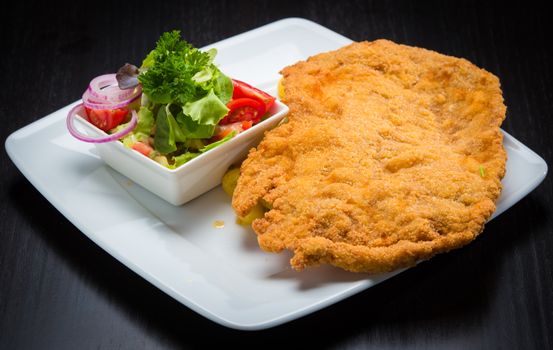
Photo: Novkov Visuals / Pexels
Eastern-European
Pork Schnitzel
The diets react (see scores below)
Common Ingredients
- pork cutlets
- flour
- eggs
- breadcrumbs
- butter
- lemon
- parsley
- salt
Specific recipes may vary.
Incompatible with 7 of 11 diets
Diet Ratings
Traditional pork schnitzel is coated in flour and breadcrumbs before frying, both of which are grain-based, high-carb ingredients that are fundamentally incompatible with ketogenic diets. A standard breaded schnitzel coating adds roughly 15-25g of net carbs per serving, easily pushing a single meal over or near the daily keto carb limit. While the pork cutlet itself and butter are excellent keto foods, the breading process disqualifies the dish as traditionally prepared. The lemon juice adds negligible carbs and parsley is fine, but the core structure of the dish relies on flour and breadcrumbs.
Pork Schnitzel contains multiple animal products and is entirely incompatible with a vegan diet. The dish's primary protein is pork (animal flesh), and the preparation requires eggs (for the breading batter) and butter (dairy). These are not incidental or trace ingredients — they are structural components of the dish. There is no ambiguity here.
Pork Schnitzel is fundamentally incompatible with the Paleo diet. The classic preparation relies on flour (wheat) and breadcrumbs (wheat-based) for the coating — both are grains explicitly excluded from Paleo. Butter is a dairy product, also excluded. Salt is added, which is discouraged. While the core ingredients of pork cutlets, eggs, lemon, and parsley are all Paleo-approved, the non-compliant breading and dairy components define the dish structurally. Without flour and breadcrumbs, the dish ceases to be a schnitzel. The violations are not incidental — they are central to the recipe.
Pork Schnitzel is fundamentally at odds with Mediterranean diet principles on multiple fronts. The primary protein is pork, a red/processed meat that should be consumed only a few times per month. The preparation method—breaded and fried—adds refined grains (white flour, breadcrumbs) and the dish is cooked in butter rather than olive oil, compounding the problem. This is an Eastern European dish with no grounding in Mediterranean culinary tradition. The combination of red meat, refined grain coating, and saturated fat cooking medium makes this a clear 'avoid' under any mainstream Mediterranean diet interpretation.
Pork Schnitzel is fundamentally incompatible with the carnivore diet. While the base protein (pork cutlets) and butter are animal-derived and acceptable, the dish is defined by its breaded coating — flour and breadcrumbs are grain-based plant foods that are strictly excluded from any tier of carnivore eating. Lemon and parsley are plant foods adding further violations. The entire preparation method revolves around a carbohydrate-heavy crust that cannot be separated from the dish's identity. This is not a matter of debate within the carnivore community — grains are universally rejected at every level of the diet.
Pork Schnitzel contains multiple excluded ingredients. Flour is a grain (wheat), breadcrumbs are a grain product, and butter is dairy — all explicitly prohibited on Whole30. Even setting aside the excluded ingredients, the dish is essentially breaded fried meat, which falls squarely into the 'no recreating junk food' rule (breaded/fried coatings mimic comfort food). There is no compliant way to prepare traditional schnitzel within Whole30 rules.
Pork schnitzel contains several low-FODMAP ingredients (pork, eggs, butter, lemon, parsley, salt) but the breading is the key concern. Standard breadcrumbs are typically made from wheat bread, which is high in fructans. Similarly, the flour used for dredging is almost certainly wheat flour, also high in fructans. However, the total amount of wheat-based coating per serving is relatively small — typically 2-4 tablespoons of flour and a thin layer of breadcrumbs — which may fall within a tolerable fructan load for some individuals. Monash University has established that small amounts of wheat (e.g., 2 plain wheat crackers) can be low-FODMAP due to the limited fructan content at that quantity. The breading on a standard schnitzel cutlet likely sits in a gray zone — possibly borderline acceptable or slightly over the threshold depending on coating thickness and portion size. Butter is low-FODMAP (fat, no FODMAPs). Lemon juice and parsley are both low-FODMAP. The dish is easily made fully low-FODMAP by substituting gluten-free breadcrumbs and rice flour or cornstarch for dredging.
Monash University data suggests small amounts of wheat flour may fall within low-FODMAP thresholds, but many clinical FODMAP practitioners recommend avoiding all wheat-containing coatings during the strict elimination phase to prevent cumulative fructan load. A standard schnitzel breading may push some sensitive individuals over their fructan threshold, and substituting gluten-free alternatives is the safer elimination-phase approach.
Pork Schnitzel is a breaded and pan-fried pork cutlet cooked in butter, placing it in caution-to-avoid territory on the DASH diet. The primary concerns are: (1) butter as the cooking fat adds saturated fat, which DASH explicitly limits; (2) the breading process (flour + breadcrumbs) adds refined carbohydrates with little fiber value; (3) salt is added during preparation, contributing to sodium load; and (4) frying in butter increases the overall fat content significantly compared to grilled or baked lean pork. On the positive side, pork loin cutlets themselves are a lean protein source that DASH permits, and lemon and parsley are DASH-friendly accompaniments. The dish is not as egregious as processed meats or high-sodium cured pork products, but the preparation method undermines the lean protein benefit. A score of 4 reflects that it is acceptable very occasionally in a DASH pattern but is not recommended as a regular choice. Modifications — using olive oil instead of butter, whole-wheat breadcrumbs, minimal added salt, and baking rather than frying — would improve compatibility meaningfully.
Pork schnitzel presents multiple Zone Diet challenges. The breading (flour and breadcrumbs) adds high-glycemic refined carbohydrates that are 'unfavorable' in Zone terminology, disrupting the 40/30/30 ratio and spiking insulin. Butter is a saturated fat rather than the preferred monounsaturated fat (olive oil, avocado, almonds). The pork cutlet itself is a lean protein source that fits Zone protein block requirements reasonably well, and lemon/parsley add polyphenols with negligible glycemic impact. However, as typically prepared, the dish is carbohydrate-heavy from breading relative to the protein portion, and the fat profile skews saturated. A Zone practitioner could adapt this dish — using minimal breading, substituting olive oil for butter, serving with a large side of colorful low-GI vegetables to balance blocks — but the traditional preparation as described does not naturally fit Zone ratios without significant modification.
Some Zone practitioners and later Sears anti-inflammatory writings place less emphasis on the distinction between saturated and monounsaturated fat, focusing more on eicosanoid balance and omega-3/omega-6 ratios. In this view, a thin breading on lean pork with butter is manageable if overall meal blocks are balanced with vegetables and the portion of breading is kept small. The pork cutlet's lean protein content is genuinely favorable, and schnitzel with a large salad could approximate Zone ratios in practice.
Pork schnitzel has a mixed anti-inflammatory profile. The dish centers on pork cutlets — a lean cut when properly trimmed — which falls in the moderate/acceptable range for anti-inflammatory eating, similar to lean poultry. However, the preparation method introduces several concerns: the breading (flour + breadcrumbs) adds refined carbohydrates, which can promote inflammatory responses when consumed regularly. Butter is a saturated fat that anti-inflammatory guidelines recommend limiting. Pan- or deep-frying in butter also raises the issue of high-heat cooking and saturated fat oxidation. On the positive side, lemon juice contributes vitamin C and polyphenols, and parsley is a modest source of antioxidants and flavonoids. Eggs in the breading are nutritionally neutral-to-moderate. The dish is not heavily processed, contains no trans fats or artificial additives, and uses whole-food ingredients throughout. Overall, it is an occasional-acceptable dish rather than something to emphasize or strictly avoid — the refined carb coating and butter are the primary inflammatory concerns.
Pork schnitzel is a breaded and pan-fried cutlet cooked in butter, making it a poor fit for GLP-1 patients on multiple fronts. The frying process saturates the breadcrumb coating with fat, dramatically increasing the fat content per serving and making it heavy and slow to digest — a significant problem given that GLP-1 medications already slow gastric emptying. Butter adds saturated fat, compounding nausea and reflux risk. The breaded coating contributes refined carbohydrates with minimal fiber. While pork loin cutlets do contain meaningful protein (~25-30g per serving), the overall nutritional profile is dominated by fat and refined carbs rather than lean protein. The dish is calorie-dense per bite with low nutrient density relative to those calories, directly conflicting with the core GLP-1 dietary principle that every calorie must count nutritionally. Easy digestibility is poor — greasy, fried, breaded foods are among the most commonly reported triggers for GLP-1 GI side effects including nausea, bloating, and reflux. The lemon and parsley garnish are nutritionally negligible in this context.
*See how scores were generated at our methodology page.
Nutritional profile
Six traits that cut across every diet.
Fiber & Plants
How much whole-plant food and fiber it delivers.
Healthy Fats
The quality of its fats (unsaturated, omega-3).
Whole / Unprocessed
How close it is to its natural, unprocessed form.
Gut Gentle
How easy it is on digestion (low FODMAP, few irritants).
Low Glycemic
How little it spikes your blood sugar.
Protein Density
How much protein it packs per calorie.
Controversy Index
Higher controversy = more disagreement between diets.
Diet-Specific Tips
 Low-FODMAP — 5/10
View tips
- Wheat breadcrumbs are high in fructans — primary FODMAP concern
- Wheat flour dredging adds additional fructan load
- Combined wheat coating may be borderline at a standard serving
- Pork cutlet itself is fully low-FODMAP
- Butter, lemon, parsley, and salt are all low-FODMAP
- Easily made low-FODMAP with GF breadcrumbs and rice flour/cornstarch substitution
- Cumulative fructan load from dual wheat sources (flour + breadcrumbs) is the key risk
 DASH — 4/10
View tips
- Butter adds saturated fat, which DASH explicitly limits
- Frying method increases total fat content beyond the lean pork baseline
- Added salt during preparation raises sodium content
- Refined white breadcrumbs contribute little fiber
- Pork cutlet itself is a lean protein permitted by DASH
- Lemon and parsley are DASH-compatible garnishes
- Baking with olive oil and whole-wheat breadcrumbs would significantly improve DASH score
- Not as problematic as cured or processed pork (bacon, sausage)
 Zone — 4/10
View tips
- Breadcrumb and flour coating adds high-glycemic refined carbohydrates — 'unfavorable' Zone carb source
- Butter contributes saturated fat rather than preferred monounsaturated fat
- Pork cutlet is a lean protein source compatible with Zone protein blocks (~7g per block)
- Lemon and parsley provide polyphenols consistent with Zone anti-inflammatory principles
- Traditional preparation skews the macronutrient ratio away from 40/30/30 without careful portioning
- Dish can be partially rehabilitated by minimizing breading, substituting olive oil, and pairing with abundant low-GI vegetables
 Anti-Inflammatory — 4/10
View tips
- Pork is a moderate protein — acceptable lean cuts, but not an anti-inflammatory highlight like fatty fish or legumes
- Refined flour and breadcrumb coating adds refined carbohydrates with minimal fiber or micronutrient value
- Butter as the cooking fat contributes saturated fat, which anti-inflammatory guidelines recommend limiting
- High-heat frying in butter can increase oxidized lipid intake
- Lemon and parsley provide modest antioxidant and anti-inflammatory benefit
- No trans fats, artificial additives, or high-fructose corn syrup — a clean ingredient list for a fried dish
- Appropriate as an occasional meal, not a dietary staple under anti-inflammatory principles