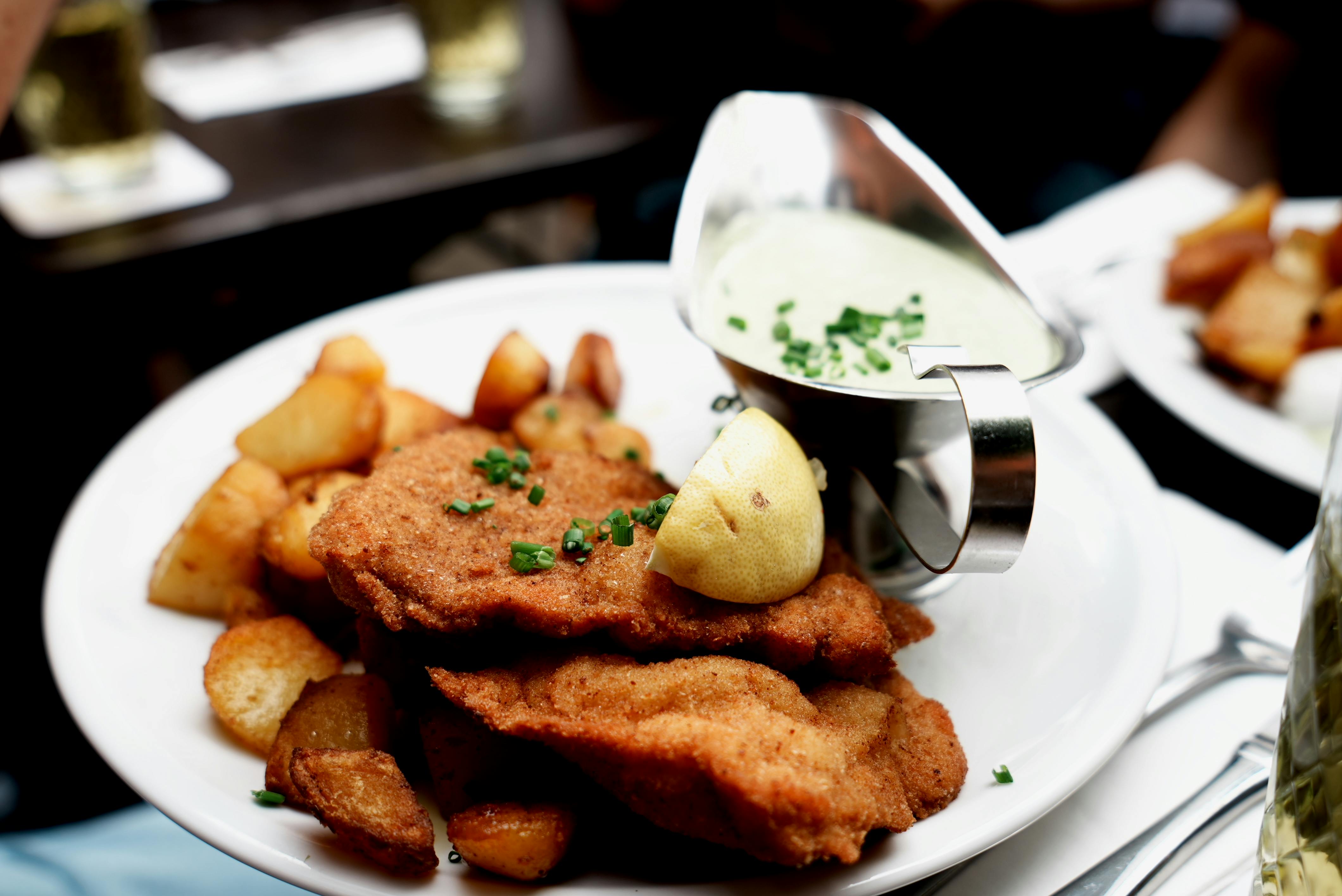
Photo: Zhang Thomas / Pexels
Eastern-European
Wiener Schnitzel
The diets react (see scores below)
Common Ingredients
- veal cutlets
- flour
- eggs
- breadcrumbs
- clarified butter
- lemon
- parsley
- lingonberry
Specific recipes may vary.
Incompatible with 7 of 11 diets
Diet Ratings
Wiener Schnitzel is fundamentally incompatible with a ketogenic diet in its traditional form. The coating process requires dredging veal cutlets in flour, then egg, then breadcrumbs — all three steps introduce significant carbohydrates. A standard serving (150-200g schnitzel) can easily contribute 20-30g of net carbs from the breading alone, potentially consuming an entire day's carb allowance in one dish. The lingonberry accompaniment (often served as a sweetened jam or sauce) adds additional sugars and carbs. While the veal itself and clarified butter are keto-friendly, the breading is non-negotiable in the traditional preparation. Note: a 'keto schnitzel' can be made by substituting almond flour and crushed pork rinds for the flour and breadcrumbs, but that is a different dish entirely.
Wiener Schnitzel is fundamentally incompatible with a vegan diet. It contains multiple animal products at its core: veal (baby cow meat) as the primary protein, eggs used in the breading process, and clarified butter (ghee) for frying. These are not incidental or trace ingredients — they are structural components of the dish without which it cannot be considered Wiener Schnitzel. There is no ambiguity here; this dish violates the vegan exclusion of meat, eggs, and dairy simultaneously.
Wiener Schnitzel is fundamentally incompatible with the paleo diet. The classic preparation requires flour (wheat) for dredging and breadcrumbs (wheat-based) for the signature crispy coating — both are grains and strict paleo exclusions. These are not optional or minor ingredients; they define the dish. The veal itself is excellent paleo protein, eggs are approved, lemon and parsley are fully compliant, and lingonberry is a whole fruit. Clarified butter (ghee) is debated but broadly accepted in modern paleo practice. However, the flour and breadcrumbs are non-negotiable structural components of this dish, making the recipe as a whole a clear avoid. A paleo-adapted version substituting almond flour or coconut flour for the wheat components would shift the verdict, but that would no longer be a traditional Wiener Schnitzel.
Wiener Schnitzel is fundamentally at odds with Mediterranean diet principles on multiple fronts. The primary protein is veal, a red meat that should be consumed only a few times per month at most. It is breaded with refined white flour and breadcrumbs, representing the processed/refined grains that the Mediterranean diet minimizes. The cooking fat is clarified butter rather than extra virgin olive oil, replacing the diet's canonical fat source with a saturated animal fat. The dish is also deep- or pan-fried, adding significant saturated fat. Lemon and parsley are the only Mediterranean-friendly components. This dish is a Central/Eastern European specialty with no meaningful alignment with Mediterranean dietary patterns.
Wiener Schnitzel is fundamentally incompatible with the carnivore diet. While veal is an excellent ruminant meat and eggs and clarified butter are carnivore-friendly, the dish is defined by its breading — flour and breadcrumbs are grain-based plant foods that are strictly excluded. Lemon, parsley, and lingonberry are all plant-derived and also excluded. The preparation method entirely coats the meat in non-carnivore ingredients, making this dish impossible to approve in its traditional form. The dish cannot be salvaged by modification — it would cease to be Wiener Schnitzel without the breading.
Wiener Schnitzel contains two clearly excluded ingredients: flour (a grain product) and breadcrumbs (also grain-based, typically wheat). These form the essential breaded coating that defines the dish. While several other ingredients are compliant — veal cutlets (meat), eggs, clarified butter (the one allowed dairy exception), lemon, and parsley — the flour and breadcrumb coating makes this dish non-compliant. Lingonberries are a whole fruit and compliant. However, the grain-based breading cannot be omitted without fundamentally changing the dish, so Wiener Schnitzel as traditionally prepared is not Whole30 compatible.
Wiener Schnitzel contains several ingredients that are individually manageable but collectively require attention. Veal, eggs, clarified butter (ghee), lemon juice, and parsley are all low-FODMAP. The primary concern is the breading: both the flour dredge and breadcrumbs are typically made from wheat, which is high-FODMAP due to fructans. However, the quantity of wheat flour and breadcrumbs used in a standard schnitzel coating is relatively small — Monash University has indicated that small amounts of wheat (e.g., used as a coating or thickener) may stay within the low-FODMAP threshold (around 15g or less of wheat per serve). Lingonberry jam, often served as a condiment, is a key wildcard — fresh lingonberries are not well-tested by Monash, and commercial lingonberry preparations may contain high-FODMAP sweeteners like HFCS or added sorbitol. The dish is on the borderline during strict elimination phase: gluten-free flour and GF breadcrumbs would make it clearly low-FODMAP, but with standard wheat-based breading and lingonberry, caution is warranted.
Monash University suggests that small wheat coatings (≤15g) may be tolerated during elimination, but many clinical FODMAP practitioners advise avoiding all wheat-containing preparations during the elimination phase to eliminate variables — these practitioners would likely recommend substituting GF breadcrumbs to be safe. The lingonberry component also lacks robust Monash testing data, and commercial versions may contain polyol-based sweeteners.
Wiener Schnitzel presents a mixed profile from a DASH perspective. Veal itself is a lean protein source, which aligns with DASH principles, but the preparation method significantly undermines its compatibility. The dish is breaded (flour, eggs, breadcrumbs) and pan-fried in clarified butter, which substantially increases saturated fat and total calorie content. Clarified butter is a high saturated fat cooking fat — DASH explicitly limits saturated fats and recommends vegetable oils instead. The breading adds refined carbohydrates rather than the whole grains DASH emphasizes. On the positive side, the dish contains lemon and parsley (fresh produce), and lingonberries (a fruit with antioxidants and moderate sugar). The sodium content depends heavily on seasoning and breadcrumb preparation — commercial seasoned breadcrumbs can add significant sodium, while homemade versions may be lower. The overall dish is not inherently high-sodium like processed meats, but the saturated fat from clarified butter and the refined breading make it a 'caution' food requiring portion control and infrequent consumption within a DASH eating plan. Occasional consumption of a single portion is acceptable, but it should not be a DASH dietary staple.
NIH DASH guidelines explicitly limit saturated fat and recommend replacing solid fats with vegetable oils, placing clarified butter-fried dishes in the 'caution' category. However, some updated clinical DASH interpretations note that veal is a lean meat and a single schnitzel portion contains moderate — not extreme — saturated fat levels, suggesting it can fit into a DASH plan as an occasional meal when prepared with low-sodium breadcrumbs and a light hand with the butter.
Wiener Schnitzel presents several Zone Diet challenges. The veal itself is a lean protein and Zone-acceptable, but the traditional preparation creates significant macro imbalances. The breading (flour + breadcrumbs) adds high-glycemic carbohydrates that are difficult to portion-control since they're integral to the dish. Clarified butter (ghee) introduces substantial saturated fat rather than preferred monounsaturated fat, and the frying process absorbs considerable fat, making the fat portion both excessive and of the wrong type. The lingonberry accompaniment is typically served sweetened, adding high-glycemic sugar. However, the Zone is ratio-based: a small portion of schnitzel paired with a large volume of low-glycemic vegetables could theoretically be balanced, and the lemon/parsley garnish are Zone-friendly polyphenol sources. The dish is 'unfavorable' in Zone terminology — workable only with strict portion control and deliberate balancing sides — making it a caution rather than an avoid, since the veal protein itself is sound and total exclusion isn't warranted.
Some Zone practitioners and Sears' later anti-inflammatory writings are somewhat more permissive about saturated fat from whole food sources like clarified butter, particularly when consumed in controlled portions. Additionally, if the breadcrumb coating is thin and the portion is small (e.g., 3 oz veal), the carbohydrate load may be manageable within a 1-2 block framework. Stricter Zone adherents following the original 'Enter the Zone' guidelines would rate this lower (score 3) given the fried breading and saturated fat, while later-era Zone practitioners might score it a 5.
Wiener Schnitzel presents a mixed anti-inflammatory profile. On the problematic side: clarified butter (ghee) is high in saturated fat, which is flagged as a 'limit' item in anti-inflammatory frameworks; the breading (flour + breadcrumbs) adds refined carbohydrates with minimal nutritional value; and deep-frying or pan-frying in substantial fat increases the overall saturated fat load. Veal, while leaner than beef, is still red meat — a 'limit' category food — though it has a better fat profile than most red meats. On the positive side: lemon provides vitamin C and flavonoids; parsley is rich in antioxidants (apigenin, luteolin) and vitamin K; lingonberry is a genuine anti-inflammatory standout, containing anthocyanins, quercetin, and resveratrol with documented anti-inflammatory properties. Eggs contribute choline and some anti-inflammatory nutrients. The dish is not a dietary disaster — it lacks trans fats, seed oils, or artificial additives — but the combination of refined breading, high saturated fat from clarified butter, and red meat makes it incompatible with regular consumption on an anti-inflammatory plan. Occasional consumption for a generally healthy person is defensible.
Some anti-inflammatory practitioners (including those following Mediterranean-adjacent frameworks) would note that clarified butter (ghee) is viewed more favorably than refined vegetable oils in certain protocols (e.g., Paleo, Wahls Protocol), as it lacks casein and lactose and contains butyrate — a short-chain fatty acid with anti-inflammatory gut effects. However, mainstream anti-inflammatory nutrition (Dr. Weil's pyramid) still categorizes butter-based fats as 'limit' items, and the overall saturated fat load here remains a concern.
Wiener Schnitzel is a poor fit for GLP-1 patients across nearly every rating criterion. The preparation method — pan-frying in clarified butter — means the breaded cutlet absorbs significant fat during cooking, resulting in a high-fat, calorie-dense dish that is precisely the type of food known to worsen GLP-1 side effects including nausea, bloating, delayed gastric emptying discomfort, and reflux. The breading (flour, breadcrumbs) adds refined carbohydrates with negligible fiber and low nutrient density. While veal itself is a relatively lean protein, the breading and frying method transform it into a low-protein-density-per-calorie dish. A standard serving (150-200g of finished schnitzel) delivers moderate protein but at a high fat and calorie cost that GLP-1 patients — eating far smaller volumes — can ill afford. The lingonberry accompaniment is typically sweetened and adds sugar with minimal fiber benefit. Clarified butter is a saturated fat, which is the least preferred fat category under GLP-1 dietary guidance. Easy digestibility is severely compromised by the fried, fatty, breaded format. There is essentially no redeeming nutritional density per calorie for a GLP-1 patient context.
*See how scores were generated at our methodology page.
Nutritional profile
Six traits that cut across every diet.
Fiber & Plants
How much whole-plant food and fiber it delivers.
Healthy Fats
The quality of its fats (unsaturated, omega-3).
Whole / Unprocessed
How close it is to its natural, unprocessed form.
Gut Gentle
How easy it is on digestion (low FODMAP, few irritants).
Low Glycemic
How little it spikes your blood sugar.
Protein Density
How much protein it packs per calorie.
Controversy Index
Higher controversy = more disagreement between diets.
Diet-Specific Tips
 Low-FODMAP — 5/10
View tips
- Wheat flour and breadcrumbs are high-FODMAP due to fructans, though coating quantities may fall under the ~15g threshold
- Veal is inherently low-FODMAP as a plain protein
- Clarified butter (ghee) is low-FODMAP — lactose removed during clarification
- Lemon and parsley are safe low-FODMAP garnishes
- Lingonberry lacks comprehensive Monash testing; commercial preparations may contain high-FODMAP sweeteners
- Substituting gluten-free breadcrumbs and flour would significantly improve the FODMAP profile
- Standard restaurant portions likely exceed the safe wheat-coating threshold
 DASH — 4/10
View tips
- Veal is a lean protein, consistent with DASH lean meat recommendations
- Clarified butter is high in saturated fat, which DASH explicitly limits
- Refined breadcrumb coating (flour, breadcrumbs) adds refined carbs rather than whole grains
- Sodium risk depends on breadcrumb preparation — commercial breadcrumbs often high in sodium
- Lemon, parsley, and lingonberries are DASH-positive ingredients
- Deep/pan frying increases total fat content significantly
- Portion size is critical — a large schnitzel can easily exceed recommended fat limits
- Overall not a DASH-emphasized food but acceptable occasionally in moderation
 Zone — 4/10
View tips
- Veal is a lean, Zone-favorable protein source
- Breadcrumb coating (flour + breadcrumbs) adds high-glycemic carbohydrates integral to the dish — cannot be easily removed
- Clarified butter is a saturated fat, not the preferred monounsaturated fat (olive oil, avocado, almonds)
- Deep frying significantly increases overall fat content beyond Zone-recommended 10-15g per meal
- Sweetened lingonberry sauce adds high-glycemic sugars
- Lemon and parsley provide polyphenols and are Zone-positive
- Dish can be partially Zone-balanced by strict portion control and pairing with large servings of low-GI vegetables
- Net carb-to-protein ratio is skewed by the breading
 Anti-Inflammatory — 4/10
View tips
- Veal is red meat — classified as 'limit' in anti-inflammatory frameworks
- Clarified butter is high in saturated fat, a pro-inflammatory concern at regular consumption
- Refined breadcrumbs and flour add minimal nutritional value and moderate glycemic load
- Lingonberry is an anti-inflammatory standout — rich in anthocyanins, quercetin, and resveratrol
- Parsley contributes anti-inflammatory flavonoids (apigenin, luteolin) and vitamin C
- Lemon adds polyphenols and vitamin C
- No trans fats, seed oils, artificial additives, or high-fructose corn syrup
- Acceptable occasionally but not suitable for regular consumption on an anti-inflammatory diet