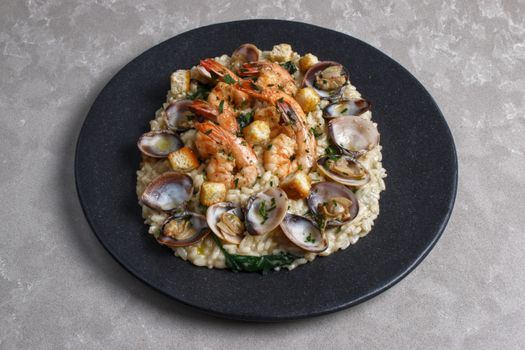
Photo: Adriano Bragi / Pexels
Italian
Seafood Risotto
The diets react (see scores below)
Common Ingredients
- arborio rice
- shrimp
- mussels
- clams
- squid
- white wine
- fish stock
- tomatoes
Specific recipes may vary.
Incompatible with 5 of 11 diets
Diet Ratings
Seafood Risotto is fundamentally incompatible with a ketogenic diet. The primary ingredient, arborio rice, is a highly refined starchy grain that delivers approximately 35-40g of net carbs per standard half-cup dry serving — easily exceeding the entire daily keto carb budget in a single dish. Risotto's defining characteristic is its starchy rice base, making substitution impossible without completely changing the dish. Additional carb contributors include tomatoes and white wine, which add further sugar and carbohydrates. While the mixed seafood (shrimp, mussels, clams, squid) is inherently keto-friendly as a lean, high-quality protein source, the surrounding dish construction makes this entirely incompatible with ketosis. There is no reasonable portion size that would bring this dish into keto compliance.
Seafood Risotto is entirely incompatible with a vegan diet. The dish contains multiple animal products as its primary components: shrimp, mussels, clams, and squid are all seafood and therefore animal products. Fish stock is derived from fish bones and flesh. There is no plant-based version of this dish that could be considered the 'default' — the animal products are not incidental ingredients but the defining elements of the recipe. Arborio rice, white wine, and tomatoes are plant-based, but they are vastly outnumbered and outweighed by the animal-derived components.
Seafood Risotto is firmly non-paleo due to its foundational ingredient: arborio rice, a grain that is explicitly excluded from the Paleolithic diet. Grains are among the most clearly prohibited foods in paleo because they were unavailable to hunter-gatherers and contain anti-nutrients such as lectins and phytic acid. The seafood components — shrimp, mussels, clams, and squid — are all excellent paleo proteins, and tomatoes and fish stock are also compatible. However, the dish is built around arborio rice, which cannot be substituted out without fundamentally changing the dish. White wine is a minor gray-area ingredient, but it is inconsequential given the primary disqualifier. This dish cannot be made paleo-compliant without ceasing to be a risotto.
Seafood risotto features an excellent protein base — mixed seafood (shrimp, mussels, clams, squid) aligns perfectly with the Mediterranean guideline of eating fish and seafood 2-3 times weekly. Tomatoes, white wine, and fish stock are wholesome, traditional Mediterranean ingredients. The main concern is the arborio rice, a refined, short-grain white rice that lacks the fiber and nutrients of whole grains. Mediterranean diet guidelines emphasize whole grains, making arborio a nutritional compromise. However, the dish is minimally processed, low in saturated fat, and rich in lean protein and micronutrients from the seafood, keeping it in the acceptable-with-moderation range rather than a clear avoid.
In traditional Italian coastal cuisine, white arborio rice in seafood risotto is a culturally authentic dish, and some Mediterranean diet authorities (particularly those grounding the diet in actual regional practices rather than modern nutritional optimization) would consider it fully acceptable as part of a varied diet. The original Mediterranean diet pyramid studies from Crete and southern Italy did not strictly exclude white rice or refined grains when consumed in traditional culinary contexts.
Seafood Risotto is fundamentally incompatible with the carnivore diet. While the seafood components (shrimp, mussels, clams, squid) and fish stock are carnivore-approved ingredients, the dish is built on a foundation of arborio rice — a grain that is strictly excluded from any tier of the carnivore diet. Additional plant-based ingredients include white wine (fermented plant product) and tomatoes (fruit/vegetable), making this dish overwhelmingly non-compliant. The majority of the dish's caloric and structural base comes from prohibited plant foods. No meaningful adaptation is possible while retaining the dish's identity as a risotto.
Seafood Risotto contains arborio rice, which is a grain and explicitly excluded on the Whole30 program. Grains of all types — including rice in all its forms — are prohibited for the full 30 days. Additionally, white wine is an alcoholic beverage, also explicitly excluded. The seafood components (shrimp, mussels, clams, squid) and tomatoes and fish stock are all compliant, but the two disqualifying ingredients (arborio rice and white wine) make this dish firmly off-limits. This is not a borderline case — both violations are clear and unambiguous under official Whole30 rules.
Seafood risotto has several low-FODMAP-friendly components but contains meaningful FODMAP risks depending on preparation. Arborio rice is low-FODMAP and a safe base. Mixed seafood (shrimp, mussels, clams, squid) are all low-FODMAP proteins with no significant FODMAP content. White wine is low-FODMAP in standard cooking quantities (the small amount used in risotto is generally fine). However, the key concerns are: (1) Fish stock — commercial fish stocks frequently contain onion, garlic, or onion powder as flavoring agents, making them high-FODMAP; only certified low-FODMAP or homemade stock without alliums is safe. (2) Tomatoes — low-FODMAP at small servings (up to 65g/half a medium tomato per Monash), but risotto recipes can use more, pushing into moderate-to-high fructose territory. (3) Traditional risotto preparations often include shallots or onion as an aromatic base, which would make this dish high-FODMAP — the listed ingredients omit these, but restaurant or home versions almost universally include them. The dish is potentially safe if prepared carefully with low-FODMAP stock, no alliums, and controlled tomato quantity, but as typically prepared it carries real FODMAP risk.
Monash University rates the individual seafood and rice components as low-FODMAP, but many clinical FODMAP dietitians advise caution with restaurant risottos during elimination phase because onion/garlic in stocks and soffritto bases are nearly ubiquitous in Italian cooking and difficult to verify. A homemade version with confirmed low-FODMAP stock and no alliums would score higher (7-8), but ordering this in a restaurant during elimination is risky.
Seafood risotto contains several DASH-friendly components — mixed seafood (shrimp, mussels, clams, squid) are lean proteins rich in potassium and magnesium, and tomatoes add fiber and micronutrients. However, the dish presents notable DASH concerns. Arborio rice is a refined white rice, lacking the fiber and nutrients of whole grains emphasized in DASH. Fish stock and shellfish (particularly clams and mussels) are naturally higher in sodium, and commercial or restaurant fish stocks can be very high in sodium — a single serving could easily approach or exceed 800–1,200mg. White wine contributes minimal nutritional value. The dish is also typically finished with butter and/or Parmesan cheese in traditional preparations, which would add saturated fat and additional sodium, though those aren't listed here. As described with these specific ingredients, it is acceptable in moderation with careful sodium management, but it is not a core DASH meal due to refined grain base and sodium load from shellfish and stock.
NIH DASH guidelines emphasize whole grains over refined grains and highlight sodium control as critical, making traditional risotto a less-than-ideal vehicle. However, updated clinical interpretations note that seafood-forward dishes are strongly cardioprotective — the AHA and some DASH-aligned cardiologists argue that the omega-3 content and lean protein profile of mixed shellfish can outweigh the refined grain concern, especially if low-sodium stock is used and portions are controlled.
Seafood risotto presents a classic Zone imbalance challenge. The protein component — mixed seafood (shrimp, mussels, clams, squid) — is excellent from a Zone perspective: all are lean, low-fat proteins rich in omega-3s and highly favorable. However, the foundation of the dish is arborio rice, a high-glycemic, starchy carbohydrate that Dr. Sears explicitly classifies as an 'unfavorable' carb. Arborio rice has a glycemic index of approximately 65-70 and is low in fiber, meaning nearly all its carbohydrate content counts as net carbs, causing rapid insulin spikes — the precise hormonal disruption the Zone seeks to avoid. A traditional risotto portion easily contains 45-60g of carbohydrate from rice alone, far exceeding the Zone's 9g net carb per block guideline for a balanced meal. White wine adds minor additional sugar/carbs. The tomatoes are favorable low-GI carbs, and fish stock is Zone-neutral. To fit the Zone, a very small portion of risotto (roughly 1/4 of a typical restaurant serving) could theoretically balance the seafood protein blocks, but this conflicts with how the dish is realistically served and consumed. The dish is carbohydrate-heavy by design, with the ratio skewed far toward carbs and away from the 40/30/30 target in practice.
Seafood risotto has a genuinely mixed anti-inflammatory profile. On the positive side, the mixed seafood (shrimp, mussels, clams, squid) provides lean marine protein, omega-3 fatty acids, zinc, selenium, and other micronutrients with anti-inflammatory properties. Shellfish like mussels and clams are particularly rich in omega-3s and minerals. Tomatoes contribute lycopene and antioxidant polyphenols. Fish stock adds collagen and mineral-rich nutrients. White wine in cooking quantities contributes minimal alcohol and some polyphenols. The limiting factor is arborio rice — a high-glycemic refined white rice that lacks the fiber and nutrient density of whole grains, and can promote glycemic spikes that drive inflammatory signaling. A whole-grain risotto-style preparation would score higher. The dish also lacks the olive oil, garlic, and herbs that would significantly enhance its anti-inflammatory profile in a traditional Italian preparation. Overall, this is a reasonably healthy dish elevated by excellent seafood choices but moderated by the refined starch base.
Some anti-inflammatory practitioners would score this higher, noting that the omega-3 and micronutrient density from mixed shellfish can offset the glycemic impact of arborio rice, especially when consumed as a balanced meal — Dr. Weil's framework emphasizes overall dietary pattern over individual food glycemic index. Conversely, stricter anti-inflammatory protocols (e.g., those targeting metabolic inflammation) would penalize the high-GI refined rice more severely, preferring whole grains or cauliflower-rice substitutions.
Seafood risotto has genuine strengths for GLP-1 patients — mixed seafood (shrimp, mussels, clams, squid) provides lean, easily digestible protein with good micronutrient density, and the fish stock base adds hydration support. Tomatoes contribute modest fiber and lycopene. However, arborio rice is a refined, high-glycemic starch with virtually no fiber, which is a meaningful drawback given how critical fiber is for GLP-1 patients managing constipation and blood sugar stability. Risotto is also traditionally prepared with butter and parmesan, though this recipe omits them — a standard restaurant serving is likely to include both, raising fat content and calorie density. The white wine adds negligible residual alcohol after cooking but does contribute to a heavier preparation. Portion sensitivity is a real issue: risotto is starchy and calorie-dense per cup, meaning a typical restaurant portion may crowd out higher-priority protein and fiber foods. Overall protein per serving is moderate but respectable if seafood is generously portioned. This dish earns its place in moderation, especially if home-prepared with controlled butter and generous seafood, but is not an ideal GLP-1 staple.
Some GLP-1-focused dietitians are more permissive with risotto when seafood is the dominant ingredient, arguing the lean protein and easy digestibility outweigh the refined starch concern in patients who already struggle to eat enough. Others flag arborio rice specifically as a food to minimize due to its glycemic impact and near-zero fiber, recommending cauliflower risotto as a substitute.
*See how scores were generated at our methodology page.
Nutritional profile
Six traits that cut across every diet.
Fiber & Plants
How much whole-plant food and fiber it delivers.
Healthy Fats
The quality of its fats (unsaturated, omega-3).
Whole / Unprocessed
How close it is to its natural, unprocessed form.
Gut Gentle
How easy it is on digestion (low FODMAP, few irritants).
Low Glycemic
How little it spikes your blood sugar.
Protein Density
How much protein it packs per calorie.
Controversy Index
Higher controversy = more disagreement between diets.
Diet-Specific Tips
 Mediterranean — 6/10
View tips
- Excellent seafood variety (shrimp, mussels, clams, squid) aligns with Mediterranean seafood guidelines
- Arborio rice is a refined grain, not a whole grain — a notable downside
- No red meat, processed ingredients, or added sugars
- Tomatoes and fish stock add nutritional value
- White wine is a traditional Mediterranean cooking ingredient
- Low in saturated fat overall
- Culturally authentic Italian coastal preparation
 Low-FODMAP — 5/10
View tips
- Arborio rice is low-FODMAP — safe base grain
- All listed seafood (shrimp, mussels, clams, squid) are low-FODMAP proteins
- Commercial fish stock very often contains onion or garlic — major FODMAP risk
- Tomatoes are low-FODMAP only up to ~65g; larger quantities add excess fructose
- White wine in cooking quantities is generally low-FODMAP
- Traditional risotto preparations almost always include onion or shallot, not listed but likely in practice
- Safe version requires verified low-FODMAP stock and no allium aromatics
 DASH — 5/10
View tips
- Arborio rice is a refined grain — whole grain alternatives (e.g., farro, brown rice) would better align with DASH
- Mixed shellfish provide lean protein, potassium, and magnesium consistent with DASH principles
- Fish stock and shellfish (clams, mussels) contribute significant sodium — low-sodium stock is essential for DASH compliance
- Tomatoes add fiber, potassium, and lycopene, supporting DASH nutrient targets
- No saturated fat sources listed (e.g., butter, heavy cream, Parmesan), which is favorable — traditional risotto preparations often include these
- White wine adds minimal nutrition and negligible sodium; acceptable in cooking context
- Portion control critical — risotto is calorie-dense and easy to overconsume
 Zone — 4/10
View tips
- Arborio rice is a high-glycemic, low-fiber 'unfavorable' carb explicitly discouraged in Zone methodology
- Mixed seafood (shrimp, mussels, clams, squid) is ideal Zone lean protein with beneficial omega-3 profile
- Realistic restaurant or home portions are carbohydrate-dominant, breaking Zone's 40/30/30 ratio
- Tomatoes are favorable low-GI carbs but do not offset the rice
- White wine adds minimal but non-zero carbohydrate load
- Dish can technically fit Zone only with dramatically reduced portion sizes, impractical in real-world serving contexts
- No significant saturated fat or trans fat concerns — the fat profile is actually reasonable
 Anti-Inflammatory — 6/10
View tips
- Mixed shellfish (mussels, clams) are good sources of omega-3 fatty acids and anti-inflammatory minerals (zinc, selenium)
- Shrimp and squid provide lean marine protein with moderate omega-3 content
- Arborio rice is a high-glycemic refined carbohydrate — a notable pro-inflammatory concern
- Tomatoes contribute lycopene and antioxidant polyphenols (anti-inflammatory positive)
- Fish stock adds mineral-rich, collagen-containing broth
- White wine used in cooking contributes trace polyphenols at low alcohol exposure
- Traditional preparation often includes olive oil and garlic, which would improve the score — absent here as listed
- No added saturated fats, processed ingredients, or trans fats noted
 GLP-1 Friendly — 5/10
View tips
- Mixed seafood provides lean, easily digestible protein supporting the 15-30g per meal target
- Arborio rice is a refined, low-fiber, high-glycemic starch — no meaningful fiber contribution
- Standard restaurant preparation likely includes butter and parmesan, significantly increasing fat content beyond what this ingredient list suggests
- Portion-sensitive: typical risotto servings are large and starchy, displacing higher-priority protein and fiber foods
- White wine and fish stock base are mild positives for flavor without significant fat or sugar load
- Tomatoes add modest fiber, hydration, and micronutrient value
- Easy digestibility of seafood is a positive for GLP-1 patients managing slowed gastric emptying