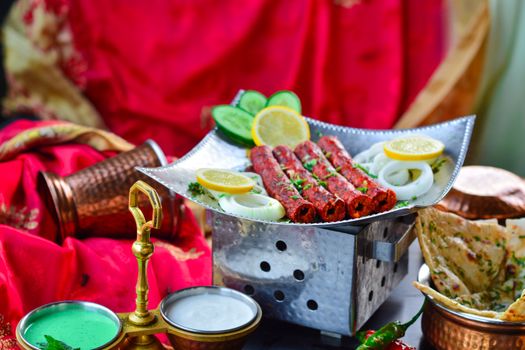
Photo: Ahmad No More / Pexels
Indian
Seekh Kebab
The diets react (see scores below)
Common Ingredients
- ground lamb
- onion
- ginger
- garlic
- green chilies
- garam masala
- cilantro
- mint
Specific recipes may vary.
Incompatible with 4 of 11 diets
Diet Ratings
Seekh Kebab is an excellent keto option. The primary ingredient is ground lamb or beef, which is naturally high in fat and protein with zero carbohydrates. The aromatics — onion, ginger, garlic, green chilies — are used in small quantities as flavoring agents, contributing minimal net carbs (roughly 2-4g per serving total). Garam masala, cilantro, and mint add negligible carbs. There are no grains, breadcrumbs, or binders in the traditional recipe, and no added sugars. The dish is grilled or skewered, making it a whole-food, minimally processed protein and fat source that fits squarely within keto macros.
Seekh Kebab is made with ground lamb (or beef) as its primary and defining ingredient. Both lamb and beef are animal flesh — direct animal products that are categorically excluded under every definition of veganism. The remaining ingredients (onion, ginger, garlic, green chilies, garam masala, cilantro, mint) are all plant-based, but they serve only as seasonings and aromatics. The dish is fundamentally a meat preparation and cannot be considered vegan in any interpretation.
Seekh Kebab in its traditional form is highly paleo-compatible. Ground lamb is an unprocessed, nutrient-dense animal protein that would have been available to Paleolithic humans. All the aromatics and seasonings — onion, ginger, garlic, green chilies, cilantro, and mint — are whole, unprocessed plant foods. Garam masala is a blend of whole spices (cumin, coriander, cardamom, cloves, cinnamon, black pepper) with no paleo-incompatible ingredients. There are no grains, legumes, dairy, refined sugars, or seed oils in this dish. The only minor watchpoint is that commercial garam masala blends occasionally contain added salt or anti-caking agents, so a homemade or clean-label blend is preferable. Grilled or skewered preparation aligns perfectly with ancestral cooking methods.
Seekh Kebab is built on ground lamb or beef, both of which are red meats that the Mediterranean diet restricts to only a few times per month. The dish is not inherently processed, and the accompanying aromatics (onion, garlic, ginger, fresh herbs) are wholesome ingredients, but the core protein fundamentally conflicts with Mediterranean dietary principles. Ground red meat also tends to be higher in saturated fat than whole cuts, compounding the concern. This is not an occasional lean red meat serving — it is the centerpiece of the meal, consumed as a main course, making regular inclusion incompatible with Mediterranean guidelines.
Seekh Kebab is fundamentally incompatible with the carnivore diet despite its animal protein base. The dish contains multiple plant-derived ingredients that are explicitly excluded: onion, ginger, garlic, green chilies, garam masala (a blend of plant spices), cilantro, and mint. These are not minor trace additives — they are structural, flavor-defining components of the recipe. While the ground lamb itself would be carnivore-approved, the dish as traditionally prepared cannot be considered carnivore-compliant. A carnivore adaptation would require stripping all plant ingredients, leaving only ground lamb formed on a skewer with salt — at which point it is no longer Seekh Kebab in any meaningful sense.
Seekh Kebab as described contains exclusively Whole30-compliant ingredients. Ground lamb is an approved protein, onion, garlic, ginger, and green chilies are all compliant vegetables/aromatics, garam masala is a blend of compliant spices (cinnamon, cardamom, cloves, cumin, coriander, black pepper), and cilantro and mint are fresh herbs explicitly allowed on the program. There are no excluded ingredients — no grains, legumes, dairy, added sugars, or other disqualifying components. The dish is a straightforward grilled/skewered meat preparation that fully aligns with the Whole30 philosophy of whole, unprocessed foods.
Seekh Kebab in its traditional form contains two significant high-FODMAP ingredients: onion and garlic. Both are among the highest-fructan foods tested by Monash University and are problematic even in small quantities. Onion is high-FODMAP at any culinary serving size, and garlic contains concentrated fructans — even 1/2 a clove is considered high-FODMAP. Ground lamb itself is low-FODMAP (plain meat contains no FODMAPs), and other ingredients like ginger, green chilies (in small amounts), garam masala, cilantro, and mint are generally low-FODMAP at typical culinary quantities. However, the inclusion of both onion and garlic as core structural ingredients — not mere traces — makes this dish unsuitable during the elimination phase without significant modification.
Seekh Kebab features ground lamb (or beef) as its primary protein, which DASH guidelines classify as red meat — a category to be limited due to higher saturated fat content. Ground lamb in particular is relatively high in saturated fat (roughly 7-9g per 100g serving), which conflicts with DASH's emphasis on limiting saturated fat. However, the dish is made with no added sodium-heavy condiments or sauces, relying instead on herbs, spices, aromatics (onion, garlic, ginger, green chilies, cilantro, mint, garam masala), which are all DASH-compatible. The spice blend itself contributes negligible sodium. The preparation (skewered and grilled) is a lean cooking method that avoids added oils or fats. Ground beef, depending on the fat percentage chosen (e.g., 90%+ lean), could partially mitigate the saturated fat concern. Overall, this dish is acceptable in moderation — a small portion (2-3 kebabs) using leaner ground meat fits within DASH allowances for limited red meat, but it cannot be a dietary staple.
NIH DASH guidelines broadly limit red meat (lamb, beef) due to saturated fat and recommend poultry or fish as preferred proteins. However, updated clinical interpretations note that when red meat is lean and minimally processed — as in this grilled, unprocessed kebab with no added sodium — some DASH-oriented dietitians allow it in controlled portions (≤3-4 oz, 1-2 times/week), particularly when overall dietary sodium and saturated fat targets are met across the day.
Seekh Kebab presents a mixed Zone profile. The protein source — ground lamb or beef — is the primary concern. Ground lamb is relatively high in saturated fat (roughly 20-25% fat by weight), which makes it less ideal than Zone-preferred lean proteins like skinless chicken, fish, or lean beef. However, the Zone Diet is ratio-based, not exclusionary, and fatty red meat is 'limit' rather than 'eliminate.' The spice blend (garam masala, ginger, garlic, green chilies, cilantro, mint) is Zone-friendly — anti-inflammatory and polyphenol-rich with negligible caloric contribution. Onion adds minimal low-glycemic carbs. The main challenge is that ground lamb's fat content skews the 30/30/30 macronutrient split — the fat block will be largely 'used up' by the meat's intrinsic saturated fat, leaving little room for the preferred monounsaturated fat additions. To bring it into Zone balance, a practitioner would pair small portions (roughly 2-3 oz cooked) with abundant low-glycemic vegetables (a large salad or grilled peppers/zucchini) to supply the carbohydrate blocks, and avoid adding extra fat since the meat supplies it already. Lean ground beef (90%+ lean) as the protein would improve the score meaningfully.
Some Zone practitioners and Sears' later writings (particularly his anti-inflammatory work) are more permissive about saturated fat from whole animal sources when omega-3 intake is adequate. If the lamb is grass-fed, its omega-6 to omega-3 ratio improves considerably, and the inflammatory concern diminishes. In that context, seekh kebab could be rated as a reasonable Zone protein block — closer to a 6 — particularly given the anti-inflammatory spice profile.
Seekh Kebab presents a genuinely mixed anti-inflammatory profile. On the positive side, the spice and herb blend is excellent — garlic, ginger, green chilies, garam masala (typically containing turmeric, coriander, cumin, cardamom), fresh cilantro, and mint all carry meaningful anti-inflammatory credentials through polyphenols, gingerols, allicin, and various antioxidants. Onion adds quercetin. These ingredients collectively represent some of the most evidence-backed anti-inflammatory foods. The preparation method (grilled on skewers) avoids heavy fats and is preferable to frying. On the negative side, the primary protein — ground lamb or beef — is red meat, which the anti-inflammatory framework places in the 'limit' category due to saturated fat content and arachidonic acid, both of which are associated with elevated inflammatory markers (CRP, IL-6) in research. Ground meat also has a higher surface area for fat oxidation during cooking. The dish is not 'avoid' because the anti-inflammatory spice and herb base is genuinely potent and meaningful, but the red meat base prevents an 'approve.' Consumed occasionally and in moderate portions, this dish is acceptable within an anti-inflammatory eating pattern. Substituting ground chicken or turkey would shift it closer to an approve.
Some anti-inflammatory practitioners, including those following Dr. Weil's broader Mediterranean-adjacent framework, may be more permissive about occasional lean red meat when it is rich in anti-inflammatory spices and consumed in moderate portions, arguing the herb-spice matrix partially offsets the pro-inflammatory lipid profile. Conversely, stricter anti-inflammatory protocols (e.g., those targeting autoimmune conditions) would rate this more harshly due to the arachidonic acid in red meat and potential saturated fat load from ground lamb, which tends to be fattier than many other red meat cuts.
Seekh kebab provides meaningful protein from ground lamb or beef, but the fat content is a significant concern for GLP-1 patients. Ground lamb is typically 15–20% fat by weight, and ground beef varies widely but is often 15–20% fat as well. High fat per serving slows gastric emptying further (compounding the GLP-1 effect), worsens nausea and reflux, and introduces saturated fat load that most GLP-1-focused RDs recommend limiting. The green chilies and spice blend (garam masala) add mild-to-moderate heat that may aggravate reflux or nausea in sensitive patients. On the positive side, the dish is low in refined carbs, contains no added sugar, uses aromatic spices with anti-inflammatory properties, and delivers roughly 18–22g protein per 100g serving. If made with leaner ground meat (90%+ lean beef or leaner lamb), grilled rather than pan-fried, and served in a small portion, it becomes more compatible. Standard restaurant or home preparation with fattier ground meat tips this into caution territory.
Some GLP-1-aware dietitians accept seekh kebab as a reasonable protein source given its low carbohydrate profile and grilled preparation, arguing that the protein and satiety benefits outweigh the saturated fat concern at typical serving sizes (2–3 kebabs). Others flag fatty red meat as a consistent trigger for GLP-1 GI side effects and recommend substituting ground chicken or turkey to preserve the dish format while improving tolerability.
*See how scores were generated at our methodology page.
Nutritional profile
Six traits that cut across every diet.
Fiber & Plants
How much whole-plant food and fiber it delivers.
Healthy Fats
The quality of its fats (unsaturated, omega-3).
Whole / Unprocessed
How close it is to its natural, unprocessed form.
Gut Gentle
How easy it is on digestion (low FODMAP, few irritants).
Low Glycemic
How little it spikes your blood sugar.
Protein Density
How much protein it packs per calorie.
Controversy Index
Higher controversy = more disagreement between diets.
Diet-Specific Tips
 Keto — 9/10
View tips
- Ground lamb or beef is zero-carb and high in fat and protein
- Aromatics used in small quantities contribute only 2-4g net carbs per serving
- No grains, breadcrumbs, or fillers in the traditional recipe
- No added sugars or starchy binders
- Grilling method preserves fat content without adding non-keto ingredients
- Garam masala and fresh herbs add negligible carbohydrates
 Paleo — 9/10
View tips
- Ground lamb is unprocessed, high-quality animal protein — fully paleo approved
- All aromatics (onion, garlic, ginger, green chilies) are whole vegetables with no paleo concerns
- Cilantro and mint are fresh herbs, clearly paleo-approved
- Garam masala is a whole-spice blend — paleo-compliant when free of additives or added salt
- No grains, legumes, dairy, refined sugar, or seed oils present
- Grilling/skewer cooking method is ancestrally appropriate
- Minor caveat: verify commercial garam masala contains no added salt or fillers
 Whole30 — 9/10
View tips
- Ground lamb is an approved Whole30 protein
- All aromatics (onion, ginger, garlic, green chilies) are compliant vegetables
- Garam masala is a compliant spice blend with no excluded additives
- Fresh herbs (cilantro, mint) are explicitly allowed
- No grains, dairy, legumes, or added sugars present
- Cooking method (grilling/skewering) is inherently compliant
- No recreated junk food or baked good concerns — this is a traditional meat dish
 DASH — 4/10
View tips
- Ground lamb/beef is red meat — limited under DASH guidelines due to saturated fat
- No high-sodium sauces, marinades, or condiments — sodium load is low
- Grilled preparation avoids excess added fats
- Herbs and spices (cilantro, mint, garam masala, ginger, garlic) are DASH-friendly and nutrient-supportive
- Lean ground beef (90%+ lean) as a substitute would improve the DASH score
- Acceptable in small portions (≤3 oz) and infrequent consumption per DASH red meat limits
- No added sugar, processed additives, or trans fats
 Zone — 5/10
View tips
- Ground lamb is high in saturated fat, making it a 'limit' protein in Zone rather than a preferred lean protein
- Saturated fat from the meat consumes the fat block allowance, leaving no room for preferred monounsaturated fats
- Spice blend (ginger, garlic, chilies, cilantro, mint, garam masala) is strongly anti-inflammatory and polyphenol-rich — a Zone positive
- No high-glycemic carbohydrates in the dish itself; carb blocks must come from accompaniments
- Portioning is manageable: 2-3 oz cooked kebab can serve as a protein block if paired with low-GI vegetables
- Lean ground beef substitution would improve Zone compatibility significantly
- Grass-fed lamb would have a better omega-6/omega-3 ratio, reducing inflammatory concern
 Anti-Inflammatory — 5/10
View tips
- Ground lamb or beef is red meat — anti-inflammatory framework recommends limiting due to saturated fat and arachidonic acid
- Ginger and garlic are well-supported anti-inflammatory ingredients (gingerols, allicin)
- Green chilies contribute capsaicin, a noted anti-inflammatory compound
- Garam masala blend likely contains turmeric and cumin — both anti-inflammatory
- Fresh cilantro and mint add antioxidant polyphenols
- Grilling method is preferable to frying — avoids added inflammatory fats
- No refined carbohydrates, added sugars, or processed additives
- Occasional consumption is more acceptable than regular inclusion
 GLP-1 Friendly — 5/10
View tips
- High saturated fat from ground lamb or beef worsens nausea and compounds slowed gastric emptying
- Meaningful protein content (~18–22g per 100g) supports daily protein targets
- Green chilies may trigger reflux or nausea in GLP-1 patients with GI sensitivity
- Grilled preparation is preferable to pan-fried; fat content varies significantly by meat choice
- Low in refined carbs and added sugar — positive for blood sugar stability
- Portion-sensitive: 1–2 kebabs from leaner meat is more compatible than a full serving of fatty ground lamb
- Swapping to 90%+ lean ground beef or ground chicken/turkey significantly improves the rating