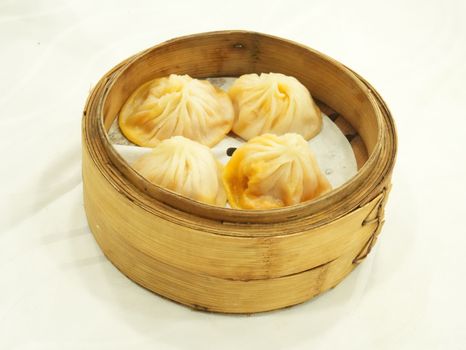
Photo: Yuen Tou Zan / Pexels
Chinese
Xiao Long Bao
The diets react (see scores below)
Common Ingredients
- ground pork
- pork aspic
- dumpling wrappers
- ginger
- Shaoxing wine
- soy sauce
- sesame oil
- scallions
Specific recipes may vary.
Incompatible with 8 of 11 diets
Diet Ratings
Xiao Long Bao are fundamentally incompatible with a ketogenic diet due to their dumpling wrappers, which are made from refined wheat flour. Each dumpling wrapper contributes roughly 4-6g of net carbs, and a standard serving of 6-8 dumplings delivers approximately 24-48g of net carbs from the wrappers alone — easily consuming or exceeding the entire daily keto carb budget in one snack. The filling itself (ground pork, pork aspic, ginger, soy sauce, sesame oil, scallions) is largely keto-friendly, but the grain-based wrapper is a dealbreaker. Shaoxing wine and soy sauce add minor carbs as well. There is no practical portion size that makes this dish compatible with ketosis when consumed in its traditional form.
Xiao Long Bao contains multiple animal products that are categorically excluded from a vegan diet. Ground pork is the primary protein and a direct animal product. Pork aspic — the gelatinized broth that creates the soup filling — is derived from slow-cooked pork bones and skin, making it a concentrated animal product. There is no ambiguity here: this dish is built around pork as both its filling and its signature liquid component. The remaining ingredients (dumpling wrappers, ginger, Shaoxing wine, soy sauce, sesame oil, scallions) are plant-based, but they cannot offset the core animal ingredients.
Xiao Long Bao contains multiple non-paleo ingredients that make it clearly incompatible with the paleo diet. The dumpling wrappers are made from wheat flour, a grain that is strictly excluded from paleo. Soy sauce is a double violation — it contains both wheat (a grain) and soy (a legume). Sesame oil is a seed oil, which is also excluded. Shaoxing wine is a processed, grain-based alcohol. While the ground pork, pork aspic, ginger, and scallions are paleo-friendly, the foundational components of this dish — the wrapper and condiments — are all non-paleo. This is not a borderline case; the dish cannot be made in its traditional form on a paleo diet.
Xiao Long Bao presents multiple conflicts with Mediterranean diet principles. The primary protein is pork (red meat), which is limited to only a few times per month in the Mediterranean pattern. The dumpling wrappers are made from refined white flour, a processed refined grain discouraged by the diet. The dish contains no olive oil, relying instead on sesame oil as its fat source, which is not traditional to the Mediterranean pattern. Soy sauce and Shaoxing wine add sodium and processed condiments not consistent with the diet's emphasis on whole, minimally processed foods. There are virtually no vegetables, legumes, or other plant-forward components. Overall, this dish contradicts the Mediterranean diet's core principles across protein, fat, and grain categories simultaneously.
Xiao Long Bao is fundamentally incompatible with the carnivore diet. While the filling contains animal-derived ingredients (ground pork and pork aspic), the dish is built around dumpling wrappers made from wheat flour — a grain-based plant food that is strictly excluded. Beyond the wrappers, the seasoning profile is entirely plant-based: ginger (plant spice), Shaoxing rice wine (fermented grain), soy sauce (fermented soy and wheat — a double plant offense), sesame oil (plant-derived seed oil), and scallions (vegetable). Nearly every non-meat component violates carnivore principles. Even if the wrapper were somehow removed, the remaining filling would still be disqualified by multiple plant-based additives and flavor agents.
Xiao Long Bao contains multiple Whole30-excluded ingredients. The dumpling wrappers are made from wheat flour, which is a grain and explicitly excluded. Soy sauce contains soy (a legume) and typically wheat (a grain), both of which are excluded. Shaoxing wine is an alcoholic rice wine, making it doubly excluded (alcohol and rice/grain). Even if coconut aminos were substituted for soy sauce, the wheat-based dumpling wrappers alone would disqualify this dish. Furthermore, as a filled dumpling, it falls into the 'recreating junk food/comfort food with wrappers' category analogous to prohibited wraps. There is no compliant version of this dish possible without fundamentally changing what it is.
Xiao Long Bao contains multiple high-FODMAP ingredients that make it unsuitable during the elimination phase. The primary concern is the dumpling wrappers, which are made from wheat flour — a significant source of fructans, one of the most problematic FODMAP groups. Even a small serving of 2–3 dumplings would deliver a meaningful fructan load from the wrappers alone. Scallions (green onions) are a secondary concern: the green tops are low-FODMAP, but if the white bulb portions are included — as is common in XLB preparation — they contribute fructans. Shaoxing wine is made from glutinous rice and wheat, adding further fructan exposure. The pork filling itself (ground pork, pork aspic/gelatin, ginger, sesame oil, soy sauce in small amounts) is generally low-FODMAP, but the wrapper and scallion issues are disqualifying. There is no realistic low-FODMAP version of this dish as traditionally prepared, as the wheat wrapper is structural to the dumpling.
Xiao Long Bao presents multiple red flags under DASH diet guidelines. The primary protein is ground pork, which is a red meat high in saturated fat — a category DASH explicitly limits. The pork aspic (gelatin made from pork skin and bones) adds additional saturated fat. Critically, the sodium content is very high: soy sauce is one of the saltiest condiments used in cooking (standard soy sauce contains ~900-1000mg sodium per tablespoon), and the overall dish as commonly consumed in restaurants or even home preparation easily exceeds 600-900mg sodium per 4-6 dumplings, making it difficult to fit within either the standard (<2,300mg/day) or low-sodium (<1,500mg/day) DASH targets as part of a full day's eating. Sesame oil adds fat, and the refined dumpling wrappers (white flour) provide no meaningful fiber or whole grain benefit. This dish lacks the potassium, calcium, magnesium, and fiber that DASH emphasizes, and its combination of red meat, saturated fat, and high sodium makes it a poor fit for the DASH eating plan.
Xiao Long Bao presents a mixed Zone profile. The ground pork provides protein but is fattier than ideal lean Zone proteins (skinless chicken, fish, egg whites), containing notable saturated fat. The pork aspic (gelatinized pork broth) adds more pork-derived fat and collagen. The dumpling wrappers are made from refined white flour — a high-glycemic, unfavorable carbohydrate in Zone terminology — though the quantity per dumpling is relatively small. On the positive side, ginger and scallions are Zone-favorable polyphenol-rich vegetables, sesame oil provides some beneficial fats, and Shaoxing wine and soy sauce are used in small flavor quantities. The macro ratio skews protein-and-fat heavy with the carb contribution coming from an unfavorable (high-GI) source. With careful portioning — treating 2-3 pieces as a snack block alongside favorable vegetables — XLB can fit into a Zone day, but the fatty pork and refined flour wrappers make it a non-ideal choice requiring compensation elsewhere. It is not an 'avoid' because the portions are naturally small and protein is present, but it requires planning.
Some Zone practitioners following Sears' later anti-inflammatory framework (Toxic Fat, The Zone Diet and Anti-Aging) note that traditional pork fat is largely monounsaturated oleic acid (~45%), which is more acceptable than early Zone materials implied. Under this view, XLB's fat profile is less problematic than classic Zone guidance suggests, potentially nudging the score slightly higher. However, the refined flour wrapper issue remains consistent across all Zone editions.
Xiao Long Bao presents a mixed anti-inflammatory profile. On the positive side, ginger is a well-established anti-inflammatory spice (inhibits NF-κB and COX-2 pathways), scallions provide quercetin and organosulfur compounds, and sesame oil contains sesamol and sesamin with antioxidant properties. Soy sauce contributes sodium but also some fermentation-derived compounds. The negatives center on the primary protein — ground pork and pork aspic (collagen-rich gelatin from pork bones/skin) are red/processed meat products. While pork is not as inflammatory as processed red meat, it does contain arachidonic acid and saturated fat, both associated with pro-inflammatory signaling. The refined wheat dumpling wrappers add refined carbohydrates with limited fiber. Shaoxing wine is a minor ingredient and its alcohol content per serving is negligible. Overall, this dish is a traditional whole-food preparation without additives or trans fats, with meaningful anti-inflammatory spices, but the pork-heavy base and refined wrappers limit its score to the caution range. Appropriate as an occasional food rather than a regular anti-inflammatory staple.
Some anti-inflammatory practitioners (aligned with Dr. Weil's more flexible pyramid) would note that traditional, minimally processed pork in moderate portions is acceptable, especially when paired with anti-inflammatory aromatics like ginger and scallion — pushing this closer to a 6. Stricter anti-inflammatory protocols, however, classify all red meat including pork as pro-inflammatory due to arachidonic acid content and would rate this lower.
Xiao Long Bao (soup dumplings) present a mixed nutritional profile for GLP-1 patients. The ground pork filling provides some protein, but pork is a moderately fatty meat — the aspic (gelatinized pork broth) adds additional fat that liquefies during steaming, contributing to the characteristic rich, fatty broth inside each dumpling. A typical serving of 6 dumplings delivers roughly 12–18g of protein, which is on the lower end of the 15–30g per meal target. Fat content is moderate-to-high per calorie, primarily from the pork and dissolved gelatin fat, which may worsen nausea, bloating, or reflux in GLP-1 patients given slowed gastric emptying. The refined flour wrapper is low in fiber and nutritionally thin. On the positive side, the portions are naturally small and manageable, steaming is a gentle cooking method (not fried), ginger has mild anti-nausea properties which is a minor benefit, and the dish is relatively easy to digest compared to fried dumplings. Sesame oil and soy sauce are present in small amounts and are unlikely to cause problems. Overall, acceptable occasionally in a small portion (3–4 pieces) as part of a higher-protein, higher-fiber meal, but not an ideal standalone GLP-1-friendly snack.
Some GLP-1-focused dietitians may rate this more permissively, noting that steamed dumplings are one of the more tolerable Asian protein sources for patients with GI sensitivity, and that the small portion format aligns well with reduced appetite. Others flag the fatty pork broth and refined wrapper as meaningful concerns for patients already struggling with nausea or reflux, particularly on dose-escalation weeks.
*See how scores were generated at our methodology page.
Nutritional profile
Six traits that cut across every diet.
Fiber & Plants
How much whole-plant food and fiber it delivers.
Healthy Fats
The quality of its fats (unsaturated, omega-3).
Whole / Unprocessed
How close it is to its natural, unprocessed form.
Gut Gentle
How easy it is on digestion (low FODMAP, few irritants).
Low Glycemic
How little it spikes your blood sugar.
Protein Density
How much protein it packs per calorie.
Controversy Index
Higher controversy = more disagreement between diets.
Diet-Specific Tips
 Zone — 5/10
View tips
- Ground pork is a fatty protein — not a lean Zone-preferred protein like chicken or fish, contains saturated fat
- Pork aspic adds additional pork-derived fat and collagen, reinforcing unfavorable fat profile
- Dumpling wrappers are refined white flour — high-glycemic, unfavorable Zone carbohydrate
- Small individual portion size naturally limits carb load per piece, aiding block control
- Ginger and scallions are Zone-favorable polyphenol-rich additions
- Sesame oil provides some monounsaturated and polyunsaturated fats but in small quantities
- Macro ratio skews protein/fat heavy with unfavorable carb source — difficult to hit 40/30/30 without pairing with low-GI vegetables
- Can fit as a snack with careful portioning (2-3 pieces) but not a Zone-ideal food
 Anti-Inflammatory — 5/10
View tips
- Pork is a red meat containing arachidonic acid and saturated fat — pro-inflammatory in excess
- Pork aspic adds additional saturated fat from collagen-rich pork gelatin
- Ginger is a well-evidenced anti-inflammatory spice (NF-κB inhibition)
- Scallions provide quercetin and organosulfur anti-inflammatory compounds
- Sesame oil contains sesamol and sesamin with antioxidant and anti-inflammatory properties
- Refined wheat dumpling wrappers contribute simple carbohydrates with minimal fiber
- Traditional whole-food preparation — no trans fats, artificial additives, or high-fructose corn syrup
- Soy sauce adds significant sodium, which can be a concern for inflammation at high intake
 GLP-1 Friendly — 4/10
View tips
- Moderate fat content from ground pork and pork aspic may worsen GLP-1 GI side effects (nausea, reflux, bloating)
- Protein yield is modest (~12–18g per 6 dumplings), below the 15–30g per meal target
- Refined flour wrapper adds low-fiber, low-nutrient calories
- Steamed preparation is a positive — not fried, relatively easy to digest
- Naturally small portion format aligns with GLP-1 reduced appetite
- Ginger in filling has mild anti-nausea properties
- Pork aspic (gelatinized fat) increases saturated fat load per serving
- Low fiber content does not support the 25–30g daily fiber target