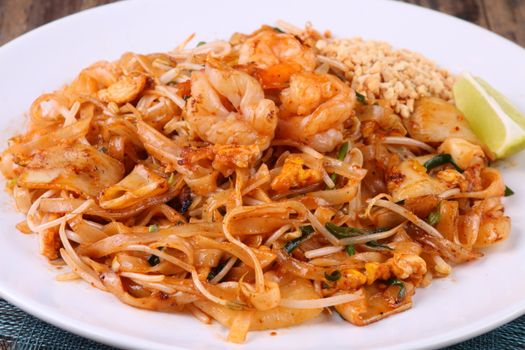
Thai
Shrimp Pad Thai
The diets react (see scores below)
Common Ingredients
- rice noodles
- shrimp
- egg
- tamarind paste
- fish sauce
- peanuts
- bean sprouts
- lime
Specific recipes may vary.
Incompatible with 5 of 11 diets
Diet Ratings
Shrimp Pad Thai is fundamentally incompatible with a ketogenic diet. The primary ingredient, rice noodles, is a high-glycemic refined grain that delivers approximately 40-50g of net carbs per standard serving alone — easily exceeding the entire daily keto carb budget in a single dish. Tamarind paste adds additional sugar-derived carbs, and the overall macronutrient profile is carbohydrate-dominant rather than fat-dominant. While individual ingredients like shrimp, egg, fish sauce, peanuts, and bean sprouts are keto-friendly or conditionally acceptable, the rice noodles make this dish a non-starter for ketosis. No realistic portion reduction can make a standard Pad Thai keto-compliant without fundamentally reconstructing the dish (e.g., substituting shirataki or zucchini noodles).
Shrimp Pad Thai contains multiple animal-derived ingredients, making it entirely incompatible with a vegan diet. Shrimp is seafood (an animal product), egg is an animal product, and fish sauce is derived from fermented fish. These three ingredients are unambiguous violations of vegan principles. The dish has no vegan-compliant version without a complete overhaul of its primary protein and sauce base.
Shrimp Pad Thai contains multiple non-paleo ingredients that disqualify it clearly. Rice noodles are a grain-based product and strictly excluded from all paleo frameworks. Peanuts are legumes, not true nuts, and are universally avoided on paleo. Bean sprouts (from mung beans) are also legumes and excluded. Fish sauce typically contains added salt and sometimes sugar or additives, placing it in the processed/avoid category. While shrimp, egg, tamarind paste, and lime are paleo-compatible, the foundational ingredients — rice noodles, peanuts, and bean sprouts — make this dish incompatible with paleo principles. This is a clear avoid with no meaningful debate in the paleo community.
Shrimp Pad Thai contains several Mediterranean-friendly elements — shrimp (an encouraged seafood protein), egg, peanuts (legume-adjacent nuts), bean sprouts, and lime — but the base is refined rice noodles rather than whole grains, and the dish lacks olive oil as the fat source. The tamarind paste and fish sauce add flavor without major nutritional concerns, though fish sauce is high in sodium. The overall dish is not traditional Mediterranean cuisine, but its seafood-forward protein, vegetable components, and relatively minimal processing make it acceptable in moderation. The refined noodle base and absence of olive oil prevent a full approval.
Some Mediterranean diet interpreters would score this lower, arguing that refined rice noodles as the primary carbohydrate base directly conflicts with the whole-grain emphasis of clinical Mediterranean diet guidelines (e.g., PREDIMED study protocols). Others applying a more flexible, ingredient-quality lens might note that shrimp, eggs, nuts, and vegetables align well enough with Mediterranean principles to warrant a lenient view of the noodle base.
Shrimp Pad Thai is almost entirely incompatible with the carnivore diet. While shrimp and egg are carnivore-approved animal products, and fish sauce is generally acceptable, the dish is dominated by plant-based and processed ingredients. Rice noodles are a grain-based carbohydrate and a complete disqualifier. Tamarind paste is a plant-derived fruit paste. Peanuts are legumes, explicitly excluded. Bean sprouts are a plant food. Lime is a fruit. The dish's foundational structure — a starch-based noodle dish with plant-derived sauce components and plant toppings — places it firmly in the avoid category. The presence of shrimp and egg does not redeem a dish that is architecturally a plant-carbohydrate meal.
Shrimp Pad Thai contains multiple excluded ingredients that make it clearly non-compliant with Whole30. Rice noodles are a grain product (rice is explicitly excluded). Peanuts are a legume and explicitly excluded. Bean sprouts, while the sprouts themselves may be debated, come from mung beans which are legumes. Any one of these three violations alone would be disqualifying, and this dish contains all three. The remaining ingredients — shrimp, egg, tamarind paste, fish sauce, and lime — are generally Whole30-compatible, but they cannot redeem a dish with such fundamental exclusions.
Shrimp Pad Thai is largely low-FODMAP in its core components: rice noodles are safe, shrimp is a low-FODMAP protein, eggs are fine, fish sauce is low-FODMAP at normal amounts, tamarind paste is low-FODMAP at small servings (up to ~1 tablespoon per Monash), lime juice is safe, and bean sprouts are low-FODMAP at up to 1 cup. The main FODMAP concern is peanuts, which Monash rates as low-FODMAP at 28g (about 32 peanuts) but moderate-to-high in GOS at larger portions — and Pad Thai is typically served with a generous handful. Tamarind paste also warrants attention: low-FODMAP at ~1 tbsp but becomes a concern if used liberally in restaurant-style preparations. Bean sprouts are generally safe but can be problematic in very large quantities. The dish is conditionally safe when portion sizes are controlled, particularly for peanuts and tamarind, but real-world restaurant servings often exceed these thresholds, making it a caution rather than a clear approve.
Monash University rates most individual ingredients in this dish as low-FODMAP at standard servings, which could support an 'approve' rating. However, clinical FODMAP practitioners often flag Pad Thai due to unpredictable restaurant portioning of peanuts and tamarind — both of which have FODMAP dose-dependency — and advise caution during the elimination phase unless prepared at home with measured quantities.
Shrimp Pad Thai contains several DASH-friendly components — shrimp is a lean protein, rice noodles are low in saturated fat, bean sprouts and lime add vegetables and micronutrients, and peanuts provide healthy fats and magnesium. However, fish sauce is extremely high in sodium (roughly 1,200–1,500mg per tablespoon), and tamarind paste adds sugar. Together, these ingredients can push a single serving well above 1,000–1,500mg sodium, making it difficult to fit into either the standard (<2,300mg) or low-sodium (<1,500mg) DASH target without significant recipe modification. The dish is not inherently high in saturated fat or cholesterol, and the protein source (shrimp) is DASH-compatible, but the sodium load from fish sauce is the primary disqualifier from an 'approve' rating. Peanuts also require portion control due to caloric density and added sodium in some preparations.
NIH DASH guidelines explicitly limit sodium and would flag fish sauce as a high-sodium ingredient, warranting caution. However, some DASH-oriented dietitians note that a home-prepared version using reduced fish sauce, low-sodium alternatives, or omitting fish sauce in favor of lime and herbs could bring sodium into an acceptable range, potentially elevating the score to the low 'approve' tier — making preparation method critical to this assessment.
Shrimp Pad Thai presents a mixed Zone profile. On the positive side, shrimp is an excellent lean protein source (low fat, high protein density), eggs add favorable protein, bean sprouts are low-glycemic vegetables, and lime contributes polyphenols with negligible carbs. However, the dish is dominated by rice noodles — a high-glycemic refined carbohydrate that Dr. Sears classifies as an 'unfavorable' carb. A typical restaurant serving of Pad Thai contains 40-60g of net carbs from rice noodles alone, far exceeding Zone block targets and spiking insulin response. Tamarind paste adds additional sugar-based carbs. Peanuts, while providing some monounsaturated fat, are omega-6 heavy and Sears generally discourages high omega-6 nuts in favor of almonds or macadamia nuts. The overall macro ratio skews heavily toward carbohydrates, making it difficult to achieve 40/30/30 balance without dramatically reducing the noodle portion. A Zone-modified version with reduced rice noodles (1 block worth), doubled bean sprouts as a noodle substitute, and measured shrimp/egg protein could work, but the traditional dish as served is poorly balanced for the Zone.
Shrimp Pad Thai presents a mixed anti-inflammatory profile. On the positive side, shrimp provides lean protein and some omega-3s (though lower than fatty fish), eggs contribute choline and selenium, bean sprouts offer fiber and micronutrients, peanuts provide some healthy fats and resveratrol, lime adds vitamin C and antioxidants, and tamarind has polyphenol content. Fish sauce, while high in sodium, is a traditional fermented condiment used in modest quantities. The dish is free of seed oils (in its traditional home-cooked form), refined sugars, and processed additives. However, rice noodles are a refined carbohydrate with a high glycemic index, which can promote post-meal glucose spikes and downstream inflammatory signaling. Peanuts, while not strictly pro-inflammatory, are legumes with higher omega-6 content than tree nuts like walnuts. Restaurant versions often add significant sugar to the tamarind sauce and may use seed oils for stir-frying, which would worsen the profile considerably. The dish lacks the strongly anti-inflammatory ingredients (fatty fish, colorful vegetables, olive oil, turmeric) that would push it into the approve range. Overall it's acceptable as an occasional meal, particularly when home-cooked with minimal added sugar and a neutral cooking oil.
Some anti-inflammatory practitioners would rate this more favorably, noting shrimp's lean protein and selenium content, tamarind's polyphenols, and the absence of red meat or processed ingredients — Dr. Weil's framework would not flag this dish as problematic. Conversely, stricter anti-inflammatory and blood sugar-focused practitioners (e.g., Dr. Mark Hyman) would caution more strongly against the refined rice noodles and the typical high sugar content in restaurant preparations, potentially pushing this toward a lower score.
Shrimp Pad Thai has genuine strengths for GLP-1 patients — shrimp is a lean, high-protein seafood, eggs add additional protein, and bean sprouts contribute hydration and light fiber. Tamarind, fish sauce, and lime are low-fat flavor builders. However, the dish is dominated by rice noodles, which are refined carbohydrates with low fiber and low protein density per calorie. This undermines the core GLP-1 priority of nutrient density per bite. The peanuts add healthy unsaturated fats but also meaningful fat content that can worsen nausea or bloating in sensitive patients. Restaurant versions are often higher in added sugar (in the sauce) and oil than home-prepared versions. Overall, a home-prepared, shrimp-forward, reduced-noodle version with extra egg and bean sprouts can be a reasonable GLP-1 meal, but standard restaurant Pad Thai is portion-sensitive and carb-heavy relative to its protein and fiber yield.
Some GLP-1-focused RDs accept Pad Thai as a practical real-world option, noting that shrimp and egg together can deliver 20-25g protein per serving and that the dish is generally well-tolerated digestively. Others caution that the refined rice noodle base and sugar-containing tamarind sauce make it a poor calorie investment on a reduced-appetite diet, and that the fat from peanuts and cooking oil elevates GI side effect risk in patients who are still titrating their dose.
*See how scores were generated at our methodology page.
Nutritional profile
Six traits that cut across every diet.
Fiber & Plants
How much whole-plant food and fiber it delivers.
Healthy Fats
The quality of its fats (unsaturated, omega-3).
Whole / Unprocessed
How close it is to its natural, unprocessed form.
Gut Gentle
How easy it is on digestion (low FODMAP, few irritants).
Low Glycemic
How little it spikes your blood sugar.
Protein Density
How much protein it packs per calorie.
Controversy Index
Higher controversy = more disagreement between diets.
Diet-Specific Tips
 Mediterranean — 5/10
View tips
- Shrimp is an encouraged seafood protein (aligns with 2-3x weekly guideline)
- Rice noodles are refined carbohydrates, not whole grains — a negative factor
- No olive oil; cooking fat not specified, likely neutral or vegetable oil
- Peanuts and bean sprouts add plant-based value
- Egg is acceptable in moderation
- No red meat, no added sugars, minimal processing overall
- Not a traditional Mediterranean dish but compatible in moderation
 Low-FODMAP — 6/10
View tips
- Rice noodles are low-FODMAP — a safe base for the dish
- Shrimp is a low-FODMAP protein with no FODMAP concerns
- Peanuts are low-FODMAP at 28g but high in GOS above that — portion control critical
- Tamarind paste is low-FODMAP at ~1 tbsp but dose-dependent; restaurant servings may exceed this
- Fish sauce is low-FODMAP at normal culinary amounts
- Bean sprouts are low-FODMAP up to ~1 cup per Monash
- Egg is low-FODMAP with no concerns
- No high-FODMAP ingredients like garlic or onion listed, but commercial sauces may contain them
 DASH — 4/10
View tips
- Fish sauce is extremely high in sodium (~1,200–1,500mg per tablespoon), potentially exceeding daily DASH sodium targets in one dish
- Shrimp is a DASH-compatible lean protein source
- Rice noodles are refined carbohydrates with low fiber — whole grain alternatives would better align with DASH
- Bean sprouts and lime contribute DASH-favorable vegetables and vitamin C
- Peanuts provide magnesium and healthy fats but require portion control
- Tamarind paste adds moderate sugar content
- Low-sodium fish sauce or reduced quantities could significantly improve DASH compatibility
 Zone — 4/10
View tips
- Rice noodles are a high-glycemic 'unfavorable' carbohydrate per Dr. Sears' classification
- Shrimp is an ideal lean Zone protein source
- Typical serving is carbohydrate-heavy, disrupting 40/30/30 ratio
- Peanuts are omega-6 heavy, conflicting with Zone's anti-inflammatory fat priorities
- Bean sprouts are favorable low-glycemic Zone vegetables
- Can be Zone-adapted by significantly reducing noodles and increasing vegetables
- Tamarind paste adds additional sugar/carb load
 Anti-Inflammatory — 5/10
View tips
- Rice noodles are refined carbohydrates with high glycemic index — potential inflammatory effect via blood sugar spikes
- Shrimp provides lean protein with modest omega-3s but lower than fatty fish
- Peanuts contain omega-6 fatty acids; less favorable than walnuts or almonds
- Bean sprouts and lime add modest antioxidant and fiber value
- Traditional recipe is free of trans fats and processed additives
- Restaurant versions frequently add significant sugar and may use seed oils, worsening the profile
- Dish lacks strongly anti-inflammatory anchors like fatty fish, colorful vegetables, olive oil, or turmeric
 GLP-1 Friendly — 5/10
View tips
- Shrimp is a lean protein source, well-suited for GLP-1 patients
- Egg adds protein density and easy digestibility
- Rice noodles are refined carbohydrates — low fiber, low protein, relatively empty calories
- Peanuts contribute healthy unsaturated fat but increase total fat per serving, raising nausea/bloating risk
- Bean sprouts add hydration and light fiber — a positive element
- Restaurant versions typically contain added sugar in the sauce and more oil than home-prepared
- Portion-sensitive: a shrimp-heavy, noodle-light home version rates significantly better than a standard restaurant serving
- No major avoid-tier ingredients, but overall nutrient density per calorie is moderate at best
Community
Healthiest Shrimp Pad Thai recipes
Community-scanned recipes for Shrimp Pad Thai, ranked by their median score across all 11 diets.
Scan your Shrimp Pad Thai recipe →