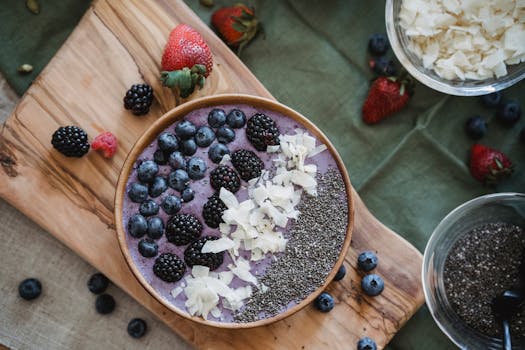
Photo: Nicola Barts / Pexels
American
Smoothie Bowl
The diets react (see scores below)
Common Ingredients
- frozen berries
- banana
- yogurt
- almond milk
- granola
- chia seeds
- honey
- sliced almonds
Specific recipes may vary.
Incompatible with 5 of 11 diets
Diet Ratings
A smoothie bowl is one of the most keto-incompatible breakfast options possible. The combination of banana (27g net carbs each), frozen berries (high sugar fruit), honey (pure sugar), granola (oat/grain-based, ~30-40g net carbs per serving), and yogurt (unless full-fat plain, often contains added sugars) stacks multiple high-carb, high-sugar ingredients together. A single serving likely contains 80-120g of net carbs — far exceeding the entire daily keto limit of 20-50g. Chia seeds and sliced almonds are keto-friendly in isolation, but they cannot offset the massive carbohydrate load from the other ingredients. This dish is fundamentally built around fruit sugars, grains, and added sweeteners, making it incompatible with ketosis by design.
This smoothie bowl contains yogurt, which is a dairy product and a clear animal-derived ingredient that disqualifies it from being vegan. Honey is also included, which the Vegan Society and most major vegan organizations exclude as an animal product. The remaining ingredients — frozen berries, banana, almond milk, granola, chia seeds, and sliced almonds — are all plant-based. However, the presence of dairy yogurt alone is sufficient to render this dish non-vegan. A vegan version is easily achievable by substituting coconut yogurt or another plant-based yogurt alternative, and using maple syrup or agave instead of honey.
A small minority of plant-based eaters accept honey as compatible with their diet, arguing that bees are not meaningfully harmed in its production and that it is a byproduct rather than a slaughter product. However, this does not resolve the dairy yogurt issue, which is unambiguously non-vegan across all vegan frameworks.
This smoothie bowl contains multiple non-paleo ingredients that disqualify it outright. Yogurt is a dairy product, explicitly excluded from the paleo diet. Almond milk in its commercial form is a processed food often containing additives, preservatives, and seed oils. Granola is grain-based (typically oats) and processed, making it a clear violation. Chia seeds, while sometimes debated, are classified as a grain-like seed and excluded by strict paleo standards. The combination of these problematic ingredients — dairy, grains, and processed foods — makes this dish incompatible with paleo principles. The paleo-approved ingredients (frozen berries, banana, honey, sliced almonds) are outnumbered and outweighed by the non-compliant ones.
This smoothie bowl contains many Mediterranean-friendly ingredients—frozen berries, banana, chia seeds, and sliced almonds are all plant-based whole foods strongly aligned with Mediterranean principles. Yogurt is an acceptable moderate dairy source. However, a few elements introduce caution: honey adds sugar (though natural and used sparingly in Mediterranean tradition, it still contributes added sugars); granola is often a processed, sugar-laden product with refined ingredients that conflicts with the emphasis on whole grains; and the overall dish is high in natural sugars from fruit and honey combined. The lack of olive oil or savory whole grains also means it sits outside the classic Mediterranean breakfast pattern, which tends toward whole grain bread, olive oil, tomatoes, and cheese. The dish is nutritious but not archetypal Mediterranean.
Some modern Mediterranean diet practitioners embrace fruit-forward breakfasts with nuts, seeds, and yogurt as fully compatible, particularly given the strong plant diversity and probiotic dairy content. Traditional Greek yogurt with honey and walnuts (a classic preparation) supports a more permissive view of this dish, pushing it closer to an 'approve' rating if granola is minimized or replaced with whole oats.
A Smoothie Bowl is almost entirely composed of plant-based foods that are strictly excluded on the carnivore diet. Frozen berries, banana, almond milk, granola, chia seeds, and sliced almonds are all plant-derived ingredients. Honey is debated but does not redeem this dish. The only marginally relevant ingredient is yogurt, which is a dairy product, but even that is a minor component surrounded by a meal that fundamentally violates every tier of carnivore eating. There is no animal protein, no animal fat, and the dish is dominated by fruits, grains, seeds, and plant-based milk. This is essentially the opposite of a carnivore meal.
This smoothie bowl contains multiple excluded ingredients: yogurt (dairy), granola (grains), and honey (added sugar). Three separate Whole30 violations make this dish clearly non-compliant. Even if those ingredients were removed, the smoothie bowl format itself skirts the program's guidance on not recreating junk food or comfort food analogs, though smoothies per se are not explicitly banned. The combination of violations here makes this a straightforward avoid.
This smoothie bowl contains multiple high-FODMAP ingredients that make it unsuitable during the elimination phase. Banana is high-FODMAP at ripe/full servings (contains excess fructose and fructooligosaccharides — only unripe, small portions are considered low-FODMAP). Yogurt is high in lactose unless a lactose-free version is specified. Honey is high in excess fructose and is a clear avoid. Granola typically contains wheat, oats in large quantities, honey, and/or dried fruit — usually high-FODMAP. The combination of even moderate-FODMAP ingredients (banana, yogurt, honey, granola) stacks to create a high cumulative FODMAP load, a phenomenon known as FODMAP stacking. Frozen berries (e.g., blueberries, raspberries) can be low-FODMAP at small portions, almond milk is generally low-FODMAP, chia seeds are low-FODMAP at 2 tbsp, and sliced almonds are low-FODMAP at small servings (10–15 almonds), but these safe ingredients are outweighed by the multiple high-FODMAP components in this dish.
A smoothie bowl contains several DASH-friendly components — frozen berries and banana provide potassium, fiber, and antioxidants; chia seeds and sliced almonds offer magnesium, healthy fats, and protein; and almond milk is a low-sodium, low-saturated-fat base. However, the dish raises caution flags depending on ingredient specifics. Yogurt could be full-fat or low-fat — DASH specifies low-fat dairy, so the version matters significantly. Honey adds free sugars, which DASH limits. Granola is frequently high in added sugar and sometimes saturated fat depending on the brand. As a combined bowl, the added sugars from honey plus granola plus naturally sweet fruit can push total sugar load high, and calorie density from granola and almonds requires portion control. When prepared with low-fat yogurt, unsweetened granola, and minimal honey, this dish trends toward approval. As commonly served in American breakfast contexts (often generous portions of sweetened granola and honey drizzle), it lands in caution territory.
NIH DASH guidelines emphasize fruits, low-fat dairy, nuts, and seeds as core food groups, which this bowl largely features — a strict DASH clinician might approve a carefully portioned version. However, some DASH-oriented dietitians caution that smoothie bowls can mask high free-sugar loads (from honey, sweetened granola, and fruit concentration), and that blending fruit removes some satiety benefits of whole fruit, making overconsumption easier.
The Smoothie Bowl presents significant Zone Diet challenges primarily due to its carbohydrate-heavy, protein-light profile. Frozen berries are favorable Zone carbs (low-glycemic, polyphenol-rich), chia seeds provide omega-3s, sliced almonds offer monounsaturated fat, and yogurt contributes some protein — these are positives. However, the dish is undermined by several 'unfavorable' Zone elements: banana is explicitly classified by Sears as an unfavorable high-glycemic fruit; granola is a dense, high-glycemic carbohydrate; and honey is essentially concentrated sugar. Together, banana + granola + honey create a significant glycemic spike that would push this meal far outside the 40/30/30 balance. Critically, the dish lacks adequate lean protein — with no primary protein source, a typical smoothie bowl would deliver maybe 8-12g of protein (mostly from yogurt) against 60-80g+ of carbohydrates, making the ratio wildly skewed. To Zone-ify this dish, one would need to eliminate or minimize banana, granola, and honey; add a scoop of protein powder or egg whites; and keep portions of remaining carbs tightly controlled. As served in a typical restaurant or recipe, this dish is difficult to balance, but with heavy modification it could work.
Some Zone practitioners following Sears' later anti-inflammatory writings (The Anti-Inflammation Zone) would note that the berries, chia seeds, and almonds provide excellent polyphenols and omega-3s that align well with the updated Zone philosophy. A smaller portion of banana (less than half) contributes potassium and is manageable within a block framework. The dish could be salvaged with Greek yogurt as the dominant base (boosting protein), removal of granola and honey, and careful portioning — making it a 'caution with modifications' rather than near-avoid.
This smoothie bowl has a strong anti-inflammatory foundation. Frozen berries deliver high concentrations of anthocyanins and polyphenols shown to reduce CRP and oxidative stress. Chia seeds provide plant-based omega-3s (ALA), fiber, and lignans. Sliced almonds contribute vitamin E and healthy monounsaturated fats. Banana adds potassium and prebiotic fiber (especially if slightly underripe). Almond milk is a neutral, low-inflammatory base. Yogurt — assuming low-fat or plain — contributes probiotics that support gut health and may modulate inflammatory pathways, though dairy is in the 'moderate' tier. The main concerns are honey (added sugar, even if natural) and granola, which is frequently made with refined oats, added sugars, and sometimes seed oils. If granola is store-bought and sweetened, it introduces refined carbohydrates and potentially pro-inflammatory ingredients that partially offset the bowl's otherwise strong profile. Overall, this is a genuinely anti-inflammatory breakfast when prepared with unsweetened or minimally sweetened granola and honey used sparingly.
Some anti-inflammatory practitioners, particularly those following AIP or low-glycemic protocols, would flag the combined glycemic load of banana + honey + granola as potentially driving insulin spikes and downstream inflammatory signaling — Dr. David Ludwig's research on glycemic variability supports this concern. Conversely, Dr. Weil's framework and mainstream anti-inflammatory nutrition would endorse this bowl for its berry polyphenols, omega-3s from chia, and overall plant diversity, viewing the natural sugars as acceptable in this whole-food context.
A smoothie bowl built on frozen berries, banana, yogurt, almond milk, chia seeds, and sliced almonds has genuine nutritional merit — antioxidants, fiber from chia seeds and berries, and some protein and healthy fats from yogurt and almonds. However, several features create friction for GLP-1 patients. First, protein is listed as 'none' and the dish as assembled is protein-light: yogurt contributes some, but without a protein-forward base (Greek yogurt, added protein powder) this bowl likely delivers only 8–12g protein, well below the 15–30g per-meal target. Second, honey adds free sugars with no nutritional payoff — an empty-calorie concern when every bite must count. Third, granola is typically high in refined carbs, added sugar, and fat, and can be surprisingly calorie-dense in even small portions. Fourth, the cold, blended, high-volume nature of the bowl can feel filling initially but may not sustain satiety the way solid protein-forward meals do; some GLP-1 patients report that cold blended foods move through the stomach faster despite slowed gastric emptying, leading to earlier hunger return. On the positive side, chia seeds add meaningful fiber and omega-3s, berries are low-sugar fruit with high antioxidant and fiber value, and almond milk is low-calorie and easy to digest. The dish is not harmful but in its standard form falls short of the protein priority that GLP-1 dietary guidance places first. A simple upgrade — swapping regular yogurt for plain Greek yogurt and omitting or minimizing honey and granola — would push this toward an approve.
Some GLP-1-focused registered dietitians view smoothie bowls favorably as a way to pack micronutrients and fiber into a small, easy-to-eat volume for patients struggling with nausea or reduced appetite, particularly in early dose-escalation phases when solid food is difficult to tolerate. Others caution that the blended format, added sugars from honey and granola, and low protein density make it a poor default breakfast choice and recommend it only as an occasional option with deliberate protein additions.
*See how scores were generated at our methodology page.
Nutritional profile
Six traits that cut across every diet.
Fiber & Plants
How much whole-plant food and fiber it delivers.
Healthy Fats
The quality of its fats (unsaturated, omega-3).
Whole / Unprocessed
How close it is to its natural, unprocessed form.
Gut Gentle
How easy it is on digestion (low FODMAP, few irritants).
Low Glycemic
How little it spikes your blood sugar.
Protein Density
How much protein it packs per calorie.
Controversy Index
Higher controversy = more disagreement between diets.
Diet-Specific Tips
 Vegan — 5/10
View tips
- Yogurt is a dairy product — a direct animal-derived ingredient that disqualifies the dish
- Honey is excluded by the Vegan Society and most mainstream vegan organizations as an animal product
- All other ingredients (berries, banana, almond milk, granola, chia seeds, sliced almonds) are fully plant-based
- A vegan version is easily made with plant-based yogurt (e.g., coconut or soy) and maple syrup or agave in place of honey
 Mediterranean — 6/10
View tips
- Berries, banana, chia seeds, and almonds are strongly Mediterranean-approved plant foods
- Yogurt is acceptable as a moderate dairy source
- Honey adds natural but non-trivial sugar load
- Granola is often processed with added sugars and refined grains, conflicting with Mediterranean principles
- No olive oil or savory whole grains; not a traditional Mediterranean breakfast pattern
- High cumulative sugar content from fruit, honey, and potentially sweetened granola
 DASH — 6/10
View tips
- Frozen berries and banana are DASH-approved fruits rich in potassium and fiber
- Chia seeds and sliced almonds provide magnesium, healthy fats, and fiber consistent with DASH
- Yogurt should be low-fat or non-fat per DASH guidelines — full-fat version would lower the score
- Honey adds free/added sugars which DASH limits — should be minimized
- Granola is frequently high in added sugar and saturated fat; unsweetened low-fat versions preferred
- Almond milk is low sodium and low saturated fat, a DASH-compatible liquid base
- Portion control is critical — this dish can easily exceed serving size recommendations for nuts and grains
- Overall nutrient profile (potassium, magnesium, fiber, calcium) aligns with DASH micronutrient targets when prepared thoughtfully
 Zone — 4/10
View tips
- Banana is explicitly 'unfavorable' in Zone methodology due to high glycemic index
- Granola is a high-glycemic, carbohydrate-dense topping that disrupts Zone ratios
- Honey adds concentrated sugar with no protein or fat to balance it
- No primary lean protein source — yogurt alone provides insufficient protein for a Zone meal (far below the 25g per meal target)
- Frozen berries are favorable Zone carbs — low-glycemic and polyphenol-rich
- Chia seeds provide beneficial omega-3 fatty acids aligned with Zone anti-inflammatory goals
- Sliced almonds are a favorable Zone fat source (monounsaturated)
- Overall macronutrient ratio likely skews 65-70% carbs / 10-15% protein / 15-20% fat — far from Zone's 40/30/30 target
 Anti-Inflammatory — 7/10
View tips
- Frozen berries: rich in anthocyanins and polyphenols — strongly anti-inflammatory
- Chia seeds: plant-based omega-3s (ALA) and soluble fiber
- Sliced almonds: vitamin E, monounsaturated fats — anti-inflammatory
- Yogurt: probiotics support gut-immune axis (moderate dairy tier)
- Granola: potential source of added sugar and refined carbs — quality matters significantly
- Honey: natural but still added sugar; inflammatory impact is dose-dependent
- Banana: prebiotic fiber benefit offset slightly by high natural sugar content
- Almond milk: neutral, low-inflammatory base
 GLP-1 Friendly — 5/10
View tips
- Protein content likely 8–12g as assembled — falls short of 15–30g per-meal GLP-1 target
- Chia seeds provide fiber and omega-3 fatty acids — positive
- Granola adds refined carbs, added sugar, and excess fat — negative
- Honey is an empty-calorie sugar source — negative for GLP-1 patients
- Berries are low-sugar, high-antioxidant, high-fiber fruit — positive
- Plain Greek yogurt substitution would significantly improve protein density
- High water content from frozen berries supports hydration — positive
- Cold blended format may be easier to tolerate during GI side-effect phases — conditional positive