Photo: Valeria Boltneva / Pexels
French
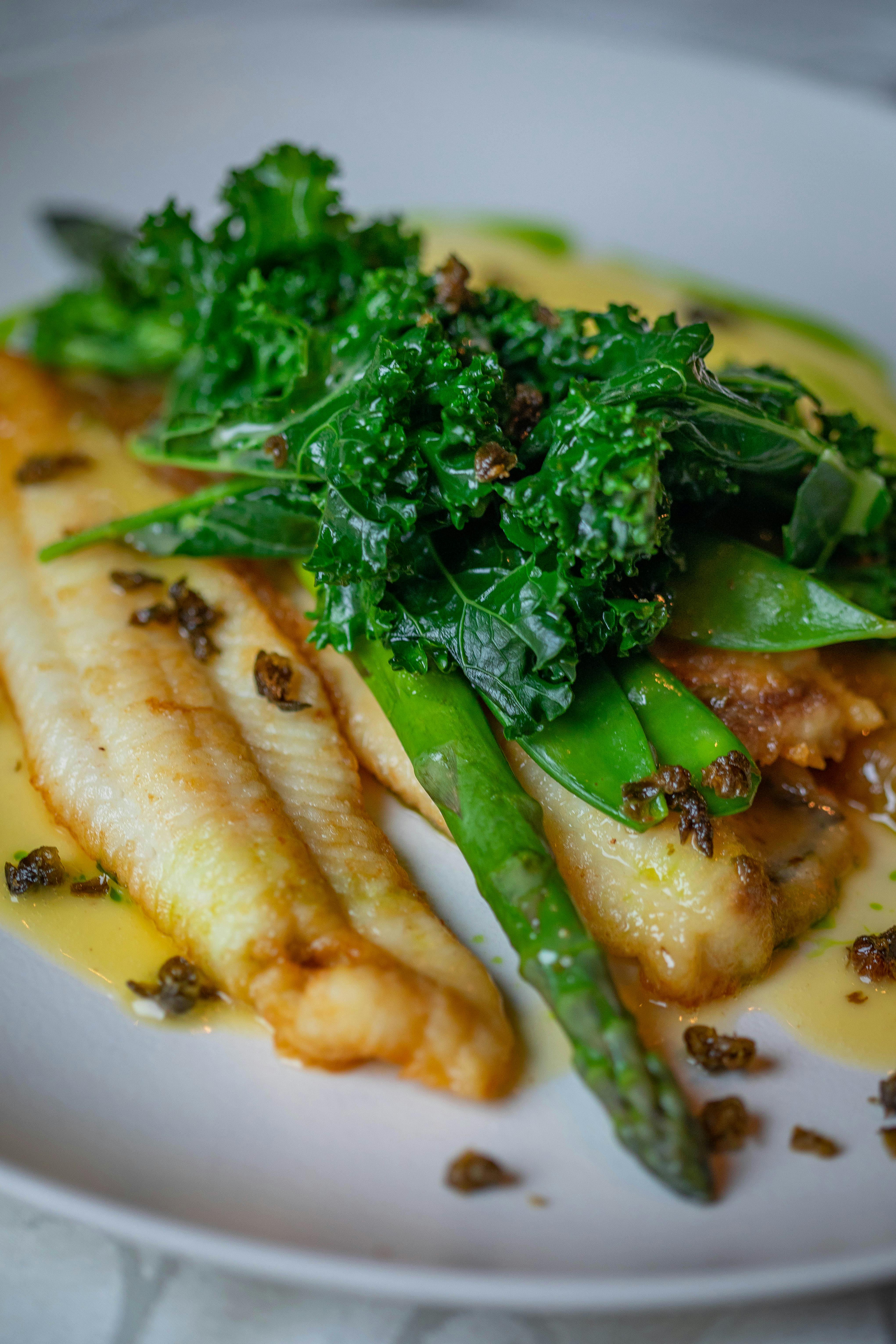
Sole Meunière
The diets react (see scores below)
Common Ingredients
- sole
- flour
- butter
- lemon juice
- parsley
- salt
- black pepper
- capers
Specific recipes may vary.
Incompatible with 4 of 11 diets
Diet Ratings
Sole Meunière is fundamentally keto-friendly in its protein and fat components — sole is a lean white fish, butter is an excellent keto fat, lemon juice and capers add minimal carbs, and parsley/seasonings are negligible. The critical problem is the flour dredge. Traditional Sole Meunière requires coating the fish in all-purpose wheat flour before pan-frying, which adds meaningful net carbs (roughly 6-10g per serving depending on coating thickness) and introduces grains — both violations of keto principles. The dish can be easily adapted (almond flour, coconut flour, or no coating at all) to become fully keto-compliant, but as traditionally prepared, the flour coating earns a caution rating. The butter-based sauce itself is ideal for keto.
Sole Meunière contains multiple animal products that are strictly excluded from a vegan diet. Sole is a fish (an animal product), and butter is a dairy product derived from cow's milk. Both are core, non-negotiable violations of vegan principles. The remaining ingredients — flour, lemon juice, parsley, salt, black pepper, and capers — are plant-based, but the presence of sole and butter makes this dish entirely incompatible with a vegan diet.
Sole Meunière contains multiple non-paleo ingredients that disqualify it. Flour (wheat) is a grain — one of the most explicitly excluded foods in all paleo frameworks. Butter is a dairy product, excluded under strict paleo rules. Salt is added, also excluded. These are not edge cases or gray-area ingredients; flour, butter, and added salt represent clear violations with broad consensus across paleo authorities including Cordain, Sisson, and Wolf. The sole itself is fully paleo-approved, and lemon juice, parsley, black pepper, and capers are all acceptable. However, the dish as classically prepared cannot be considered paleo-compatible without significant substitutions (e.g., almond flour instead of wheat flour, ghee or olive oil instead of butter, omitting added salt).
Sole Meunière is built around sole, a lean white fish that is highly compatible with Mediterranean diet principles — fish is strongly encouraged 2-3 times per week. The lemon juice, parsley, capers, and black pepper are all Mediterranean-friendly ingredients. However, the dish departs from Mediterranean principles in two notable ways: butter is the primary cooking fat rather than olive oil, and the fish is dredged in refined white flour. Butter is an animal-derived saturated fat that is not a traditional Mediterranean staple, whereas extra virgin olive oil is the canonical fat. The refined flour adds minimal nutritional value. These two elements together prevent a full 'approve' rating, though the dish's excellent protein source and overall lightness keep it well above 'avoid' territory.
Some Mediterranean diet authorities, particularly those studying traditional French coastal and Provençal culinary practices, argue that occasional butter use in otherwise fish-forward dishes is acceptable within a broadly Mediterranean eating pattern. A more lenient interpretation would note that the overall dish is lean, vegetable-adjacent in its garnishes, and far preferable to red meat preparations.
Sole Meunière is fundamentally incompatible with the carnivore diet despite having a carnivore-approved protein (sole) and fat (butter). The dish is defined by its non-carnivore components: flour (grain-based coating), lemon juice (plant-derived citrus), parsley (herb/plant), black pepper (plant spice), and capers (plant-derived). The sole and butter are carnivore-approved, but the remaining ingredients are all plant-derived or grain-based, making this dish a clear avoid. It cannot be adapted in minor ways — removing flour, lemon, parsley, and capers would leave only butter-seared sole, which is an entirely different dish.
Sole Meunière contains two excluded ingredients: flour (a grain product, used to dredge the fish) and butter (dairy, not ghee or clarified butter). 'Meunière' literally means 'miller's wife' and refers to the flour coating, which is central to the dish. Regular butter is explicitly excluded — only ghee or clarified butter is permitted. Without both flour and butter, this dish is fundamentally altered and no longer Sole Meunière. The remaining ingredients (sole, lemon juice, parsley, salt, black pepper, capers) are all Whole30 compliant.
Sole Meunière is largely low-FODMAP, with sole (fish) being entirely safe, butter low-FODMAP at standard serving sizes, lemon juice low-FODMAP in typical amounts, parsley low-FODMAP as a garnish, and salt, pepper, and capers all safe. The main concern is the wheat flour used for dredging. While the actual amount of flour that adheres to the fish during cooking is small (typically 1-2 tablespoons coating a fillet), it does contain fructans from wheat. In the strict elimination phase, even small amounts of wheat flour are technically discouraged. However, the quantity of flour per serving after dredging and cooking is minimal and may not reach the threshold to trigger symptoms in most IBS sufferers. Gluten-free flour (e.g., rice flour) can be substituted for a clearly low-FODMAP version.
Monash University classifies wheat as high-FODMAP due to fructans, and during the strict elimination phase many clinical FODMAP dietitians advise avoiding all wheat-containing preparations regardless of quantity. However, the negligible amount of flour remaining after dredging and pan-frying means some practitioners consider this dish effectively low-FODMAP in practice, especially if gluten-free flour is substituted.
Sole Meunière features sole, a lean white fish that is strongly aligned with DASH principles — fish is explicitly encouraged. However, the classic preparation involves a significant amount of butter (typically 3-4 tablespoons per serving), which introduces saturated fat well beyond DASH recommendations for a single dish. The lemon juice and parsley are DASH-positive additions. Capers are moderately high in sodium (roughly 200-400mg per tablespoon), and added salt compounds sodium concerns. Flour dredging is minimal and not a significant issue. Overall, the dish is not inherently incompatible with DASH, but the generous butter and sodium from capers and salt require moderation and portion awareness. A DASH-modified version using reduced butter or a plant oil substitute and omitting or rinsing capers would score higher (7-8).
NIH DASH guidelines emphasize lean fish as a core protein and would flag the substantial butter as a saturated fat concern, placing this dish firmly in caution territory. However, updated clinical interpretations note that moderate butter use in an otherwise fish-forward dish is acceptable within a broader DASH-compliant dietary pattern, especially given sole's excellent lean protein and omega content, and some practitioners allow occasional classical preparations.
Sole Meunière has strong Zone foundations — sole is an excellent lean white fish providing high-quality protein with minimal saturated fat, and lemon juice, parsley, and capers are polyphenol-rich, low-glycemic additions that Sears would actively endorse. However, two issues require attention. First, the flour dredge introduces a moderate-glycemic carbohydrate coating; while the quantity is small, it is a refined grain with a higher glycemic index, making it an 'unfavorable' carb in Zone terminology. Second, and more significantly, butter is the primary fat in this dish. Early Zone protocol strongly favored monounsaturated fats (olive oil, avocado) over saturated fats like butter, and the butter quantity in a classic meunière preparation can be substantial (2-3 tbsp), pushing fat calories into the saturated range. If portioned carefully — a 3-4 oz sole fillet, a light flour dusting, and a modest 1 tsp butter finish supplemented with lemon — this dish can be incorporated into a Zone meal. It is not an ideal Zone building block, but it is far from disqualifying. The dish lacks a carbohydrate block counterpart and would need to be served alongside low-glycemic vegetables to achieve the 40/30/30 ratio as a complete meal.
Sears' later writings (The Anti-Inflammation Zone, The OmegaRx Zone) placed greater emphasis on omega-3 fatty acids and polyphenols, which would elevate sole's standing as an anti-inflammatory protein source. Some Zone practitioners argue that small amounts of butter in a sauce are perfectly acceptable within the Zone's fat block allotment, especially when paired with the omega-3 profile of the fish. From this perspective, a well-portioned Sole Meunière could score closer to a 7, provided the butter is kept to under 1 tsp and the flour is minimized.
Sole Meunière presents a genuinely mixed anti-inflammatory profile. On the positive side, sole is a lean white fish that provides some omega-3 fatty acids (though far less than fatty fish like salmon or mackerel), along with quality protein and selenium. Lemon juice adds vitamin C and flavonoids, parsley is rich in antioxidants (apigenin, luteolin, vitamin K), black pepper contains piperine with mild anti-inflammatory properties, and capers are notably high in quercetin and kaempferol — both potent anti-inflammatory flavonoids. However, the defining characteristic of meunière preparation is generous use of butter (a saturated fat), which anti-inflammatory frameworks consistently list as a food to limit or moderate. The flour dredging adds refined carbohydrates, another ingredient to minimize. The dish is not inherently pro-inflammatory in the way fried fast food would be, but the butter content is a meaningful concern. A home cook could reduce the butter quantity significantly and achieve a better anti-inflammatory outcome, but as traditionally prepared, the dish lands in the caution zone — acceptable occasionally but not a model anti-inflammatory meal.
Some anti-inflammatory practitioners, including those following a Mediterranean-adjacent approach, would argue that small to moderate amounts of butter in an otherwise fish-based, herb-rich dish are acceptable and that the anti-inflammatory benefits of regular fish consumption (even lean white fish) and the potent flavonoids in capers and parsley partially offset the saturated fat concern. Strict anti-inflammatory protocols (e.g., Dr. Weil's framework) would emphasize replacing butter with extra virgin olive oil to transform this into a clearly approved preparation.
Sole Meunière features a lean, easily digestible white fish (sole) that is an excellent protein source — roughly 20-25g protein per 150g fillet — which strongly supports GLP-1 dietary goals. However, the classic preparation involves dredging in flour and cooking in a generous amount of browned butter (beurre meunière), which introduces significant saturated fat per serving. The butter is not a trace ingredient; it is structurally central to the dish. High fat content is a known trigger for nausea, bloating, and reflux in GLP-1 patients due to slowed gastric emptying. The flour dredge adds refined carbohydrates with minimal fiber benefit. On the positive side, sole itself is low-fat and easy to digest, lemon juice and parsley add micronutrients, and capers contribute antioxidants with negligible calories. The dish is portion-friendly and not fried in the deep-fry sense. If prepared with a significantly reduced butter quantity — a light pan coating rather than the classic generous beurre — it becomes a much better GLP-1 option. As traditionally prepared in a restaurant, the fat load earns a caution rating.
Some GLP-1-focused dietitians consider moderate amounts of unsaturated or even saturated fat acceptable when paired with high-quality lean protein, arguing that the satiety benefit and protein density of sole outweigh the fat concern in a reduced-portion context. Others maintain that butter-heavy preparations should be categorically limited because individual sensitivity to fat-triggered nausea is highly variable and difficult to predict in GLP-1 patients.
*See how scores were generated at our methodology page.
Nutritional profile
Six traits that cut across every diet.
Fiber & Plants
How much whole-plant food and fiber it delivers.
Healthy Fats
The quality of its fats (unsaturated, omega-3).
Whole / Unprocessed
How close it is to its natural, unprocessed form.
Gut Gentle
How easy it is on digestion (low FODMAP, few irritants).
Low Glycemic
How little it spikes your blood sugar.
Protein Density
How much protein it packs per calorie.
Controversy Index
Higher controversy = more disagreement between diets.
Diet-Specific Tips
 Keto — 5/10
View tips
- Wheat flour dredge is the primary keto concern — adds 6-10g net carbs and violates no-grains rule
- Butter sauce is excellent for keto — high-fat, minimal carbs
- Sole provides quality protein with very low carbs
- Lemon juice contributes ~1-2g net carbs per serving — acceptable in moderation
- Capers and parsley are negligible carb contributors
- Easily modified: substitute almond flour or skip dredge entirely to make fully keto-compliant
 Mediterranean — 5/10
View tips
- Sole is a lean white fish, strongly encouraged in Mediterranean diet
- Butter replaces olive oil as primary fat — not Mediterranean-canonical
- Refined white flour coating contradicts preference for whole grains or no breading
- Lemon, capers, parsley are exemplary Mediterranean-compatible flavor components
- Overall dish is light and fish-centered, aligning with the spirit of the diet despite technique issues
 Low-FODMAP — 6/10
View tips
- Sole (fish) is entirely FODMAP-free and safe in any quantity
- Wheat flour for dredging contains fructans — amount adhering per serving is small but technically non-compliant during strict elimination
- Substituting rice flour or gluten-free flour makes this dish clearly low-FODMAP
- Butter is low-FODMAP at standard serving sizes (lactose is minimal in butter)
- Lemon juice is low-FODMAP at typical culinary amounts (up to 2 tablespoons)
- Capers are low-FODMAP in standard garnish quantities
- Parsley is low-FODMAP as a herb garnish
- No garlic or onion in this classic preparation
 DASH — 5/10
View tips
- Sole is a lean white fish explicitly encouraged in DASH guidelines
- Butter is the primary concern — high saturated fat content typical in Meunière preparation
- Capers contribute moderate-to-high sodium; added table salt further increases sodium load
- Lemon juice and parsley are DASH-positive ingredients with no downsides
- Flour dredging is minimal and does not significantly affect nutritional profile
- Dish can be easily DASH-modified by reducing butter quantity or substituting olive oil
 Zone — 6/10
View tips
- Sole is an excellent lean white fish — ideal Zone protein source, approximately 7g protein per ounce
- Butter provides saturated fat rather than the preferred monounsaturated fat; quantity must be carefully limited
- Flour dredge is a refined, higher-glycemic carbohydrate — classified as 'unfavorable' in Zone terminology
- Lemon juice, parsley, and capers are polyphenol-rich, anti-inflammatory additions aligned with Zone principles
- Dish as presented lacks a complete carbohydrate block and must be paired with low-glycemic vegetables
- Classic preparation can use 2-3 tbsp butter, which would significantly exceed Zone fat block targets and saturated fat limits
 Anti-Inflammatory — 5/10
View tips
- Sole provides lean protein and modest omega-3 fatty acids — beneficial but not as potent as fatty fish
- Butter (saturated fat) is the primary fat source — consistently flagged as a limit/moderate ingredient in anti-inflammatory guidelines
- Capers are exceptionally high in quercetin and kaempferol, among the most anti-inflammatory flavonoids
- Parsley contributes apigenin, luteolin, and vitamin C — meaningful antioxidant support
- Flour dredging adds refined carbohydrates, a minor but noted negative
- Lemon juice and black pepper (piperine) add further anti-inflammatory micronutrients
- Preparation method (pan-frying in butter) is the key limiting factor — substituting EVOO would significantly improve the profile
 GLP-1 Friendly — 5/10
View tips
- Sole is a lean, high-quality protein source (~20-25g per fillet) — strongly positive
- Butter is a structural, generous ingredient adding significant saturated fat — negative for GLP-1 tolerability
- Slowed gastric emptying on GLP-1s amplifies fat-related GI side effects (nausea, bloating, reflux)
- Flour dredge adds refined carbs with negligible fiber — minor negative
- No high-fiber ingredients present — a missed nutritional opportunity
- Dish is portion-friendly and not deep-fried — mild positive
- Home preparation with reduced butter would improve score to 7-8