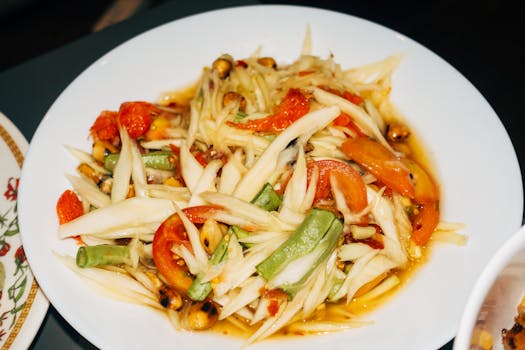
Photo: Markus Winkler / Pexels
Thai
Som Tam with Shrimp
The diets react (see scores below)
Common Ingredients
- green papaya
- shrimp
- lime juice
- fish sauce
- peanuts
- Thai chiles
- garlic
- palm sugar
Specific recipes may vary.
Incompatible with 6 of 11 diets
Diet Ratings
Som Tam with Shrimp contains multiple keto-problematic ingredients that make it largely incompatible with ketosis. Green papaya, while unripe and lower in sugar than ripe papaya, still contains significant net carbs (roughly 8-12g per cup shredded). More critically, palm sugar is a direct added sugar with high glycemic impact, and traditional Som Tam recipes use it liberally. Combined with the natural sugars in green papaya, a standard serving could easily push 20-30g net carbs — potentially consuming an entire day's keto carb budget in one dish. Shrimp, lime juice, fish sauce (in small amounts), Thai chiles, garlic, and peanuts are more manageable, but the palm sugar alone is a near-disqualifier. A heavily modified version omitting palm sugar and using very small portions of papaya might shift this to caution, but the traditional preparation as described is not keto-compatible.
Some lazy keto or targeted keto practitioners argue that unripe green papaya is close enough to a vegetable (low sugar, higher fiber than ripe fruit) and that a small amount of palm sugar spread across multiple servings is negligible, placing the dish in caution territory with portion control and sugar reduction.
Som Tam with Shrimp contains multiple animal-derived ingredients that are strictly excluded from a vegan diet. Shrimp is seafood (an animal product), and fish sauce is derived from fermented fish — both are clear animal products with no ambiguity in vegan classification. While the base of this dish (green papaya, lime juice, peanuts, Thai chiles, garlic, palm sugar) is entirely plant-based, the primary protein and a key flavoring component are animal-derived, making this dish entirely incompatible with a vegan diet.
Som Tam with Shrimp contains three significant non-paleo ingredients that disqualify it from approval. Peanuts are legumes and clearly excluded from the paleo diet. Fish sauce, while seemingly natural, is a processed condiment that typically contains added salt and sometimes sugar or preservatives — both excluded under paleo rules. Palm sugar is a refined/processed sugar and falls into the avoid category. The base ingredients — green papaya, shrimp, lime juice, Thai chiles, and garlic — are genuinely paleo-friendly, but the combination of peanuts (a legume), fish sauce (processed/added salt), and palm sugar (refined sugar) pulls this dish firmly into avoid territory. It could be modified into a paleo dish by substituting peanuts with cashews or omitting them, replacing fish sauce with coconut aminos, and swapping palm sugar for a small amount of honey or dates.
Som Tam with Shrimp aligns well with Mediterranean diet principles despite being a Thai dish. Shrimp is seafood, encouraged 2-3 times weekly. Green papaya is a fresh vegetable base, peanuts provide plant-based healthy fats and protein, garlic and chiles are anti-inflammatory aromatics, and lime juice adds brightness without added sugar. The dish is whole-food, plant-forward, and seafood-centered. The main concern is palm sugar (a small amount of added sugar) and fish sauce (high sodium, processed condiment), which slightly detract from an otherwise excellent profile. Overall, this is a nutrient-dense, low-calorie, vegetable-rich dish with quality protein.
Some Mediterranean diet purists might rate this lower due to palm sugar (added sugar contradicts guidelines) and fish sauce (a processed, high-sodium condiment with no Mediterranean analog). A stricter interpretation would substitute lemon juice and minimal salt, as the diet traditionally avoids added sugars and heavily processed condiments even in small quantities.
Som Tam with Shrimp is almost entirely incompatible with the carnivore diet. While shrimp and fish sauce are animal-derived and acceptable, they are completely overshadowed by the dish's plant-based foundation. Green papaya is the primary ingredient — a fruit excluded on carnivore. Peanuts are legumes, strictly forbidden. Thai chiles, garlic, and lime juice are all plant-derived. Palm sugar is a processed plant sweetener. The dish is fundamentally a plant salad with shrimp as a minor component, making it a clear avoid regardless of which carnivore tier is considered.
Som Tam with Shrimp contains two excluded ingredients that make it non-compliant with Whole30. First, peanuts are legumes and explicitly excluded from the Whole30 program — peanut butter and peanuts are specifically called out as off-limits. Second, palm sugar is an added sugar (a natural sweetener, but still sugar), which is excluded under the Whole30 rule against added sugars of any kind. The remaining ingredients — green papaya, shrimp, lime juice, fish sauce, Thai chiles, and garlic — are all Whole30-compliant on their own. A modified version of this dish could be made compliant by omitting the peanuts and palm sugar (or substituting compliant ingredients like crushed compliant nuts and date paste or fruit juice for sweetness), but as traditionally prepared, this dish cannot be consumed on Whole30.
Som Tam with Shrimp contains two clear high-FODMAP ingredients that make it unsuitable during the elimination phase. Garlic is one of the highest-fructan foods tested by Monash University and is a definitive 'avoid' at any culinary quantity — even a small clove used in a marinade or dressing is problematic. Palm sugar, while lower in FODMAPs than some sweeteners, is less concerning, but the dish's structural use of garlic is the dominant issue. Green papaya is generally considered low-FODMAP at standard servings. Shrimp is a low-FODMAP protein with no FODMAPs. Lime juice and fish sauce are low-FODMAP condiments. Thai chiles are low-FODMAP. Peanuts are low-FODMAP at a small serving (approximately 32g per Monash). However, garlic is a non-negotiable high-FODMAP ingredient in this dish and cannot be safely consumed during elimination. The dish as traditionally prepared cannot be made low-FODMAP without substituting garlic with garlic-infused oil, which would require a significant recipe modification.
Som Tam with Shrimp has several DASH-friendly elements — green papaya is a low-calorie, fiber-rich vegetable; shrimp is a lean protein; lime juice adds flavor without sodium; garlic and Thai chiles are DASH-compatible aromatics. However, the dish is significantly compromised by fish sauce, which is extremely high in sodium (roughly 1,000–1,500mg per 2 tablespoons, the typical amount used in a single serving of som tam). This alone can approach or exceed the standard DASH sodium limit for an entire day. Palm sugar is a tropical-derived added sugar, which DASH limits. Peanuts are acceptable in moderation (nuts are encouraged on DASH) but add caloric density. The overall dish is nutritious in concept but the fish sauce sodium load is a serious concern for DASH compliance, placing it firmly in 'caution' territory rather than 'avoid' because the base ingredients are otherwise wholesome and the dish can be modified.
NIH DASH guidelines explicitly restrict high-sodium condiments like fish sauce, making standard Som Tam problematic. However, updated clinical interpretations note that for non-hypertensive individuals or those on standard (not low-sodium) DASH, a smaller amount of fish sauce paired with an otherwise low-sodium day may be manageable — some DASH-oriented dietitians allow ethnic condiments in reduced quantities rather than categorical exclusion.
Som Tam with Shrimp aligns well with Zone Diet principles in several key ways. Green papaya is a low-glycemic, high-fiber vegetable carbohydrate — exactly the type of colorful, favorable carb Sears promotes. Shrimp is an excellent lean protein source, fitting cleanly into Zone protein blocks. Lime juice, fish sauce, garlic, and Thai chiles add flavor with negligible macro impact. The main caution is palm sugar, which is a moderate-to-high glycemic sweetener that nudges the dish toward 'unfavorable' carb territory, though traditional recipes use a relatively small amount. Peanuts introduce fat (primarily monounsaturated with some polyunsaturated omega-6), which is acceptable as a fat block but requires portioning. Overall, this dish is a reasonable Zone meal — the protein-to-carb balance is workable, fat comes from a legitimate source, and the glycemic load remains relatively low given the fiber content of green papaya. Portion control on the peanuts and sugar will determine whether this hits the 40/30/30 target.
Some Zone practitioners would score this higher (8-9) given that green papaya is a premier low-GI Zone vegetable and shrimp is among the leanest proteins. However, palm sugar is classified as an 'unfavorable' carbohydrate in Sears' framework, and peanuts — while acceptable — are technically legumes with an omega-6 fat profile less ideal than Sears' preferred monounsaturated sources like almonds or macadamia nuts. Practitioners following Sears' later anti-inflammatory writing may also flag the fish sauce sodium and ensure omega-3 balance is addressed elsewhere in the day.
Som Tam with Shrimp is a nutrient-dense, largely whole-food dish with several genuinely anti-inflammatory components. Green papaya provides papain, vitamin C, and beta-carotene. Thai chiles and garlic are well-established anti-inflammatory spices with capsaicin and allicin content respectively. Lime juice contributes vitamin C and flavonoids. Shrimp is a lean protein with some omega-3s and astaxanthin (a potent antioxidant carotenoid), though its omega-6 to omega-3 ratio and arachidonic acid content are mild concerns. Peanuts offer resveratrol and monounsaturated fats but also have a higher omega-6 content than tree nuts like walnuts. The two ingredients pulling this dish toward 'caution' rather than 'approve' are fish sauce and palm sugar. Fish sauce is high in sodium (chronic high sodium intake is associated with inflammatory pathways and hypertension, though it is used in modest amounts here as a condiment), and palm sugar is still an added sugar — though it has a lower glycemic index than refined white sugar and contains trace minerals. The palm sugar distinguishes this from a purely anti-inflammatory dish; added sugars of any kind are on the 'limit' list. The overall dish is lightly sweetened and the sugar quantity is small in context, so this is a borderline approve/caution rather than a concern dish. Rated 6 — close to the approve threshold but held back by added sugar and sodium load.
Some anti-inflammatory practitioners, particularly those following Dr. Weil's broader framework emphasizing colorful whole foods, spices, and lean seafood, might rate this dish higher (7/approve) given the dominant anti-inflammatory ingredients — chiles, garlic, lime, papaya, and shrimp — arguing that the small amount of palm sugar used as a flavor balance is nutritionally negligible. Others following stricter protocols that flag any added sugars and high-sodium fermented condiments (fish sauce) as inflammatory triggers would keep it firmly in caution territory.
Som Tam with Shrimp is a nutrient-dense, largely whole-food dish with meaningful strengths for GLP-1 patients, but a few features warrant moderation. Shrimp is an excellent lean protein source, delivering roughly 18-20g of protein in a standard serving at very low fat — a strong positive. Green papaya is high in water content and fiber, supporting hydration and digestion. Lime juice and garlic add micronutrients with negligible calories. However, the Thai chiles are a real concern: significant chile heat can worsen reflux, nausea, and GI irritation in GLP-1 patients due to slowed gastric emptying — spicy food stays in contact with the stomach lining longer. Palm sugar adds modest but non-trivial added sugar with little nutritional value. Peanuts contribute healthy unsaturated fats but also add fat and calories that can accumulate quickly and slow gastric emptying further. Fish sauce is high in sodium, which is generally acceptable in small amounts but worth noting. The dish scores well on protein density, fiber, water content, and nutrient density per calorie — but the spice level and combination of peanut fat plus chile heat make it a caution rather than an approve for many GLP-1 patients, particularly in early treatment phases when GI sensitivity is highest.
Some GLP-1-focused dietitians would rate this higher, noting that the spice concern is highly individual — patients with established GI tolerance may find this dish well-suited to their needs given its lean protein, fiber, and hydration profile. Others maintain that even moderate chile heat is disproportionately problematic on GLP-1s due to prolonged gastric contact time, and would recommend requesting a mild preparation to move this into the approve category.
*See how scores were generated at our methodology page.
Nutritional profile
Six traits that cut across every diet.
Fiber & Plants
How much whole-plant food and fiber it delivers.
Healthy Fats
The quality of its fats (unsaturated, omega-3).
Whole / Unprocessed
How close it is to its natural, unprocessed form.
Gut Gentle
How easy it is on digestion (low FODMAP, few irritants).
Low Glycemic
How little it spikes your blood sugar.
Protein Density
How much protein it packs per calorie.
Controversy Index
Higher controversy = more disagreement between diets.
Diet-Specific Tips
 Mediterranean — 8/10
View tips
- Shrimp is an approved seafood source, aligned with 2-3x weekly recommendation
- Green papaya serves as a whole-vegetable base, strongly encouraged
- Peanuts provide plant-based fat and protein, Mediterranean-compatible
- Palm sugar is an added sugar, which Mediterranean guidelines discourage
- Fish sauce is a high-sodium processed condiment, not Mediterranean-traditional
- No refined grains, no red meat, no saturated fat sources
- Lime juice and garlic are anti-inflammatory, diet-compatible ingredients
 DASH — 5/10
View tips
- Fish sauce is very high in sodium (~1,000–1,500mg per typical serving use), a major DASH concern
- Green papaya is a DASH-positive vegetable — low calorie, high fiber, rich in potassium
- Shrimp is a lean protein well-aligned with DASH guidelines
- Palm sugar is an added sugar from a tropical source, both of which DASH limits
- Peanuts are DASH-approved nuts but portion control is needed for caloric balance
- Lime juice, garlic, and chiles add flavor without sodium — DASH-friendly substitutes for salt
- Low-sodium or reduced fish sauce versions would significantly improve DASH compatibility
 Zone — 7/10
View tips
- Green papaya is a low-glycemic, high-fiber Zone-favorable vegetable carbohydrate
- Shrimp is a lean, clean protein source well-suited to Zone protein blocks
- Palm sugar is an unfavorable high-glycemic carb that should be minimized in portion
- Peanuts provide fat blocks but carry more omega-6 than Sears' preferred monounsaturated sources
- Fish sauce and lime juice add flavor with negligible macro disruption
- Overall macro balance is achievable with modest portioning adjustments
 Anti-Inflammatory — 6/10
View tips
- Green papaya: rich in vitamin C, beta-carotene, and papain — anti-inflammatory
- Thai chiles: capsaicin is a well-documented anti-inflammatory compound
- Garlic: allicin and organosulfur compounds reduce inflammatory markers
- Shrimp: lean protein with astaxanthin and modest omega-3s, mild arachidonic acid concern
- Lime juice: vitamin C and flavonoids support antioxidant defense
- Peanuts: contain resveratrol but higher omega-6 than tree nuts
- Palm sugar: added sugar — pro-inflammatory in excess, though used in small amounts here
- Fish sauce: high sodium; chronic excess linked to inflammatory pathways
 GLP-1 Friendly — 6/10
View tips
- Shrimp provides lean, high-quality protein (~18-20g per serving) with minimal fat — strong positive
- Green papaya is high in fiber and water content, supporting digestion and hydration
- Thai chiles may worsen GLP-1 GI side effects (nausea, reflux) due to slowed gastric emptying — significant concern
- Peanuts add healthy unsaturated fat but increase total fat per serving and can slow gastric emptying
- Palm sugar contributes added sugar with low nutritional value — minor but nonzero negative
- Fish sauce is high sodium — acceptable in the small quantities typical of this dish
- Overall nutrient density per calorie is good; dish is whole-food based with no refined grains or fried components
- Spice level is the primary swing factor — a mild preparation would likely score 7-8