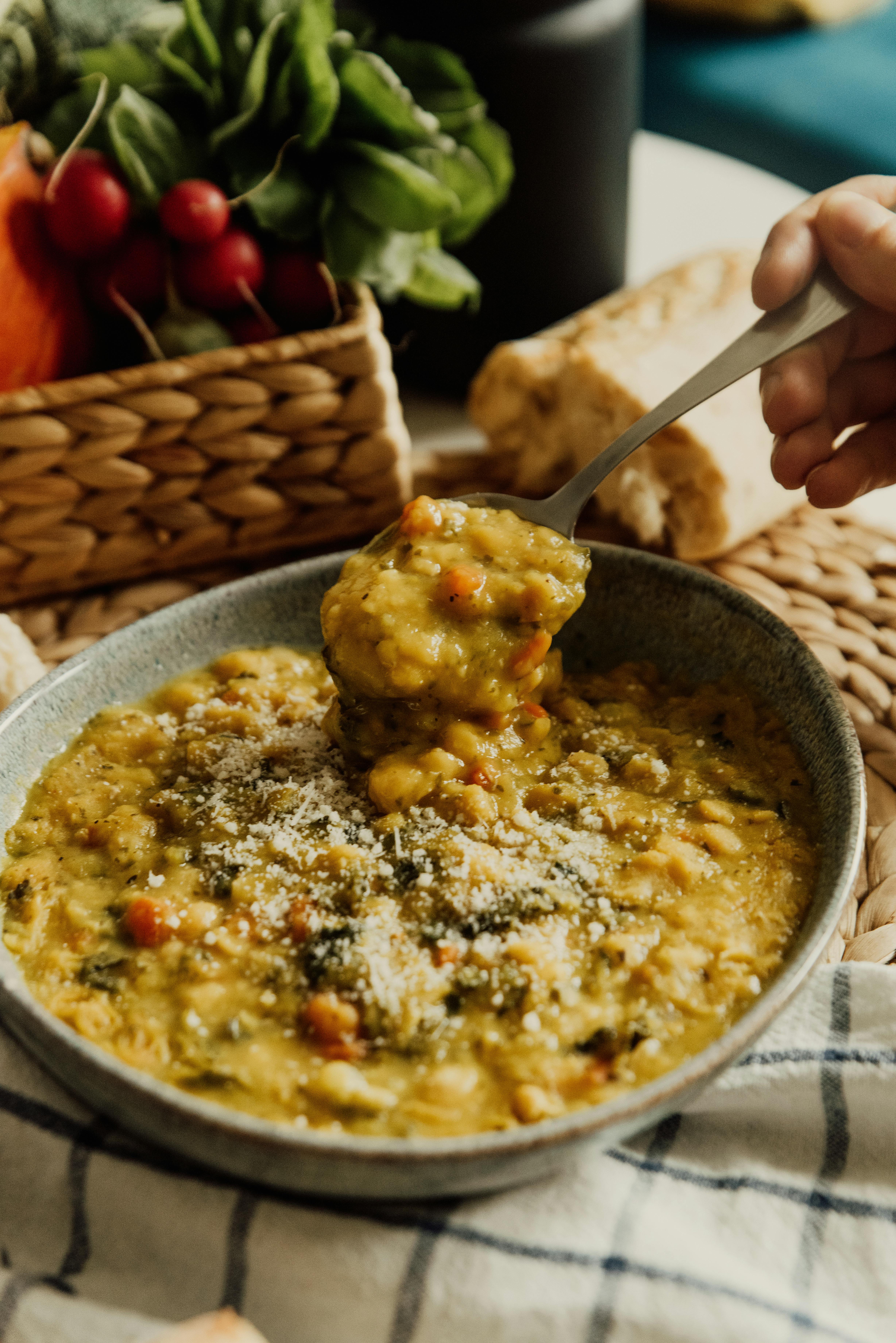
Photo: Alesia Kozik / Pexels
French
Soupe au Pistou
The diets react (see scores below)
Common Ingredients
- white beans
- zucchini
- green beans
- tomatoes
- basil
- garlic
- Parmesan
- olive oil
Specific recipes may vary.
Incompatible with 6 of 11 diets
Diet Ratings
Soupe au Pistou is fundamentally incompatible with ketogenic eating. The primary offender is white beans (haricots blancs), which are a legume dense in starch — a single cup contains roughly 35-40g net carbs, far exceeding most people's daily keto limit on its own. Tomatoes add additional net carbs, and the soup is traditionally served in generous portions. While zucchini, green beans, basil, garlic, Parmesan, and olive oil are all keto-friendly ingredients, they cannot redeem a dish whose identity and bulk come from white beans. The pistou sauce itself (basil, garlic, olive oil, Parmesan) is excellent for keto, but the soup base as a whole is a high-carb vegetable and legume dish that will reliably break ketosis.
Soupe au Pistou as listed contains Parmesan cheese, which is an animal-derived dairy product and therefore not vegan. Parmesan is also notably non-vegetarian in its traditional form (containing animal rennet), but the primary vegan disqualifier here is simply that it is dairy. The remaining ingredients — white beans, zucchini, green beans, tomatoes, basil, garlic, and olive oil — are all fully plant-based and would constitute an excellent vegan soup base. A vegan version is easily achievable by omitting Parmesan or substituting a nutritional yeast-based or store-bought vegan Parmesan alternative.
Soupe au Pistou contains multiple non-paleo ingredients that make it clearly incompatible with the diet. White beans are legumes, explicitly excluded from paleo due to their lectin and phytate content. Green beans are also legumes and similarly excluded. Parmesan is dairy, which is prohibited across virtually all paleo frameworks. While zucchini, tomatoes, basil, garlic, and olive oil are all paleo-approved, the foundation of this dish — its beans and cheese — are hard stops. With three distinct non-paleo ingredient categories present (legumes ×2, dairy ×1), this dish cannot be adapted without fundamentally changing its character.
Soupe au Pistou is a Provençal dish that exemplifies Mediterranean dietary principles almost perfectly. The base consists entirely of plant foods — white beans (legumes), zucchini, green beans, and tomatoes (vegetables) — with extra virgin olive oil as the primary fat source in the pistou sauce alongside fresh basil and garlic. Parmesan is present but in small amounts typical of a finishing garnish, consistent with moderate dairy use. There are no refined grains, added sugars, red meat, or processed ingredients. This is essentially the French Mediterranean answer to minestrone, rooted in the same culinary tradition that inspired the Mediterranean diet framework.
Soupe au Pistou is a Provençal vegetable and bean soup that is entirely plant-based. Every single ingredient — white beans, zucchini, green beans, tomatoes, basil, garlic, and olive oil — is explicitly excluded from the carnivore diet. Legumes (white beans) are among the most problematic foods on carnivore due to lectins and antinutrients. The pistou itself is a plant-oil-and-herb paste. The only marginally animal-adjacent ingredient is Parmesan, which is a dairy product and would itself be debated, but it is a minor garnish in an otherwise 100% plant-based dish. There is no animal protein, no animal fat of carnivore-approved origin, and no pathway to making this dish carnivore-compatible without a complete reconstruction.
Soupe au Pistou contains two clearly excluded ingredients under Whole30 rules. First, white beans are legumes and are explicitly excluded from the program — unlike green beans, snow peas, and sugar snap peas, white beans (and other dried/canned legumes) have no exception. Second, Parmesan is a dairy product and is explicitly excluded. Green beans are present but are one of the explicitly allowed legume exceptions, so they pose no problem. The remaining ingredients — zucchini, tomatoes, basil, garlic, and olive oil — are all fully compliant. However, the two excluded ingredients (white beans and Parmesan) are not incidental; they are structural and defining components of this classic French dish. The dish cannot be considered Whole30-compatible as described.
Soupe au Pistou contains multiple high-FODMAP ingredients that make it unsuitable during the elimination phase. White beans are high in GOS (galacto-oligosaccharides) and are high-FODMAP even at small servings (safe only at ~42g canned, rinsed — a very small portion for a soup where beans are a primary ingredient). Garlic is one of the highest-FODMAP foods known, rich in fructans, and is a foundational ingredient in pistou (the French equivalent of pesto). Parmesan, while lower in lactose, can contribute depending on quantity. The combination of white beans as a bulk ingredient plus garlic in the pistou sauce makes this dish essentially unavoidable high-FODMAP in its traditional form. Green beans and zucchini are low-FODMAP at standard servings, tomatoes are low-FODMAP in moderate amounts, and olive oil and basil are safe — but the problematic ingredients are structural to the dish, not optional garnishes.
Soupe au Pistou is highly compatible with the DASH diet. The base is built on white beans (legumes — excellent source of fiber, potassium, and plant protein), zucchini, green beans, and tomatoes (all DASH-emphasized vegetables rich in potassium, magnesium, and fiber). The pistou paste uses olive oil (a DASH-approved vegetable oil), fresh basil, and garlic — all favorable. The main DASH concern is the Parmesan cheese, which contributes sodium and some saturated fat; however, Parmesan is used in small amounts as a garnish in this dish, limiting its impact. When prepared without added salt or with careful sodium control, this soup aligns well with DASH principles across multiple food groups simultaneously.
NIH DASH guidelines approve legumes, vegetables, and olive oil as core components, making this soup largely unambiguous. However, some conservative DASH clinicians flag that restaurant or packaged versions of this soup can contain 600–900mg of sodium per serving from added salt and cheese, pushing it toward 'caution' — home preparation with minimal added salt keeps it firmly in 'approve' territory.
Soupe au Pistou is a nutrient-dense, vegetable-forward dish with several Zone-favorable components. The zucchini, green beans, tomatoes, basil, and garlic are all excellent low-glycemic vegetables. Olive oil is an ideal monounsaturated fat. However, the dish lacks a dedicated lean protein source (listed as 'none'), which means the 30% protein target of a Zone meal is not met without supplementation. White beans serve as the primary protein contributor but are classified as 'unfavorable' carbohydrates in Zone terminology due to their higher carbohydrate density relative to protein — they count primarily as carb blocks with modest protein. Parmesan adds a small amount of protein and fat but is also relatively high in saturated fat. The pistou (basil, garlic, olive oil, Parmesan) is Zone-friendly in appropriate quantities. As a standalone meal, the macro ratio skews heavily toward carbohydrates with insufficient protein, making it a 'caution.' With the addition of a lean protein (e.g., poached fish or chicken on the side), this dish becomes a strong Zone component.
Some Zone practitioners, particularly those following Sears' later anti-inflammatory and polyphenol-focused work (e.g., 'The Zone Diet and Inflammation'), would view this dish more favorably. The high polyphenol content from tomatoes, basil, garlic, and olive oil aligns strongly with Sears' later emphasis on anti-inflammatory eating. White beans, while carb-heavy, provide fiber that reduces net carb blocks and offer meaningful plant protein, and Sears acknowledges legumes as acceptable vegetarian protein-carb blocks in 'Mastering the Zone.' A generous portion of Parmesan alongside ample white beans could partially close the protein gap.
Soupe au Pistou is an excellent anti-inflammatory dish. The pistou base — extra virgin olive oil, basil, and garlic — is a trifecta of anti-inflammatory compounds: oleocanthal and polyphenols from EVOO, eugenol and rosmarinic acid from basil, and allicin/organosulfur compounds from garlic. White beans and green beans supply fiber, plant protein, and magnesium, all associated with reduced inflammatory markers like CRP and IL-6. Zucchini and tomatoes contribute antioxidants including carotenoids (lycopene in tomatoes) and vitamin C. Parmesan is present in a modest finishing quantity, so the saturated fat load from full-fat dairy is minimal and unlikely to shift the overall inflammatory profile meaningfully. The absence of processed ingredients, refined carbohydrates, or pro-inflammatory oils makes this a nearly ideal anti-inflammatory soup. It aligns closely with the Mediterranean dietary pattern, which is one of the most research-supported anti-inflammatory eating frameworks.
Soupe au Pistou is a nutrient-dense, vegetable-forward French soup that aligns well with GLP-1 dietary priorities. White beans and green beans provide meaningful plant-based protein and fiber — a single serving can deliver 8-12g protein and 6-10g fiber depending on portion size. The vegetable base (zucchini, tomatoes, green beans) adds volume, water content, and micronutrients with low caloric density, supporting hydration and easy digestibility. The pistou — basil, garlic, Parmesan, and olive oil — uses unsaturated fat (olive oil) and a modest amount of Parmesan for flavor and additional protein. Fat content is moderate but comes from preferred sources. The broth-based format is gentle on the stomach and well-suited to the slowed gastric emptying caused by GLP-1 medications. The main limitation is that white beans alone are not a complete high-density protein source per GLP-1 standards, and this dish as described has no primary animal protein, making it difficult to hit 15-30g protein per meal without a significant serving size or a protein add-on.
Some GLP-1-focused dietitians would rate this higher as an excellent fiber and plant-protein vehicle, particularly for patients tolerating legumes well, while others would flag the olive oil quantity in pistou as portion-sensitive — traditional recipes can add 3-4 tablespoons, meaningfully increasing fat load and potential for GI discomfort in sensitive patients.
*See how scores were generated at our methodology page.
Nutritional profile
Six traits that cut across every diet.
Fiber & Plants
How much whole-plant food and fiber it delivers.
Healthy Fats
The quality of its fats (unsaturated, omega-3).
Whole / Unprocessed
How close it is to its natural, unprocessed form.
Gut Gentle
How easy it is on digestion (low FODMAP, few irritants).
Low Glycemic
How little it spikes your blood sugar.
Protein Density
How much protein it packs per calorie.
Controversy Index
Higher controversy = more disagreement between diets.
Diet-Specific Tips
 Mediterranean — 9/10
View tips
- Legumes (white beans) provide plant-based protein and fiber — a Mediterranean dietary staple
- Multiple vegetables (zucchini, green beans, tomatoes) as the dish base
- Extra virgin olive oil is the primary fat via the pistou
- Fresh garlic and basil add phytonutrients with no nutritional downside
- Parmesan used sparingly as a garnish, consistent with moderate dairy guidelines
- No red meat, processed foods, refined grains, or added sugars
- Provençal origin places this squarely within traditional Mediterranean culinary heritage
 DASH — 8/10
View tips
- White beans are DASH-ideal legumes: high fiber, potassium, and plant protein
- Multiple DASH-core vegetables: zucchini, green beans, tomatoes
- Olive oil is the preferred fat source in DASH guidelines
- Parmesan adds sodium and saturated fat but in small garnish quantities
- No red meat, no added sugar, no tropical oils
- Sodium level depends heavily on preparation — home-cooked with low-sodium broth is DASH-compliant
- Rich in potassium, magnesium, and fiber from vegetable-bean base
 Zone — 6/10
View tips
- No dedicated lean protein source — meal skews heavily carbohydrate without addition of protein
- White beans are 'unfavorable' Zone carbs: high net carbs relative to protein, count primarily as carb blocks
- Olive oil in pistou is an ideal Zone monounsaturated fat source
- Zucchini, green beans, and tomatoes are all favorable low-glycemic Zone vegetables
- Parmesan contributes some protein and fat but also adds saturated fat
- High polyphenol content (basil, garlic, tomatoes, olive oil) aligns with Sears' anti-inflammatory focus
- Dish is Zone-compatible as a meal component if paired with a lean protein side
 Anti-Inflammatory — 9/10
View tips
- Extra virgin olive oil provides oleocanthal and polyphenols with well-documented anti-inflammatory effects
- Garlic contains allicin and organosulfur compounds that suppress NF-κB inflammatory pathways
- Basil contributes rosmarinic acid and eugenol, both anti-inflammatory phytochemicals
- White beans and green beans provide fiber and plant protein associated with lower CRP
- Tomatoes supply lycopene and vitamin C, potent antioxidants
- Zucchini adds carotenoids and additional fiber with minimal inflammatory load
- Parmesan is used in small amounts, limiting saturated fat impact
- No refined carbohydrates, seed oils, added sugars, or processed ingredients
 GLP-1 Friendly — 7/10
View tips
- Good plant-based protein from white beans, but falls short of 15-30g per meal target without a protein add-on
- High fiber content from beans, zucchini, green beans, and tomatoes supports digestion and constipation prevention
- Broth-based and vegetable-heavy — easy to digest and hydration-supportive
- Olive oil is a preferred unsaturated fat but quantity in pistou is portion-sensitive
- Parmesan adds flavor and a small protein boost with modest saturated fat
- No fried, spicy, carbonated, or high-sugar components — no major GLP-1 side effect triggers
- Protein gap: recommend pairing with grilled chicken, fish, or a protein shake to meet per-meal targets