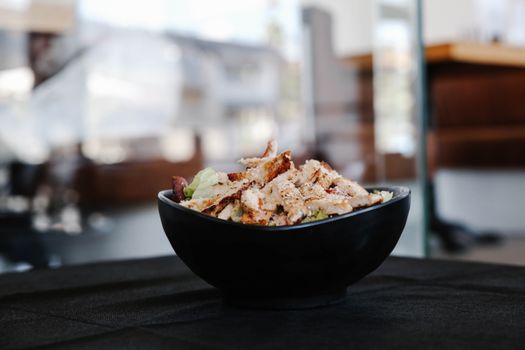
Photo: Maor Attias / Pexels
American
Southwest Chicken Salad
The diets react (see scores below)
Common Ingredients
- chicken breast
- romaine lettuce
- black beans
- corn
- avocado
- tomato
- tortilla strips
- chipotle dressing
Specific recipes may vary.
Incompatible with 6 of 11 diets
Diet Ratings
This Southwest Chicken Salad is largely incompatible with a ketogenic diet due to multiple high-carb ingredients. Black beans (~20g net carbs per half cup), corn (~15g net carbs per half cup), and tortilla strips (~15-20g net carbs per serving) alone can easily push a single meal well past the entire daily carb limit of 20-50g. The chipotle dressing likely contains added sugars. While some ingredients are keto-friendly — chicken breast as lean protein, romaine lettuce, avocado (a keto superfood), and tomato in small amounts — the problematic ingredients are structural to the dish, not minor garnishes. This salad as served would almost certainly break ketosis.
Southwest Chicken Salad contains chicken breast as its primary protein, which is poultry — a direct animal product explicitly excluded under all vegan frameworks. There is no ambiguity here: no vegan organization or school of thought permits the consumption of slaughtered animal flesh. The remaining ingredients (romaine lettuce, black beans, corn, avocado, tomato, tortilla strips) are plant-based, and the chipotle dressing may or may not be vegan depending on formulation, but none of that matters given the presence of chicken. This dish is wholly incompatible with a vegan diet.
This Southwest Chicken Salad contains multiple non-paleo ingredients that make it incompatible with the diet. Black beans are legumes, which are explicitly excluded from paleo due to their lectin and phytate content. Corn is a grain and also excluded. Tortilla strips are a processed grain product (typically made from corn or wheat). The chipotle dressing is likely a processed condiment containing seed oils, added sugar, and/or preservatives. While the base ingredients — chicken breast, romaine lettuce, avocado, and tomato — are fully paleo-approved, the disqualifying ingredients (black beans, corn, tortilla strips, chipotle dressing) are too numerous and central to the dish to salvage it as-is.
This Southwest Chicken Salad has a solid Mediterranean-compatible foundation — lean chicken breast (acceptable in moderation), romaine lettuce, black beans (excellent legume source), tomato, avocado (healthy monounsaturated fats), and corn are all broadly aligned with Mediterranean principles. However, several elements pull it away from ideal: tortilla strips are a refined, processed grain add-on with little nutritional value and added sodium; the chipotle dressing is likely processed and may contain added sugars, seed oils, or preservatives not aligned with Mediterranean eating; and the overall flavor profile is Tex-Mex American rather than Mediterranean. The dish is not harmful but requires modification — swapping tortilla strips for nuts or seeds and replacing chipotle dressing with olive oil and lemon — to become a strong Mediterranean option.
Some flexible Mediterranean diet interpretations, including those promoted by American clinical dietitians adapting the diet for U.S. populations, would view this salad favorably given its heavy vegetable and legume base, lean protein, and avocado, arguing that the spirit of the diet (whole foods, plant-forward) is largely preserved even if specific ingredients aren't traditionally Mediterranean.
Southwest Chicken Salad is fundamentally incompatible with the carnivore diet. While chicken breast is an acceptable animal protein, the dish is overwhelmingly composed of plant-based ingredients. Romaine lettuce, black beans, corn, avocado, tomato, and tortilla strips are all entirely plant-derived and strictly excluded from the carnivore diet. Black beans and corn are legumes and grains respectively — among the most prohibited categories. Tortilla strips are processed grain products. The chipotle dressing almost certainly contains plant oils, spices, and likely sugar or other plant-derived additives. Even the most liberal carnivore practitioners who include dairy and coffee would have no basis for consuming this dish. The single carnivore-compatible ingredient (chicken) is completely overwhelmed by the plant-heavy composition.
This Southwest Chicken Salad contains multiple Whole30-excluded ingredients. Black beans are legumes and explicitly prohibited on Whole30. Corn is a grain and is excluded. Tortilla strips are both a grain product (corn/wheat-based) and fall under the 'no chips/crackers/tortillas' rule (rule 4 explicitly lists chips, tortillas, and crackers as prohibited). The chipotle dressing is likely to contain non-compliant ingredients such as added sugar, dairy, or soy. With at least three clearly excluded ingredient categories present, this dish is definitively non-compliant.
This Southwest Chicken Salad contains multiple high-FODMAP ingredients that make it unsuitable during the elimination phase. Black beans are high in GOS (galacto-oligosaccharides) and are high-FODMAP at any typical serving size. Avocado becomes high-FODMAP above 1/8 of a fruit due to polyols (sorbitol), and a salad portion typically includes at least half an avocado. Tortilla strips are almost certainly made from wheat flour (fructans) unless specified corn-based. The chipotle dressing is an unknown quantity — commercial dressings frequently contain garlic and/or onion (fructans), honey or HFCS (excess fructose), or other high-FODMAP additives. Corn is low-FODMAP at half a cob but can become moderate at larger portions. The remaining ingredients — chicken breast, romaine lettuce, and tomato — are all low-FODMAP and safe. However, the combination of black beans, avocado at salad-portion sizes, likely wheat-based tortilla strips, and an unspecified dressing creates too many high-FODMAP risks to make this dish safe during elimination without substantial modification.
Southwest Chicken Salad contains several strong DASH-compatible ingredients — lean chicken breast is an excellent protein source, romaine lettuce and tomato are core DASH vegetables, black beans provide fiber/potassium/magnesium, avocado offers healthy monounsaturated fats and potassium, and corn adds fiber. However, two components pull the dish into caution territory: tortilla strips are a processed, sodium-containing addition with refined carbs and potentially trans or saturated fats depending on preparation, and chipotle dressing is typically high in sodium, saturated fat, and sometimes added sugar. The dressing in particular can easily add 300–600mg of sodium per serving, significantly impacting the DASH sodium budget. As commonly served in restaurants, this dish likely exceeds moderate sodium thresholds, though a homemade version with low-sodium dressing and baked tortilla strips could score 7–8.
NIH DASH guidelines would flag the sodium-heavy dressing and processed tortilla strips as problematic components. However, updated clinical interpretations note that the overall nutrient density of this dish — with avocado, black beans, and lean protein — aligns well with DASH principles if the dressing is made with olive oil, lime juice, and minimal salt, and tortilla strips are omitted or minimized; some DASH dietitians would approve a modified version outright.
The Southwest Chicken Salad has a strong Zone foundation but contains two problematic ingredients that require careful management. The base is excellent: chicken breast is a ideal lean Zone protein, romaine lettuce is a favorable low-glycemic vegetable, avocado provides perfect monounsaturated fat, and tomato is a favorable carb source. Black beans are a reasonable Zone carb with decent fiber (lowering net carbs) and even contribute some protein. However, corn is a higher-glycemic, starchy vegetable that Sears classifies as unfavorable — similar to potatoes in its glycemic impact. Tortilla strips are a processed, high-glycemic refined carb that add empty starch with little nutritional value. The chipotle dressing is an unknown variable: many restaurant versions are high in sugar, omega-6 seed oils, or saturated fat. As served in most restaurants, this dish is likely carb-heavy and unbalanced toward the 40% carb target — the corn, beans, and tortilla strips together push carbs well above Zone proportions. With portion control (reducing or eliminating tortilla strips, limiting corn, requesting dressing on the side or substituting olive oil), this dish can be brought into Zone balance and becomes a solid meal.
Some Zone practitioners would rate this higher (7) arguing that black beans are a favorable high-fiber carb and the avocado plus chicken combination naturally approximates Zone macros. Sears' later writings also place more emphasis on polyphenol-rich foods like the chipotle and tomato, which could be seen as anti-inflammatory bonuses. The verdict depends heavily on portion sizes and dressing composition, which vary significantly.
This Southwest Chicken Salad has a genuinely mixed anti-inflammatory profile. On the positive side, avocado is a standout — rich in monounsaturated fats, vitamin E, and anti-inflammatory phytosterols. Black beans provide fiber, plant protein, and polyphenols. Romaine lettuce and tomato offer carotenoids and antioxidants. Corn contributes some fiber and antioxidants like lutein and zeaxanthin, though it is relatively high in omega-6 and starchy. Chicken breast is a lean protein that falls squarely in the 'moderate' category per anti-inflammatory guidelines. The problematic elements are the tortilla strips (refined carbohydrates, likely fried in seed oils, often contain additives) and the chipotle dressing, which is the biggest wildcard — commercial chipotle dressings frequently contain soybean or canola oil, added sugars, and preservatives, all of which are cautionary or avoid-tier ingredients. If the dressing is homemade with olive oil and quality spices, the dish rises toward a 7; with a typical commercial dressing and generous tortilla strips, it leans toward the low end of 'caution.' The chipotle spice itself (chili pepper base) is anti-inflammatory. Overall, this dish has a solid anti-inflammatory foundation undermined by processed components.
Most anti-inflammatory frameworks would rate the whole-food components (avocado, beans, lean chicken, vegetables) favorably, but the verdict hinges heavily on preparation details. Anti-inflammatory purists following Dr. Weil's guidelines or functional medicine protocols would flag the refined tortilla strips and commercial dressing as disqualifying for a full 'approve,' while a more flexible interpretation of the anti-inflammatory framework — focusing on the overall dietary pattern rather than individual ingredients — might approve a version with minimal strips and a light olive oil-based dressing.
This Southwest Chicken Salad has a strong nutritional foundation for GLP-1 patients — chicken breast provides lean, high-quality protein (25-35g per serving), black beans add both protein and fiber, romaine and tomato contribute hydration and micronutrients, and avocado offers heart-healthy unsaturated fats. However, two ingredients push this from approve to caution: the tortilla strips and the chipotle dressing. Tortilla strips are fried, low in nutritional value, and add refined carbs and fat with little protein or fiber payoff — the definition of empty calories for a GLP-1 patient eating small portions. Chipotle dressing is typically high in fat (often cream- or mayo-based) and can be moderately spicy, both of which risk worsening nausea, reflux, or bloating. The avocado, while a healthy fat source, adds meaningful fat volume; combined with a creamy dressing, total fat per serving can become problematic for GLP-1 GI tolerance. As ordered at a restaurant this dish is also portion-sensitive — standard restaurant servings are large and the calorie and fat load scales up quickly. Modified (tortilla strips omitted or minimized, dressing on the side or swapped for salsa or a light vinaigrette), this dish would score 8 and earn an approve.
Some GLP-1-focused registered dietitians would approve this dish as-is, arguing that the avocado and dressing fats are unsaturated and the overall protein-fiber combination is exactly what GLP-1 patients need; the disagreement centers on individual fat tolerance, since GLP-1-related delayed gastric emptying means fat tolerance varies considerably from patient to patient and some handle moderate fat meals without significant GI side effects.
*See how scores were generated at our methodology page.
Nutritional profile
Six traits that cut across every diet.
Fiber & Plants
How much whole-plant food and fiber it delivers.
Healthy Fats
The quality of its fats (unsaturated, omega-3).
Whole / Unprocessed
How close it is to its natural, unprocessed form.
Gut Gentle
How easy it is on digestion (low FODMAP, few irritants).
Low Glycemic
How little it spikes your blood sugar.
Protein Density
How much protein it packs per calorie.
Controversy Index
Higher controversy = more disagreement between diets.
Diet-Specific Tips
 Mediterranean — 5/10
View tips
- Chicken breast is an acceptable moderate protein — not a core Mediterranean food but permitted a few times weekly
- Black beans and corn contribute legume and vegetable value, consistent with Mediterranean principles
- Avocado provides heart-healthy monounsaturated fats analogous to olive oil's role
- Tortilla strips are refined, processed grains — a clear negative against Mediterranean guidelines
- Chipotle dressing is likely processed with non-Mediterranean oils, added sugar, or preservatives
- No olive oil as primary fat; avocado partially compensates but dressing undermines this
- Overall dish is nutritionally reasonable but not authentically or fully Mediterranean
 DASH — 6/10
View tips
- Lean chicken breast is a DASH-approved protein source
- Black beans provide DASH-valued fiber, potassium, and magnesium
- Avocado contributes heart-healthy monounsaturated fats and potassium
- Chipotle dressing is typically high in sodium and saturated fat — a major concern
- Tortilla strips are processed, refined-carb, and sodium-containing — not DASH-emphasized
- Corn, tomato, and romaine lettuce are all DASH-compatible vegetables
- Low-sodium homemade dressing and eliminating tortilla strips would significantly improve DASH compatibility
- Restaurant versions likely exceed DASH sodium limits for a single dish
 Zone — 6/10
View tips
- Chicken breast is an ideal Zone lean protein source
- Avocado provides excellent monounsaturated fat — a perfect Zone fat block
- Romaine and tomato are favorable low-glycemic Zone carbohydrates
- Black beans are usable Zone carbs due to high fiber reducing net carbs, but portion must be controlled
- Corn is classified as an unfavorable high-glycemic vegetable in Zone methodology
- Tortilla strips are a processed refined carb — the single worst Zone element in this dish
- Chipotle dressing is an unknown variable likely containing sugar or seed oils
- As restaurant-served, total carbs likely exceed Zone's 40% target; modification needed
 Anti-Inflammatory — 6/10
View tips
- Avocado: strong anti-inflammatory monounsaturated fats and vitamin E — approve-tier
- Black beans: high fiber and polyphenols, reduces CRP — approve-tier
- Lean chicken breast: neutral to mildly favorable — moderate-tier
- Tortilla strips: refined carbohydrates, likely fried in seed oils — caution/avoid-tier
- Chipotle dressing: commercial versions often contain seed oils, added sugar, preservatives — caution/avoid-tier
- Tomato and romaine: antioxidants, carotenoids — approve-tier
- Corn: some fiber and antioxidants but higher omega-6 and glycemic load — caution-tier
- Chipotle/chili pepper seasoning itself: anti-inflammatory capsaicin — approve-tier
 GLP-1 Friendly — 6/10
View tips
- Chicken breast is an excellent lean protein source, estimated 25-35g protein per serving
- Black beans contribute meaningful fiber (~7-8g per half cup) and additional plant protein
- Tortilla strips are fried and nutritionally empty — a significant drawback for small-portion eating
- Chipotle dressing is typically high in fat and moderately spicy, both GLP-1 GI risk factors
- Avocado adds healthy unsaturated fat but increases total fat load alongside the dressing
- Combined fat from avocado plus creamy dressing may worsen nausea or reflux
- Dish is highly modifiable — dressing on the side and omitting tortilla strips significantly improves the profile
- Restaurant portion sizes are typically too large for GLP-1 patients; half-portion or take-home strategy recommended
Community
Healthiest Southwest Chicken Salad recipes
Community-scanned recipes for Southwest Chicken Salad, ranked by their median score across all 11 diets.
Scan your Southwest Chicken Salad recipe →