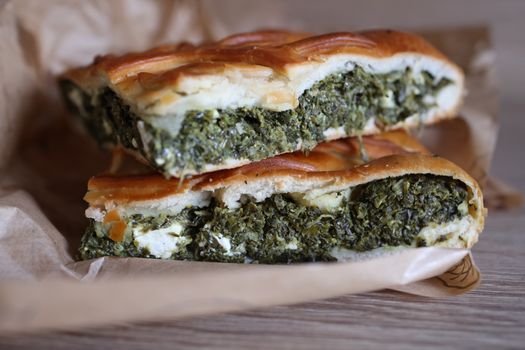
Photo: Valeria Boltneva / Pexels
Mediterranean
Spanakopita
The diets react (see scores below)
Common Ingredients
- phyllo dough
- spinach
- feta cheese
- onion
- eggs
- dill
- parsley
- olive oil
Specific recipes may vary.
Incompatible with 6 of 11 diets
Diet Ratings
Spanakopita is fundamentally incompatible with a ketogenic diet due to its primary structural ingredient: phyllo dough. Phyllo is a refined wheat-based pastry with extremely high net carbs — a standard serving of spanakopita (2-3 pieces) can deliver 25-40g of net carbs from the dough alone, easily exceeding the entire daily keto carb allowance. The remaining ingredients (spinach, feta, eggs, olive oil, herbs) are keto-friendly, but the phyllo dough is non-negotiable in this dish and disqualifies it entirely. There is no portion size small enough to make traditional spanakopita keto-compatible while still being a meaningful serving of the dish.
Spanakopita contains two clear animal-derived ingredients: feta cheese (dairy) and eggs. Both are explicitly excluded under vegan dietary rules. Phyllo dough, spinach, onion, dill, parsley, and olive oil are all plant-based, but the presence of feta and eggs makes this dish incompatible with a vegan diet. A vegan version could be made by substituting feta with a tofu- or cashew-based cheese and omitting or replacing the eggs with a flax egg or similar binder.
Spanakopita contains two major non-paleo ingredients that disqualify it entirely: phyllo dough (made from refined wheat flour, a grain) and feta cheese (dairy). These are not fringe or debated exclusions — grains and dairy are among the most clearly prohibited food groups in all mainstream paleo frameworks. The remaining ingredients (spinach, onion, eggs, dill, parsley, olive oil) are fully paleo-approved, but they cannot offset the foundational violations. This dish is structurally defined by its wheat-based pastry shell and dairy filling, making substitution necessary rather than optional. There is no version of authentic spanakopita that qualifies as paleo.
Spanakopita is a traditional Greek dish with strong Mediterranean roots. The filling is excellent — spinach, feta, onion, fresh herbs, eggs, and olive oil are all core Mediterranean ingredients. However, phyllo dough is a refined grain product, and the dish contains moderate amounts of feta (a dairy) and eggs, placing it in the 'moderation' category rather than a daily staple. It is far from processed junk food, but the refined flour pastry shell tempers an otherwise plant-forward profile. As a snack or occasional side dish it fits well within Mediterranean eating patterns, but the refined grain component prevents a full 'approve' rating.
Some Mediterranean diet authorities, particularly those grounded in traditional Greek culinary practice, would argue spanakopita deserves full approval, as it is a genuine cultural staple consumed regularly in Greece and across the eastern Mediterranean. They note the vegetable-forward filling and olive oil usage outweigh concerns about the thin phyllo layers, which are used sparingly compared to Western pastry.
Spanakopita is almost entirely plant-based and incompatible with the carnivore diet. The dish is built around phyllo dough (grain-based), spinach (leafy vegetable), onion (vegetable), dill and parsley (plant herbs), and olive oil (plant oil). While it does contain eggs and feta cheese — both of which are animal-derived and debated but accepted by many carnivore practitioners — these are minor components surrounded by a foundation of excluded plant foods. No single ingredient substitution or removal could salvage this dish for carnivore compliance; it would need to be fundamentally reconstructed. The presence of grains (phyllo), multiple vegetables, and plant oil places this firmly in the avoid category with no meaningful ambiguity.
Spanakopita contains two clearly excluded ingredients: phyllo dough (a grain-based pastry made from wheat flour) and feta cheese (dairy). Either one alone would disqualify this dish. Phyllo dough is a wheat-grain product, and all grains are excluded on Whole30. Feta is a dairy cheese, and all dairy except ghee/clarified butter is excluded. Beyond the ingredient violations, even if substitutes were attempted, spanakopita is a pastry/baked good by nature — recreating it with compliant ingredients would violate the 'no recreating baked goods' rule. This dish is firmly off-limits on Whole30.
Spanakopita contains multiple high-FODMAP ingredients that make it unsuitable during the elimination phase. Phyllo dough is made from wheat flour, which is high in fructans — a major FODMAP trigger. Onion is one of the highest-FODMAP foods tested by Monash University, containing significant fructans even in small amounts. Feta cheese, while lower in lactose than many cheeses due to the aging/brining process, is rated by Monash as low-FODMAP only at a 40g serving — but combined with the other high-FODMAP ingredients, the overall dish remains problematic. The combination of wheat-based phyllo and onion alone makes this dish clearly high-FODMAP with no realistic portion size that would render a standard serving safe during elimination.
Spanakopita has a mixed DASH profile. On the positive side, spinach is an excellent DASH food — rich in potassium, magnesium, and fiber — and olive oil, onion, and fresh herbs (dill, parsley) align well with DASH principles. Eggs in moderation are acceptable. However, feta cheese is high in sodium (a single ounce contains ~320–370mg) and saturated fat, and spanakopita typically uses a generous amount of it. Phyllo dough adds refined carbohydrates and, depending on the recipe, significant butter or olive oil layers. The cumulative sodium from feta plus phyllo can push a serving well toward or beyond 600–900mg, which is a substantial portion of the DASH daily sodium budget (1,500–2,300mg). The saturated fat from feta is also a concern under DASH guidelines, which specify low-fat dairy. As a snack-sized portion occasionally, it is acceptable in a DASH-conscious diet, but the sodium and saturated fat content prevent a full approval.
NIH DASH guidelines emphasize low-fat dairy and sodium restriction, which feta cheese clearly challenges. However, some updated DASH-oriented clinicians note that Mediterranean dietary patterns — of which spanakopita is a traditional component — have strong cardiovascular evidence, and that the antioxidant-rich spinach and olive oil may offset some concerns; a small portion made with reduced-fat or less feta could be viewed more favorably in this context.
Spanakopita presents a mixed Zone Diet profile. The filling is actually quite favorable: spinach is an excellent low-glycemic Zone carb rich in polyphenols, feta provides moderate protein, eggs add lean protein, olive oil is the ideal Zone fat source, and herbs (dill, parsley) contribute antioxidants. However, the phyllo dough is the primary problem — it is a refined, high-glycemic carbohydrate that counts as an 'unfavorable' Zone carb block. A typical spanakopita serving is also carbohydrate-heavy relative to its protein content (feta and eggs are modest protein sources), making it difficult to achieve the 40/30/30 ratio in a single snack serving without pairing with additional lean protein. The fat profile is better than most pastry items given olive oil use, but feta contributes some saturated fat. As a snack, the portion would need to be small (1-2 triangles) and ideally paired with additional protein to approach Zone balance. The dish cannot easily stand alone as a Zone-compliant snack without significant adjustment.
Some Zone practitioners would rate spanakopita more favorably, noting that the spinach-heavy filling is genuinely Zone-friendly and that a small portion of phyllo (1 triangle) represents only a modest carb block. Dr. Sears' later writings emphasize the overall anti-inflammatory quality of a meal — the olive oil, spinach, eggs, and polyphenol-rich herbs align well with his anti-inflammatory framework, which might justify a slightly more lenient view on the small amount of refined carb in the crust.
Spanakopita presents a mixed anti-inflammatory profile. On the positive side, spinach is rich in antioxidants (vitamins C, E, K, beta-carotene) and anti-inflammatory carotenoids like lutein and zeaxanthin. Olive oil contributes oleocanthal and polyphenols with well-documented anti-inflammatory effects. Onion provides quercetin, a potent flavonoid. Dill and parsley are anti-inflammatory herbs with meaningful phytonutrient content. Eggs offer choline and selenium. The negatives center on phyllo dough — a refined carbohydrate with negligible fiber — and feta cheese, a full-fat dairy product that contributes saturated fat and sodium. The refined dough raises the glycemic load of the dish, and saturated fat from feta (while modest per serving) is flagged under anti-inflammatory guidelines. Feta is lower in fat than many hard cheeses, which somewhat mitigates the dairy concern. Overall, the dish blends genuinely strong anti-inflammatory ingredients (spinach, olive oil, herbs, onion) with two moderately problematic ones (refined phyllo, full-fat feta). Occasional consumption is reasonable; it would not be a dietary staple under a strict anti-inflammatory protocol.
Some anti-inflammatory practitioners, including those following Dr. Weil's Mediterranean-influenced framework, would view spanakopita quite favorably given its dense greens, olive oil, and herb content — and would consider moderate feta acceptable as part of a Mediterranean dietary pattern supported by robust anti-inflammatory and cardiovascular research. A stricter reading of anti-inflammatory rules, emphasizing limitation of refined carbohydrates and full-fat dairy, would push the score lower and suggest swapping phyllo for a whole-grain alternative.
Spanakopita has meaningful nutritional upsides — spinach provides fiber, micronutrients, and water content; eggs contribute some protein; olive oil provides unsaturated fat. However, it falls short as a GLP-1-friendly snack for several reasons. Phyllo dough is a refined grain with low fiber and low protein density, and traditional spanakopita uses multiple buttered or oiled layers, raising the fat per serving meaningfully. Feta cheese adds saturated fat alongside its modest protein contribution. The dish's protein density per calorie is low for a GLP-1 patient's needs — a typical 2-triangle serving delivers roughly 6-8g protein and 200-250 calories, which is a poor protein-to-calorie ratio. The combination of layered pastry, cheese fat, and oil can also slow digestion further on top of GLP-1's existing gastric emptying delay, increasing risk of bloating, heaviness, or nausea. It is not fried and does use olive oil rather than butter in many recipes, which is a positive. As an occasional small-portion snack alongside a higher-protein item it is acceptable, but it should not be a primary snack choice.
Some GLP-1-focused dietitians consider spanakopita a reasonable Mediterranean diet-aligned option given its vegetable base and use of unsaturated fat, particularly when homemade with minimal oil. Others flag the refined pastry layers and saturated fat from feta as meaningful drawbacks given reduced caloric budgets and GI sensitivity, and would steer patients toward higher-protein snacks entirely.
*See how scores were generated at our methodology page.
Nutritional profile
Six traits that cut across every diet.
Fiber & Plants
How much whole-plant food and fiber it delivers.
Healthy Fats
The quality of its fats (unsaturated, omega-3).
Whole / Unprocessed
How close it is to its natural, unprocessed form.
Gut Gentle
How easy it is on digestion (low FODMAP, few irritants).
Low Glycemic
How little it spikes your blood sugar.
Protein Density
How much protein it packs per calorie.
Controversy Index
Higher controversy = more disagreement between diets.
Diet-Specific Tips
 Mediterranean — 6/10
View tips
- Spinach-dominant filling strongly aligns with plant-based Mediterranean emphasis
- Feta and eggs are acceptable moderate-consumption dairy/protein sources
- Olive oil is the fat used, consistent with Mediterranean principles
- Phyllo dough is a refined grain, detracting from whole-grain recommendations
- Authentic traditional Greek dish with clear Mediterranean cultural heritage
- No added sugars, no red meat, no highly processed ingredients
 DASH — 5/10
View tips
- Spinach is a DASH-ideal vegetable rich in potassium, magnesium, and fiber
- Feta cheese is high in sodium (~320–370mg/oz) — a significant DASH concern
- Feta is a full-fat dairy product, which DASH guidelines discourage
- Olive oil is a DASH-approved fat source
- Phyllo dough contributes refined carbohydrates and caloric density from oil layering
- Cumulative sodium per serving can be 600–900mg, a large share of the DASH daily budget
- Herbs and onion add flavor without sodium penalty, supporting DASH sodium reduction strategies
- Portion size is critical — a small snack piece is more DASH-compatible than a large serving
 Zone — 4/10
View tips
- Phyllo dough is a refined, high-glycemic 'unfavorable' carbohydrate in Zone terminology
- Spinach filling is an excellent Zone carbohydrate — low-glycemic and polyphenol-rich
- Olive oil is the ideal Zone fat source (monounsaturated)
- Protein content (feta + eggs) is modest and may be insufficient for a Zone snack without additions
- Feta cheese contributes saturated fat, which Zone limits
- The carb-to-protein ratio is skewed toward carbohydrates in a typical serving
- As a snack category item, a 1-block portion (1 small triangle) could be made to fit with careful portioning and protein pairing
 Anti-Inflammatory — 6/10
View tips
- Spinach is rich in anti-inflammatory carotenoids (lutein, zeaxanthin) and antioxidants (vitamins C, E, K)
- Olive oil contributes oleocanthal and polyphenols — a cornerstone anti-inflammatory fat
- Onion provides quercetin, a well-studied anti-inflammatory flavonoid
- Dill and parsley are anti-inflammatory culinary herbs with phytonutrient value
- Phyllo dough is a refined carbohydrate with high glycemic load and negligible fiber — a moderate negative
- Feta cheese is full-fat dairy contributing saturated fat and sodium, flagged as 'limit' under anti-inflammatory guidelines
- Eggs contribute choline and selenium; mixed but generally acceptable in moderation
- Overall dish is nutrient-dense in greens but refined dough limits anti-inflammatory score
 GLP-1 Friendly — 4/10
View tips
- Low protein density per calorie — approximately 6-8g protein per typical serving, insufficient as a standalone snack
- Refined phyllo dough contributes refined carbohydrates with minimal fiber
- Feta cheese adds saturated fat, which may worsen nausea or reflux in GLP-1 patients
- Olive oil is a positive — unsaturated fat preferred over saturated
- Spinach provides fiber, micronutrients, and water content — meaningful benefit
- Multiple fat sources combined (feta + oil + pastry layers) may cause GI heaviness given slowed gastric emptying
- Acceptable in small portions paired with a higher-protein food, not ideal as a standalone snack