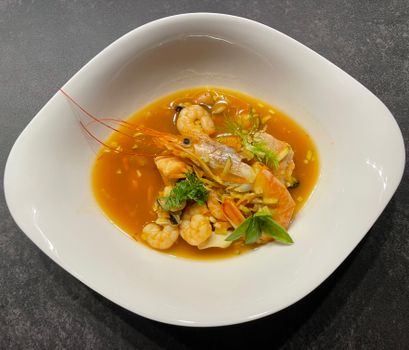
Photo: Rudi Kessler / Pexels
Spanish
Spanish Seafood Stew (Zarzuela)
The diets react (see scores below)
Common Ingredients
- white fish
- shrimp
- mussels
- squid
- brandy
- almonds
- saffron
- tomato
Specific recipes may vary.
Incompatible with 3 of 11 diets
Diet Ratings
Spanish Seafood Stew (Zarzuela) is largely keto-compatible but requires attention to a few ingredients. The core proteins—white fish, shrimp, mussels, squid—are excellent keto foods: high protein, low fat, and very low net carbs. Almonds and saffron are keto-friendly. The main concerns are: (1) tomatoes add moderate carbs (~3-4g net per 100g), and stews often use a significant quantity; (2) brandy contributes alcohol-derived calories and trace sugars—most of the alcohol cooks off but residual carbs remain; (3) squid and mussels carry slightly higher carbs than fish or shrimp (~3g net per 100g), so large portions can accumulate. A standard restaurant serving likely lands in the 8-15g net carb range, which is manageable within daily keto limits but not negligible. The dish contains no grains, starches, or added sugars in its traditional form, making it a reasonable keto choice with mindful portioning.
Some strict keto practitioners flag shellfish like mussels and squid as borderline due to their glycogen content and higher carb profile compared to fin fish, recommending they be limited or avoided in therapeutic/clinical keto protocols. Additionally, some hard-line keto advocates exclude any alcohol including cooking brandy, as it halts ketone production while being metabolized.
Spanish Seafood Stew (Zarzuela) contains multiple animal products as its primary ingredients: white fish, shrimp, mussels, and squid are all seafood/animal-derived foods explicitly excluded under vegan dietary rules. There is no ambiguity here — this dish is fundamentally built around animal flesh and is entirely incompatible with a vegan diet.
Spanish Seafood Stew (Zarzuela) is largely paleo-compatible at its core. White fish, shrimp, mussels, squid, almonds, saffron, and tomato are all clearly paleo-approved ingredients. The stew becomes a gray area primarily due to brandy — an alcoholic distillate that sits in the 'caution' zone per paleo rating criteria. Alcohol is not strictly paleo, though small culinary amounts used in cooking (where most evaporates) are tolerated by many practitioners. The remaining ingredients are wholesome and unprocessed, making this dish close to a full approve if the brandy is omitted or used minimally in cooking.
Strict paleo authorities like Loren Cordain discourage alcohol in any form, including cooking alcohol, as it was not part of the Paleolithic dietary pattern. Those following a strict interpretation would flag the brandy even in small culinary quantities and recommend omitting it entirely.
Spanish Seafood Stew (Zarzuela) is an excellent Mediterranean diet dish. It features multiple types of seafood (white fish, shrimp, mussels, squid) as the primary protein, which aligns perfectly with the Mediterranean recommendation of eating fish and seafood 2-3 times per week. The base includes tomato and saffron, both whole plant-based ingredients rich in antioxidants. Almonds add healthy fats and plant-based nutrients, consistent with the diet's emphasis on nuts. Brandy is used in small culinary amounts for flavoring rather than as a beverage, which is a traditional Spanish cooking technique and does not significantly impact the dish's nutritional profile. The dish is minimally processed, free of refined grains or added sugars, and typical of traditional Mediterranean coastal cuisine.
While the seafood components (white fish, shrimp, mussels, squid) are fully carnivore-approved animal products, this dish is heavily compromised by multiple plant-based ingredients that are strictly excluded from the carnivore diet. Tomato is a plant food, almonds are a nut, saffron is a plant-derived spice, and brandy is an alcohol derived from fermented fruit. The seafood itself would be fine, but as prepared in this traditional Spanish stew, the dish cannot be considered carnivore-compatible. The plant ingredients are not minor trace additives — they are structural, flavor-defining components of the recipe.
Spanish Seafood Zarzuela traditionally includes brandy, which is an alcoholic spirit and explicitly excluded on Whole30. All other ingredients — white fish, shrimp, mussels, squid, almonds, saffron, and tomato — are fully compliant whole foods. However, the brandy alone disqualifies the dish as traditionally prepared. A compliant version could be made by omitting the brandy entirely or substituting with additional seafood stock, but as the dish is classically made, it must be avoided.
Spanish Seafood Stew (Zarzuela) is built around a seafood base — white fish, shrimp, mussels, and squid — all of which are naturally low-FODMAP proteins. Saffron and tomato (in moderate amounts) are also low-FODMAP. However, the dish raises concerns in two areas. First, almonds are used in the traditional 'picada' thickener: Monash rates almonds as low-FODMAP only at 10 almonds (approximately 12g), and high-FODMAP at 20+ almonds due to GOS and excess fructose — a thickening paste used across a full stew may easily exceed safe per-serving thresholds depending on quantity. Second, brandy in small cooked quantities is generally considered low-FODMAP (alcohol itself is not a FODMAP and much evaporates during cooking), but if used generously or added late, the fructose content in some brandies could be a marginal concern. The critical unknown is whether the recipe includes high-FODMAP aromatics like onion or garlic, which are staples in traditional Zarzuela but were not listed here — if present, the dish would move firmly to 'avoid.' As listed, the dish is conditionally acceptable with careful portion control on almonds and confirmation that no onion or garlic is used.
Monash University approves almonds only at a strict 10-almond serving; clinical FODMAP practitioners often flag nut-based thickeners (picada) as a hidden source of GOS that can accumulate to problematic levels when distributed across a stew serving. Additionally, traditional Zarzuela almost universally contains sofrito with onion and garlic — if this recipe omits them for FODMAP compliance, that omission must be verified and the stew must use garlic-infused oil as a substitute if any garlic flavor is desired.
Spanish Seafood Stew (Zarzuela) contains predominantly DASH-friendly ingredients: white fish, shrimp, mussels, and squid are all lean proteins rich in omega-3 fatty acids, aligned with DASH emphasis on fish and seafood. Tomatoes contribute potassium and antioxidants, almonds provide healthy unsaturated fats, magnesium, and fiber, and saffron is a negligible-calorie spice. However, several factors warrant caution. Shrimp and mussels are naturally higher in sodium than white fish or squid, and traditional stew preparations often add significant salt, olive oil, and occasionally cured ingredients. Brandy, while used in modest cooking quantities, represents an added alcohol component that DASH does not encourage. The dish as typically prepared in restaurants may carry moderate-to-high sodium from shellfish broth, added salt, and cooking wine. Portion control and home preparation with sodium monitoring would elevate the DASH compatibility considerably. The core seafood-and-vegetable profile is strong, but the practical sodium load in a restaurant-style stew keeps this in the caution range.
NIH DASH guidelines strongly endorse fish and seafood as lean protein sources, which would push this dish toward approval given its predominantly seafood and vegetable base. However, updated clinical interpretation among DASH-focused dietitians notes that shellfish-heavy stews can contribute 800–1,200mg of sodium per serving from natural shellfish content plus cooking additions, making portion size and preparation method critical variables that prevent a confident approval rating.
Spanish Seafood Stew (Zarzuela) is an excellent Zone Diet candidate. The dish is built around mixed seafood — white fish, shrimp, mussels, and squid — all of which are lean, low-fat proteins highly favored in Zone methodology. Seafood also provides beneficial omega-3 fatty acids, directly supporting Sears' anti-inflammatory dietary focus. Tomato provides a low-glycemic carbohydrate with polyphenols (lycopene), and saffron contributes additional anti-inflammatory compounds. Almonds supply monounsaturated fat, the preferred fat source in Zone. The brandy introduces a small amount of sugar/alcohol calories, but in typical cooking quantities (used for flambéing) it burns off substantially and contributes minimal residual carbohydrate. The overall macro profile leans naturally toward Zone ratios: abundant lean protein, low-glycemic vegetables as the primary carb source, and monounsaturated fat from almonds. Portion control would involve balancing the almond quantity (fat blocks) and ensuring no starchy thickeners like bread or potatoes are added. As traditionally prepared, this stew is one of the more Zone-compatible complex dishes across any cuisine.
Spanish Seafood Stew (Zarzuela) is a strongly anti-inflammatory dish overall. The protein base — white fish, shrimp, mussels, and squid — is rich in lean protein and omega-3 fatty acids (especially the mussels and white fish), which are central to anti-inflammatory eating. Mussels in particular are among the most omega-3-dense shellfish and also provide zinc and selenium, both of which support antioxidant defense. Tomato contributes lycopene and vitamin C, both potent antioxidants. Saffron is one of the more researched anti-inflammatory spices, with crocin and safranal shown to reduce oxidative stress and inflammatory markers. Almonds add healthy monounsaturated fats, vitamin E, and fiber — all anti-inflammatory contributors. The stew format (no deep frying, typically uses olive oil as the fat base) aligns well with Mediterranean anti-inflammatory principles. The one notable caution is brandy: spirits are in the 'limit' category under anti-inflammatory guidelines, as alcohol other than moderate red wine is discouraged. However, much of the brandy's alcohol typically cooks off during preparation, and the quantity per serving is modest. Overall, this dish closely mirrors the Mediterranean dietary pattern that underlies much of anti-inflammatory nutrition science.
The brandy introduces a mild point of debate: most updated anti-inflammatory frameworks recommend avoiding spirits entirely, even in cooking, due to alcohol's pro-inflammatory metabolic effects — though at cooking quantities the impact is negligible for most people. Additionally, some autoimmune protocol (AIP) advocates would flag shellfish like shrimp and squid as potential triggers for individuals with shellfish sensitivity or autoimmune conditions, though mainstream anti-inflammatory guidance strongly endorses seafood.
Spanish Seafood Stew (Zarzuela) has a strong nutritional foundation for GLP-1 patients: the mixed seafood base (white fish, shrimp, mussels, squid) delivers high-quality lean protein with excellent protein density per calorie, and the tomato base adds fiber, lycopene, and hydration. Saffron and almonds contribute antioxidants and healthy unsaturated fats respectively. However, two ingredients introduce meaningful concerns. Brandy is an alcohol, which is categorically flagged for GLP-1 patients due to dehydration risk and empty calories — even if much of it cooks off, a non-trivial amount may remain depending on preparation. Almonds add saturated and unsaturated fat that can worsen nausea or bloating at higher quantities. If the brandy is fully cooked off and almonds are used in small amounts (as is traditional in a picada paste), the dish improves significantly toward an approve. As typically prepared in a restaurant, the alcohol content and fat load from almonds and cooking oil create enough GI risk to warrant caution rather than a full approve.
Some GLP-1-focused dietitians would rate this higher, arguing that alcohol used in cooking largely volatilizes and the overall dish is one of the most protein-dense, nutrient-rich options in Spanish cuisine. Others maintain that GLP-1 patients have heightened sensitivity to even residual alcohol and higher fat loads, and that restaurant preparation often uses more oil and brandy than home recipes, justifying a cautious approach.
*See how scores were generated at our methodology page.
Nutritional profile
Six traits that cut across every diet.
Fiber & Plants
How much whole-plant food and fiber it delivers.
Healthy Fats
The quality of its fats (unsaturated, omega-3).
Whole / Unprocessed
How close it is to its natural, unprocessed form.
Gut Gentle
How easy it is on digestion (low FODMAP, few irritants).
Low Glycemic
How little it spikes your blood sugar.
Protein Density
How much protein it packs per calorie.
Controversy Index
Higher controversy = more disagreement between diets.
Diet-Specific Tips
 Keto — 6/10
View tips
- Seafood base (fish, shrimp, mussels, squid) is high-protein and low-fat — excellent keto foundation
- Tomatoes add moderate net carbs; quantity used in the stew is the key variable
- Brandy contributes trace residual carbs and temporarily disrupts ketosis while metabolized
- Almonds are keto-friendly and add healthy fats
- Squid and mussels have higher carbs than fin fish (~3g net/100g) — portion size matters
- No grains, starchy vegetables, or added sugar in traditional recipe
- Estimated 8-15g net carbs per serving — fits within keto limits but requires awareness
 Paleo — 6/10
View tips
- White fish, shrimp, mussels, and squid are all strongly paleo-approved seafood proteins
- Almonds, saffron, and tomato are fully paleo-compliant ingredients
- Brandy (alcohol) places this dish in the caution zone — alcohol is debated within the paleo community
- Culinary use of brandy typically involves cooking off most of the alcohol, which some paleo practitioners consider acceptable
- No grains, legumes, dairy, seed oils, or refined sugar present
- Dish is otherwise unprocessed and nutrient-dense
 Mediterranean — 9/10
View tips
- Multiple seafood varieties (fish, shrimp, mussels, squid) align with Mediterranean 2-3x weekly seafood recommendation
- Tomato and saffron provide antioxidant-rich plant-based ingredients
- Almonds contribute heart-healthy fats and plant protein
- Brandy used only as a small culinary flavoring agent, a traditional Spanish technique
- No refined grains, added sugars, or heavily processed ingredients
- Authentic traditional Spanish coastal dish rooted in Mediterranean culinary tradition
 Low-FODMAP — 5/10
View tips
- White fish, shrimp, mussels, and squid are all low-FODMAP proteins — safe at standard servings
- Almond picada thickener is a dose-dependent risk: low-FODMAP at ≤10 almonds per serving, high-FODMAP above that threshold
- Saffron is low-FODMAP and safe
- Tomato is low-FODMAP at standard serving (e.g., 1 medium tomato or canned equivalent without additives)
- Brandy used in cooking is generally low-FODMAP in small amounts as alcohol is not a FODMAP
- Traditional Zarzuela typically contains onion and garlic (high-FODMAP fructans) — their absence from the ingredient list is critical; recipe must confirm omission or use of garlic-infused oil
- No high-FODMAP ingredients explicitly listed aside from the portion-sensitive almonds
 DASH — 6/10
View tips
- Lean seafood proteins (white fish, shrimp, mussels, squid) align well with DASH lean protein guidelines
- Tomatoes provide potassium and are a DASH-approved vegetable
- Almonds contribute healthy unsaturated fats, magnesium, and fiber consistent with DASH nut recommendations
- Shrimp and mussels have naturally elevated sodium content compared to other proteins
- Brandy adds alcohol, which DASH does not encourage
- Restaurant or traditional preparations likely carry moderate-to-high sodium from broth and added salt
- Low-sodium home preparation with fresh seafood and no added salt would score significantly higher (8-9)
 Zone — 8/10
View tips
- Mixed seafood (white fish, shrimp, mussels, squid) provides lean, Zone-favorable protein rich in omega-3s
- Tomato is a low-glycemic, polyphenol-rich carbohydrate source favored in Zone
- Almonds supply monounsaturated fat, the ideal Zone fat block
- Saffron contributes anti-inflammatory polyphenols aligned with Sears' later work
- Brandy is used in small cooking quantities; minimal residual carbohydrate/sugar impact
- No high-glycemic carbs (potatoes, white rice, bread) in the base recipe
- Naturally balanced macro profile requiring only portion adjustments for precise Zone blocking
 Anti-Inflammatory — 8/10
View tips
- Mixed seafood (mussels, white fish, shrimp, squid) provides omega-3 fatty acids and lean protein — core anti-inflammatory proteins
- Mussels are exceptionally rich in omega-3s and anti-inflammatory minerals (zinc, selenium)
- Saffron contains crocin and safranal, shown to reduce oxidative stress and inflammatory markers
- Tomato contributes lycopene and vitamin C — potent antioxidants
- Almonds add monounsaturated fats, vitamin E, and fiber
- Mediterranean cooking format (olive oil base, no frying) aligns with anti-inflammatory principles
- Brandy is a mild concern as a spirit; alcohol content largely cooks off, limiting pro-inflammatory impact
 GLP-1 Friendly — 6/10
View tips
- High-quality lean protein from mixed seafood (white fish, shrimp, mussels, squid) supports daily protein targets
- Brandy introduces alcohol concern — dehydration risk even if partially cooked off
- Tomato base adds fiber, hydration, and micronutrients — supports GLP-1 digestive priorities
- Almonds contribute unsaturated fats but increase overall fat load, which may worsen nausea or bloating
- Saffron and tomato are GI-gentle ingredients with no significant side effect risk
- Small-portion friendly as a stew — works well with GLP-1 reduced appetite
- Preparation method matters significantly: restaurant versions likely use more fat and alcohol than home-cooked