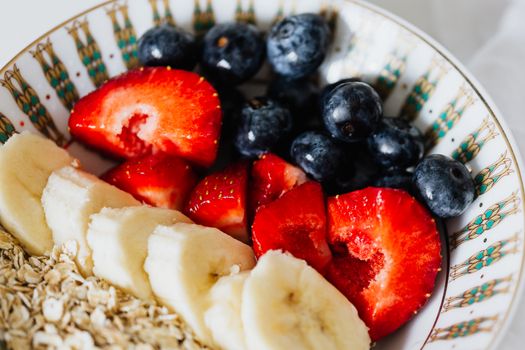
Photo: www.kaboompics.com / Pexels
American
Steel-Cut Oatmeal
The diets react (see scores below)
Common Ingredients
- steel-cut oats
- milk
- brown sugar
- cinnamon
- banana
- blueberries
- walnuts
- maple syrup
Specific recipes may vary.
Incompatible with 6 of 11 diets
Diet Ratings
Steel-cut oatmeal as prepared here is one of the most keto-incompatible breakfast dishes possible. Steel-cut oats alone contain roughly 27g of net carbs per half-cup serving, already pushing or exceeding the entire daily keto limit. The dish then compounds this with multiple high-carb additions: banana (a high-sugar fruit, ~24g net carbs), brown sugar, maple syrup (pure sugar), blueberries, and milk — all of which add significant carbohydrates and sugars. The total net carb load for a standard serving would easily exceed 80-100g, which is 2-5x the maximum daily keto allowance. The only marginally keto-friendly ingredient is walnuts, but their presence is irrelevant given the overwhelming carb load. This dish violates nearly every core keto rule: it contains grains, added sugars, high-sugar fruit, and starchy carbohydrates.
This dish contains dairy milk, which is a clear animal product and disqualifies it from vegan compliance. All other ingredients — steel-cut oats, brown sugar, cinnamon, banana, blueberries, walnuts, and maple syrup — are fully plant-based. The fix is straightforward: substituting the dairy milk with any plant-based milk (oat, almond, soy, coconut, etc.) would make this an excellent whole-food vegan breakfast scoring 9/10.
Steel-cut oatmeal is fundamentally incompatible with the Paleo diet. The base ingredient — steel-cut oats — is a grain, which is categorically excluded from Paleo. Beyond oats, milk is a dairy product (excluded), and brown sugar is a refined sugar (excluded). These three core ingredients each independently disqualify the dish. The remaining ingredients — cinnamon, banana, blueberries, and walnuts — are Paleo-approved, and maple syrup falls in the caution/gray area, but no combination of compliant toppings can redeem a dish built on a grain-and-dairy foundation. This is one of the clearest possible avoid verdicts in the Paleo framework.
Steel-cut oats are a whole grain and strongly align with Mediterranean diet principles, and the addition of walnuts, banana, and blueberries adds healthy fats, fiber, and antioxidants consistent with the diet. However, this dish includes both brown sugar and maple syrup as sweeteners — added sugars that the Mediterranean diet discourages — which lower its overall score. Milk is acceptable in moderation under Mediterranean guidelines. If the added sugars were omitted or minimized, this dish would comfortably score in the approve range.
Some Mediterranean diet practitioners and researchers note that the diet is not strictly anti-sweetener and that small amounts of natural sweeteners like honey or maple syrup are acceptable within a broadly plant-forward pattern; in that interpretation, this dish could be considered a solid approve given its whole grain, fruit, and nut profile.
Steel-cut oatmeal is entirely plant-based and violates every principle of the carnivore diet. The dish contains no animal products whatsoever. Steel-cut oats are a grain — one of the most excluded foods on carnivore. The remaining ingredients compound the problem: banana and blueberries are fruits, walnuts are nuts, cinnamon is a plant spice, brown sugar and maple syrup are plant-derived sweeteners, and milk is the only animal-derived ingredient but is entirely overshadowed by the overwhelmingly plant-based composition. This dish represents essentially the opposite of carnivore eating — a high-carbohydrate, plant-forward breakfast with multiple categories of excluded foods (grains, fruits, nuts, seeds, sugars, spices).
Steel-cut oatmeal is disqualified on multiple fronts. Oats are a grain and explicitly excluded from the Whole30 program. Additionally, this dish contains milk (dairy, excluded), brown sugar (added sugar, excluded), and maple syrup (added sugar, excluded). That is four separate excluded ingredient categories in a single dish, making this deeply incompatible with Whole30. The banana, blueberries, walnuts, and cinnamon are compliant, but they cannot redeem a dish built on excluded foundations.
This dish contains multiple high-FODMAP ingredients that make it unsuitable during the elimination phase. The most problematic is regular cow's milk, which is high in lactose — a standard serving of milk in oatmeal (e.g., 1 cup) is clearly high-FODMAP. Banana is low-FODMAP only when firm and unripe (1/3 medium serving), but a standard ripe banana serving is high in fructans and polyols. Blueberries are borderline — low-FODMAP at 40g but commonly eaten in larger portions. Steel-cut oats themselves are low-FODMAP at up to 52g (1/2 cup dry), so they are acceptable in controlled portions. Walnuts are low-FODMAP at 10 per serve (30g). Maple syrup is low-FODMAP at small servings (2 tablespoons). Cinnamon is low-FODMAP. Brown sugar is low-FODMAP in small amounts. The primary offenders are the milk and the ripe banana, either of which alone is enough to make this dish high-FODMAP at standard servings. Even with lactose-free milk substituted, a standard ripe banana portion remains problematic. This dish as written is not safe during the elimination phase.
Monash University rates some components of this dish as conditionally low-FODMAP (e.g., oats, blueberries in small portions, maple syrup), and clinical FODMAP practitioners would note that simple swaps — lactose-free milk or plant-based alternative, an unripe banana at 1/3 serving — could make a modified version borderline acceptable; however, as written with standard ingredients and servings, this dish fails elimination phase criteria.
Steel-cut oatmeal is an excellent DASH-diet breakfast built around whole grains, fruits, and nuts — all core DASH food groups. Steel-cut oats are high in soluble fiber (beta-glucan), which supports blood pressure and cholesterol reduction. Banana and blueberries contribute potassium, antioxidants, and natural sweetness. Walnuts add heart-healthy unsaturated fats, magnesium, and additional fiber. Cinnamon and the fruit reduce the need for heavy sweetening. The dish is naturally low in sodium and saturated fat. The main caution is the combined added sugars from both brown sugar and maple syrup — together they can meaningfully elevate total sugar content, which DASH limits. If milk is low-fat or non-fat, it aligns perfectly with DASH dairy guidance; whole milk would add saturated fat. Portion control on the sweeteners is the primary modifier; omitting one or both would push the score to a 9.
NIH DASH guidelines emphasize limiting added sugars and sweets, which raises concern about using both brown sugar and maple syrup simultaneously. However, updated clinical interpretations note that when added sugars are used in small amounts to make nutrient-dense whole foods more palatable — particularly for patients transitioning to DASH — the overall nutrient profile (fiber, potassium, magnesium) still strongly favors cardiovascular benefit, and some DASH practitioners accept modest dual sweetening in this context.
Steel-cut oatmeal has a more favorable glycemic profile than rolled or instant oats and can technically fit into Zone eating, but this particular preparation stacks multiple Zone-unfavorable elements. The dish as described is heavily carbohydrate-dominant with no lean protein source listed, immediately breaking the 40/30/30 ratio. Steel-cut oats are a 'less unfavorable' grain in Zone — Dr. Sears allows 0-1 grain servings per day — but the additions of banana (a high-glycemic fruit explicitly flagged as unfavorable in Zone), brown sugar, and maple syrup all push the glycemic load significantly higher and add empty carbohydrate blocks. The walnuts provide omega-3 fatty acids and are Zone-favorable as a fat source, and blueberries are an excellent Zone-approved polyphenol-rich fruit. However, without lean protein (e.g., egg whites on the side, Greek yogurt, or protein powder stirred in), this meal cannot achieve Zone balance. The carbohydrate-to-protein ratio is extremely skewed. With significant modifications — removing banana, brown sugar, and maple syrup; replacing with more blueberries; adding a lean protein source — this dish could move toward Zone compliance. As served, it represents a high-carb, low-protein breakfast that would drive an insulin spike inconsistent with Zone principles.
Some Zone practitioners and Sears' later writings on anti-inflammatory eating do acknowledge steel-cut oats as a legitimate slow-digesting carbohydrate with beta-glucan fiber benefits that support healthy eicosanoid balance. In a modified version — steel-cut oats with blueberries, cinnamon, walnuts, and a protein source on the side — this could score a 5-6. The walnuts and blueberries are genuinely Zone-favorable. The disagreement centers on whether the dish's base grain and fruit components can be portion-controlled sufficiently to offset the other unfavorable additions.
This steel-cut oatmeal bowl is built on a strong anti-inflammatory foundation. Steel-cut oats are a whole grain rich in beta-glucan fiber, which has demonstrated ability to reduce CRP and support gut microbiome health. Walnuts are one of the top plant-based sources of ALA omega-3 fatty acids and also provide polyphenols with anti-inflammatory activity — they are explicitly emphasized in anti-inflammatory frameworks. Blueberries are among the most antioxidant-dense fruits available, loaded with anthocyanins that reduce IL-6 and NF-κB inflammatory signaling. Cinnamon contributes meaningful anti-inflammatory polyphenols even at culinary doses. Banana provides potassium, magnesium, and prebiotic fiber. Milk is a moderate dairy choice — low-fat dairy is acceptable in anti-inflammatory frameworks. The main concern is the combined glycemic load from brown sugar, maple syrup, and banana, which together could generate a meaningful added-sugar contribution. Refined sugars and rapidly digested carbohydrates can transiently promote inflammatory signaling, partially offsetting the dish's otherwise strong profile. If the sweeteners were minimized or eliminated (letting the fruit provide natural sweetness), this bowl would score higher. As prepared with both brown sugar and maple syrup, it earns a solid 8 rather than a 9-10, but remains a clearly approvable breakfast.
The glycemic load concern is debated: some anti-inflammatory practitioners (e.g., Dr. Mark Hyman's functional medicine approach) would flag even small amounts of added sugar alongside high-GI fruit as disruptive to blood sugar and therefore mildly pro-inflammatory, and might rate the dish 'caution' until sweeteners are reduced. Mainstream anti-inflammatory guidance (Dr. Weil's framework) would still approve this bowl overall, viewing moderate natural sweeteners as acceptable within a largely whole-food, high-antioxidant context.
Steel-cut oatmeal has genuine strengths for GLP-1 patients: it is a whole grain with meaningful fiber (roughly 4-5g per serving from the oats alone), easy to digest, and nutrient-dense per calorie. The blueberries add antioxidants and additional fiber, cinnamon supports blood sugar stability, and walnuts provide omega-3 fats. However, as prepared here, this dish has a significant protein gap — with no primary protein source listed, a standard bowl likely delivers only 6-9g of protein total, well below the 15-30g per meal target that is the top priority for GLP-1 patients. The sugar load is also a concern: banana, brown sugar, and maple syrup together push added and total sugars substantially higher than ideal, risking a blood sugar spike and crash that undermines satiety. Walnuts add healthy fat but also increase caloric density, which matters when appetite is suppressed and every calorie needs to count nutritionally. The dish is not a poor choice for general health, but in its current form it is protein-deficient and sugar-heavy relative to GLP-1 dietary priorities.
Some GLP-1-focused registered dietitians are more permissive about oatmeal-based breakfasts, arguing that the soluble fiber (beta-glucan) in oats meaningfully blunts the glycemic impact of the added sugars and supports the constipation side effect that is common on these medications. However, most obesity medicine practitioners would still flag the low protein and dual sweeteners (brown sugar plus maple syrup) as meaningful drawbacks that should be corrected before this meal is considered routine.
*See how scores were generated at our methodology page.
Nutritional profile
Six traits that cut across every diet.
Fiber & Plants
How much whole-plant food and fiber it delivers.
Healthy Fats
The quality of its fats (unsaturated, omega-3).
Whole / Unprocessed
How close it is to its natural, unprocessed form.
Gut Gentle
How easy it is on digestion (low FODMAP, few irritants).
Low Glycemic
How little it spikes your blood sugar.
Protein Density
How much protein it packs per calorie.
Controversy Index
Higher controversy = more disagreement between diets.
Diet-Specific Tips
 Mediterranean — 6/10
View tips
- Steel-cut oats are a minimally processed whole grain — a Mediterranean staple
- Walnuts provide heart-healthy omega-3 fatty acids, strongly encouraged
- Banana and blueberries add fruit servings consistent with daily Mediterranean intake
- Brown sugar and maple syrup together represent a notable added sugar load, which the diet discourages
- Milk is acceptable in moderation but dairy is not a core Mediterranean breakfast component
- No olive oil or legumes; dish is plant-forward but not fully Mediterranean in construction
 DASH — 8/10
View tips
- Steel-cut oats are a high-fiber whole grain strongly supported by DASH guidelines
- Banana and blueberries provide DASH-critical potassium and antioxidants
- Walnuts deliver heart-healthy unsaturated fats and magnesium
- Combined brown sugar + maple syrup adds unnecessary dual sweeteners — a DASH caution
- Low-fat or non-fat milk keeps saturated fat low; whole milk reduces score
- Naturally very low sodium — aligns well with both standard and low-sodium DASH targets
- Cinnamon adds flavor without sodium or sugar, supporting DASH meal palatability
 Zone — 4/10
View tips
- No lean protein source — critical Zone imbalance, 40/30/30 ratio impossible as constructed
- Banana is explicitly listed as a Zone-unfavorable high-glycemic fruit by Dr. Sears
- Brown sugar and maple syrup add unnecessary high-glycemic carbohydrate blocks with no nutritional value
- Steel-cut oats are the least glycemic grain option, marginally acceptable as Zone's 0-1 grain serving
- Blueberries are Zone-favorable — high in polyphenols, low glycemic index
- Walnuts provide omega-3 fatty acids and are Zone-approved monounsaturated/polyunsaturated fat
- Cinnamon is Zone-neutral to beneficial (may support insulin sensitivity)
- Milk adds some protein but insufficient to balance the heavy carbohydrate load
 Anti-Inflammatory — 8/10
View tips
- Steel-cut oats: whole grain with beta-glucan fiber, reduces CRP
- Walnuts: high ALA omega-3 fatty acids, emphasized in anti-inflammatory diets
- Blueberries: anthocyanins reduce IL-6 and NF-κB inflammatory signaling
- Cinnamon: polyphenols with anti-inflammatory activity
- Brown sugar + maple syrup: added sugars partially offset anti-inflammatory benefits
- Milk: moderate dairy, acceptable in anti-inflammatory framework
- Banana: prebiotic fiber and micronutrients, naturally sweet
 GLP-1 Friendly — 5/10
View tips
- Protein critically low (~6-9g estimated) — fails the 15-30g per meal target
- Triple sugar sources (brown sugar, maple syrup, banana) create unnecessary glycemic load
- Steel-cut oats provide good soluble fiber (beta-glucan) supporting digestion and constipation prevention
- Walnuts contribute beneficial omega-3 fats but add caloric density
- Blueberries are a GLP-1-friendly fruit — high fiber, low sugar relative to volume
- Easy digestibility is a positive — oatmeal is well tolerated during GI side effects
- Fix: swap brown sugar and maple syrup for a small drizzle of honey or omit entirely; add a scoop of unflavored protein powder, Greek yogurt, or cottage cheese on the side to reach protein targets