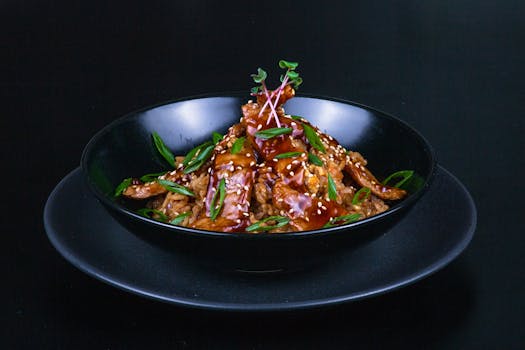
Photo: Vitaliy Haiduk / Pexels
American
Teriyaki Chicken Bowl
The diets react (see scores below)
Common Ingredients
- chicken thighs
- white rice
- broccoli
- teriyaki sauce
- carrots
- sesame seeds
- green onion
- soy sauce
Specific recipes may vary.
Incompatible with 5 of 11 diets
Diet Ratings
The Teriyaki Chicken Bowl is fundamentally incompatible with a ketogenic diet. White rice alone contains approximately 45g of net carbs per cup, which exceeds or nearly exhausts the entire daily carb allowance in a single serving. Teriyaki sauce is loaded with added sugar (typically 5-15g net carbs per 2 tablespoons), and carrots add additional net carbs. While the chicken thighs, broccoli, sesame seeds, and green onion are keto-friendly, the combination of white rice and teriyaki sauce makes this dish a high-carb meal that would immediately break ketosis. No reasonable portion reduction can make this dish keto-compatible as long as rice and standard teriyaki sauce are included.
Teriyaki Chicken Bowl contains chicken thighs as its primary protein, which is poultry and a direct animal product. This is an unambiguous violation of vegan dietary principles. No substitution or preparation method makes this dish vegan-compatible as described. The remaining ingredients (white rice, broccoli, carrots, sesame seeds, green onion, soy sauce) are plant-based, but the inclusion of chicken is disqualifying regardless.
The Teriyaki Chicken Bowl contains multiple non-paleo ingredients that make it incompatible with the diet. White rice is a grain, strictly excluded by all major paleo authorities. Soy sauce is derived from soybeans (a legume) and is heavily processed, containing wheat as well — a double violation. Teriyaki sauce is typically made with soy sauce, refined sugar, and other additives, making it non-paleo. Sesame seeds, while technically paleo, are often pressed into sesame oil (a seed oil to avoid), though as whole seeds they are borderline acceptable. The paleo-compliant elements — chicken thighs, broccoli, carrots, and green onion — are solid paleo foods, but the foundational components of this dish (rice, soy sauce, teriyaki sauce) are clear violations with strong consensus across the paleo community.
The Teriyaki Chicken Bowl contains several elements that conflict with Mediterranean diet principles while also including some acceptable components. Chicken thighs are permissible in moderation (poultry is acceptable a few times per week), and the vegetables (broccoli, carrots, green onion) are genuinely Mediterranean-friendly. However, white rice is a refined grain less preferred than whole grains, and the teriyaki sauce and soy sauce introduce high sodium and added sugars that are minimally processed food concerns. The dish lacks olive oil as the primary fat, relies on a distinctly non-Mediterranean flavor profile, and the sweet, sodium-heavy sauce is not aligned with the diet's principles. Sesame seeds are a positive plant-based addition. Overall, this is a borderline dish — acceptable protein source and good vegetables, but undermined by refined grains and processed, sugar-laden sauce.
Some modern Mediterranean diet adaptations acknowledge that poultry-and-vegetable bowls can fit within the dietary pattern if the sauce is modified and whole grains substituted; traditional Greek and Turkish cuisines do use grain-based poultry bowls with vegetables, suggesting a modified version with brown rice and a reduced-sugar sauce could approach acceptability.
The Teriyaki Chicken Bowl is fundamentally incompatible with the carnivore diet. While chicken thighs are an acceptable animal protein, virtually every other ingredient violates carnivore principles. White rice is a grain and entirely excluded. Broccoli and carrots are plant vegetables. Teriyaki sauce is a heavily processed condiment containing sugar, soy, and plant-derived ingredients. Soy sauce is fermented plant-based liquid. Sesame seeds are plant seeds. Green onion is a plant. Only the chicken thighs themselves are carnivore-compatible, making this dish approximately 90% non-compliant by ingredient count and likely by caloric contribution as well. This is a classic example of a dish that would need to be completely deconstructed — removing all components except the chicken — to be considered on a carnivore diet.
This dish contains multiple Whole30-excluded ingredients. White rice is a grain and is explicitly prohibited on the Whole30 program. Soy sauce is a soy-based product (legume derivative) and is explicitly excluded. Standard teriyaki sauce typically contains soy sauce, added sugar, and often other non-compliant ingredients — all of which are excluded. Even if the teriyaki sauce were replaced with a compliant coconut aminos-based version, the white rice alone would make this dish non-compliant. The chicken, broccoli, carrots, sesame seeds, and green onion are all compliant ingredients, but the foundational components of this bowl (rice, soy sauce, teriyaki sauce) disqualify it entirely.
This dish has several low-FODMAP-friendly components — chicken thighs, white rice, carrots, sesame seeds, and broccoli (at controlled portions) are all generally safe during elimination. However, two ingredients raise significant concerns: teriyaki sauce and green onions. Commercial teriyaki sauce typically contains garlic and/or onion (high-fructan ingredients), as well as honey or high-fructose corn syrup (excess fructose) — making most store-bought teriyaki sauces high-FODMAP. Soy sauce itself is low-FODMAP in small amounts (up to 2 tablespoons), but if it's being added on top of teriyaki sauce, sodium accumulation aside, the FODMAP load increases. Green onion (scallion) green tops are low-FODMAP, but if the white bulb portions are included, they are high in fructans. Broccoli is low-FODMAP at 3/4 cup (75g) but becomes high-FODMAP at larger servings. As typically prepared with commercial teriyaki sauce and whole green onions, this dish is likely high-FODMAP. It can be made compliant with a homemade low-FODMAP teriyaki sauce (using garlic-infused oil, low-FODMAP sweetener, tamari), using only green scallion tops, and watching broccoli portions.
Monash University certifies soy sauce and scallion green tops as low-FODMAP, and a carefully homemade teriyaki sauce could render this dish safe. However, most clinical FODMAP practitioners advise avoiding commercial teriyaki and Asian sauces entirely during the elimination phase due to near-universal inclusion of garlic, onion, or high-FODMAP sweeteners in commercial formulations — making this dish a caution at best as standardly prepared.
The Teriyaki Chicken Bowl presents a mixed DASH profile. On the positive side, it includes lean poultry (chicken), DASH-friendly vegetables (broccoli, carrots, green onion), and sesame seeds (a healthy fat/mineral source). However, there are significant concerns: (1) Sodium is the primary issue — both teriyaki sauce and soy sauce are extremely high in sodium; a typical teriyaki bowl can easily contain 1,200–2,000mg of sodium, approaching or exceeding the entire daily DASH sodium budget in a single meal. (2) Chicken thighs contain more saturated fat than DASH-preferred skinless chicken breast. (3) White rice is a refined grain, whereas DASH emphasizes whole grains. The dish could be modified to align better with DASH by substituting brown rice, using low-sodium soy sauce and a reduced-sodium teriyaki sauce, and switching to chicken breast — but as commonly prepared, the sodium load is prohibitive for DASH adherence.
The Teriyaki Chicken Bowl has Zone-friendly elements but several significant concerns. On the positive side, chicken and broccoli/carrots are solid Zone building blocks — lean protein and low-glycemic vegetables. However, this dish as traditionally prepared has three notable Zone problems: (1) White rice is a high-glycemic, unfavorable carb in Zone terminology — it spikes blood sugar and provides minimal polyphenol or fiber value; (2) Chicken thighs, while usable, are higher in saturated fat than skinless breast, making fat block management harder; (3) Teriyaki sauce and soy sauce are high in sugar and sodium — teriyaki sauce in particular is essentially a sugar-heavy glaze that adds significant unfavorable carb load without fiber to offset glycemic impact. The dish could be Zone-adapted by substituting cauliflower rice or reducing white rice to a very small portion (roughly 1/3 cup cooked), using skinless chicken breast instead of thighs, and minimizing the teriyaki sauce. As traditionally served in restaurants or homes, the ratio skews heavily toward high-glycemic carbohydrates with insufficient lean protein and favorable fat to balance. The vegetables are a genuine positive and prevent this from scoring lower.
The Teriyaki Chicken Bowl has a mixed anti-inflammatory profile. On the positive side, chicken thighs provide lean protein (though slightly higher in fat than breast), broccoli and carrots are colorful vegetables rich in antioxidants, carotenoids, and fiber, while sesame seeds offer modest amounts of lignans and healthy fats. Green onion adds beneficial flavonoids. However, several elements work against an anti-inflammatory rating: white rice is a refined carbohydrate with a high glycemic index that can promote insulin spikes and low-grade inflammation when eaten regularly; teriyaki sauce and soy sauce are typically high in sodium and added sugars (teriyaki sauce often contains significant amounts of refined sugar or high-fructose corn syrup), which are pro-inflammatory. The dish is not inherently harmful and contains real vegetables, but the refined carbohydrate base and sugar-laden sauce prevent it from being a strong anti-inflammatory choice. Simple swaps — brown rice or cauliflower rice, a low-sugar or homemade teriyaki sauce with tamari, and adding more vegetables — would substantially improve its profile.
Some anti-inflammatory practitioners, following Dr. Weil's moderate approach, would view this dish more favorably given the lean poultry and substantial vegetable content, arguing that occasional refined carbs and condiments are acceptable within a broadly healthy diet. Others following stricter protocols (such as those emphasizing glycemic control or low-sugar eating) would rate this closer to 'avoid' due to the white rice and sugary teriyaki sauce combination.
The Teriyaki Chicken Bowl has a solid nutritional foundation — chicken and broccoli/carrots provide protein, fiber, and micronutrients — but several elements reduce its GLP-1 suitability in a standard preparation. Chicken thighs are used instead of chicken breast, meaning higher fat content per serving, which can worsen nausea, bloating, and reflux due to GLP-1-slowed gastric emptying. White rice is a refined carbohydrate with low fiber density, taking up significant stomach volume that could be used for more nutrient-dense foods. Teriyaki sauce and soy sauce are typically high in sodium and added sugars, contributing empty calories and potential blood sugar spikes without nutritional value. The broccoli and carrots are positives — fiber-rich, high water content, nutrient-dense, and easy to digest when cooked. Sesame seeds add small amounts of healthy unsaturated fat. Overall, this dish is not harmful but is suboptimal without modifications: swapping chicken thighs for breast, replacing white rice with brown rice or cauliflower rice, and using a low-sodium, low-sugar teriyaki sauce would significantly improve its GLP-1 suitability.
Some GLP-1-focused dietitians consider teriyaki bowls a reasonable real-world meal choice because the overall protein and vegetable content supports satiety and muscle preservation, and rigid food restriction can undermine long-term adherence — individual tolerance to fat content and sodium varies considerably among GLP-1 patients.
*See how scores were generated at our methodology page.
Nutritional profile
Six traits that cut across every diet.
Fiber & Plants
How much whole-plant food and fiber it delivers.
Healthy Fats
The quality of its fats (unsaturated, omega-3).
Whole / Unprocessed
How close it is to its natural, unprocessed form.
Gut Gentle
How easy it is on digestion (low FODMAP, few irritants).
Low Glycemic
How little it spikes your blood sugar.
Protein Density
How much protein it packs per calorie.
Controversy Index
Higher controversy = more disagreement between diets.
Diet-Specific Tips
 Mediterranean — 4/10
View tips
- Chicken thighs are acceptable poultry, permissible in moderation
- Broccoli and carrots are Mediterranean-approved vegetables
- White rice is a refined grain, discouraged in favor of whole grains
- Teriyaki and soy sauce add significant sodium and added sugars, not Mediterranean-aligned
- No olive oil as primary fat; dish uses a processed sauce as flavor base
- Sesame seeds add a small plant-based positive element
- Overall flavor profile and sauce composition are non-traditional and processed
 Low-FODMAP — 5/10
View tips
- Commercial teriyaki sauce almost always contains garlic and/or onion (high-fructan) — a primary FODMAP concern
- Honey or HFCS in teriyaki sauce adds excess fructose risk
- Green onion: green tops are low-FODMAP but white bulbs are high in fructans — preparation matters
- Broccoli is low-FODMAP at ≤75g but portion creep can push it into high-FODMAP territory
- White rice is low-FODMAP at standard servings — safe
- Chicken thighs are protein with no FODMAPs — safe
- Soy sauce is low-FODMAP at ≤2 tbsp per Monash
- Sesame seeds are low-FODMAP — safe
- Dish can be made compliant with ingredient substitutions but is risky as typically prepared
 DASH — 4/10
View tips
- Extremely high sodium from teriyaki sauce and soy sauce — standard teriyaki bowl can exceed 1,500mg sodium per serving
- Chicken thighs are higher in saturated fat than DASH-preferred skinless chicken breast
- White rice is a refined grain; DASH recommends whole grains like brown rice
- Broccoli and carrots are excellent DASH vegetables providing fiber, potassium, and magnesium
- Sesame seeds contribute magnesium and healthy unsaturated fats
- Low-sodium soy sauce and homemade reduced-sodium teriyaki sauce could significantly improve DASH compatibility
- Dish could be upgraded to DASH-friendly with ingredient swaps: brown rice, chicken breast, low-sodium sauces
 Zone — 5/10
View tips
- White rice is an unfavorable high-glycemic carbohydrate in Zone protocol
- Teriyaki sauce adds significant sugar load, worsening the glycemic profile
- Chicken thighs have higher saturated fat than Zone-preferred skinless breast
- Broccoli and carrots are favorable low-glycemic Zone vegetables — a genuine positive
- High sodium from soy sauce and teriyaki is not a Zone concern per se but reflects processed ingredient reliance
- Dish is Zone-adaptable with cauliflower rice substitution and sauce reduction
- Sesame seeds provide small monounsaturated fat contribution but sesame oil is omega-6 heavy — net neutral
 Anti-Inflammatory — 5/10
View tips
- Broccoli and carrots provide valuable antioxidants and anti-inflammatory phytonutrients
- White rice is a refined carbohydrate with high glycemic index — a notable anti-inflammatory concern
- Teriyaki sauce commonly contains added sugars and high sodium, both pro-inflammatory
- Chicken thighs are an acceptable moderate-category protein but not anti-inflammatory in themselves
- Sesame seeds offer modest lignans and healthy fatty acids
- High sodium load from both teriyaki and soy sauce may contribute to inflammatory stress
- Dish can be easily modified toward a more anti-inflammatory profile with ingredient swaps
 GLP-1 Friendly — 5/10
View tips
- Chicken thighs are higher in fat than breast, increasing GI side effect risk
- White rice is a low-fiber refined carbohydrate with poor nutrient density per calorie
- Teriyaki and soy sauces are high in sodium and added sugars
- Broccoli and carrots provide meaningful fiber, water content, and micronutrients
- Dish is modifiable — protein source and grain swap would substantially improve score
- Portion control is critical; rice volume can crowd out protein intake in small-appetite GLP-1 patients