Photo: Jose Luis Maestre Peñataro / Pexels
American
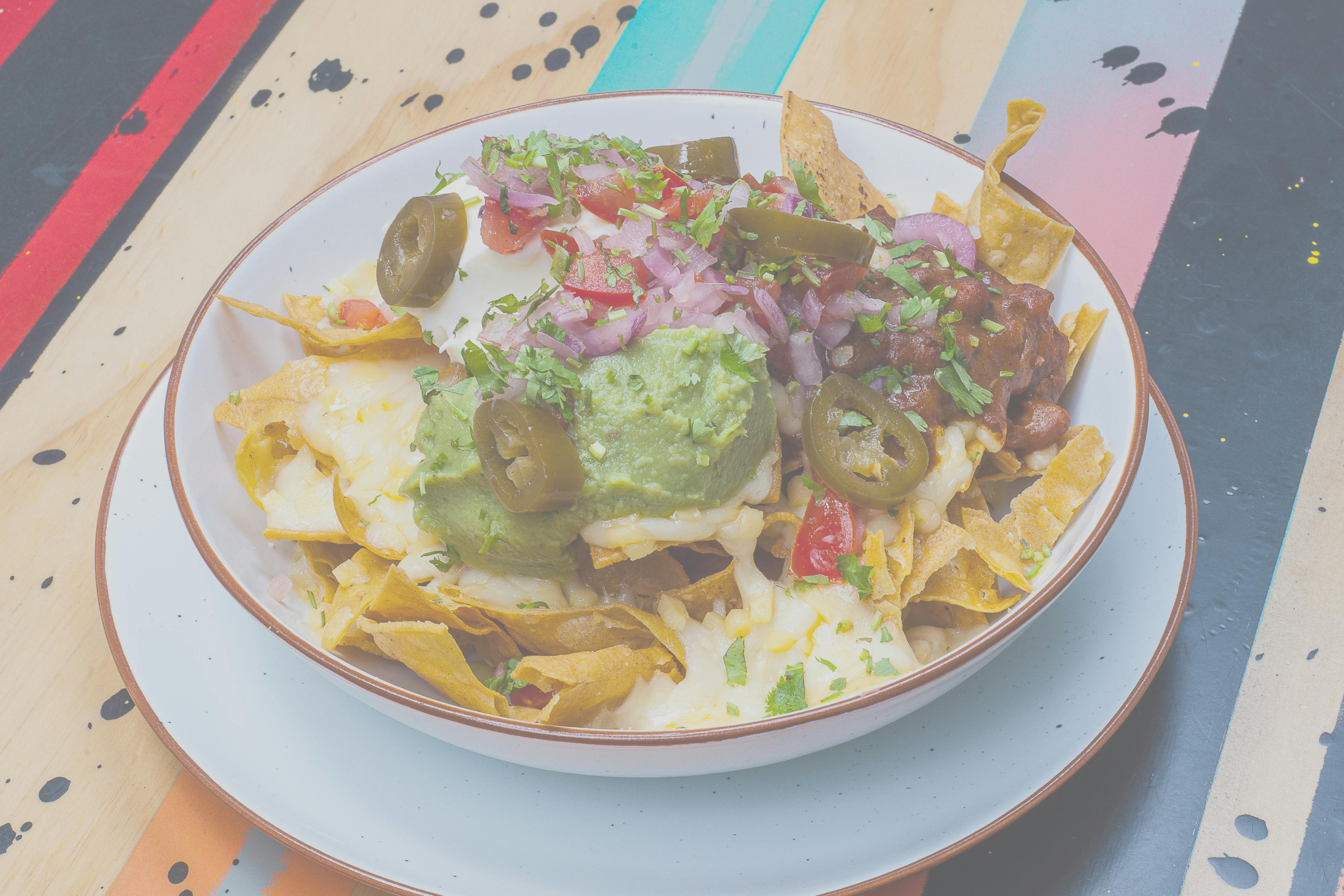
Tex-Mex Nachos
The diets react (see scores below)

That’s a heavy plate — want to see the leaner version?
Common Ingredients
- tortilla chips
- ground beefGround turkey
Lean ground turkey cuts the saturated fat of ground beef while keeping the dish a ground-meat dish.
- cheddar cheese
- refried beans
- jalapeños
- salsa
- sour creamGreek yogurt (plain, nonfat)
Nonfat Greek yogurt keeps the creamy body of sour cream with more protein and far less fat.
- guacamole
Specific recipes may vary.
Incompatible with 11 of 11 diets
Diet Ratings
Tex-Mex Nachos are fundamentally incompatible with a ketogenic diet. The base ingredient — tortilla chips — is a corn-derived grain product with extremely high net carbs (approximately 60-70g per standard serving), instantly blowing the daily carb budget. Refried beans add another significant carb load (~20-25g per serving), and salsa contributes additional sugars. While several individual components — ground beef, cheddar cheese, sour cream, guacamole, and jalapeños — are keto-friendly, the core structural ingredients (tortilla chips and refried beans) make this dish as traditionally prepared entirely incompatible with ketosis. There is no realistic portion size that rescues this dish in its standard form.
Tex-Mex Nachos as described contain multiple animal products that are unambiguously excluded from a vegan diet. Ground beef is slaughtered animal flesh, cheddar cheese is a dairy product derived from cow's milk, and sour cream is also a dairy product. These three ingredients alone are definitive disqualifiers under any standard definition of veganism. While several other components — tortilla chips, refried beans, jalapeños, salsa, and guacamole — are plant-based and would be vegan-compatible, the dish as a whole cannot be considered vegan in this formulation.
Tex-Mex Nachos are fundamentally incompatible with the Paleo diet. The dish is built on multiple core non-Paleo ingredients: tortilla chips are made from corn (a grain), refried beans are a legume, cheddar cheese and sour cream are dairy products, and the cheese likely contains added salt and preservatives. While a few individual components — ground beef, jalapeños, and guacamole — are Paleo-approved, and salsa can be compliant in its basic form, the foundational ingredients of this dish (grains, legumes, dairy) are explicitly excluded. This is not a dish that can be made Paleo-compliant with minor modifications; it would require replacing virtually every defining ingredient.
Tex-Mex Nachos are fundamentally incompatible with the Mediterranean diet. The dish centers on tortilla chips (refined, processed grain), ground beef (red meat, limited to a few times per month), and cheddar cheese (high saturated fat dairy). Sour cream adds more saturated fat with minimal nutritional benefit. While a few ingredients — jalapeños, salsa, refried beans, and guacamole — have Mediterranean-friendly qualities (vegetables, legumes, healthy fats), they are minor components in an overall dish dominated by processed refined carbs, red meat, and high-saturated-fat dairy. The combination and preparation style are entirely outside Mediterranean culinary tradition and nutritional principles.
Tex-Mex Nachos are fundamentally incompatible with the carnivore diet. The base ingredient — tortilla chips — is a grain-based, plant-derived, processed food, which alone disqualifies the dish entirely. Beyond that, refried beans are legumes (a strict carnivore exclusion), jalapeños and salsa are plant foods, and guacamole is fruit-derived. While ground beef and cheddar cheese are animal products, they are completely overwhelmed by the volume and number of plant-based, grain-based, and processed ingredients. This dish is the archetypal example of a carbohydrate-heavy snack food that carnivore diets are specifically designed to eliminate.
Tex-Mex Nachos contain multiple excluded ingredients that make this dish clearly incompatible with Whole30. Tortilla chips are a grain-based product (corn) explicitly excluded from the program, and they also fall under the 'no recreating junk food/chips' rule. Cheddar cheese and sour cream are dairy products, which are excluded. Refried beans are legumes, also excluded. Even setting aside the spirit-of-the-program concerns, the sheer number of excluded ingredients makes this dish impossible to rehabilitate into a compliant version without fundamentally changing what it is.
Tex-Mex Nachos as described contain multiple high-FODMAP ingredients that make this dish unsuitable during the elimination phase. Refried beans are the most significant offender — they are made from pinto or black beans, which are very high in GOS (galacto-oligosaccharides) and fructans, making them high-FODMAP at any realistic serving. Commercial salsa typically contains onion and/or garlic, both of which are high in fructans. Sour cream contains lactose and is considered high-FODMAP at a standard serving (over 2 tablespoons). Guacamole, while avocado itself is low-FODMAP only at 1/8 avocado (30g), is typically served in larger portions and commercial guacamole frequently contains onion and garlic. Ground beef itself is low-FODMAP, tortilla chips (corn-based, plain) are generally low-FODMAP, cheddar cheese is low in lactose and low-FODMAP, and jalapeños are low-FODMAP. However, the combination of refried beans, onion/garlic-containing salsa, and lactose-containing sour cream creates an unavoidably high-FODMAP dish. Even with substitutions, this dish as traditionally prepared cannot be considered safe during elimination.
Tex-Mex Nachos as commonly prepared are highly incompatible with DASH diet principles across multiple dimensions. Tortilla chips are high in sodium and refined carbohydrates with no whole-grain benefit. Ground beef contributes saturated fat and cholesterol, which DASH limits. Cheddar cheese is full-fat dairy, directly opposed to DASH's low-fat dairy recommendation, and adds significant sodium. Sour cream adds saturated fat and calories. Refried beans, while legumes are DASH-friendly in principle, are typically prepared with lard and heavy sodium. The cumulative sodium load from chips, cheese, refried beans, salsa, and seasoned beef can easily exceed 1,500–2,500mg in a single snack serving, potentially surpassing the entire daily DASH sodium budget. The dish is also high in saturated fat from multiple sources simultaneously. Guacamole and jalapeños are the only genuinely DASH-compatible components, providing healthy monounsaturated fats and vegetables respectively, but they cannot offset the overall profile. This dish represents nearly the opposite of DASH dietary priorities in a single snack.
Tex-Mex Nachos as traditionally prepared are nearly impossible to fit into Zone balance. The foundation is tortilla chips — a high-glycemic, refined carbohydrate that Sears explicitly categorizes as 'unfavorable' and which spike insulin rapidly, directly undermining the Zone's core anti-inflammatory goal. The macronutrient ratio is severely skewed: the dish is overwhelmingly carbohydrate and fat-heavy, with the carbs coming from the worst possible source (fried refined corn). Ground beef adds saturated fat rather than lean protein. Cheddar cheese contributes more saturated fat with minimal protein benefit per Zone block. Refried beans can provide some protein and fiber, making them a more favorable element, but they are typically prepared with lard adding more saturated fat. Sour cream is pure saturated fat with negligible Zone value. The guacamole is the only genuinely Zone-friendly component, providing monounsaturated fat. Jalapeños and salsa are favorable polyphenol-rich additions but don't redeem the dish. Even with extreme portion control, the base ingredient (tortilla chips) cannot be Zone-balanced — you would need so few chips that the dish loses its identity. This is essentially a high-glycemic, high-saturated-fat vehicle with no lean protein anchor and no low-GI carbohydrate base.
Tex-Mex Nachos present a strongly pro-inflammatory profile across multiple components. Tortilla chips are a refined carbohydrate typically fried in seed oils high in omega-6 fatty acids, offering minimal fiber and spiking blood sugar. Ground beef adds saturated fat and arachidonic acid, a precursor to pro-inflammatory eicosanoids. Cheddar cheese contributes full-fat dairy with saturated fat, which anti-inflammatory guidelines recommend limiting. Sour cream adds more full-fat dairy and saturated fat with negligible anti-inflammatory benefit. The combination of refined chips fried in industrial seed oils plus multiple sources of saturated fat creates a cumulative pro-inflammatory load. The dish does have a few redeeming elements: guacamole provides anti-inflammatory monounsaturated fats and antioxidants from avocado; jalapeños contain capsaicin, which has demonstrated anti-inflammatory properties; salsa contributes lycopene and polyphenols from tomatoes and garlic; and refried beans offer some fiber and plant protein. However, these benefits are overwhelmed by the dominant pro-inflammatory ingredients. As a snack dish — rather than an occasional indulgence within an otherwise healthy diet — the nacho format delivers this combination in a highly palatable, easy-to-overconsume format. The overall profile is clearly in 'avoid' territory from an anti-inflammatory standpoint.
Tex-Mex Nachos as typically prepared are a poor fit for GLP-1 patients on nearly every criterion. The base is tortilla chips — a refined, fried, high-fat, low-fiber, low-protein vehicle with almost no nutritional density per calorie. Ground beef adds some protein but also significant saturated fat. Cheddar cheese piles on additional saturated fat and calories in a small volume. Sour cream contributes more saturated fat with minimal nutritional benefit. Guacamole adds healthy unsaturated fat but also caloric density in a dish already heavy with fat. Refried beans and salsa are the only genuinely GLP-1-friendly elements — beans offer fiber and plant protein, salsa is low-calorie and micronutrient-rich — but they are minor components in an overall very problematic dish. Jalapeños may worsen reflux and nausea, which are already common GLP-1 side effects. The combination of high saturated fat, fried chips, spicy ingredients, and low protein density per calorie means this dish is likely to trigger or worsen nausea, bloating, reflux, and gastric discomfort given the slowed gastric emptying caused by GLP-1 medications. It also delivers empty calories at a time when every bite must count nutritionally. Even in a small portion, the fat-to-protein ratio is unfavorable and the digestibility is poor.
*See how scores were generated at our methodology page.
Nutritional profile
Six traits that cut across every diet.
Fiber & Plants
How much whole-plant food and fiber it delivers.
Healthy Fats
The quality of its fats (unsaturated, omega-3).
Whole / Unprocessed
How close it is to its natural, unprocessed form.
Gut Gentle
How easy it is on digestion (low FODMAP, few irritants).
Low Glycemic
How little it spikes your blood sugar.
Protein Density
How much protein it packs per calorie.
Controversy Index
Higher controversy = more disagreement between diets.