Photo: Elsa silva / Pexels
Thai
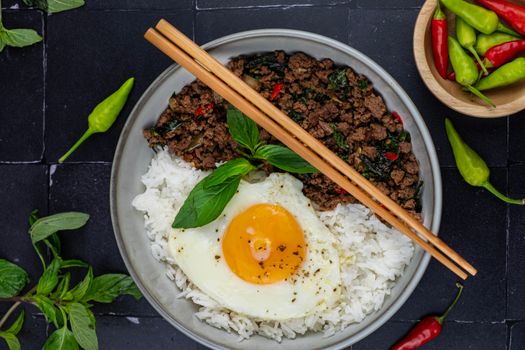
Thai Basil Beef
The diets react (see scores below)
Common Ingredients
- beef
- Thai holy basil
- garlic
- Thai chiles
- oyster sauce
- fish sauce
- soy sauce
- jasmine rice
Specific recipes may vary.
Incompatible with 8 of 11 diets
Diet Ratings
Thai Basil Beef as traditionally prepared is incompatible with a ketogenic diet primarily due to jasmine rice, which is a high-glycemic grain delivering roughly 45g of net carbs per cup — easily exceeding the entire daily keto carb budget in a single serving. Beyond the rice, oyster sauce contains added sugar and starch (approximately 5-7g net carbs per tablespoon), and soy sauce adds marginal carbs. The beef, Thai basil, garlic, chiles, and fish sauce components are keto-friendly, but the dish as a whole — particularly as served — is a keto disqualifier. Without the rice and with oyster sauce substituted or minimized, the stir-fry portion alone could be adapted to keto, but the standard dish cannot.
Thai Basil Beef contains multiple animal products and animal-derived ingredients that are categorically incompatible with a vegan diet. Beef is a direct animal product (mammal flesh). Fish sauce is made from fermented fish and/or krill. Oyster sauce is derived from oyster extracts. These three ingredients alone make this dish firmly non-vegan, with no meaningful debate within the vegan community.
Thai Basil Beef contains multiple non-paleo ingredients that disqualify it outright. Soy sauce is a fermented soy and wheat product — both legume and grain derivatives that are firmly excluded from the paleo diet. Oyster sauce is heavily processed and typically contains added sugar, modified starch, and preservatives. Fish sauce, while more natural, commonly contains added salt, which is excluded under strict paleo rules. Most critically, the dish is served over jasmine rice, a grain that is excluded by all mainstream paleo authorities. The base protein (beef), Thai holy basil, garlic, and Thai chiles are paleo-compatible, but the sauce components and the rice make this dish clearly non-paleo as traditionally prepared.
Thai Basil Beef conflicts with Mediterranean diet principles on multiple fronts. Beef is a red meat, which should be limited to only a few times per month under Mediterranean guidelines. The dish is built around beef as the primary protein rather than using it as an occasional accent. Jasmine rice is a refined white grain, not a whole grain. Oyster sauce and soy sauce are highly processed condiments high in sodium with added sugars and refined ingredients, far removed from the whole-food, minimally processed ethos of the Mediterranean diet. The dish uses no olive oil, no legumes, and no vegetables beyond aromatics. While garlic and chiles are Mediterranean-friendly, they play a minor supporting role here. The overall dish profile — red meat-centric, refined grain base, processed sauces — directly contradicts the core pillars of Mediterranean eating.
Thai Basil Beef is incompatible with the carnivore diet. While beef is an excellent carnivore food, this dish is loaded with plant-based ingredients that are strictly excluded: Thai holy basil (herb/plant), garlic (plant), Thai chiles (plant), and jasmine rice (grain). The sauces compound the problem — oyster sauce typically contains sugar and starch, soy sauce is a fermented soy product (legume-derived), and fish sauce, while animal-derived, is used here within a wholly plant-heavy dish. The jasmine rice alone is a disqualifying grain. This dish is fundamentally a plant-forward Thai recipe that uses beef as a protein component, not a carnivore meal with minor additions.
Thai Basil Beef contains multiple Whole30-excluded ingredients that make it clearly non-compliant. Soy sauce is a soy-based product, and soy is explicitly excluded from the Whole30 program. Oyster sauce typically contains added sugar and sometimes cornstarch or other excluded ingredients. Jasmine rice is a grain, which is categorically excluded for the full 30 days. Even if the rice were removed and soy sauce replaced with coconut aminos, the oyster sauce would still require a compliant substitute. This dish as traditionally prepared fails on at least three counts.
Thai Basil Beef is fundamentally incompatible with the low-FODMAP elimination phase due to garlic, which is one of the highest-FODMAP foods tested by Monash University (high in fructans even in tiny amounts). Garlic is a core structural ingredient in this dish — not a garnish — making substitution essentially impossible without changing the dish entirely. Oyster sauce also typically contains garlic and/or onion derivatives and is rated high-FODMAP by Monash. Soy sauce in small amounts (1 tablespoon) is considered low-FODMAP, but many Thai preparations use it in larger quantities. Thai holy basil, Thai chiles, beef, fish sauce (in small amounts), and jasmine rice are all low-FODMAP individually. However, the garlic and oyster sauce alone are sufficient to classify this dish as high-FODMAP and unsuitable for the elimination phase at any standard restaurant or home serving.
Thai Basil Beef is a sodium-heavy dish that conflicts with core DASH diet principles on multiple fronts. The combination of oyster sauce, fish sauce, and soy sauce creates an extremely high-sodium profile — a single serving can easily exceed 1,500–2,500mg of sodium, surpassing both the standard DASH limit (2,300mg/day) and the low-sodium DASH limit (1,500mg/day) in one meal alone. Red meat (beef) is also a food DASH guidelines explicitly recommend limiting due to its saturated fat and cholesterol content. Jasmine rice is a refined grain, which DASH de-emphasizes in favor of whole grains. While garlic, Thai chiles, and fresh basil are DASH-friendly ingredients, they cannot offset the sodium and saturated fat burden of this dish as commonly prepared. Occasional consumption of a heavily modified low-sodium version (low-sodium soy sauce, reduced oyster/fish sauce, lean beef in small portion) could push this toward 'caution,' but the standard preparation is a clear avoid.
Thai Basil Beef has a mixed Zone profile. The lean ground or sliced beef provides solid protein blocks, though it carries more saturated fat than ideal Zone proteins like chicken breast or fish. The aromatics — Thai holy basil, garlic, and chiles — are excellent Zone-friendly polyphenol-rich additions with negligible impact on blocks. The sauces (oyster, fish, soy) add sodium and minor sugar but in typical quantities don't significantly disrupt block ratios. The core problem is jasmine rice: it is a high-glycemic carbohydrate (GI ~72) that Sears explicitly categorizes as an 'unfavorable' carb. Jasmine rice spikes insulin rapidly, undermining the Zone's goal of hormonal control. A standard restaurant serving will be carb-heavy and protein-light relative to Zone targets. However, this dish is very salvageable: substituting cauliflower rice or reducing jasmine rice to a small portion (½ cup cooked ≈ 2 carb blocks) while loading the plate with non-starchy vegetables restores Zone balance. The beef itself, if lean, fits reasonably into the protein block system.
Thai Basil Beef presents a genuinely mixed anti-inflammatory profile. On the positive side, Thai holy basil contains eugenol and rosmarinic acid with documented anti-inflammatory properties, garlic has allicin which reduces inflammatory markers, and Thai chiles provide capsaicin — all strong anti-inflammatory contributors. However, the dish's primary protein is beef (red meat), which is classified as 'limit' in anti-inflammatory frameworks due to saturated fat and arachidonic acid content that can upregulate pro-inflammatory eicosanoids. The condiment base — oyster sauce, fish sauce, and soy sauce — adds significant sodium and contains preservatives and additives that some anti-inflammatory practitioners flag. Jasmine rice is a refined/high-glycemic white rice that lacks the fiber of whole grains and can trigger modest insulin spikes, though it is less problematic than wheat-based refined carbs. The dish does not use seed oils (a positive), and the aromatic base of garlic, basil, and chiles genuinely offsets some of the inflammatory burden. Overall, the pro-inflammatory signal from red meat and high-sodium processed sauces, combined with white rice, pulls this into 'caution' territory — not harmful as an occasional meal, but not anti-inflammatory by design.
Some anti-inflammatory practitioners (aligned with Dr. Weil's more permissive framework) might view this dish more favorably, noting that the potent anti-inflammatory aromatics — basil, garlic, and chiles — meaningfully reduce the overall inflammatory burden of a modest beef serving, particularly if lean cuts are used. Conversely, stricter anti-inflammatory and AIP-aligned protocols would rate this more negatively, citing red meat's arachidonic acid content, soy sauce (potential lectin/gluten concerns), and the high-sodium processed condiments as compounding inflammatory signals.
Thai Basil Beef presents a mixed nutritional profile for GLP-1 patients. The beef provides meaningful protein, but the cut used in this dish is typically ground beef or thinly sliced fatty cuts, which carry moderate-to-high saturated fat — a concern given that high-fat foods worsen GLP-1 side effects like nausea, bloating, and reflux. The Thai chiles are a notable flag: spicy foods can aggravate the GI side effects already common on GLP-1 medications, including reflux and nausea. The oyster sauce and fish sauce add sodium and some sugar with minimal nutritional upside. Jasmine rice is a refined grain — low fiber, moderate glycemic index, and nutritionally thin compared to what GLP-1 patients need from every calorie they consume. The dish lacks significant fiber and relies on a fat-forward protein source. It is not inherently off-limits, but several elements work against the dietary priorities for GLP-1 patients, and it would need meaningful modification (lean ground beef or sirloin, reduced chile, smaller rice portion or swap for cauliflower rice, added vegetables) to move toward approve territory.
Some GLP-1-focused dietitians would rate this more permissively, noting that beef is a complete protein source and that individual spice tolerance varies widely — patients who tolerate spice without GI symptoms need not avoid it categorically. Others would flag the refined jasmine rice and saturated fat more strictly, particularly for patients on higher doses experiencing pronounced gastric slowing, and would rate the dish closer to avoid without substitutions.
*See how scores were generated at our methodology page.
Nutritional profile
Six traits that cut across every diet.
Fiber & Plants
How much whole-plant food and fiber it delivers.
Healthy Fats
The quality of its fats (unsaturated, omega-3).
Whole / Unprocessed
How close it is to its natural, unprocessed form.
Gut Gentle
How easy it is on digestion (low FODMAP, few irritants).
Low Glycemic
How little it spikes your blood sugar.
Protein Density
How much protein it packs per calorie.
Controversy Index
Higher controversy = more disagreement between diets.
Diet-Specific Tips
 Zone — 5/10
View tips
- Jasmine rice is high-glycemic (GI ~72) and an 'unfavorable' Zone carbohydrate that disrupts insulin control
- Beef protein is Zone-compatible but higher in saturated fat than preferred lean proteins (chicken, fish)
- Thai holy basil, garlic, and chiles are polyphenol-rich and Zone-favorable
- Oyster and fish sauces add minor sugars and sodium but are low volume and not a significant macro concern
- Dish is easily modified for Zone compliance by replacing jasmine rice with cauliflower rice or reducing portion significantly
- Standard restaurant portions will be carb-heavy and protein-insufficient relative to 40/30/30 targets
 Anti-Inflammatory — 4/10
View tips
- Beef (red meat): pro-inflammatory — saturated fat and arachidonic acid; classified as 'limit' in anti-inflammatory frameworks
- Thai holy basil: anti-inflammatory — contains eugenol and rosmarinic acid, reduces NF-κB activity
- Garlic: anti-inflammatory — allicin and organosulfur compounds reduce CRP and IL-6
- Thai chiles: anti-inflammatory — capsaicin inhibits substance P and pro-inflammatory cytokines
- Oyster sauce, fish sauce, soy sauce: high sodium, additives, and preservatives; processed condiments are generally flagged
- Jasmine white rice: refined carbohydrate, high glycemic index — neutral to mildly pro-inflammatory vs. preferred whole grain alternatives
- No seed oils used — a positive distinction from many stir-fry preparations
 GLP-1 Friendly — 4/10
View tips
- Beef provides complete protein but is typically a fatty cut in this preparation, raising saturated fat concerns
- Thai chiles are likely to worsen nausea and reflux — common GLP-1 side effects
- Jasmine rice is a refined grain: low fiber, moderate glycemic load, nutritionally sparse per calorie
- Oyster sauce contributes added sugar and high sodium with minimal nutritional benefit
- Dish is low in fiber with no vegetable content as written
- High sodium from fish sauce, oyster sauce, and soy sauce combined may contribute to water retention and is not ideal on reduced caloric intake
- Dish can be modified favorably: lean beef, reduced chile, cauliflower rice, added vegetables