Photo: Markus Winkler / Pexels
Thai
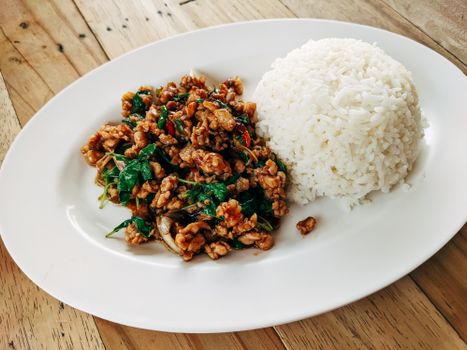
Thai Basil Pork
The diets react (see scores below)
Common Ingredients
- ground pork
- Thai holy basil
- garlic
- Thai chiles
- oyster sauce
- fish sauce
- sugar
- jasmine rice
Specific recipes may vary.
Incompatible with 8 of 11 diets
Diet Ratings
Thai Basil Pork as traditionally prepared is incompatible with a ketogenic diet primarily due to jasmine rice, which alone contributes roughly 45-50g of net carbs per cup serving — immediately exceeding most people's daily keto limit. Beyond the rice, the dish contains added sugar (a direct keto violation), oyster sauce (high in sugar and starch, ~5-7g net carbs per tablespoon), and fish sauce adds minor carbs. The ground pork, Thai basil, garlic, and chiles are keto-friendly, but the overall dish as served cannot be consumed within keto parameters. A heavily modified version (omit rice, replace oyster sauce with coconut aminos, eliminate sugar) could potentially be keto-compatible, but that would be a fundamentally different dish.
Thai Basil Pork contains multiple animal products and animal-derived ingredients that are categorically incompatible with a vegan diet. Ground pork is a direct animal flesh product. Oyster sauce is derived from oysters (shellfish). Fish sauce is derived from fermented fish. These three ingredients alone make this dish entirely off-limits for vegans. There is no ambiguity or debate within the vegan community about any of these ingredients.
Thai Basil Pork contains multiple non-paleo ingredients that disqualify it from approval. Jasmine rice is a grain and is excluded under strict paleo guidelines. Oyster sauce is a processed condiment typically containing sugar, cornstarch, and additives. Sugar (refined) is explicitly excluded. Fish sauce, while made from fermented fish, commonly contains added salt and sometimes sugar — and added salt is excluded on paleo. The base proteins and aromatics (ground pork, Thai holy basil, garlic, Thai chiles) are paleo-approved, but the overall dish as traditionally prepared fails on multiple counts. To make this paleo-compliant, one would need to eliminate the rice, replace oyster sauce with a paleo alternative, use coconut aminos instead of fish sauce, and omit the sugar.
Thai Basil Pork conflicts with Mediterranean diet principles on multiple fronts. Ground pork is a red meat, which is limited to only a few times per month in the Mediterranean diet. The dish is served over jasmine rice, a refined white grain lacking the fiber and nutrients of whole grains. Oyster sauce and fish sauce are highly processed condiments with significant added sodium, and added sugar is included in the recipe. The cooking fat is unspecified but almost certainly not olive oil. While garlic, basil, and chiles are Mediterranean-friendly aromatics, they cannot compensate for the core protein and carbohydrate base both running counter to Mediterranean principles.
Thai Basil Pork is fundamentally incompatible with the carnivore diet. While ground pork is an approved animal protein, the dish is built around multiple plant-based ingredients and prohibited additives. Thai holy basil, garlic, and Thai chiles are all plant foods explicitly excluded from carnivore. Oyster sauce and fish sauce often contain sugar and plant-derived additives, and sugar is directly added as well. Jasmine rice is a grain — one of the most strictly excluded food categories on carnivore. The only salvageable component is the ground pork itself; every other ingredient disqualifies this dish entirely.
Thai Basil Pork contains multiple Whole30-excluded ingredients: (1) sugar — an explicitly excluded added sugar; (2) oyster sauce — typically contains sugar and sometimes corn starch or other non-compliant additives; (3) jasmine rice — a grain, which is categorically excluded from Whole30. Even if a compliant oyster sauce substitute could be found and the sugar omitted, the jasmine rice alone disqualifies this dish as commonly prepared.
Thai Basil Pork (Pad Kra Pao) is a high-FODMAP dish due to two major offenders: garlic and oyster sauce. Garlic is one of the highest-fructan foods known and is a definitive avoid during the FODMAP elimination phase at any meaningful culinary quantity. Oyster sauce is also high in FODMAPs (fructans) and is used in sufficient quantity in this dish to be problematic. The remaining ingredients are generally low-FODMAP: ground pork is protein and FODMAP-free, Thai holy basil is used as an herb in small amounts and is considered low-FODMAP, Thai chiles are low-FODMAP in standard amounts, fish sauce is low-FODMAP at typical serving sizes, sugar is low-FODMAP in small quantities, and jasmine rice is definitively low-FODMAP. However, garlic alone disqualifies this dish during elimination — it is a foundational, non-optional ingredient in authentic Pad Kra Pao and cannot be reduced to a FODMAP-safe level while maintaining the dish's identity. Oyster sauce compounds the problem. This dish is not suitable for the FODMAP elimination phase as traditionally prepared.
Thai Basil Pork (Pad Krapao Moo) is a poor fit for the DASH diet due to its multiple high-sodium ingredients. Oyster sauce and fish sauce are both extremely high in sodium — a single tablespoon of fish sauce contains roughly 1,400–1,500mg of sodium, and oyster sauce adds another 400–500mg per tablespoon, meaning a single serving can easily exceed the entire daily sodium budget for both standard DASH (<2,300mg) and low-sodium DASH (<1,500mg) targets. Ground pork, while leaner than some red meats, is still classified as red meat which DASH limits due to saturated fat content. Jasmine rice is a refined grain, offering less fiber than DASH-preferred whole grains like brown rice. The added sugar also conflicts with DASH guidance on limiting sweets. While garlic, Thai chiles, and Thai basil are DASH-friendly aromatics, they cannot offset the sodium and saturated fat load of this dish as traditionally prepared.
Thai Basil Pork (Pad Krapow Moo) has some Zone-compatible elements but is problematic as traditionally prepared. Ground pork is a moderately lean protein that can serve as a Zone protein block, though it carries more saturated fat than ideal Zone proteins like skinless chicken or fish. The holy basil, garlic, and Thai chiles are excellent low-glycemic, polyphenol-rich additions that align well with Zone anti-inflammatory principles. However, the dish has two significant Zone liabilities: (1) Jasmine rice is a high-glycemic carbohydrate — one of the highest GI carbs available, explicitly discouraged in Zone methodology, contributing a rapid glucose spike that disrupts the eicosanoid balance Sears prioritizes. (2) Oyster sauce and added sugar contribute additional high-glycemic load with minimal nutritional value. The traditional macro ratio is also skewed heavily toward carbohydrates from the rice base, making the 40/30/30 block balance difficult to achieve without significant modification. Zone adaptation would require: replacing jasmine rice with cauliflower rice or a small portion of a lower-GI grain, eliminating added sugar, reducing oyster sauce, and ensuring the pork portion matches roughly 3 protein blocks (~21g protein). In modified form this could reach a score of 6-7, but as traditionally served it struggles.
Thai Basil Pork (Pad Krapao Moo) has a genuinely mixed anti-inflammatory profile. On the positive side, Thai holy basil is rich in eugenol and rosmarinic acid, both with documented anti-inflammatory properties. Garlic provides allicin and organosulfur compounds that reduce inflammatory markers. Thai chiles contribute capsaicin, a well-established anti-inflammatory compound. Fish sauce, while high in sodium, is minimally processed and contains some bioactive peptides. However, several factors pull this dish toward caution: ground pork is red meat, which anti-inflammatory frameworks consistently recommend limiting due to arachidonic acid content and saturated fat — though leaner ground pork is less problematic than fatty cuts. Oyster sauce typically contains added sugar, modified starch, and preservatives. The added sugar, while modest in cooking quantities, contributes to the inflammatory load. Jasmine rice is a high-glycemic refined grain with minimal fiber, unlike the whole grains emphasized in anti-inflammatory eating. The dish isn't inherently harmful and contains meaningful anti-inflammatory spices, but the combination of red meat, refined rice, added sugar, and processed condiments makes this a 'moderate occasionally' rather than a recommended choice.
Some anti-inflammatory practitioners, particularly those following Dr. Weil's broader dietary philosophy, would view this dish more favorably — the abundant garlic, chiles, and holy basil meaningfully offset the pork's inflammatory potential, and lean ground pork in modest portions is not dramatically different from poultry. Critics following stricter protocols (e.g., AIP or Mediterranean-focused frameworks) would push this closer to avoid, citing red meat and high-glycemic jasmine rice as two simultaneous anti-inflammatory strikes in a single dish.
Thai Basil Pork (pad kra pao) presents a mixed profile for GLP-1 patients. Ground pork provides meaningful protein (roughly 20-25g per serving), which is a genuine positive, but it carries moderate-to-high saturated fat depending on the fat percentage of the grind (80/20 is common in restaurant versions). The Thai chiles are a meaningful concern — spicy foods can worsen the nausea, reflux, and GI discomfort that are already common GLP-1 side effects, particularly early in treatment. Fish sauce and oyster sauce add significant sodium with minimal nutritional benefit. The sugar in the sauce adds modest but unnecessary empty calories. Jasmine rice is a refined, high-glycemic carbohydrate with low fiber and low protein density — it fills stomach volume without contributing meaningfully to protein or fiber targets, which is a real cost given the reduced appetite GLP-1 patients experience. The dish as a whole is not nutrient-dense per calorie at the portions a GLP-1 patient would realistically eat. It is not fried and does contain garlic and basil (minor positive for micronutrients), but the combination of spice, moderate fat, refined carb base, and added sugar pushes this into caution territory rather than approve.
Some GLP-1-focused dietitians would rate this more favorably if prepared with lean ground pork (93/7) and served over a smaller portion of brown or cauliflower rice, arguing the protein content and whole-food ingredients make it workable. Others flag the chile heat and high sodium as consistent triggers for nausea and reflux in GLP-1 patients regardless of preparation adjustments, and would advise avoiding it entirely during the early titration phase.
*See how scores were generated at our methodology page.
Nutritional profile
Six traits that cut across every diet.
Fiber & Plants
How much whole-plant food and fiber it delivers.
Healthy Fats
The quality of its fats (unsaturated, omega-3).
Whole / Unprocessed
How close it is to its natural, unprocessed form.
Gut Gentle
How easy it is on digestion (low FODMAP, few irritants).
Low Glycemic
How little it spikes your blood sugar.
Protein Density
How much protein it packs per calorie.
Controversy Index
Higher controversy = more disagreement between diets.
Diet-Specific Tips
 Zone — 4/10
View tips
- Jasmine rice is high-glycemic and explicitly unfavorable in Zone carbohydrate hierarchy
- Added sugar in oyster sauce and directly further elevates glycemic load
- Ground pork is acceptable Zone protein but higher in saturated fat than ideal lean proteins
- Holy basil, garlic, and Thai chiles are excellent Zone-favorable polyphenol sources
- Traditional serving ratio is carbohydrate-heavy, making 40/30/30 balance difficult without modification
- Fish sauce adds sodium but negligible macronutrient impact on Zone blocks
- Dish is salvageable with cauliflower rice substitution and sugar reduction
 Anti-Inflammatory — 4/10
View tips
- Ground pork is red meat — limited in anti-inflammatory frameworks due to saturated fat and arachidonic acid
- Thai holy basil contains eugenol and rosmarinic acid with anti-inflammatory properties
- Garlic provides allicin and organosulfur compounds shown to reduce CRP
- Thai chiles contribute capsaicin, a well-researched anti-inflammatory compound
- Jasmine rice is a high-glycemic refined grain — pro-inflammatory in excess
- Oyster sauce adds sugar, sodium, and preservatives — modest amounts in cooking
- Fish sauce is high-sodium but minimally processed
- Added sugar (from oyster sauce and direct addition) contributes to inflammatory load
 GLP-1 Friendly — 4/10
View tips
- Ground pork provides moderate protein (~20-25g/serving) but carries significant saturated fat in standard 80/20 versions
- Thai chiles are a direct GI irritant — spicy foods commonly worsen nausea and reflux on GLP-1 medications
- Jasmine rice is a refined, low-fiber, high-glycemic carbohydrate that displaces nutrient-dense calories in a reduced-appetite context
- Added sugar in the sauce contributes empty calories — a meaningful cost when total intake is severely limited
- High sodium from fish sauce and oyster sauce may worsen bloating and fluid retention
- Dish is not fried — a positive that distinguishes it from worse Thai options
- Portion sensitivity is high: standard restaurant servings are large relative to what GLP-1 patients can comfortably eat