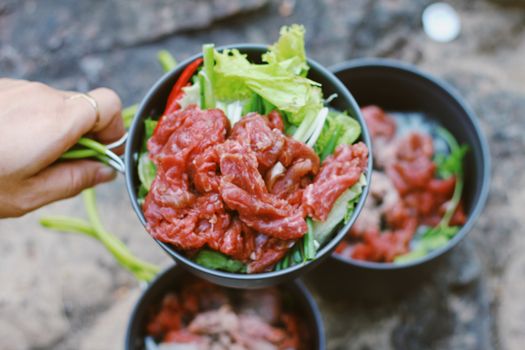
Thai
Thai Beef Salad
The diets react (see scores below)
Common Ingredients
- beef
- lime juice
- fish sauce
- mint
- cilantro
- red onion
- Thai chiles
- cucumber
Specific recipes may vary.
Incompatible with 3 of 11 diets
Diet Ratings
Thai Beef Salad is a strong keto fit in its base form. Beef provides high-quality protein and fat, while the herbs (mint, cilantro), cucumber, and red onion contribute minimal net carbs. Lime juice and fish sauce add small amounts of carbs but in typical serving quantities remain well within keto limits. Thai chiles add negligible carbs. The main watch-out is that many restaurant or recipe versions include added sugar (palm sugar or honey in the dressing) and sometimes rice noodles — those additions would push it toward caution. Evaluated as listed with no added sugar, this dish fits keto well.
Some stricter keto practitioners flag fish sauce and lime juice combinations as potentially containing hidden sugars depending on brand or preparation, and caution that restaurant versions almost always include sugar in the dressing, making ordering this dish reliably keto-compatible difficult in practice.
Thai Beef Salad contains multiple animal-derived ingredients that make it entirely incompatible with a vegan diet. Beef is a mammalian meat — a direct and unambiguous animal product. Fish sauce, a staple condiment in Thai cuisine, is made from fermented anchovies or other fish and is equally non-vegan. The remaining ingredients (lime juice, mint, cilantro, red onion, Thai chiles, cucumber) are all plant-based, but two of the core components disqualify this dish outright. There is no meaningful debate within the vegan community about either beef or fish sauce.
Thai Beef Salad is largely paleo-compliant, featuring unprocessed beef, fresh vegetables, herbs, lime juice, and chiles — all clearly approved paleo foods. The sticking point is fish sauce, a staple of Thai cooking. Most commercial fish sauces contain added salt, and many include additives or preservatives, both of which are excluded under strict paleo rules. Salt itself is a gray area: Loren Cordain's original framework explicitly excludes added salt, while many modern paleo practitioners (Mark Sisson, Robb Wolf) consider high-quality fish sauce acceptable in moderation given its ancestral fermented-food profile. If using a clean, additive-free fish sauce, this dish edges closer to a full approve — but the salt content and processing of most commercial fish sauces keep it in caution territory.
Mark Sisson and Robb Wolf's more flexible paleo frameworks generally permit fish sauce as a fermented, minimally processed condiment used in small quantities, arguing its ancestral fermentation process and trace mineral content outweigh concerns about added salt. Strict Cordain-school paleo, however, excludes both added salt and processed condiments categorically.
Thai Beef Salad is built around beef as its primary protein, which is a significant concern for Mediterranean diet compatibility. Red meat is limited to just a few times per month in Mediterranean dietary guidelines. While the dish has genuinely positive elements — fresh herbs (mint, cilantro), vegetables (cucumber, red onion), chiles, and lime juice are all plant-forward ingredients consistent with Mediterranean principles — the beef centerpiece disqualifies it from approval. Fish sauce is a non-traditional condiment but is not inherently problematic in small amounts. The absence of olive oil and the reliance on beef as the protein anchor push this into 'avoid' territory, though the vegetable-rich composition prevents a rock-bottom score.
Some Mediterranean diet interpreters, particularly those following less restrictive 'once weekly' red meat allowances rather than 'a few times per month,' might rate this as 'caution' if consumed occasionally — especially given the dish's strong vegetable and herb content, low saturated fat profile from a lean beef cut, and acid-forward dressing. The salad format and fresh ingredients mirror Mediterranean eating patterns even if the protein source does not.
Thai Beef Salad is fundamentally incompatible with the carnivore diet despite containing beef as the primary protein. The dish is overwhelmingly plant-based in composition: mint, cilantro, red onion, Thai chiles, cucumber, and lime juice are all plant-derived and explicitly excluded from carnivore. Fish sauce, while animal-derived, typically contains added sugar and is used here as a flavoring alongside plant ingredients rather than as a standalone food. This dish is essentially a plant salad with beef added — the opposite of what carnivore requires. Only the beef itself would be permitted; the dish as a whole cannot be approved in any form.
Thai Beef Salad as described is highly Whole30-compatible. Beef is explicitly allowed, lime juice is a natural acid from fruit, fresh herbs (mint, cilantro) and vegetables (red onion, Thai chiles, cucumber) are all compliant. The one ingredient requiring attention is fish sauce: most commercial fish sauces contain only anchovies, salt, and water, making them compliant, but some brands add sugar or other excluded ingredients. As long as a compliant fish sauce (no added sugar) is used, this dish is fully aligned with Whole30 principles. It is a whole-food, unprocessed meal that clearly honors the spirit of the program.
Fish sauce is the only variable here — official Whole30 guidelines allow fish sauce with compliant ingredients, but label-reading is required since many mainstream brands add sugar. Melissa Urban and the official Whole30 site recommend choosing brands like Red Boat (0° fish sauce) that contain only anchovies and salt.
Thai Beef Salad contains several low-FODMAP ingredients (beef, lime juice, fish sauce, mint, cilantro, cucumber) but is complicated by two problematic ingredients: red onion and the ambiguous quantity of Thai chiles. Red onion is high in fructans and is clearly high-FODMAP at any meaningful serving — even small amounts used as a garnish can push the dish into high-FODMAP territory. Thai chiles (fresh hot chiles) are low-FODMAP in small quantities per Monash (up to 11g), but Thai recipes often use them liberally. Fish sauce is generally low-FODMAP in typical serving quantities. The dish cannot be approved as traditionally prepared due to the red onion, but with modifications (omitting or substituting green onion tops only), it could become low-FODMAP. Rating as 'caution' reflects that the dish as listed contains a clear FODMAP trigger in red onion, but the overall FODMAP load depends heavily on quantities used.
Monash University rates red onion as high-FODMAP even in small servings (fructans are present at just 28g/1oz), so many clinical FODMAP practitioners would rate this dish as 'avoid' rather than 'caution' since red onion is a core ingredient rather than an incidental additive. Substituting the green tops of spring onions/scallions is the standard clinical workaround, but this changes the dish from its traditional form.
Thai Beef Salad presents a mixed DASH profile. On the positive side, it features an abundance of DASH-friendly vegetables and herbs (cucumber, red onion, mint, cilantro, Thai chiles) and lime juice, which are rich in potassium, vitamins, and antioxidants. However, two significant DASH concerns emerge: (1) Beef is a red meat, which DASH guidelines explicitly limit due to saturated fat and cholesterol content — the cut and portion size matter greatly, as a lean cut like sirloin or flank steak in a 3 oz portion is more acceptable than a fatty cut. (2) Fish sauce is very high in sodium, typically contributing 1,000–1,500mg per 2 tablespoons, which can easily push a single serving toward or beyond the DASH sodium ceiling of 2,300mg/day (or well beyond the 1,500mg low-sodium DASH target). The dish is not inherently unhealthy and offers many DASH-positive elements, but the combination of red meat and high-sodium fish sauce requires meaningful portion control and ingredient modification to fit DASH guidelines comfortably.
NIH DASH guidelines explicitly limit red meat and high-sodium condiments like fish sauce, placing this dish in a cautionary category. However, some updated clinical interpretations note that lean beef in modest portions (3 oz) can fit within DASH's lean protein allowance, and reduced-sodium fish sauce or a lime-juice-heavy dressing could substantially improve sodium compliance — making this dish more DASH-adaptable than a strict reading would suggest.
Thai Beef Salad aligns well with Zone Diet principles in several key respects. The carbohydrate sources — cucumber, red onion, lime juice, fresh herbs (mint, cilantro), and Thai chiles — are all low-glycemic, colorful vegetables that Zone methodology explicitly favors. Fish sauce contributes negligible carbs. The protein source (beef) is the primary concern: lean cuts (sirloin, flank steak) are acceptable Zone protein sources, but beef inherently carries more saturated fat than preferred Zone proteins like skinless chicken or fish. Portioning to approximately 25g protein per meal (about 3 oz lean beef) keeps this manageable. The dish has no added fat component listed, so it skews low on the fat block — a dieter would want to add a small serving of monounsaturated fat (e.g., a few sliced avocado pieces or a drizzle of olive oil) to hit the 30% fat target. Overall the macro profile of this dish, with lean beef and abundant low-GI vegetables, is a reasonable Zone meal with minor adjustments.
Some Zone practitioners and Sears' earlier writings (Enter the Zone) more strictly limit red meat due to its arachidonic acid content and saturated fat, which can promote pro-inflammatory eicosanoids — counter to Zone's anti-inflammatory goals. Later Sears work is more nuanced, allowing lean red meat in moderation. The cut of beef matters significantly: flank or sirloin scores better than ribeye. Additionally, fish sauce is high in sodium, which while not a Zone concern per se, may be flagged by health-conscious Zone followers.
Thai Beef Salad presents a genuinely mixed anti-inflammatory profile. On the positive side, the dish is rich in anti-inflammatory herbs and aromatics: mint, cilantro, Thai chiles (capsaicin is well-documented as anti-inflammatory), and red onion (quercetin, flavonoids). Lime juice provides vitamin C and polyphenols that support antioxidant activity. Fish sauce, while high in sodium, is a fermented condiment used in small amounts and contributes minimal inflammatory burden. Cucumber adds hydration and antioxidants. This is fundamentally a fresh, vegetable-forward preparation with no refined carbohydrates, added sugars, seed oils, or processed ingredients — all strong positives. The limiting factor is beef, which the anti-inflammatory framework consistently places in the 'limit' category due to saturated fat, arachidonic acid (a precursor to pro-inflammatory eicosanoids), and associations with elevated CRP and IL-6 in research. The cut and preparation matter significantly: a lean cut like sirloin or flank steak, used in moderate portions (as is traditional in this dish), is far less inflammatory than a fatty ribeye or large portion. Grass-fed beef would meaningfully improve the omega-3 to omega-6 ratio. Overall, the herb-heavy, vegetable-forward structure partially offsets the beef's inflammatory potential, landing this dish in cautious/moderate territory rather than outright avoidance.
Some anti-inflammatory practitioners (e.g., those following Dr. Weil's guidelines strictly) would rate this more favorably, arguing that lean beef in moderate portions within a polyphenol-rich dish is acceptable and that the cumulative anti-inflammatory load of the herbs and chiles is meaningful. Conversely, stricter anti-inflammatory and AIP-adjacent protocols would rate beef more harshly, citing arachidonic acid content and advising substitution with fatty fish (e.g., grilled salmon) for a clearly approved profile.
Thai Beef Salad offers meaningful protein from beef and is light, fresh, and vegetable-forward, but the beef component introduces notable drawbacks for GLP-1 patients. The dish is not fried and is largely easy to digest due to its fresh, herb-heavy, acid-dressed format. However, beef — even lean cuts like sirloin typically used in this dish — carries more saturated fat than preferred protein sources (chicken breast, fish, tofu), and cut selection varies widely. The Thai chiles are a genuine concern: spicy foods can worsen nausea and reflux, both common GLP-1 side effects, and Thai chiles are high-heat. Fish sauce adds sodium but in small quantities is not disqualifying. The lime juice, cucumber, mint, cilantro, and red onion contribute fiber, micronutrients, and hydration support — positives. This dish could be a reasonable occasional choice if made with a lean cut (eye of round, sirloin) and with chiles reduced or omitted, but as typically prepared it sits in caution territory due to saturated fat from beef and spice level.
Some GLP-1-focused dietitians view lean beef as an acceptable high-protein option given its complete amino acid profile and iron content, particularly for patients at risk of anemia during caloric restriction — making the beef component less concerning if a lean cut is confirmed. Others maintain that even lean red meat should be minimized due to saturated fat sensitivity and slower gastric emptying compounding GI discomfort, especially early in treatment.
*See how scores were generated at our methodology page.
Nutritional profile
Six traits that cut across every diet.
Fiber & Plants
How much whole-plant food and fiber it delivers.
Healthy Fats
The quality of its fats (unsaturated, omega-3).
Whole / Unprocessed
How close it is to its natural, unprocessed form.
Gut Gentle
How easy it is on digestion (low FODMAP, few irritants).
Low Glycemic
How little it spikes your blood sugar.
Protein Density
How much protein it packs per calorie.
Controversy Index
Higher controversy = more disagreement between diets.
Diet-Specific Tips
 Keto — 6/10
View tips
- Beef is high-protein, high-fat, zero carb — ideal keto protein
- No grains, starchy vegetables, or explicit added sugars in listed ingredients
- Lime juice contributes ~1-2g net carbs per tablespoon — manageable
- Fish sauce is very low carb in typical quantities (~0.5g per tablespoon)
- Red onion has modest net carbs (~2-3g per 2 tbsp) — portion awareness advised
- Thai restaurant versions frequently contain palm sugar or honey — not reflected here
- Cucumber is very low net carb and keto-friendly
 Paleo — 6/10
View tips
- Beef is a fully approved paleo protein
- Lime juice, mint, cilantro, red onion, Thai chiles, and cucumber are all unprocessed, paleo-approved ingredients
- Fish sauce typically contains added salt, which is excluded under strict Cordain-school paleo
- Most commercial fish sauces may contain additives or preservatives
- Fish sauce is a fermented condiment, which some modern paleo frameworks accept in moderation
- No grains, legumes, dairy, seed oils, or refined sugars present
 Whole30 — 9/10
View tips
- Beef is fully Whole30-compliant
- Lime juice is a natural fruit acid — allowed
- Fresh herbs and vegetables are all compliant
- Fish sauce must be label-checked for added sugar — compliant versions (e.g., Red Boat) exist
- No grains, legumes, dairy, or other excluded ingredients
- Dish honors the whole-food spirit of Whole30
 Low-FODMAP — 5/10
View tips
- Red onion is high-FODMAP due to fructans — a significant concern even in small amounts
- Beef is low-FODMAP and safe as a protein source
- Fish sauce is low-FODMAP at typical serving amounts (2-3 tbsp)
- Lime juice, mint, cilantro, and cucumber are all low-FODMAP
- Thai chiles are low-FODMAP under ~11g per serving but portion control needed
- Dish is rescuable with modification: replace red onion with green onion tops only
 DASH — 5/10
View tips
- Red meat (beef) is limited on DASH due to saturated fat — cut and portion size are critical
- Fish sauce is very high in sodium (~1,000–1,500mg per 2 tbsp), a major DASH concern
- Cucumber, red onion, chiles, and herbs are DASH-approved vegetables rich in potassium and fiber
- Lime juice adds flavor without sodium, supporting DASH's sodium-reduction strategy
- Dish can be made more DASH-compatible with lean beef (flank/sirloin), reduced fish sauce, or low-sodium substitutes
- No added sugars, heavy dairy, or tropical oils — positives for DASH compliance
 Zone — 7/10
View tips
- Lean beef cut is critical — flank or sirloin keeps saturated fat in check and fits Zone protein blocks
- Carbohydrate profile is excellent: cucumber, red onion, herbs, lime juice, and chiles are all low-glycemic Zone-favorable vegetables
- No added fat in recipe — needs monounsaturated fat addition (avocado, olive oil) to balance fat block to 30%
- Fish sauce adds negligible carbs and serves as a flavorful low-calorie flavoring consistent with Zone
- Anti-inflammatory herbs (cilantro, mint) and chiles add polyphenol value consistent with Sears' later anti-inflammatory Zone focus
- Beef's arachidonic acid content is a mild Zone concern compared to preferred proteins like fish or chicken
 Anti-Inflammatory — 5/10
View tips
- Beef is pro-inflammatory at high quantities due to saturated fat and arachidonic acid — anti-inflammatory frameworks recommend limiting red meat
- Thai chiles (capsaicin) are strongly anti-inflammatory and well-supported by research
- Mint and cilantro provide polyphenols and antioxidants with anti-inflammatory properties
- Red onion is high in quercetin, a potent flavonoid with anti-inflammatory activity
- No refined carbohydrates, added sugars, seed oils, or processed ingredients — clean preparation
- Fish sauce used in small amounts; fermented, minimal inflammatory impact
- Lime juice provides vitamin C and supports antioxidant defense
- Lean cut and moderate portion size would significantly improve the inflammatory profile
- Grass-fed beef would improve omega-3:omega-6 ratio compared to conventional beef
 GLP-1 Friendly — 5/10
View tips
- Beef provides complete protein but carries saturated fat risk compared to preferred lean proteins
- Thai chiles are high-heat and likely to worsen nausea or reflux — a direct GLP-1 side effect concern
- Fresh, unfried preparation is easy to digest and stomach-friendly compared to cooked or greasy dishes
- Cucumber, herbs, and lime juice support hydration and add micronutrient density
- Fish sauce is high sodium but used in small quantities — minor concern
- Cut of beef matters significantly: lean cuts (sirloin, eye of round) are more acceptable than fatty cuts (ribeye, brisket)
- No refined grains, added sugars, or empty calories — nutrient density is solid
- Portion sensitivity: a small serving is manageable; a large beef-heavy portion increases saturated fat load