Photo: Роман Нагаевский / Pexels
Thai
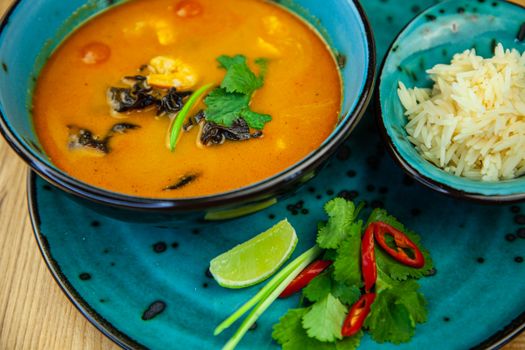
Thai Coconut Curry Mussels
The diets react (see scores below)
Common Ingredients
- mussels
- coconut milk
- red curry paste
- lemongrass
- kaffir lime leaves
- Thai basil
- fish sauce
- lime
Specific recipes may vary.
Incompatible with 2 of 11 diets
Diet Ratings
Thai Coconut Curry Mussels is largely keto-compatible but requires attention to portions and ingredients. Mussels are a lean, moderate-protein seafood with roughly 7g net carbs per 3oz serving, so portion size matters. Full-fat coconut milk is excellent for keto — high in healthy saturated fats (MCTs) with minimal net carbs. The main concern is red curry paste, which typically contains sugar and some starchy ingredients, contributing 2-4g net carbs per tablespoon. Fish sauce adds negligible carbs. Lemongrass, kaffir lime leaves, and Thai basil are used in small aromatic quantities and contribute minimally. A squeeze of lime juice adds trace carbs. A reasonable serving (200-250g mussels with coconut curry broth) likely lands in the 10-15g net carb range, which is manageable within a daily keto budget but not freely consumable. The dish is not served with rice in this formulation, which keeps it viable. The key risk is using a commercial curry paste with added sugar or consuming a large portion of mussels.
Strict keto practitioners flag mussels as a higher-carb shellfish compared to other seafood options, and some exclude red curry paste entirely due to its sugar and carbohydrate content from chilies and other base ingredients, preferring to build curry flavor from individual spices to maintain tighter carb control.
Thai Coconut Curry Mussels contains multiple animal-derived ingredients that are strictly excluded under vegan dietary standards. Mussels are shellfish (animals), fish sauce is derived from fermented fish, and both are direct animal products. There is no meaningful debate within the vegan community about shellfish or fish sauce — both are clearly non-vegan. While the remaining ingredients (coconut milk, red curry paste, lemongrass, kaffir lime leaves, Thai basil, lime) are plant-based, the presence of mussels and fish sauce alone is sufficient to classify this dish as firmly off-limits for vegans.
Thai Coconut Curry Mussels is largely paleo-friendly but has one significant concern: commercial red curry paste. Most store-bought red curry pastes contain added salt, sugar, and sometimes non-paleo additives or preservatives — making it a processed ingredient by strict paleo standards. The remaining ingredients are solid: mussels are an excellent paleo protein (shellfish were a staple for coastal hunter-gatherers), coconut milk is well-accepted, lemongrass and kaffir lime leaves are natural herbs, Thai basil is paleo, and lime is a whole fruit. Fish sauce is a gray area — traditional fish sauce is simply fermented fish and salt, and while salt is technically excluded from strict paleo, many practitioners accept it as a minimally processed condiment. If red curry paste is made from scratch (chilies, galangal, lemongrass, garlic, shallots, spices) and a clean fish sauce is used, this dish would score much higher and likely reach 'approve' territory.
Strict Cordain-school paleo would flag fish sauce (added salt) and any commercial curry paste outright. Conversely, practitioners following Robb Wolf or Mark Sisson's more pragmatic approach tend to accept traditional fermented condiments like fish sauce and homemade curry pastes as ancestrally consistent, which would push this dish toward a full approve.
Mussels are an excellent Mediterranean diet protein — shellfish and seafood are strongly encouraged 2-3 times weekly. However, this dish departs significantly from Mediterranean culinary tradition. Coconut milk, the dominant fat source here, is high in saturated fat and entirely absent from traditional Mediterranean cooking, where extra virgin olive oil is the canonical fat. Red curry paste, lemongrass, kaffir lime leaves, and Thai basil are Southeast Asian ingredients with no foothold in Mediterranean dietary tradition. Fish sauce is a reasonable analog to Mediterranean garum or anchovy-based umami. The dish is whole-food, minimally processed, and vegetable-forward in its aromatics, which aligns with Mediterranean principles, but the saturated fat load from coconut milk and the complete absence of olive oil pull it away from the diet's core framework.
Some modern Mediterranean diet researchers take a broader 'dietary pattern' view, arguing that any whole-food, seafood-centered meal with abundant herbs and no refined grains or added sugar captures the spirit of the diet regardless of geographic origin. Others, particularly those following strict traditional Mediterranean guidelines, would flag coconut milk's high saturated fat content as directly contradicting the diet's emphasis on unsaturated fats from olive oil.
Thai Coconut Curry Mussels is overwhelmingly plant-derived in its flavor and sauce components. While mussels are an animal product accepted by most carnivore practitioners, the dish is built around coconut milk (plant fat from coconut), red curry paste (a blend of plant spices, chilies, and aromatics), lemongrass (plant), kaffir lime leaves (plant), Thai basil (plant herb), and lime (fruit). Fish sauce is the one carnivore-friendly ingredient beyond the mussels themselves. The dominant caloric and flavor base is entirely plant-derived, making this dish fundamentally incompatible with the carnivore diet. This is not a borderline case — the dish is defined by its plant-based curry sauce and cannot be adapted without completely dismantling the recipe.
This dish is built on a strong Whole30-compliant foundation: mussels (seafood), coconut milk, lemongrass, kaffir lime leaves, Thai basil, and lime are all fully allowed. Fish sauce is generally Whole30-compatible when made from just fish and salt, but many commercial brands include added sugar or preservatives, requiring careful label reading. The most significant concern is red curry paste — commercial versions (e.g., Mae Ploy, Maesri) frequently contain shrimp paste, which is typically fine, but also often include added sugar, soy, or other excluded ingredients. A label-verified compliant curry paste makes this dish excellent, but using a standard grocery store brand without checking could introduce excluded ingredients. If made with compliant-verified versions of both fish sauce and red curry paste, this is a well-constructed Whole30 meal.
Some Whole30 practitioners argue that relying on packaged curry pastes — even compliant ones — leans too heavily on processed condiments rather than whole ingredients, which can undermine the program's goal of resetting food relationships. Melissa Urban's official guidance, however, permits compliant packaged products and does not restrict their use in cooking.
Most ingredients in this dish are individually low-FODMAP: mussels are a low-FODMAP protein, full-fat canned coconut milk is low-FODMAP at around 1/2 cup (125ml) per Monash, lemongrass is low-FODMAP, kaffir lime leaves are low-FODMAP, Thai basil is low-FODMAP in typical culinary amounts, fish sauce is low-FODMAP at standard serving sizes (2-3 tsp), and lime juice is low-FODMAP. The critical problem is red curry paste, which almost universally contains garlic and onion — two of the highest-FODMAP ingredients (fructans). Commercial red curry pastes list garlic and shallots/onion as primary ingredients, making this dish high-FODMAP as typically prepared. The dish could theoretically be made low-FODMAP with a homemade FODMAP-friendly curry paste (omitting garlic and onion, using asafoetida and garlic-infused oil instead), but as standardly prepared with commercial red curry paste, it presents significant FODMAP risk. Coconut milk portion also warrants attention — at restaurant servings the quantity may exceed the low-FODMAP threshold.
Monash University has not specifically tested red curry paste as a whole product, and some clinical FODMAP practitioners suggest that the small quantity of paste used per serving may dilute garlic/onion fructans below threshold levels. However, most FODMAP dietitians advise avoiding commercial curry pastes entirely during the elimination phase, as garlic is high-FODMAP even in very small amounts and its concentration in paste form is difficult to control.
Thai Coconut Curry Mussels presents a mixed DASH profile. Mussels are an excellent DASH-friendly protein — low in saturated fat, rich in potassium, magnesium, zinc, and omega-3s, and explicitly aligned with DASH's emphasis on seafood. Lemongrass, kaffir lime leaves, Thai basil, and lime are low-sodium, nutrient-rich aromatics that add no DASH concerns. However, two ingredients significantly complicate the picture: (1) Full-fat coconut milk is high in saturated fat (primarily lauric acid via medium-chain triglycerides), which DASH guidelines limit, and tropical oils/coconut products are explicitly called out as items to restrict. A standard can of full-fat coconut milk contributes roughly 20-30g of saturated fat — well above DASH's target of keeping saturated fat to ~6% of total calories. (2) Fish sauce is extremely high in sodium (~1,400mg per tablespoon), which can quickly push the dish toward or beyond the DASH sodium ceiling of 1,500–2,300mg/day in a single serving. Red curry paste also adds moderate sodium. The combination of high saturated fat from coconut milk and high sodium from fish sauce and curry paste prevents approval, despite the mussels being an ideal DASH protein. With modifications — light coconut milk and reduced or low-sodium fish sauce — the dish could move closer to a 6-7 score.
NIH DASH guidelines explicitly limit saturated fat and identify coconut products as problematic tropical oils. However, updated clinical interpretations note that the saturated fat in coconut milk (largely medium-chain triglycerides) may have a more neutral or less atherogenic effect than long-chain saturated fats found in red meat and full-fat dairy; some DASH-aligned cardiologists permit moderate coconut milk use, particularly when the overall dietary pattern remains adherent. Similarly, fish sauce used sparingly as a seasoning rather than a base ingredient may be acceptable within a low-sodium DASH framework if the rest of the day's sodium intake is tightly controlled.
Thai Coconut Curry Mussels present a mixed Zone picture. Mussels are an excellent lean protein source — low in fat, high in protein, and rich in omega-3s, making them a favorable Zone protein block. The aromatics (lemongrass, kaffir lime leaves, Thai basil, lime) are essentially free foods in Zone terms, contributing polyphenols and anti-inflammatory compounds that Sears would strongly endorse. Fish sauce adds minimal macronutrient impact. The problematic element is full-fat coconut milk, which is high in saturated fat (primarily lauric acid) and calorie-dense. A typical serving of coconut curry uses enough coconut milk to significantly skew the fat ratio toward saturated fat rather than the monounsaturated fats Sears prefers. Red curry paste is generally low-glycemic and Zone-friendly in the quantities used. The dish can be made Zone-compatible by using light coconut milk to reduce saturated fat load and controlling portion size to keep fat blocks in balance with protein blocks, but as typically prepared with full-fat coconut milk, the fat profile deviates from Zone ideals. The overall carbohydrate content is actually quite low and favorable, and the protein source is excellent, so this is a caution rather than avoid — it needs modification to fit cleanly into Zone ratios.
Sears' later anti-inflammatory writing (notably 'The Mediterranean Zone' and subsequent work) takes a more nuanced view of coconut milk's saturated fat content, noting that medium-chain triglycerides in coconut products have a different metabolic profile than long-chain saturated fats. Some Zone practitioners following Sears' updated anti-inflammatory framework would treat this dish more favorably, particularly given the omega-3 content of mussels, the polyphenol-rich aromatics, and the low glycemic load. In that reading, this could score as a moderate approve (6-7) with standard portioning.
Thai Coconut Curry Mussels is a dish with a strong anti-inflammatory foundation. Mussels are an excellent source of omega-3 fatty acids (EPA and DHA), zinc, and selenium — nutrients well-documented to reduce inflammatory markers like CRP and IL-6. They are among the most nutrient-dense shellfish available. The aromatic base — lemongrass, kaffir lime leaves, Thai basil, and lime — contributes polyphenols and antioxidants that align closely with anti-inflammatory principles. Red curry paste typically contains chili peppers (capsaicin is anti-inflammatory), galangal or ginger, garlic, and turmeric — all emphasized on Dr. Weil's Anti-Inflammatory Food Pyramid. Fish sauce, while high in sodium, is used in small quantities as a flavoring and does not meaningfully alter the dish's inflammatory profile. The main point of nuance is full-fat coconut milk, which is high in saturated fat — primarily lauric acid (C12). Most anti-inflammatory guidelines recommend limiting saturated fat, placing coconut milk in the 'use in moderation' category. However, coconut milk's saturated fat profile differs from animal-based sources, and some researchers argue lauric acid behaves differently metabolically. Overall, this dish's omega-3-rich protein, anti-inflammatory spice profile, and antioxidant-dense aromatics outweigh the moderate saturated fat concern, especially when consumed as an occasional dish rather than a daily staple.
Full-fat coconut milk is the primary point of contention: Dr. Weil's framework and mainstream anti-inflammatory nutrition caution against high saturated fat intake, which could lower this dish's rating for those with cardiovascular concerns. A minority of functional medicine and paleo-aligned practitioners (e.g., advocates of MCT research) argue that coconut-derived saturated fats, particularly lauric acid, are metabolically distinct and may not drive inflammation the same way animal saturated fats do, potentially justifying a higher score.
Thai Coconut Curry Mussels offers a genuinely mixed nutritional profile for GLP-1 patients. Mussels are an excellent protein source — roughly 18-20g protein per 3oz serving — lean, easy to digest, and rich in B12, zinc, selenium, and omega-3s, making them a strong GLP-1-compatible protein. The aromatics (lemongrass, kaffir lime, Thai basil, lime) are essentially free from a caloric and GI standpoint. The problem is coconut milk: a standard Thai curry preparation uses full-fat coconut milk, which is high in saturated fat — roughly 12-14g fat per half-cup, mostly saturated. This directly conflicts with Rule 3 (low fat per serving) and can worsen nausea, bloating, and reflux — the classic GLP-1 side effects. Red curry paste is generally well-tolerated in moderate amounts but can be spicy enough to trigger reflux in some patients. Fish sauce adds sodium but is used in small enough quantities to be a non-issue. The dish scores higher than a typical high-fat preparation because the protein base is genuinely excellent and the portion can be kept small, but the coconut milk fat load is a real concern at standard restaurant or recipe volumes. A modified version using light coconut milk would shift this toward approve.
Some GLP-1-focused RDs are more permissive about coconut milk in small portions, arguing that the medium-chain triglycerides (MCTs) in coconut fat are metabolized differently than long-chain saturated fats and may be better tolerated; others in the obesity medicine space hold that any high-saturated-fat preparation meaningfully increases GI side effect risk and should be consistently flagged regardless of fat type.
*See how scores were generated at our methodology page.
Nutritional profile
Six traits that cut across every diet.
Fiber & Plants
How much whole-plant food and fiber it delivers.
Healthy Fats
The quality of its fats (unsaturated, omega-3).
Whole / Unprocessed
How close it is to its natural, unprocessed form.
Gut Gentle
How easy it is on digestion (low FODMAP, few irritants).
Low Glycemic
How little it spikes your blood sugar.
Protein Density
How much protein it packs per calorie.
Controversy Index
Higher controversy = more disagreement between diets.
Diet-Specific Tips
 Keto — 6/10
View tips
- Mussels contain ~7g net carbs per 3oz — portion control essential
- Full-fat coconut milk is keto-favorable due to high MCT fat content
- Red curry paste typically contains added sugar and starchy components (2-4g net carbs/tbsp)
- No grains or starchy vegetables in this formulation
- Fish sauce, lime, lemongrass, and kaffir lime leaves contribute negligible net carbs
- Estimated 10-15g net carbs per serving — fits keto budget but not freely consumable
- Commercial curry paste brands vary significantly in sugar content — label check recommended
 Paleo — 5/10
View tips
- Mussels are an excellent, ancestrally appropriate shellfish protein
- Coconut milk is widely accepted in paleo
- Commercial red curry paste typically contains added salt, sugar, and preservatives — the primary concern
- Fish sauce (fermented fish + salt) is debated; salt is technically excluded from strict paleo
- Lemongrass, kaffir lime leaves, Thai basil, and lime are all whole, paleo-approved aromatics
- Dish scores significantly higher if curry paste is made from scratch with whole ingredients
 Mediterranean — 6/10
View tips
- Mussels are an ideal Mediterranean protein — shellfish strongly encouraged
- Coconut milk is high in saturated fat and not a Mediterranean ingredient
- No olive oil present — the diet's primary and essential fat source is absent
- Dish is minimally processed with whole-food aromatics
- Thai cuisine origin means several core ingredients have no Mediterranean precedent
- Fish sauce provides umami similar to traditional Mediterranean anchovy use
- No refined grains, added sugars, or red meat — structurally clean
 Whole30 — 6/10
View tips
- Mussels are Whole30-approved seafood
- Coconut milk is fully compliant (watch for added gums/thickeners, though carrageenan is now allowed)
- Red curry paste often contains added sugar or soy — must verify label
- Fish sauce must be checked for added sugar; compliant versions (e.g., Red Boat) exist
- Lemongrass, kaffir lime leaves, Thai basil, and lime are all compliant whole ingredients
- Dish is compliant if ingredient labels are verified — not automatically compliant as commonly purchased
 Low-FODMAP — 5/10
View tips
- Red curry paste contains garlic and onion — high-FODMAP fructan sources that trigger symptoms even in small amounts
- Mussels are low-FODMAP and a safe protein choice
- Full-fat canned coconut milk is low-FODMAP at ≤125ml but may exceed threshold in restaurant-sized curry portions
- Lemongrass, kaffir lime leaves, Thai basil, fish sauce, and lime are all low-FODMAP
- Dish could be made low-FODMAP with homemade FODMAP-friendly curry paste using garlic-infused oil and asafoetida
- As standardly prepared with commercial red curry paste, this dish should be avoided during elimination phase
 DASH — 4/10
View tips
- Mussels are an ideal DASH lean seafood protein — rich in potassium, magnesium, and omega-3s
- Full-fat coconut milk is high in saturated fat and is a tropical oil product explicitly limited by DASH guidelines
- Fish sauce is extremely high in sodium (~1,400mg/tbsp), a major DASH concern
- Red curry paste adds additional sodium
- Aromatic ingredients (lemongrass, kaffir lime, Thai basil, lime) are DASH-neutral or beneficial
- Substituting light coconut milk and low-sodium fish sauce would significantly improve DASH compatibility
- Dish could exceed daily sodium limits in a single serving as commonly prepared
 Zone — 5/10
View tips
- Mussels are an excellent lean Zone protein — low fat, high protein, rich in omega-3s
- Full-fat coconut milk adds significant saturated fat, deviating from Zone's preference for monounsaturated fats
- Very low carbohydrate load from this dish — aromatics and curry paste are essentially negligible in Zone block terms
- No high-glycemic carbohydrates present — favorable carb profile
- Anti-inflammatory ingredients (Thai basil, lemongrass, lime) align with Sears' polyphenol emphasis
- Can be made more Zone-compatible by substituting light coconut milk to reduce saturated fat per block
- Fish sauce adds negligible macronutrients but contributes sodium
 Anti-Inflammatory — 7/10
View tips
- Mussels are rich in omega-3 fatty acids (EPA/DHA), a cornerstone of anti-inflammatory eating
- Red curry paste contributes chili peppers, garlic, ginger/galangal, and often turmeric — all strongly anti-inflammatory
- Lemongrass, kaffir lime leaves, and Thai basil provide polyphenols and antioxidants
- Lime juice adds vitamin C and flavonoids
- Full-fat coconut milk is high in saturated fat, which is moderated under most anti-inflammatory frameworks
- Fish sauce is used as a condiment-level seasoning; sodium content is notable but the quantity is small
- No refined carbohydrates, seed oils, added sugars, or processed ingredients
 GLP-1 Friendly — 5/10
View tips
- Mussels are a high-quality lean protein — approximately 18-20g protein per 3oz, excellent nutrient density per calorie
- Full-fat coconut milk is high in saturated fat (~12-14g per half-cup), a known GLP-1 side effect trigger for nausea, bloating, and reflux
- Red curry paste may be spicy enough to worsen reflux or GI discomfort in sensitive patients
- Aromatics (lemongrass, kaffir lime, Thai basil, lime) are GLP-1 neutral — no meaningful fat, sugar, or GI risk
- Low fiber content — no vegetables or legumes in this preparation to support the 25-30g daily fiber target
- Light coconut milk substitution would significantly improve the rating
- Small-portion friendly — mussels work well in modest servings, which suits reduced GLP-1 appetite