Thai
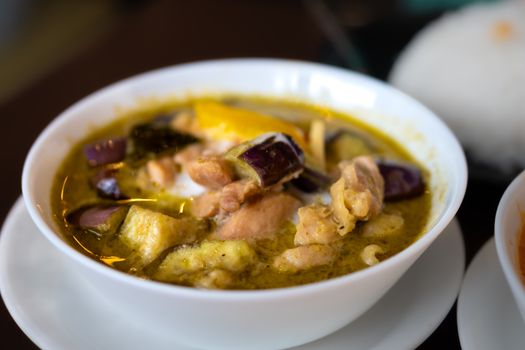
Thai Eggplant Curry
The diets react (see scores below)
Common Ingredients
- Thai eggplants
- coconut milk
- red curry paste
- bamboo shoots
- Thai basil
- fish sauce
- palm sugar
- kaffir lime leaves
Specific recipes may vary.
Incompatible with 6 of 11 diets
Diet Ratings
Thai Eggplant Curry has several keto-friendly components — full-fat coconut milk is an excellent keto fat source, and Thai eggplant, bamboo shoots, Thai basil, fish sauce, and kaffir lime leaves are relatively low in net carbs. However, two ingredients raise concern: red curry paste (contains sugar, galangal, and starchy elements, adding ~3-5g net carbs per 2 tbsp) and especially palm sugar, which is an added sugar that directly conflicts with keto rules. The dish is also vegetarian/no-protein, meaning fat and carbs dominate the macros. Without protein, the caloric ratio may skew toward carbs relative to the keto ideal. A modified version omitting palm sugar and reducing curry paste could be approved, but as traditionally prepared, portion control is essential and the palm sugar is a genuine problem.
Strict keto practitioners would flag this as avoid due to the palm sugar (an added sugar with no place in keto), arguing that even small amounts of added sugar undermine ketosis and reinforce sugar dependence. Some would also point to red curry paste's variable and often unlabeled sugar content as a hidden carb trap.
This Thai Eggplant Curry contains fish sauce, a direct animal-derived ingredient made from fermented fish. Fish sauce is a clear disqualifier under any vegan framework. While the base of the dish — Thai eggplants, coconut milk, bamboo shoots, Thai basil, kaffir lime leaves, and palm sugar — is plant-based, fish sauce is a foundational seasoning here, not a trace contaminant. Additionally, many commercial red curry pastes contain shrimp paste (kapi), making them non-vegan by default, though vegan versions do exist. The dish as described with these ingredients cannot be considered vegan.
This Thai eggplant curry contains several problematic ingredients from a paleo perspective. Red curry paste is a significant concern — commercial versions almost universally contain shrimp paste, galangal, and spices that are paleo-acceptable, but also often include added salt, preservatives, and occasionally sugar or non-paleo additives, making it a processed product. Fish sauce traditionally contains only fermented fish and salt, but added salt and preservatives in commercial versions place it in avoid territory for strict paleo. Palm sugar is a refined/processed sugar that falls into the avoid category. Bamboo shoots are generally paleo-acceptable as a vegetable. Coconut milk, Thai eggplant, Thai basil, and kaffir lime leaves are all paleo-approved whole foods. The dish is ultimately pulled into avoid territory by the combination of palm sugar (refined sugar), commercial red curry paste (processed, typically with added salt/preservatives), and fish sauce (added salt). A homemade version with a from-scratch curry paste, no added sugar, and coconut aminos substituting for fish sauce could be elevated to caution or approve status.
Some paleo practitioners, including those following the Primal Blueprint (Mark Sisson) or Whole30-adjacent approaches, would accept fish sauce and small amounts of palm sugar as minimally processed traditional condiments, and would make their own curry paste — in which case this dish could be rated caution or even approve with minor modifications.
Thai Eggplant Curry contains several Mediterranean-friendly elements — eggplant is a staple vegetable in Mediterranean cuisine, bamboo shoots and Thai basil add plant-based value, and fish sauce provides umami without significant nutritional concern. However, coconut milk is the primary fat source here rather than olive oil, and it is high in saturated fat, which directly contradicts a core Mediterranean principle. Palm sugar adds refined/added sugar, and red curry paste may contain processed ingredients. The dish is plant-forward and vegetable-centric, which aligns well, but the coconut milk base is a meaningful departure from Mediterranean fat guidelines. It can be consumed occasionally with awareness of the saturated fat load.
Some modern Mediterranean diet interpreters argue that whole-food plant fats, including coconut milk used in modest amounts, are acceptable within a broadly plant-forward pattern — particularly as global dietary traditions gain recognition. However, classical Mediterranean diet frameworks (e.g., Willett et al., Harvard School of Public Health) consistently identify olive oil as the canonical fat and flag high saturated fat sources as inconsistent with the diet's cardiovascular benefits.
Thai Eggplant Curry is almost entirely plant-based and incompatible with the carnivore diet. The primary ingredients — Thai eggplants, coconut milk, red curry paste, bamboo shoots, Thai basil, kaffir lime leaves, and palm sugar — are all plant-derived and explicitly excluded from carnivore eating. Fish sauce is the only animal-derived ingredient, but it functions merely as a seasoning in an otherwise fully plant-based dish. Palm sugar is an added sugar, further disqualifying this dish. There is no meaningful animal protein or fat source. This dish represents virtually everything the carnivore diet excludes.
This Thai Eggplant Curry contains palm sugar, which is an added sugar and explicitly excluded on the Whole30 program. Additionally, commercial red curry paste frequently contains shrimp paste, sugar, and other non-compliant additives, making it a likely source of excluded ingredients. Fish sauce is generally compliant if it contains only fish and salt (no added sugar), but many commercial brands do contain sugar. The remaining ingredients — Thai eggplants, coconut milk, bamboo shoots, Thai basil, and kaffir lime leaves — are all Whole30-compatible. However, palm sugar alone disqualifies this dish as written. A compliant version could be made by omitting the palm sugar and carefully selecting a sugar-free red curry paste and a clean-label fish sauce.
This Thai Eggplant Curry contains multiple high-FODMAP ingredients that make it problematic during the elimination phase. Red curry paste is the primary concern — commercial Thai red curry paste almost universally contains garlic and shallots/onion, both of which are high in fructans and are among the most potent FODMAP triggers. Even small amounts of garlic and onion in paste form can deliver significant FODMAP load. Thai eggplants are another concern: while Western eggplant (aubergine) has been tested by Monash and is low-FODMAP at around 75g, Thai eggplants have less reliable testing data and are typically consumed in larger quantities in curry. Coconut milk is low-FODMAP at 1/2 cup (125ml) but can become high-FODMAP at larger servings due to sorbitol. Bamboo shoots are low-FODMAP. Fish sauce, Thai basil, kaffir lime leaves, and palm sugar are generally considered low-FODMAP at typical cooking quantities. The dish's fate largely rests on the red curry paste — unless made from scratch without garlic and onion (using garlic-infused oil and the green tops of spring onions instead), this dish is high-FODMAP. As typically prepared from commercial paste, this dish should be avoided during elimination.
Monash University does not have specific data on all Thai curry pastes, and some FODMAP-aware recipes substitute garlic-free homemade curry paste to make this dish compliant — in that modified form, clinical FODMAP practitioners would consider it potentially acceptable. However, as a standard restaurant or home-cooked preparation using commercial red curry paste, the garlic/onion content makes it high-FODMAP with high practical certainty.
Thai Eggplant Curry contains multiple ingredients that conflict significantly with DASH diet principles. Coconut milk is high in saturated fat from a tropical oil source, which DASH explicitly limits. Palm sugar is an added sugar. Fish sauce is extremely high in sodium (typically 1,400–1,500mg per tablespoon), making it very difficult to stay within DASH sodium limits for a single dish. Red curry paste also contributes additional sodium. While Thai eggplants, bamboo shoots, Thai basil, and kaffir lime leaves are DASH-friendly vegetables and aromatics, the overall dish is dominated by high-saturated-fat coconut milk, high-sodium fish sauce and curry paste, and added sugar — a combination that runs counter to DASH's core restrictions on sodium, saturated fat, and tropical oils.
NIH DASH guidelines clearly restrict coconut milk (tropical oil, high saturated fat) and high-sodium condiments like fish sauce. However, some updated DASH-oriented clinicians note that if the dish is made with light coconut milk (substantially lower saturated fat), low-sodium fish sauce or a reduced amount, and a homemade low-sodium curry paste, the vegetable-rich base could be acceptable in moderation — though this would require significant modification from the standard preparation.
Thai Eggplant Curry presents several Zone Diet challenges. On the positive side, eggplant and bamboo shoots are low-glycemic vegetables that Zone approves, and Thai basil and kaffir lime leaves add polyphenols. However, the dish has significant structural problems for Zone compliance. First, it lacks a lean protein source entirely — no chicken, fish, tofu, or other protein — making it impossible to hit the 30% protein target without adding a protein component. Second, coconut milk is high in saturated fat, which Sears consistently flags as unfavorable and pro-inflammatory; the fat profile here is saturated rather than the preferred monounsaturated. Third, palm sugar is a high-glycemic added sugar that Zone discourages. Fourth, red curry paste typically contains omega-6-heavy ingredients. The overall macronutrient ratio of this dish as presented skews heavily toward fat (saturated) and carbohydrates with nearly zero protein — essentially the inverse of Zone targets. With careful modification (light coconut milk in small quantities, omitting palm sugar, adding a lean protein block), it could be incorporated, but as presented it requires substantial reconstruction to Zone-balance.
Some Zone practitioners in later Sears frameworks (particularly post-2012 anti-inflammatory work) acknowledge that certain saturated fats in coconut milk contain medium-chain triglycerides (MCTs) that may have different metabolic effects than long-chain saturated fats, softening the strict anti-coconut milk position. Additionally, the polyphenol-rich herbs and spices (basil, kaffir lime, turmeric in curry paste) align with Sears' later emphasis on polyphenol consumption. If portioned as a small side dish with an appropriate lean protein and served in a context where overall meal ratios are corrected, some Zone practitioners would rate this more favorably.
This Thai eggplant curry presents a genuinely mixed anti-inflammatory profile. On the positive side: Thai eggplants provide antioxidants (nasunin, chlorogenic acid) and fiber; red curry paste contains turmeric, lemongrass, galangal, and chili — all with meaningful anti-inflammatory properties (curcumin, capsaicin); Thai basil and kaffir lime leaves add polyphenols and flavonoids; bamboo shoots provide fiber and some antioxidants. The problematic elements are coconut milk and palm sugar. Coconut milk is high in saturated fat (lauric acid), which is debated but generally flagged as a 'limit' ingredient in mainstream anti-inflammatory frameworks. Palm sugar is still added sugar, though it has a lower glycemic index than refined sugar and contains some trace minerals — it's preferable to HFCS but still a concern. Fish sauce contributes sodium but in small amounts typical of Thai cooking is unlikely to be meaningfully inflammatory. The nightshade status of eggplant adds another layer of debate for autoimmune-sensitive individuals. Overall this is a dish with real anti-inflammatory strengths undermined by coconut milk's saturated fat load and added sugar, landing it firmly in 'caution' territory.
Dr. Weil and mainstream anti-inflammatory frameworks flag coconut milk for its high saturated fat content, pushing this dish toward caution; however, some functional medicine practitioners (e.g., Mark Hyman) argue lauric acid in coconut products has distinct metabolic properties and is not equivalently inflammatory to other saturated fats. Additionally, the AIP and autoimmune-focused protocols (Dr. Tom O'Bryan) would flag eggplant as a nightshade to avoid for sensitive individuals, while mainstream anti-inflammatory nutrition considers eggplant a net positive due to its antioxidant content.
Thai Eggplant Curry as described is a vegetable-forward dish with no listed protein source, making it poorly suited as a standalone main for GLP-1 patients who need 15-30g protein per meal. Coconut milk is the primary fat source and is high in saturated fat, which can worsen GLP-1 side effects like nausea, bloating, and reflux — especially problematic given that GLP-1 medications slow gastric emptying and high-fat meals linger longer in the stomach. Eggplant and bamboo shoots do contribute some fiber and are easy to digest, and the dish is low in refined carbohydrates. Palm sugar adds a small amount of sugar but is unlikely to be significant at typical curry quantities. The dish is not fried and is vegetable-based, which are positives, but the high saturated fat from coconut milk and the absence of protein are meaningful drawbacks for GLP-1 patients eating smaller portions where every calorie must count nutritionally. Could be made acceptable by pairing with a lean protein (tofu, shrimp, chicken) and using light coconut milk to reduce fat load.
Some GLP-1-focused dietitians are more permissive about coconut milk in modest curry portions, noting that the volume used per serving may be limited and that the dish's vegetable fiber content supports digestion. Others flag that even small amounts of high-saturated-fat ingredients can trigger significant nausea in GLP-1 patients, particularly in the early weeks of dose escalation, making individual tolerance the key variable here.
*See how scores were generated at our methodology page.
Nutritional profile
Six traits that cut across every diet.
Fiber & Plants
How much whole-plant food and fiber it delivers.
Healthy Fats
The quality of its fats (unsaturated, omega-3).
Whole / Unprocessed
How close it is to its natural, unprocessed form.
Gut Gentle
How easy it is on digestion (low FODMAP, few irritants).
Low Glycemic
How little it spikes your blood sugar.
Protein Density
How much protein it packs per calorie.
Controversy Index
Higher controversy = more disagreement between diets.
Diet-Specific Tips
 Keto — 4/10
View tips
- Palm sugar is an added sugar — directly incompatible with strict keto
- Red curry paste contains sugar and starchy binders, adding hidden net carbs
- Full-fat coconut milk is a strong keto-friendly fat source
- Thai eggplant and bamboo shoots are moderate in net carbs but manageable in small portions
- No primary protein source weakens the macro profile for keto purposes
- Dish can be modified (omit palm sugar, reduce paste) to become more keto-compatible
 Mediterranean — 5/10
View tips
- Eggplant is a Mediterranean staple vegetable — strongly positive
- Coconut milk is high in saturated fat and replaces olive oil as the fat source — negative
- Palm sugar adds unnecessary refined/added sugar — negative
- No olive oil present — misses a core Mediterranean principle
- Plant-forward with no red meat — positive
- Fish sauce is a minor ingredient with negligible nutritional impact
- Thai basil and kaffir lime leaves are aromatic plant foods — mildly positive
 Zone — 4/10
View tips
- No protein source — cannot hit 30% protein target as presented
- Coconut milk is high in saturated fat, which Zone discourages in favor of monounsaturated fats
- Palm sugar is a high-glycemic added sugar unfavorable in Zone
- Eggplant and bamboo shoots are favorable low-glycemic Zone carbohydrates
- Polyphenol-rich herbs and spices align with anti-inflammatory Zone principles
- Dish requires significant modification (lean protein addition, reduced coconut milk, no palm sugar) to become Zone-compatible
 Anti-Inflammatory — 5/10
View tips
- Coconut milk: high in saturated fat (lauric acid) — flagged as 'limit' in standard anti-inflammatory frameworks
- Red curry paste: contains turmeric, lemongrass, galangal, chili — meaningful anti-inflammatory spice profile
- Thai eggplant: antioxidant-rich (nasunin, chlorogenic acid) but nightshade — debated for autoimmune conditions
- Palm sugar: added sugar, though lower glycemic than refined sugar — still a pro-inflammatory concern
- Thai basil + kaffir lime leaves: polyphenol and flavonoid contributors
- Bamboo shoots: fiber and mild antioxidant benefit
- Fish sauce: minimal inflammatory concern at typical culinary doses
 GLP-1 Friendly — 4/10
View tips
- No protein source listed — fails the 15-30g protein per meal target for GLP-1 patients
- Coconut milk is high in saturated fat, which worsens nausea, bloating, and reflux on GLP-1 medications
- High fat slows gastric emptying further on top of GLP-1-induced delay, increasing GI discomfort risk
- Eggplant and bamboo shoots provide modest fiber, supporting digestion
- Palm sugar adds small amount of sugar — minor concern at typical serving volumes
- Not fried and vegetable-based — easy to digest apart from the fat content
- Low nutrient density per calorie without added protein
- Easily improved by adding lean protein and substituting light coconut milk