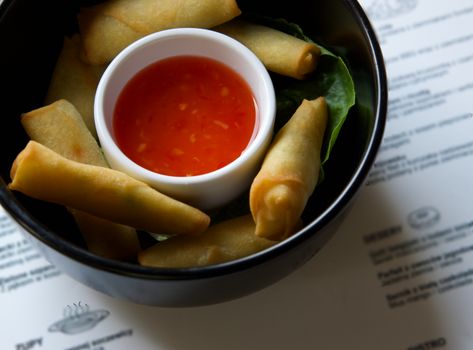
Photo: Sylwester Ficek / Pexels
Thai
Thai Fried Spring Rolls
The diets react (see scores below)
Common Ingredients
- spring roll wrappers
- ground pork
- glass noodles
- cabbage
- carrots
- garlic
- fish sauce
- sweet chili sauce
Specific recipes may vary.
Incompatible with 10 of 11 diets
Diet Ratings
Thai Fried Spring Rolls are fundamentally incompatible with ketogenic eating. The spring roll wrappers are made from wheat or rice flour, contributing significant net carbs per roll. Glass noodles (mung bean starch) add another dense carbohydrate load. Sweet chili sauce contains added sugar, compounding the problem. Even with modest portions, a single spring roll can contain 10-15g of net carbs, making it nearly impossible to fit within a daily keto budget without sacrificing the rest of the day's intake. The deep-frying method does add fat, but the carbohydrate sources are structurally integral to the dish — not optional additions — so the dish cannot be made keto-compliant without a complete reconstruction.
Thai Fried Spring Rolls contain multiple animal-derived ingredients that disqualify them from a vegan diet. Ground pork is a direct animal meat product, and fish sauce is derived from fermented fish — both are unambiguous animal products. These two ingredients alone make this dish incompatible with veganism regardless of the plant-based components (cabbage, carrots, glass noodles, garlic). There is no meaningful debate within the vegan community about whether pork or fish sauce are acceptable.
Thai Fried Spring Rolls contain multiple non-paleo ingredients that make this dish clearly incompatible with the Paleolithic diet. Spring roll wrappers are made from wheat or rice flour — both grains that are explicitly excluded. Glass noodles are typically made from mung bean starch, a legume derivative, also excluded. Sweet chili sauce is a heavily processed condiment containing refined sugar and additives. Fish sauce, while derived from fish, almost always contains added salt and sometimes preservatives. The frying process typically uses seed oils (vegetable or canola oil), which are also excluded. The underlying vegetables (cabbage, carrots, garlic) and ground pork are paleo-compliant, but they are entirely outweighed by the multiple core violations in this dish.
Thai Fried Spring Rolls conflict with Mediterranean diet principles on multiple levels. The dish features deep-frying in unspecified oils (not olive oil), refined spring roll wrappers (refined grain), ground pork as the primary protein (red meat, limited to a few times per month), and sweet chili sauce which contains added sugars. Glass noodles are a refined starch with minimal nutritional value. While cabbage, carrots, and garlic are Mediterranean-friendly vegetables, and fish sauce adds some seafood-derived flavor, these positives are overwhelmed by the deep-frying method, refined wrappers, pork content, and sugary dipping sauce. This dish is also entirely outside the Mediterranean culinary tradition and contradicts core dietary principles.
Thai Fried Spring Rolls are fundamentally incompatible with the carnivore diet. The dish is dominated by plant-based and processed ingredients: spring roll wrappers (grain-based flour), glass noodles (starch-based), cabbage, carrots, and garlic are all plant foods explicitly excluded from carnivore. Sweet chili sauce contains sugar and plant-derived ingredients. While ground pork and fish sauce are carnivore-compatible components, they represent a minor fraction of the dish. The overall composition is essentially a plant-heavy, grain-wrapped snack with a small amount of animal protein — the opposite of what carnivore prescribes.
Thai Fried Spring Rolls contain multiple Whole30-excluded ingredients. Spring roll wrappers are made from wheat or rice flour — both grains explicitly excluded from the program. Glass noodles are typically made from mung bean starch (a legume) or sweet potato starch, but regardless, they function as a noodle/pasta analog which falls under the 'no pasta or noodles' rule. Sweet chili sauce almost universally contains added sugar. Additionally, the dish itself is a fried, wrapped snack that closely resembles the 'chips, crackers, and junk food recreations' the program explicitly prohibits. Even if individual ingredients were swapped, the format (fried dough wrapper filled with noodles) fundamentally violates Whole30 rules.
Thai Fried Spring Rolls contain multiple high-FODMAP ingredients that make them unsuitable during the elimination phase. Garlic is one of the highest-FODMAP foods tested by Monash University, being high in fructans even at very small quantities. Spring roll wrappers are typically made from wheat flour, which is high in fructans. Sweet chili sauce commonly contains garlic and/or onion and high-fructose corn syrup or excess fructose from concentrated fruit, making it high-FODMAP. Cabbage in large portions can accumulate FODMAP load. The combination of garlic, wheat-based wrappers, and sweet chili sauce creates a dish that is unambiguously high-FODMAP at any standard serving size. While some individual components like ground pork, glass noodles (mung bean), carrots, and fish sauce are low-FODMAP, the problematic ingredients cannot be easily separated or reduced to safe levels in this dish as traditionally prepared.
Thai Fried Spring Rolls are problematic for the DASH diet on multiple fronts. The dish is deep-fried, significantly increasing total fat content and caloric density. Fish sauce is extremely high in sodium (approximately 1,200–1,500mg per tablespoon), and sweet chili sauce adds substantial sodium and refined sugar. Ground pork, while a protein source, is a red meat with notable saturated fat content — a category DASH explicitly limits. The refined white flour spring roll wrappers offer no fiber or whole-grain benefit. Collectively, a typical serving of 3–4 spring rolls could easily deliver 800–1,200mg of sodium or more, a significant portion of even the standard DASH daily sodium ceiling of 2,300mg. The combination of high sodium from fish sauce, added sugars from sweet chili sauce, saturated fat from pork, and deep-frying makes this dish fundamentally incompatible with DASH principles.
Thai Fried Spring Rolls present several Zone Diet challenges that push them toward the lower end of 'caution.' The spring roll wrappers are refined-flour, high-glycemic carbohydrates — an 'unfavorable' carb in Zone terminology. Deep frying adds significant fat that is likely omega-6-heavy from seed/vegetable oils rather than the preferred monounsaturated fat. Sweet chili sauce adds sugar, further elevating the glycemic load. Glass noodles (mung bean starch) are moderately high-glycemic as well. On the positive side, ground pork provides protein (though it's fattier than ideal lean Zone proteins like chicken breast), and the cabbage, carrots, and garlic are Zone-favorable vegetables. Fish sauce adds flavor with minimal macronutrient impact. The macro ratio is problematic: the dish skews heavily toward refined carbs and omega-6 fats, with insufficient lean protein and monounsaturated fat relative to Zone's 40/30/30 target. A single small spring roll could potentially fit as part of a carefully constructed Zone snack (1 block), but typical serving sizes make balancing the ratio quite difficult. This is not a food Dr. Sears would categorize as favorable, but it's not categorically impossible to include in strict moderation.
Some Zone practitioners note that glass noodles have a lower glycemic index than wheat noodles or white rice (GI ~26-35), which slightly improves the carbohydrate quality compared to other fried snack wrappers. In Sears' later anti-inflammatory writings, the emphasis on omega-3/polyphenol balance could make a very small portion acceptable if paired with omega-3-rich foods, though the deep-frying oil quality remains a concern that most strict Zone followers would flag.
Thai fried spring rolls present multiple anti-inflammatory concerns. The primary cooking method — deep frying — is the most significant issue: frying at high temperatures in seed oils (typically soybean, sunflower, or corn oil) generates oxidized lipids, aldehydes, and advanced glycation end products (AGEs), all of which promote systemic inflammation. The refined white-flour spring roll wrappers are processed carbohydrates with a high glycemic load, and the glass noodles (mung bean starch) contribute additional refined starch with minimal fiber or micronutrient value. Ground pork is a red/processed-adjacent meat that the anti-inflammatory framework recommends limiting. Sweet chili sauce typically contains added sugar and high-fructose corn syrup, compounding the glycemic burden. On the positive side, garlic, cabbage, and carrots provide modest antioxidants and polyphenols, and fish sauce contributes umami without major inflammatory concern. However, these positives are substantially outweighed by the deep-fried, refined-carb, high-AGE profile of the dish as typically prepared.
Thai fried spring rolls are a poor fit for GLP-1 patients on multiple fronts. The primary cooking method is deep frying, which significantly raises the fat content and makes these difficult to digest — a serious concern given that GLP-1 medications already slow gastric emptying. High-fat, greasy foods are strongly associated with worsened nausea, bloating, and reflux in GLP-1 users. The protein contribution from ground pork is modest relative to the calorie load, and pork in this context is a fatty cut embedded in a fried wrapper rather than a lean protein source. Glass noodles and the spring roll wrappers are refined carbohydrates with negligible fiber, offering empty calories that a patient eating significantly reduced portions cannot afford. The sweet chili dipping sauce adds sugar with no nutritional benefit. While cabbage and carrots provide some micronutrients and a small amount of fiber, the volume is too low in a typical serving to offset the other drawbacks. This dish fails on fat content, cooking method, protein density, fiber, and digestibility — nearly every GLP-1 dietary priority is compromised.
*See how scores were generated at our methodology page.
Nutritional profile
Six traits that cut across every diet.
Fiber & Plants
How much whole-plant food and fiber it delivers.
Healthy Fats
The quality of its fats (unsaturated, omega-3).
Whole / Unprocessed
How close it is to its natural, unprocessed form.
Gut Gentle
How easy it is on digestion (low FODMAP, few irritants).
Low Glycemic
How little it spikes your blood sugar.
Protein Density
How much protein it packs per calorie.
Controversy Index
Higher controversy = more disagreement between diets.
Diet-Specific Tips
 Zone — 4/10
View tips
- Refined flour spring roll wrappers are high-glycemic 'unfavorable' carbs in Zone terminology
- Deep frying likely uses omega-6-heavy seed oils, contrary to Zone's monounsaturated fat preference
- Sweet chili sauce adds sugar, increasing glycemic load beyond Zone guidelines
- Ground pork is a fattier protein source — acceptable in Zone but less ideal than lean chicken, fish, or tofu
- Cabbage, carrots, and garlic are Zone-favorable vegetables, providing some polyphenols and fiber
- Glass noodles have a lower GI than wheat noodles but still contribute significant net carbs
- Portion control is critical — one small roll could fit a single block, but typical servings break Zone ratios
- Overall macro profile skews toward carbs and saturated/omega-6 fats, misaligning with 40/30/30 target