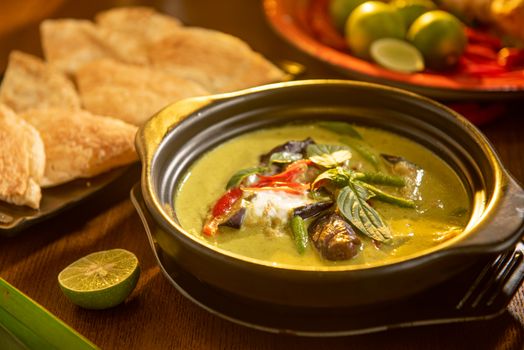
Photo: Sai Kuen Leung / Pexels
Thai
Thai Green Curry
The diets react (see scores below)
Common Ingredients
- chicken
- coconut milk
- green curry paste
- Thai eggplants
- bamboo shoots
- Thai basil
- fish sauce
- kaffir lime leaves
Specific recipes may vary.
Incompatible with 4 of 11 diets
Diet Ratings
Thai Green Curry has a solid keto-friendly base — chicken provides quality protein, full-fat coconut milk delivers healthy fats, and fish sauce plus kaffir lime leaves add negligible carbs. However, green curry paste is a wildcard: commercial versions often contain sugar and starchy binders, contributing 2-4g net carbs per tablespoon. Thai eggplants and bamboo shoots add moderate fiber with modest net carbs (~3-5g per serving combined). A typical restaurant serving can push 10-15g net carbs total, which is manageable within a daily 20-50g keto budget but requires portion awareness. Homemade versions using sugar-free curry paste can reduce carb load significantly, making this closer to an approve. The dish is fundamentally higher-fat and lower-carb than most Thai dishes, but the curry paste and vegetable combination introduce enough carb variability to warrant caution rather than outright approval.
Strict keto practitioners flag commercial green curry paste as nearly always containing added sugars and some starches, making restaurant versions unreliable; this camp recommends treating all restaurant Thai curries as avoid unless you can verify ingredients. Conversely, lazy keto or 'flexible keto' advocates often approve this dish freely, citing the dominant coconut milk fat content and relatively low net carbs compared to rice-based Thai dishes.
This Thai Green Curry contains multiple animal-derived ingredients that categorically exclude it from a vegan diet. Chicken is direct animal flesh, fish sauce is derived from fermented fish, and green curry paste in its traditional Thai form typically contains shrimp paste. These are not trace contaminants or processing aids — they are primary ingredients. The dish is fundamentally incompatible with vegan principles.
Thai Green Curry is largely paleo-friendly in its core components — chicken, coconut milk, Thai eggplants, bamboo shoots, Thai basil, and kaffir lime leaves are all whole, unprocessed paleo staples. However, two ingredients introduce meaningful concerns. Fish sauce typically contains added salt and sometimes sugar or preservatives, making it a processed condiment that strict paleo excludes (though it is widely used in paleo cooking as a fermented, ancestral condiment). The bigger issue is green curry paste: commercial versions almost universally contain added salt, shrimp paste (fermented but often with additives), and occasionally sugar or preservatives. If made from scratch with fresh chiles, lemongrass, galangal, garlic, shallots, and coriander root, the paste is paleo-compliant — but the commercially prepared form is not. The dish earns a caution rating due to these processed condiment dependencies rather than any fundamentally non-paleo ingredient.
Many paleo practitioners, including those following Chris Kresser's and Robb Wolf's more flexible approaches, accept fish sauce and traditional fermented condiments as ancestral foods compatible with paleo principles, arguing that fermentation and minimal salt use mirror ancestral food preservation. Under this view, a homemade green curry paste version of this dish could reasonably score 7-8 and receive an approve verdict.
Thai Green Curry contains several elements that partially align with Mediterranean principles but diverges in key ways. Chicken is an acceptable moderate protein (poultry is caution-level), and the vegetables (Thai eggplants, bamboo shoots, Thai basil) are genuinely positive. However, coconut milk is the dominant fat source rather than extra virgin olive oil, and it is high in saturated fat — directly contradicting the Mediterranean emphasis on EVOO as the primary fat. Green curry paste and fish sauce introduce processed, high-sodium condiments not typical of Mediterranean eating. The dish is not Mediterranean in origin or composition, making it an occasional acceptable option rather than a diet staple.
Some modern Mediterranean diet interpreters argue that coconut milk, as a plant-derived fat, can fit within a broadly plant-forward eating pattern, and that the abundance of vegetables and lean poultry brings the dish closer to Mediterranean values. The inclusion of fish sauce also echoes the Mediterranean tradition of umami-rich fermented fish condiments like garum or colatura di alici.
Thai Green Curry is fundamentally incompatible with the carnivore diet. While it contains some animal-derived ingredients (chicken, fish sauce), the dish is overwhelmingly plant-based in its composition. Green curry paste contains plant ingredients (lemongrass, galangal, shallots, garlic, chili peppers), coconut milk is a plant-derived fat, Thai eggplants and bamboo shoots are vegetables, Thai basil is an herb, and kaffir lime leaves are plant matter. The majority of this dish's flavor, texture, and bulk comes from plant sources. Even the fish sauce, while animal-derived, is typically present in small quantities and may contain additives. This dish represents a classic plant-heavy preparation that violates nearly every core carnivore principle.
Thai Green Curry is largely Whole30-compatible in its core ingredients — chicken, coconut milk, vegetables (Thai eggplants, bamboo shoots), Thai basil, fish sauce, and kaffir lime leaves are all allowed. However, the critical variable is the green curry paste. Most commercial green curry pastes contain added sugar, shrimp paste (usually compliant), and sometimes soy or other excluded additives. Label-reading is essential. Additionally, fish sauce brands vary — many are compliant (just anchovies and salt), but some contain added sugar or preservatives. Coconut milk is generally compliant but some brands add thickeners or sweeteners. This dish is very achievable as a Whole30 meal with the right ingredient sourcing, but as typically ordered in a restaurant or made with standard grocery store curry paste, it likely contains added sugar and thus would be non-compliant.
Official Whole30 guidelines permit all the whole-food ingredients in this dish, and compliant versions of green curry paste and fish sauce do exist (e.g., Maesri or homemade paste). However, the community broadly flags Thai restaurant curries as a common Whole30 pitfall due to near-universal use of sugar-containing curry pastes and fish sauces, making this a reliable 'caution' for dining out or using standard commercial products.
Thai Green Curry contains several high-FODMAP ingredients that make it problematic during the elimination phase. The most significant concern is the green curry paste, which almost universally contains garlic and shallots/onion — both major sources of fructans and among the highest-FODMAP ingredients per Monash University. Unless the curry paste is specifically certified low-FODMAP or homemade without alliums, it must be treated as high-FODMAP. Thai eggplants are also high-FODMAP at typical serving sizes (Monash rates common eggplant as low-FODMAP only at 75g, and Thai eggplants are typically eaten in larger quantities in a curry). Coconut milk is low-FODMAP at 1/2 cup (125ml) but can become moderate-to-high at larger servings due to polyols. The remaining ingredients — chicken, Thai basil, fish sauce, kaffir lime leaves, and bamboo shoots — are generally low-FODMAP. However, the near-certainty of onion and garlic in commercial green curry paste alone is sufficient to classify this dish as high-FODMAP in any standard restaurant or home preparation using store-bought paste.
A homemade version using a FODMAP-friendly curry paste (garlic-infused oil instead of garlic cloves, omitting shallots/onion) with careful portion control on coconut milk and eggplant could be made low-FODMAP; some clinical FODMAP practitioners note that small amounts of paste in a dish shared among multiple servings may dilute fructan load below threshold, but Monash University and most elimination-phase protocols treat any garlic/onion-containing ingredient as a disqualifier regardless of dilution.
Thai Green Curry as commonly prepared presents multiple DASH diet concerns. Coconut milk is high in saturated fat from a tropical oil source, which DASH explicitly limits. Fish sauce is extremely high in sodium (approximately 1,400mg per tablespoon), and green curry paste adds additional sodium, making this dish likely to exceed a significant portion of the daily DASH sodium limit (1,500–2,300mg) in a single serving. The combination of full-fat coconut milk and high-sodium condiments places this dish firmly in the 'avoid' category under standard DASH guidelines. While chicken, Thai eggplants, bamboo shoots, and Thai basil are DASH-friendly ingredients, they are outweighed by the problematic components. Modified versions using light coconut milk (reduced saturated fat), low-sodium fish sauce or reduced quantities, and homemade low-sodium curry paste could elevate this to a 'caution' rating.
Thai Green Curry has several Zone-friendly components but is complicated primarily by coconut milk, which is high in saturated fat and calorie-dense. The chicken is a lean Zone-approved protein. The vegetables — Thai eggplants, bamboo shoots, and Thai basil — are low-glycemic and Zone-favorable carb sources. Fish sauce and kaffir lime leaves add negligible macros. Green curry paste typically contains lemongrass, galangal, chilies, and shrimp paste — all low in problematic macros and rich in polyphenols. The core issue is coconut milk: it is predominantly saturated fat (lauric acid), not monounsaturated fat, which Zone traditionally discourages. A typical Thai green curry uses a generous amount of coconut milk, which can easily push the fat ratio well above 30% and shift fat quality away from monounsaturated sources. However, in controlled portions — using light coconut milk or a smaller quantity — the dish can be made Zone-compatible. The protein-to-fat ratio can be balanced by using a generous portion of chicken and limiting the coconut milk. This dish requires careful portioning and modification to fit Zone blocks cleanly, placing it firmly in 'caution' territory.
Dr. Sears' later anti-inflammatory work (e.g., The OmegaRx Zone, Toxic Fat) takes a more nuanced view of saturated fat, particularly medium-chain triglycerides (MCTs) found in coconut milk, acknowledging that lauric acid has a different metabolic profile than long-chain saturated fats. Some Zone practitioners following Sears' updated anti-inflammatory framework may be more permissive with coconut milk in moderate quantities, potentially rating this dish slightly higher. Conversely, strict early-Zone practitioners would penalize it more heavily for the saturated fat load and lack of monounsaturated fat dominance.
Thai green curry is a nutritionally complex dish with a mixed anti-inflammatory profile. On the positive side, it contains several genuinely anti-inflammatory ingredients: Thai basil and kaffir lime leaves supply flavonoids and volatile aromatic compounds with antioxidant activity; green curry paste typically includes lemongrass, galangal, green chilies, and garlic — all recognized anti-inflammatory spices; Thai eggplants provide anthocyanins and nasunin; bamboo shoots add fiber; and fish sauce, though high in sodium, contributes umami without significant inflammatory load. The lean chicken protein is in the 'moderate' tier. The key complicating factor is full-fat coconut milk, which is high in saturated fat (primarily lauric acid). Mainstream anti-inflammatory guidance — including Dr. Weil's framework — recommends limiting saturated fat and full-fat dairy/tropical oils. Lauric acid is debated: some researchers argue it raises HDL alongside LDL and behaves differently from other saturated fats, while the prevailing anti-inflammatory consensus still categorizes high saturated fat intake as pro-inflammatory. Green curry paste can also contain added salt and sometimes refined additives depending on the brand, and restaurant versions may use more coconut milk than home recipes. Overall, this dish has a genuinely beneficial spice and vegetable base, but the substantial coconut milk content prevents a full approval under standard anti-inflammatory frameworks.
Dr. Weil's anti-inflammatory pyramid and mainstream anti-inflammatory nutrition flag high saturated fat from full-fat coconut milk as a concern. However, a growing body of research, including work by proponents of paleo and ancestral diet frameworks (e.g., Mark Sisson, Chris Kresser), argues that lauric acid in coconut milk has a neutral-to-beneficial cardiovascular and inflammatory profile, and that the medium-chain triglycerides (MCTs) are metabolized differently than long-chain saturated fats — suggesting the dish may be more benign than traditional anti-inflammatory scoring implies.
Thai Green Curry with chicken has real strengths — lean chicken breast provides solid protein (20-25g per serving), and vegetables like Thai eggplant and bamboo shoots add fiber and micronutrients. However, coconut milk is the dominant concern: it is high in saturated fat, which can worsen GLP-1 side effects including nausea, bloating, and reflux due to slowed gastric emptying. A standard Thai restaurant serving may contain half a can or more of full-fat coconut milk per portion, pushing fat content to 20-30g+ per serving. Green curry paste and fish sauce are generally fine in the amounts used. The dish is not fried and is reasonably easy to digest if portioned appropriately. It rates as caution rather than avoid because the protein source is lean and the vegetable content is meaningful — but coconut milk volume is the critical variable that determines whether this dish is acceptable or problematic for a GLP-1 patient.
Some GLP-1-focused dietitians consider this dish acceptable when made with light coconut milk or a reduced coconut milk ratio, arguing the protein and vegetable content justify inclusion; others flag full-fat coconut milk as a reliable trigger for GI side effects and recommend patients avoid coconut-milk-based curries entirely until GI tolerance is well established, particularly in the early titration phase.
*See how scores were generated at our methodology page.
Nutritional profile
Six traits that cut across every diet.
Fiber & Plants
How much whole-plant food and fiber it delivers.
Healthy Fats
The quality of its fats (unsaturated, omega-3).
Whole / Unprocessed
How close it is to its natural, unprocessed form.
Gut Gentle
How easy it is on digestion (low FODMAP, few irritants).
Low Glycemic
How little it spikes your blood sugar.
Protein Density
How much protein it packs per calorie.
Controversy Index
Higher controversy = more disagreement between diets.
Diet-Specific Tips
 Keto — 5/10
View tips
- Full-fat coconut milk is an excellent keto fat source
- Commercial green curry paste frequently contains added sugar and starch — label-check critical
- Thai eggplants and bamboo shoots add 3-6g net carbs per standard serving
- No grains, no starchy staples in the dish itself
- Fish sauce contributes minimal carbs
- Restaurant portions may exceed home-cooked carb estimates
- Homemade with sugar-free paste can score 7-8 (approve range)
- Total net carbs per serving estimated 8-15g depending on paste and portion size
 Paleo — 5/10
View tips
- Chicken is fully paleo-approved
- Coconut milk is paleo-approved (full-fat, unsweetened)
- Thai eggplants, bamboo shoots, Thai basil, and kaffir lime leaves are all whole paleo foods
- Green curry paste (commercial) typically contains added salt, shrimp paste with additives, and sometimes sugar — a processed condiment concern
- Fish sauce contains added salt and is technically processed, though widely accepted in paleo cooking as a fermented ancestral condiment
- Homemade green curry paste from whole ingredients would significantly improve the paleo compliance of this dish
 Mediterranean — 4/10
View tips
- Coconut milk as primary fat is high in saturated fat and not aligned with EVOO-centric Mediterranean principles
- Chicken is acceptable poultry, appropriate in moderation
- Vegetables (eggplant, bamboo shoots, basil) are positives aligning with plant-forward emphasis
- Green curry paste and fish sauce are processed, high-sodium condiments not typical of Mediterranean cuisine
- Dish is non-Mediterranean in origin with no traditional overlap
- No olive oil, whole grains, or legumes present
 Whole30 — 5/10
View tips
- Green curry paste frequently contains added sugar — label-check or make from scratch required
- Fish sauce brands vary; many compliant options exist (anchovy + salt only) but sugar is common in cheaper brands
- Coconut milk is generally compliant but verify no added sweeteners or non-compliant thickeners
- All whole-food ingredients (chicken, eggplant, bamboo shoots, basil, kaffir lime) are Whole30-approved
- Restaurant versions almost certainly non-compliant due to added sugar in paste and sauces
- Homemade version with compliant ingredients would be fully approved
 Zone — 5/10
View tips
- Chicken is a lean Zone-approved protein source — favorable
- Coconut milk is high in saturated fat, not Zone-preferred monounsaturated fat — unfavorable
- Thai eggplants and bamboo shoots are low-glycemic Zone-favorable vegetables — favorable
- Green curry paste is polyphenol-rich with minimal problematic macros — favorable
- High coconut milk volume can easily over-allocate fat blocks and skew the 30/30/40 ratio — unfavorable
- Dish can be Zone-adapted with light coconut milk and controlled portions — conditionally favorable
- No high-glycemic carbohydrates (no rice included in this formulation) — favorable
- Fish sauce adds sodium but negligible macro impact — neutral
 Anti-Inflammatory — 5/10
View tips
- Full-fat coconut milk is high in saturated fat (lauric acid) — flagged as a concern by standard anti-inflammatory guidelines
- Green curry paste contains lemongrass, galangal, green chili, and garlic — all recognized anti-inflammatory spices
- Thai basil and kaffir lime leaves supply flavonoids and volatile phenolic compounds with antioxidant activity
- Lean chicken is an acceptable moderate-tier protein in anti-inflammatory frameworks
- Thai eggplants provide anthocyanins; bamboo shoots add dietary fiber
- Fish sauce contributes high sodium but no significant inflammatory compounds at culinary doses
- No trans fats, refined sugars, or high-omega-6 seed oils in traditional preparation
- Coconut milk saturated fat debate: contested between mainstream anti-inflammatory consensus and ancestral/paleo nutrition perspectives
 GLP-1 Friendly — 5/10
View tips
- High saturated fat from coconut milk may worsen nausea, bloating, and reflux on GLP-1 medications
- Chicken provides lean protein (~20-25g per serving) — a meaningful positive
- Thai eggplant and bamboo shoots contribute fiber and micronutrients
- Green curry paste and fish sauce are low-fat, low-calorie flavor contributors — generally well tolerated
- Fat content is highly preparation-dependent: full-fat vs. light coconut milk changes the rating significantly
- Small portion of this dish over rice may be manageable; large restaurant portions with rich coconut milk base are risky
- Not fried and not heavily spicy in most standard preparations — digestibility is moderate