Thai
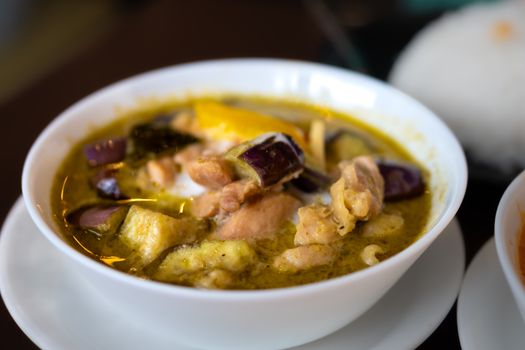
Thai Green Curry Chicken
The diets react (see scores below)
Common Ingredients
- chicken
- coconut milk
- green curry paste
- Thai eggplants
- Thai basil
- fish sauce
- palm sugar
- kaffir lime leaves
Specific recipes may vary.
Incompatible with 5 of 11 diets
Diet Ratings
Thai Green Curry Chicken has a mixed keto profile. The base is promising — chicken is an excellent lean protein and coconut milk provides healthy high-fat content ideal for keto. However, several ingredients introduce meaningful carb load: Thai eggplants add moderate net carbs, green curry paste typically contains galangal, lemongrass, shallots, and chilies that contribute carbs, kaffir lime leaves are negligible, and fish sauce adds minimal carbs. The biggest concern is palm sugar, a traditional ingredient that is essentially pure sucrose — a direct keto violation. A standard restaurant portion may push 15-25g net carbs depending on palm sugar quantity and portion size of eggplant. The dish is salvageable with modifications: omitting or substituting palm sugar (e.g., a keto-friendly sweetener), reducing eggplant, and using a low-sugar curry paste. As traditionally prepared, it sits in the caution zone due to the added sugar and cumulative carb load.
Strict keto practitioners and those following therapeutic or clinical keto protocols would likely classify this as 'avoid' outright due to the palm sugar (added sucrose) — any form of added sugar is considered a hard line violation regardless of quantity, and green curry paste's hidden carbs make portion control unreliable. Conversely, lazy keto adherents tracking only daily totals might approve a small portion if it fits within their 50g daily net carb budget.
Thai Green Curry Chicken contains multiple animal-derived ingredients that disqualify it entirely from a vegan diet. Chicken is direct animal flesh, fish sauce is derived from fermented fish, and green curry paste typically contains shrimp paste. These are clear, unambiguous animal products with no debate within the vegan community. Coconut milk, Thai eggplants, Thai basil, palm sugar, and kaffir lime leaves are plant-based, but the presence of chicken, fish sauce, and shrimp paste in the curry paste make this dish firmly non-vegan.
Thai Green Curry Chicken is largely paleo-compatible but contains several ingredients that require scrutiny. Chicken, coconut milk, Thai eggplants, Thai basil, kaffir lime leaves, and fish sauce (a fermented fish product) are generally paleo-approved. However, green curry paste is typically a processed product containing added salt and sometimes shrimp paste with preservatives — its paleo status depends heavily on whether it is homemade or store-bought. Palm sugar is a natural unrefined sugar but still falls into the caution category alongside other natural sweeteners. Fish sauce, while naturally fermented and paleo in principle, almost universally contains added salt, placing it in a gray area. The combination of a processed curry paste and palm sugar tips this dish into caution territory rather than a clear approval, even though the overall ingredient profile is closer to paleo than most Thai dishes.
Strict Cordain-school paleo would flag the added salt in fish sauce and commercial curry paste outright, and some practitioners avoid all added sugars including palm sugar entirely. Conversely, more relaxed modern paleo frameworks (e.g., Mark Sisson's Primal Blueprint) would likely approve this dish if made with a clean homemade curry paste and minimal palm sugar, treating it as a whole-food meal.
Thai Green Curry Chicken sits at the intersection of several Mediterranean diet considerations. Chicken is an acceptable moderate protein source, and the vegetables (Thai eggplants, Thai basil) align well with plant-forward principles. However, coconut milk is the dominant fat source rather than olive oil, and it is high in saturated fat — directly contradicting the Mediterranean principle of olive oil as the primary fat. Palm sugar adds refined sweetener, and green curry paste may contain processed ingredients. Fish sauce provides a fermented umami element loosely analogous to Mediterranean use of anchovies or capers. Overall, this is a flavorful dish with some acceptable components, but the coconut milk fat profile and added sugar make it a caution rather than an approve.
Some modern Mediterranean diet adaptations focus on the overall dietary pattern rather than strict fat sourcing, and would view this dish more favorably given its lean protein, abundant vegetables, and herb-forward profile. Traditional Southeast Asian cuisines share the Mediterranean emphasis on whole ingredients and vegetables, and some integrative practitioners accept occasional coconut milk use as part of a broadly plant-rich diet.
Thai Green Curry Chicken is heavily incompatible with the carnivore diet. While chicken itself is permissible, nearly every other ingredient violates core carnivore principles. Green curry paste contains plant-based ingredients (lemongrass, galangal, chili, garlic, shallots). Thai eggplants and Thai basil are plant foods. Coconut milk is a plant-derived fat. Palm sugar is a plant-derived sweetener. Kaffir lime leaves are plant matter. Fish sauce is the only genuinely carnivore-friendly supporting ingredient. This dish is fundamentally a plant-heavy preparation that uses chicken as a vehicle for numerous excluded food categories.
Thai Green Curry Chicken contains palm sugar, which is an added sugar and explicitly excluded on Whole30. Additionally, commercial green curry paste frequently contains shrimp paste, fish sauce additives, and sometimes sugar or other non-compliant ingredients that require careful label reading. Fish sauce itself is generally compliant (fermented fish and salt), chicken, coconut milk, Thai eggplants, Thai basil, and kaffir lime leaves are all compliant. However, palm sugar alone disqualifies this dish as prepared. A Whole30-compliant version could be made by omitting the palm sugar and sourcing a compliant green curry paste.
Thai Green Curry Chicken is high-FODMAP primarily due to green curry paste, which almost universally contains garlic and shallots/onion — both significant sources of fructans. These are the dominant FODMAP concern and cannot be avoided by portion reduction. Thai eggplants (also called pea eggplants or round Thai eggplants) are different from regular eggplant and have not been well-tested by Monash, but standard eggplant is low-FODMAP in small serves. Coconut milk is low-FODMAP at up to 1/2 cup (120ml). Chicken, fish sauce (in small amounts), kaffir lime leaves, and Thai basil are low-FODMAP. Palm sugar is low-FODMAP at typical culinary quantities. However, the green curry paste containing garlic and onion makes this dish a clear avoid during the elimination phase. A low-FODMAP version could be made using homemade garlic-free, onion-free curry paste with garlic-infused oil, but as prepared using standard green curry paste, this dish is not suitable for the elimination phase.
Thai Green Curry Chicken conflicts with DASH diet guidelines on multiple fronts. Coconut milk is high in saturated fat from a tropical oil source, which DASH explicitly limits. Palm sugar adds significant refined/added sugar. Fish sauce is extremely high in sodium (one tablespoon contains ~1,000–1,400mg sodium), making it nearly impossible to stay within DASH sodium limits (2,300mg/day standard, 1,500mg/day low-sodium) when combined with green curry paste, which itself is high in sodium. The combination of coconut milk (saturated fat), fish sauce (high sodium), palm sugar (added sugar), and curry paste (high sodium) stacks multiple DASH-discouraged components into a single dish. While the chicken, eggplants, and Thai basil are DASH-compatible, they are minor contributors to the overall nutritional profile of this dish as commonly prepared.
Thai Green Curry Chicken presents a mixed Zone profile. The chicken is an excellent lean protein source that fits Zone blocks well. However, the dish has two significant Zone concerns: (1) Coconut milk is high in saturated fat, which conflicts with Zone's emphasis on monounsaturated fats and anti-inflammatory eating — a typical serving contributes substantial saturated fat that pushes well beyond Zone's preferred fat profile. (2) Palm sugar is a high-glycemic sweetener that Sears would classify as an unfavorable carbohydrate. On the positive side, Thai eggplants are low-glycemic vegetables, Thai basil and kaffir lime leaves add polyphenols (which Sears increasingly emphasizes in his later anti-inflammatory framework), and fish sauce adds minimal macronutrient load. The dish can be adapted for Zone use by reducing coconut milk (or substituting light coconut milk), minimizing palm sugar, and controlling portion size carefully — but as typically prepared, the saturated fat load from full-fat coconut milk makes precise Zone blocking difficult without modification.
In Sears' later works (notably 'The Zone Diet' updates and his anti-inflammatory writings), he softened his position on saturated fat somewhat, acknowledging that medium-chain triglycerides (MCTs) in coconut milk behave differently metabolically than long-chain saturated fats. Some Zone practitioners therefore treat light coconut milk as acceptable in moderate portions. Additionally, the polyphenol content from Thai basil, kaffir lime leaves, and curry paste spices aligns well with Sears' later emphasis on polyphenol-rich eating for eicosanoid balance.
Thai Green Curry Chicken presents a genuinely mixed anti-inflammatory profile. On the positive side, the dish contains several strongly anti-inflammatory ingredients: green curry paste typically includes lemongrass, galangal, green chilies, garlic, and cilantro — all herbs and spices with documented anti-inflammatory properties including capsaicin and polyphenols. Thai basil provides flavonoids and eugenol with anti-inflammatory effects. Thai eggplants are members of the nightshade family but contain nasunin (a potent antioxidant) and chlorogenic acid. Kaffir lime leaves contribute antioxidant limonene compounds. Lean chicken breast is a moderate-tier protein with no significant pro-inflammatory concern. The main point of contention is full-fat coconut milk, which is high in saturated fat (primarily lauric acid) — a LIMIT ingredient under anti-inflammatory guidelines due to its potential to raise inflammatory markers like CRP and LDL. Palm sugar is an added sugar (LIMIT category) and fish sauce, while used in small amounts, adds sodium but is traditional and used in minimal quantities. The overall dish is far from a 'clean' anti-inflammatory meal due to the saturated fat load from coconut milk, but the herb and spice complexity provides genuine anti-inflammatory offset. It's best classified as an occasional, moderate-portion meal rather than a regular anti-inflammatory staple.
Coconut milk sits at the heart of the debate: Dr. Weil and mainstream anti-inflammatory nutrition limit saturated fats, placing full-fat coconut milk in the 'use sparingly' category due to its impact on lipid profiles and inflammatory markers. However, a growing paleo and ancestral health camp (including practitioners like Mark Sisson and Whole30 guidelines) considers coconut-derived saturated fat (lauric acid) metabolically distinct and potentially anti-inflammatory, arguing it raises HDL and has antimicrobial properties. The research is not settled, particularly on lauric acid specifically versus other saturated fats.
Thai Green Curry Chicken has a meaningful protein foundation from chicken, but the dominant issue for GLP-1 patients is full-fat coconut milk, which is high in saturated fat and can worsen nausea, bloating, and reflux — the primary GLP-1 side effects. A standard serving of green curry made with full-fat coconut milk can deliver 15-20g of fat per cup, much of it saturated. The green curry paste may also contain moderately spicy chilies that can aggravate GI discomfort. On the positive side, chicken provides solid lean protein, Thai eggplant adds some fiber and micronutrients, fish sauce and kaffir lime leaves are low-calorie flavor contributors, and the dish is generally easy to eat in small portions. Palm sugar adds minimal but non-zero refined sugar. The dish scores higher than a full avoid because the chicken protein is real and meaningful, and the dish can be modified (light coconut milk, larger vegetable ratio) to become more GLP-1 appropriate. As prepared in the traditional version, the high saturated fat load from coconut milk is the primary concern.
Some GLP-1-focused RDs are more permissive with coconut milk-based dishes, noting that the fat content slows digestion in a way that can enhance satiety in small portions, and that medium-chain triglycerides (MCTs) in coconut milk may be metabolized differently than other saturated fats. Others maintain that any high-fat dish risks triggering nausea and delayed gastric emptying complications and should be consistently flagged as caution regardless of fat source.
*See how scores were generated at our methodology page.
Nutritional profile
Six traits that cut across every diet.
Fiber & Plants
How much whole-plant food and fiber it delivers.
Healthy Fats
The quality of its fats (unsaturated, omega-3).
Whole / Unprocessed
How close it is to its natural, unprocessed form.
Gut Gentle
How easy it is on digestion (low FODMAP, few irritants).
Low Glycemic
How little it spikes your blood sugar.
Protein Density
How much protein it packs per calorie.
Controversy Index
Higher controversy = more disagreement between diets.
Diet-Specific Tips
 Keto — 5/10
View tips
- Palm sugar is added sucrose — a direct keto violation as traditionally prepared
- Coconut milk provides ideal high-fat content supporting ketosis
- Chicken is an excellent clean protein source
- Thai eggplants add moderate net carbs (~3-5g per serving)
- Green curry paste contains shallots, galangal, and chilies contributing hidden carbs
- Dish is keto-adaptable by omitting palm sugar and limiting eggplant
- Standard restaurant portions likely contain 15-25g net carbs total
 Paleo — 5/10
View tips
- Chicken and coconut milk are fully paleo-approved
- Green curry paste (store-bought) typically contains added salt and preservatives — homemade is preferred
- Fish sauce contains added salt, a paleo exclusion
- Palm sugar is a natural but still added sugar, placing it in the caution category
- Thai eggplants, Thai basil, and kaffir lime leaves are unprocessed and fully paleo
- Overall dish can be made paleo-compliant with ingredient substitutions (homemade paste, no added sugar)
 Mediterranean — 4/10
View tips
- Chicken is an acceptable moderate protein — caution tier under Mediterranean guidelines
- Coconut milk is high in saturated fat and replaces olive oil as the primary fat source — not Mediterranean
- Thai eggplants and Thai basil are plant-forward and nutritionally positive
- Palm sugar adds unwanted refined/added sugar
- Fish sauce is a fermented condiment analogous to anchovy use — minor positive
- Green curry paste may contain processed or high-sodium ingredients
- Dish is non-traditional to Mediterranean cuisine with a divergent fat profile
 Zone — 5/10
View tips
- Chicken is a favorable Zone lean protein — strong positive
- Full-fat coconut milk is high in saturated fat, conflicting with Zone's monounsaturated fat preference
- Palm sugar is an unfavorable high-glycemic carbohydrate in Zone terminology
- Thai eggplants are favorable low-glycemic Zone vegetables
- Thai basil and kaffir lime leaves contribute polyphenols valued in Sears' anti-inflammatory framework
- Fish sauce adds negligible macronutrients — neutral
- Dish is Zone-adaptable with light coconut milk and reduced sugar, but requires significant modification from traditional preparation
 Anti-Inflammatory — 5/10
View tips
- Green curry paste is rich in anti-inflammatory herbs: lemongrass, galangal, green chili, garlic
- Thai basil provides flavonoids and eugenol with anti-inflammatory activity
- Full-fat coconut milk is high in saturated fat — a 'limit' ingredient under most anti-inflammatory frameworks
- Palm sugar is an added sugar, contributing a modest pro-inflammatory element
- Kaffir lime leaves and Thai eggplants contribute antioxidant polyphenols
- Lean chicken is a moderate-tier protein with a neutral inflammatory profile
- Fish sauce is used in small quantities; minimal impact on inflammatory profile
- Thai eggplants may be a concern for those following autoimmune (AIP) protocols due to nightshade classification
 GLP-1 Friendly — 5/10
View tips
- Full-fat coconut milk is high in saturated fat and a known GLP-1 side effect trigger for nausea and bloating
- Chicken provides good lean protein, supporting the #1 dietary priority
- Green curry paste contains chili peppers that may worsen GI discomfort or reflux in sensitive patients
- Palm sugar adds refined sugar, though in small amounts typical of the dish
- Thai eggplant contributes modest fiber and micronutrients
- Dish is portion-friendly and can be eaten in small servings
- Modifiable: light coconut milk substitution would significantly improve the GLP-1 profile