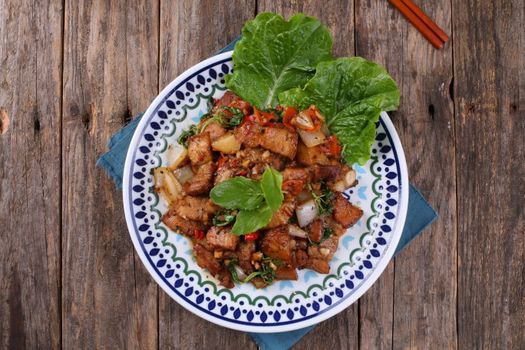
Thai
Thai Pork Belly with Basil
The diets react (see scores below)
Common Ingredients
- pork belly
- Thai holy basil
- garlic
- Thai chiles
- oyster sauce
- fish sauce
- soy sauce
- sugar
Specific recipes may vary.
Incompatible with 9 of 11 diets
Diet Ratings
Thai Pork Belly with Basil presents a mixed keto picture. The pork belly itself is an excellent keto protein — high in fat with zero carbs — and Thai holy basil, garlic, and chiles add negligible carbs. However, the sauce combination is problematic: oyster sauce is notably high in sugar and starch (roughly 7-9g net carbs per 2 tbsp), soy sauce adds minimal carbs but raises concerns for some, and most critically, added sugar is listed as a direct ingredient. Fish sauce is generally keto-friendly. In a restaurant portion, the cumulative sugar from oyster sauce plus added sugar could easily push 10-20g net carbs per serving, making this risky for strict keto. A home-cooked version with oyster sauce omitted or replaced with a keto oyster sauce substitute, and sugar eliminated, could be fully keto-compatible. As traditionally prepared, this dish warrants caution rather than outright avoidance, given that the carb load is moderate rather than extreme.
Strict keto practitioners would likely rate this as 'avoid' outright, arguing that the explicit addition of sugar and carb-laden oyster sauce make it incompatible regardless of portion size, and that no dish with added sugar belongs in a ketogenic protocol. Conversely, lazy keto or flexible keto advocates might approve it if portions are small and daily carb totals are managed.
Thai Pork Belly with Basil contains multiple animal products and animal-derived ingredients that are fundamentally incompatible with a vegan diet. Pork belly is a direct animal flesh product. Oyster sauce is derived from oysters (shellfish). Fish sauce is derived from fermented fish. These three ingredients alone each individually disqualify this dish from vegan compliance, and together they make this one of the clearest possible avoid verdicts.
While pork belly, Thai holy basil, garlic, and Thai chiles are all paleo-compliant ingredients, this dish is disqualified by multiple non-paleo components. Soy sauce is derived from fermented soybeans, a legume, and is strictly excluded. Oyster sauce is a processed condiment containing sugar, modified starch, and additives. Refined sugar is explicitly excluded from the paleo diet. Fish sauce can be borderline (some versions contain only fish and salt, though added salt is also discouraged). The combination of soy sauce, oyster sauce, and refined sugar makes this dish firmly in the 'avoid' category with high confidence — these are not gray-area ingredients but clear paleo violations.
Thai Pork Belly with Basil is strongly at odds with Mediterranean diet principles on multiple fronts. Pork belly is one of the fattiest cuts of red meat, extremely high in saturated fat, and red meat is restricted to just a few times per month in the Mediterranean diet. Beyond the protein, the dish contains added sugar, high-sodium processed condiments (oyster sauce, soy sauce, fish sauce), and no olive oil or whole grains. The cuisine is entirely outside the Mediterranean tradition, and the ingredient profile reflects almost none of the diet's core values: no legumes, no whole grains, no primary vegetables, no olive oil as fat source.
Thai Pork Belly with Basil is fundamentally incompatible with the carnivore diet. While pork belly itself is an excellent carnivore food — fatty, minimally processed, and animal-derived — this dish is loaded with plant-based and processed ingredients that are entirely off-limits. Thai holy basil, garlic, and Thai chiles are all plant foods explicitly excluded from the carnivore diet. Oyster sauce and soy sauce are processed condiments containing plant-derived ingredients, starches, and additives. Soy sauce is derived from fermented soybeans — a legume — making it a clear violation. Sugar is excluded on carnivore both as a plant-derived product and as a processed carbohydrate. Fish sauce is the only ingredient beyond the pork belly that could be considered carnivore-adjacent, though commercial fish sauce often contains additives. The dish as a whole cannot be adapted within its traditional form and must be avoided entirely.
This dish contains multiple excluded ingredients: soy sauce (contains soy, a legume, and often wheat/gluten — both excluded), oyster sauce (typically contains sugar and often corn starch or other excluded additives), and added sugar (explicitly excluded). These are not edge cases or ambiguous items — soy sauce and added sugar are clearly and unambiguously prohibited on Whole30. To make a compliant version, soy sauce would need to be replaced with coconut aminos, oyster sauce omitted or replaced with a compliant alternative, and sugar entirely eliminated.
This dish is high-FODMAP primarily due to garlic, which is one of the highest-fructan foods in the Monash system and must be avoided entirely during the elimination phase — even small amounts cooked into a dish will leach fructans into the food. Additionally, oyster sauce and soy sauce frequently contain wheat (fructans) and sometimes garlic or onion derivatives. Oyster sauce in particular is rated high-FODMAP by Monash due to its composition. Fish sauce in small quantities is generally low-FODMAP, and pork belly is a protein and therefore FODMAP-free. Thai holy basil and Thai chiles are low-FODMAP. Sugar is low-FODMAP. However, the garlic alone disqualifies this dish from the elimination phase, and the oyster sauce compounds the problem. To make a low-FODMAP version, garlic would need to be replaced with garlic-infused oil, and a certified gluten-free, low-FODMAP oyster sauce substitute or tamari (gluten-free soy sauce) would be needed.
Thai Pork Belly with Basil is highly incompatible with the DASH diet on multiple fronts. Pork belly is one of the fattiest cuts of pork, loaded with saturated fat and cholesterol — directly contradicting DASH's emphasis on lean proteins and limited saturated fat. The sodium load from the triple combination of oyster sauce, fish sauce, and soy sauce is extreme, easily exceeding 1,500–2,300mg of sodium in a single serving, violating both standard and low-sodium DASH thresholds. Sugar is added, contributing to the diet's discouraged sweets category. While garlic, Thai chiles, and holy basil are DASH-friendly aromatics with beneficial phytonutrients, they cannot offset the fundamental incompatibilities of this dish. This dish conflicts with DASH guidelines on protein type, fat quality, and sodium content simultaneously.
Thai Pork Belly with Basil presents significant Zone Diet challenges. Pork belly is an extremely high-fat cut, dominated by saturated fat rather than the monounsaturated fats Zone recommends. A typical serving can contain 30-50g of fat with only 10-15g of protein, completely inverting the Zone's lean protein principle (25g protein, 10-15g fat per meal). The sauce components add further concerns: sugar directly raises glycemic load, and oyster sauce and soy sauce contribute modest sugar and sodium. On the positive side, Thai holy basil, garlic, and chiles are polyphenol-rich and anti-inflammatory, aligning with Sears' later emphasis on micronutrient quality. Fish sauce is essentially protein-neutral. However, the fat profile of pork belly is the dominant issue — it is nearly impossible to build a Zone-balanced meal around this cut without consuming far too much saturated fat and total fat relative to protein. A small portion (2-3 oz) could technically be used as part of a Zone meal, but the caloric imbalance makes this a very poor Zone building block. This scores low within 'caution' territory, borderline 'avoid,' primarily because portion control could theoretically allow inclusion but practical meal construction is extremely difficult.
Some Zone practitioners following Sears' later anti-inflammatory writings (Toxic Fat, The Mediterranean Zone) note that Sears moderated his stance on saturated fat somewhat, acknowledging that the inflammatory index matters as much as macro ratios. Under this view, a very small portion of pork belly (1-2 oz) paired with abundant low-GI vegetables and used as a flavoring component rather than a primary protein source could be workable. However, this dish as traditionally prepared remains a poor Zone match regardless of which era of Sears' writing is applied.
Thai Pork Belly with Basil has a few genuinely anti-inflammatory components — holy basil (contains eugenol and rosmarinic acid with anti-inflammatory properties), garlic (allicin, quercetin), and Thai chiles (capsaicin reduces inflammatory cytokines). However, these benefits are substantially outweighed by the pro-inflammatory profile of the dish as a whole. Pork belly is one of the highest-fat cuts of pork, dominated by saturated fat, which at these levels is firmly in the 'limit to avoid' category of anti-inflammatory guidelines. The condiment base — oyster sauce, fish sauce, and soy sauce — adds a significant sodium load that can contribute to systemic inflammation and cardiovascular stress. Added sugar, even in small quantities, nudges the profile further in a pro-inflammatory direction. The dish is not a processed food in the traditional sense and does contain real spices with genuine benefit, but the primary protein source (high-fat red/processed meat) is the defining factor here. Anti-inflammatory protocols universally recommend limiting fatty red meat and high-saturated-fat cuts; pork belly as a central, full-portion ingredient tips this dish into the avoid category.
Thai Pork Belly with Basil is a poor choice for GLP-1 patients. Pork belly is one of the fattiest cuts available, typically 40-50% fat by weight with very high saturated fat content, which directly worsens GLP-1 side effects including nausea, bloating, and reflux. Because GLP-1 medications slow gastric emptying, high-fat meals sit in the stomach for an extended period, significantly amplifying GI distress. The protein-to-fat ratio is poor compared to lean protein alternatives. Thai chiles add spice that may worsen nausea and reflux. The sauce base (oyster sauce, fish sauce, soy sauce, sugar) adds sodium and sugar with minimal nutritional benefit. This dish fails on multiple core criteria: high saturated fat, poor protein density per calorie, likely to trigger or worsen GI side effects, and not small-portion friendly in terms of satiety value relative to its caloric load.
*See how scores were generated at our methodology page.
Nutritional profile
Six traits that cut across every diet.
Fiber & Plants
How much whole-plant food and fiber it delivers.
Healthy Fats
The quality of its fats (unsaturated, omega-3).
Whole / Unprocessed
How close it is to its natural, unprocessed form.
Gut Gentle
How easy it is on digestion (low FODMAP, few irritants).
Low Glycemic
How little it spikes your blood sugar.
Protein Density
How much protein it packs per calorie.
Controversy Index
Higher controversy = more disagreement between diets.
Diet-Specific Tips
 Keto — 4/10
View tips
- Pork belly is an ideal keto fat-protein source with zero net carbs
- Oyster sauce contains significant sugar and starch (~7-9g net carbs per 2 tbsp)
- Added sugar is an explicit ingredient — a direct keto violation
- Fish sauce and soy sauce contribute minimal carbs
- Thai basil, garlic, and chiles are keto-compatible aromatics
- Total net carbs per serving likely 10-20g depending on sauce volume — risky for strict keto budgets
- Home modification (omit sugar, replace oyster sauce) would make this keto-approved
 Zone — 5/10
View tips
- Pork belly is extremely high in saturated fat, violating Zone's lean protein principle
- Fat-to-protein ratio in pork belly is severely imbalanced for Zone block construction
- Added sugar in sauce increases glycemic load
- Thai holy basil, garlic, and chiles are polyphenol-rich and anti-inflammatory, a Zone positive
- Fish sauce and oyster sauce are low-calorie condiments but oyster sauce contains sugar
- Practically impossible to hit 40/30/30 ratio with pork belly as the primary protein
- Small portion as flavoring component is theoretically possible but defeats the dish's purpose