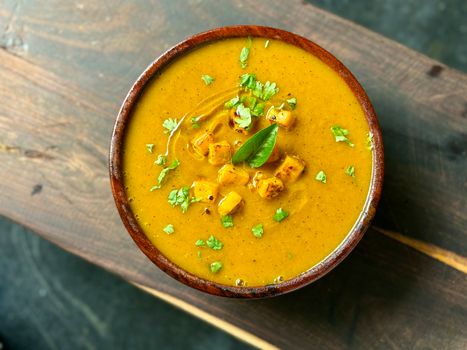
Photo: Rahul Sonawane / Pexels
The diets react (see scores below)
Common Ingredients
- kabocha pumpkin
- coconut milk
- red curry paste
- Thai basil
- fish sauce
- palm sugar
- kaffir lime leaves
- onion
Specific recipes may vary.
Incompatible with 5 of 11 diets
Diet Ratings
Thai pumpkin curry presents a mixed keto profile. Coconut milk is keto-friendly (high fat, low carb), and red curry paste and fish sauce are acceptable in small amounts. However, kabocha pumpkin is notably higher in net carbs than most keto vegetables (roughly 9-10g net carbs per 100g cooked), and palm sugar is a direct added sugar that disrupts ketosis. Onion adds modest additional carbs. A standard restaurant serving could easily exceed 20-25g net carbs from the pumpkin and palm sugar combined. With strict portion control (small pumpkin serving) and omission or minimal use of palm sugar, it becomes borderline manageable, but as typically prepared this dish sits in cautionary territory. The dish is salvageable for keto if palm sugar is eliminated and pumpkin portion is reduced to under 75g.
Some stricter keto practitioners would rate this as 'avoid' outright, citing palm sugar as a non-negotiable disqualifier and kabocha's glycemic load as too high regardless of portion size. Conversely, lazy keto advocates may approve small portions, arguing the fat content from coconut milk offsets the carb load in practice.
This Thai pumpkin curry contains two clear animal-derived ingredients that disqualify it from vegan compliance: fish sauce (made from fermented fish) and the option of chicken as the primary protein. Fish sauce is a staple non-vegan ingredient in traditional Thai cooking, present here as a listed ingredient rather than a trace contaminant. The chicken option compounds the issue. The remaining ingredients — kabocha pumpkin, coconut milk, red curry paste (which itself often contains shrimp paste in traditional Thai versions), Thai basil, palm sugar, kaffir lime leaves, and onion — are plant-based, but the dish as described cannot be considered vegan. A vegan adaptation is straightforward: substitute fish sauce with soy sauce or tamari, omit chicken, and verify the red curry paste uses no shrimp paste.
Pumpkin Curry has a genuinely mixed paleo profile. The base is strong: kabocha pumpkin, coconut milk, Thai basil, kaffir lime leaves, and onion are all paleo-approved whole foods. Fish sauce in its pure form (fermented fish and salt) is ancestrally plausible, though the added salt and occasional preservatives in commercial versions put it in a gray zone for strict paleo. Palm sugar is a natural, minimally processed sweetener derived from palm sap — paleo treats natural sweeteners as 'caution' rather than outright avoid. The most significant concern is red curry paste: commercial Thai curry pastes almost universally contain added salt, shrimp paste (fermented, generally acceptable), and sometimes preservatives or sugar. A homemade paste from fresh chilies, lemongrass, galangal, garlic, and shallots would be fully paleo-compliant. Together, the palm sugar and processed curry paste pull this dish out of 'approve' territory into a cautious yellow zone. With chicken added and a homemade or clean-label curry paste, this dish skews toward the higher end of caution.
Strict Cordain-school paleo would flag fish sauce for its salt content and commercial curry paste for additives, pushing this dish toward 'avoid.' However, most modern paleo practitioners (Mark Sisson, Practical Paleo by Diane Sanfilippo) treat fish sauce and small amounts of natural sweeteners pragmatically, keeping a dish like this well within acceptable range.
Pumpkin Curry has several Mediterranean-compatible elements — kabocha pumpkin is an excellent vegetable, onion and Thai basil are plant-forward ingredients, and fish sauce adds umami with minimal caloric impact. However, coconut milk is the primary fat source here rather than olive oil, and it is high in saturated fat, which directly contradicts Mediterranean diet principles where extra virgin olive oil is the canonical fat. Palm sugar adds a modest amount of refined sugar. Red curry paste is mildly processed but contains whole-food spices. If chicken is included, it falls into the acceptable-in-moderation category. Overall, the dish is vegetable-rich and nutritious in many respects, but the coconut milk base is a meaningful departure from Mediterranean fat guidelines, warranting a caution rating rather than outright avoidance.
Some modern Mediterranean diet interpretations acknowledge that coconut milk, as a plant-derived fat, can be used occasionally in the context of an otherwise plant-rich diet. Traditional Southeast Asian culinary patterns that use coconut milk heavily are sometimes cited as having favorable health outcomes, leading a minority of researchers to view coconut-based dishes more permissively than classical Mediterranean guidelines would suggest.
Pumpkin Curry is fundamentally incompatible with the carnivore diet. The dish is built almost entirely on plant-based ingredients: kabocha pumpkin (starchy vegetable), coconut milk (plant fat), red curry paste (a blend of plant spices, chili, lemongrass, galangal), Thai basil (herb), palm sugar (plant-derived sugar), kaffir lime leaves (plant), and onion (vegetable). Fish sauce is the only carnivore-compatible ingredient, and even that is typically a minor flavoring agent. Palm sugar is an outright disqualifier — it is a plant-derived sugar explicitly excluded. The entire flavor and structural foundation of this dish is plant-derived. Even if chicken were added as the protein, the dish would remain firmly off-limits due to the overwhelming volume and variety of excluded plant ingredients.
This Pumpkin Curry contains palm sugar, which is an added sugar and explicitly excluded on Whole30. All forms of added sugar — real or artificial — are prohibited for the full 30 days. Additionally, red curry paste commonly contains shrimp paste, fish sauce, and other ingredients that are individually compliant, but many commercial curry pastes include added sugar or other excluded ingredients, requiring careful label verification. However, the disqualifying ingredient here is the palm sugar listed directly in the recipe. Without the palm sugar (and with a verified-compliant curry paste), the dish could be made Whole30-compliant, as all other ingredients — kabocha pumpkin, coconut milk, Thai basil, fish sauce (check for no added sugar), kaffir lime leaves, and onion — are generally allowed.
This dish contains two major high-FODMAP ingredients that make it unsuitable during the elimination phase. First, onion is one of the highest-fructan foods on the Monash scale and is high-FODMAP at virtually any cooking amount — it cannot be swapped out by simply removing it after cooking, as fructans leach into the dish. Second, commercial red curry paste almost universally contains garlic and often onion as primary ingredients, both of which are high in fructans. Even small amounts of curry paste used in a standard serving will introduce significant fructans. Kabocha pumpkin is low-FODMAP at a standard 75–100g serving. Coconut milk is low-FODMAP at approximately 1/2 cup (125ml) per serving. Thai basil, fish sauce, kaffir lime leaves, and palm sugar are all low-FODMAP. However, the onion and red curry paste together create a dish that is definitively high-FODMAP regardless of the safe status of the other ingredients.
Thai Pumpkin Curry presents multiple DASH diet concerns despite containing some beneficial ingredients. The primary issues are: (1) Coconut milk is high in saturated fat from a tropical oil source — DASH explicitly limits tropical oils and saturated fat. A typical serving of full-fat coconut milk contains 10-15g saturated fat, well above DASH targets. (2) Red curry paste is typically high in sodium, and fish sauce adds substantial additional sodium — together these can push a single serving to 800-1,200mg or more, a significant portion of the 1,500-2,300mg daily DASH limit. (3) Palm sugar is an added sugar, which DASH limits. On the positive side, kabocha pumpkin is an excellent DASH food (rich in potassium, fiber, and beta-carotene), onion and Thai basil are DASH-friendly vegetables, and lean chicken protein aligns with DASH. However, the combination of coconut milk (saturated fat/tropical oil), high-sodium curry paste and fish sauce, and added sugar creates a dish that conflicts with core DASH principles in its standard preparation.
NIH DASH guidelines explicitly restrict tropical oils and saturated fat, placing coconut milk-based dishes outside DASH recommendations. However, some updated clinical interpretations note that recent meta-analyses have not found a clear link between coconut milk consumption and adverse cardiovascular outcomes in the context of an otherwise nutrient-rich diet — some DASH-oriented practitioners suggest that using reduced-fat coconut milk, low-sodium curry paste, and limiting portion size could make a modified version acceptable on DASH at 'caution' level.
Pumpkin Curry presents a mixed Zone profile. Kabocha pumpkin is a relatively low-glycemic squash compared to other starchy vegetables, making it more favorable than standard pumpkin or sweet potato. However, the dominant Zone concern is coconut milk, which is high in saturated fat — a significant departure from the Zone's preference for monounsaturated fats. Coconut milk makes the fat block ratio difficult to control and skews the fat profile toward saturated rather than anti-inflammatory monounsaturated sources. Palm sugar adds a glycemic hit, and fish sauce adds negligible macros but significant sodium. Red curry paste contributes polyphenols, which aligns with Sears' anti-inflammatory emphasis. If chicken is included, protein balance improves substantially. Without chicken or tofu, the dish is primarily fat and carbohydrate with poor protein representation, making Zone block balancing very difficult. The dish can fit Zone principles with modifications: reduce coconut milk, use light coconut milk, add lean protein, and minimize or omit palm sugar. As typically prepared in Thai restaurants, the fat content from full-fat coconut milk and the added sugar make this a meal that requires careful portioning and modification rather than straightforward approval.
Some Zone practitioners and later Sears anti-inflammatory writings show more nuance around coconut fat, noting that medium-chain triglycerides (MCTs) in coconut may have neutral or beneficial metabolic effects, potentially relaxing the strict monounsaturated fat preference. Additionally, kabocha is sometimes cited as more Zone-friendly than standard pumpkin varieties, and the polyphenols from curry paste and Thai basil align well with Sears' later polyphenol-focused Zone work. This could push the dish to a moderate 6 if prepared with light coconut milk and lean chicken.
This Thai pumpkin curry has a genuinely mixed anti-inflammatory profile. On the positive side: kabocha pumpkin is rich in beta-carotene and antioxidant carotenoids; red curry paste typically contains turmeric, galangal, lemongrass, and chili — all well-supported anti-inflammatory spices; Thai basil and kaffir lime leaves contribute polyphenols and aromatic compounds with antioxidant activity; onion provides quercetin. These ingredients collectively represent a strong anti-inflammatory base. The central concern is full-fat coconut milk, which is high in saturated fat (primarily lauric acid). Anti-inflammatory frameworks generally flag saturated fat and recommend limiting it, though coconut milk's lauric acid is debated — some researchers argue it raises HDL alongside LDL, while mainstream anti-inflammatory protocols (including Dr. Weil's) recommend using coconut milk sparingly rather than regularly. Palm sugar is a modest source of added sugar but used in small quantities as a flavor balance, which limits concern. Fish sauce adds sodium but in typical culinary amounts is not a meaningful inflammatory driver. Red curry paste may contain refined additives or seed oils depending on the commercial brand, which could nudge the profile toward caution. If chicken is included, lean breast meat is in the 'moderate' category. Overall: a nutrient-rich dish with meaningful anti-inflammatory ingredients offset by regular full-fat coconut milk use — best as an occasional dish rather than a dietary staple.
Dr. Weil's anti-inflammatory pyramid permits coconut milk used moderately and emphasizes the anti-inflammatory power of spice-forward cooking like Thai curry; from this perspective the dish could lean toward approve. Conversely, stricter anti-inflammatory and AIP-aligned practitioners flag saturated fat from coconut milk as potentially pro-inflammatory at regular consumption levels, and commercial curry pastes may introduce seed oils or additives that worsen the profile.
Thai Pumpkin Curry presents a mixed nutritional profile for GLP-1 patients. The kabocha pumpkin is a positive — it is nutrient-dense, moderately high in fiber, rich in beta-carotene, and easy to digest. However, the dish is built around full-fat coconut milk, which is high in saturated fat and can significantly worsen GLP-1 side effects including nausea, bloating, and reflux due to slowed gastric emptying. The red curry paste and fish sauce add sodium and moderate spice, which most patients tolerate but some find irritating on an already-sensitive GI tract. Palm sugar adds refined sugar with minimal nutritional value. Without chicken, this dish is very low in protein — a critical deficiency for GLP-1 patients — and would fail to meet the 15–30g per meal protein target. With chicken breast added, protein improves meaningfully but the fat concern from coconut milk remains. Overall, this dish is acceptable occasionally if prepared with light coconut milk, chicken added, and portion-controlled, but the standard full-fat restaurant version is problematic for regular consumption on a GLP-1 regimen.
Some GLP-1-focused dietitians accept coconut-milk-based curries in moderate portions, noting that the medium-chain triglycerides in coconut milk may digest somewhat differently than other saturated fats and that the overall meal volume is small given reduced appetite. Others flag full-fat coconut milk as a consistent GI trigger in their GLP-1 patient populations and recommend avoiding it entirely, particularly in the early dose-escalation phase when nausea and reflux are most pronounced.
*See how scores were generated at our methodology page.
Nutritional profile
Six traits that cut across every diet.
Fiber & Plants
How much whole-plant food and fiber it delivers.
Healthy Fats
The quality of its fats (unsaturated, omega-3).
Whole / Unprocessed
How close it is to its natural, unprocessed form.
Gut Gentle
How easy it is on digestion (low FODMAP, few irritants).
Low Glycemic
How little it spikes your blood sugar.
Protein Density
How much protein it packs per calorie.
Controversy Index
Higher controversy = more disagreement between diets.
Diet-Specific Tips
 Keto — 4/10
View tips
- Kabocha pumpkin is higher-carb (~9-10g net carbs/100g) compared to typical keto vegetables
- Palm sugar is an added sugar incompatible with strict keto
- Coconut milk is keto-friendly and provides beneficial fats
- Red curry paste contains minimal carbs per serving
- Fish sauce and kaffir lime leaves are negligible in carbs
- Combined carb load from pumpkin, palm sugar, and onion likely exceeds ideal keto limits in standard portions
- Dish can be modified (less pumpkin, omit sugar) to be more keto-compatible
 Paleo — 5/10
View tips
- Kabocha pumpkin is a paleo-approved whole food vegetable
- Coconut milk is fully paleo-compliant
- Palm sugar is a natural sweetener — rated caution, not avoid
- Commercial red curry paste typically contains added salt and preservatives — homemade is preferred
- Fish sauce (fermented fish + salt) is borderline — salt content is the concern for strict paleo
- Thai basil, kaffir lime leaves, and onion are unambiguously paleo
- Optional chicken protein is paleo-approved
- Overall dish is paleo-friendly with clean ingredient sourcing but not unconditionally approved
 Mediterranean — 5/10
View tips
- Kabocha pumpkin is a nutrient-dense vegetable, strongly aligned with Mediterranean plant-forward principles
- Coconut milk is high in saturated fat and replaces olive oil as the primary fat — a significant departure from Mediterranean guidelines
- Palm sugar adds refined/added sugar, contradicting the low-sugar principle
- Fish sauce is a fermented condiment; fish-derived ingredients are generally compatible
- If chicken is included, it is acceptable in moderation as poultry
- Dish is not processed or refined-grain-based, preserving some compatibility
- Thai cuisine is not a Mediterranean tradition; this is an imported culinary framework
 Zone — 5/10
View tips
- Coconut milk is high in saturated fat, conflicting with Zone's monounsaturated fat preference
- Kabocha pumpkin is relatively low-glycemic compared to other squash — a Zone positive
- Palm sugar raises glycemic load and should be minimized or eliminated
- Dish lacks adequate lean protein without chicken addition — Zone block imbalance risk
- Red curry paste and Thai basil provide anti-inflammatory polyphenols aligned with Zone principles
- Full-fat coconut milk makes fat block control difficult; light coconut milk would improve Zone compatibility
- Fish sauce is nutritionally neutral in Zone context but adds significant sodium
 Anti-Inflammatory — 5/10
View tips
- Kabocha pumpkin: high in beta-carotene and carotenoid antioxidants — anti-inflammatory positive
- Red curry paste: contains turmeric, galangal, lemongrass, chili — strong anti-inflammatory spice base
- Thai basil and kaffir lime leaves: polyphenols, flavonoids — anti-inflammatory positive
- Full-fat coconut milk: high in saturated fat (lauric acid) — flagged as 'limit' in most anti-inflammatory frameworks
- Palm sugar: added sugar — minor concern at typical culinary doses
- Fish sauce: high sodium but not a significant inflammatory driver in culinary quantities
- Commercial red curry paste: may contain seed oils or additives depending on brand — potential concern
- Lean chicken (if included): acceptable in moderation per anti-inflammatory guidelines
 GLP-1 Friendly — 4/10
View tips
- Full-fat coconut milk is high in saturated fat and a known GLP-1 GI trigger (nausea, bloating, reflux)
- Without chicken, protein content is very low — fails the 15–30g per meal target
- With chicken breast added, protein becomes adequate but fat concern persists
- Kabocha pumpkin is nutrient-dense, fiber-rich, and easy to digest — a strong positive
- Palm sugar adds low-value refined sugar calories
- Red curry paste introduces moderate spice — tolerable for most but may worsen reflux in sensitive patients
- Dish can be improved significantly by substituting light coconut milk and adding lean protein
- Restaurant versions are likely to use full-fat coconut milk and higher sugar, making them less suitable