Photo: Augustinus Martinus Noppé / Pexels
The diets react (see scores below)
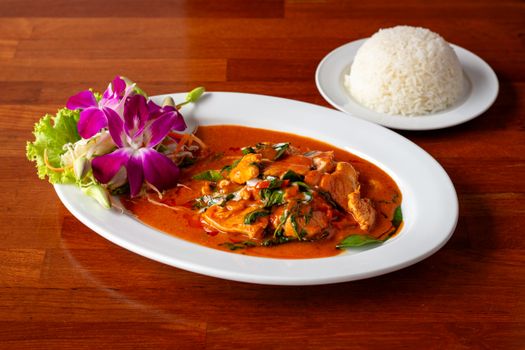
Common Ingredients
- chicken
- coconut milk
- red curry paste
- bamboo shoots
- Thai basil
- fish sauce
- kaffir lime leaves
- palm sugar
Specific recipes may vary.
Incompatible with 4 of 11 diets
Diet Ratings
Thai Red Curry has a solid keto foundation — chicken and full-fat coconut milk provide quality protein and high fat content — but two ingredients introduce meaningful carb concerns. Red curry paste typically contains sugar, shrimp paste, and starchy components, adding roughly 3-5g net carbs per 2 tbsp serving. More critically, palm sugar is a direct added sugar that is incompatible with strict keto. Bamboo shoots are low-carb and fine. Fish sauce adds minimal carbs. Kaffir lime leaves and Thai basil are negligible. The dish can be made keto-compatible by omitting or substituting palm sugar and using a clean, low-sugar curry paste, but as traditionally prepared with palm sugar, it earns a caution rating. A standard restaurant portion could push 10-15g net carbs, which is manageable within daily limits but requires tracking.
Strict keto practitioners argue that any added sugar (palm sugar) and commercial curry pastes with hidden sugars have no place in a ketogenic diet, as even small amounts of refined sugar can provoke an insulin response disproportionate to the carb count. They would recommend a full avoid unless the dish is explicitly modified with sugar-free paste and no palm sugar.
This Thai Red Curry contains multiple animal-derived ingredients that disqualify it entirely from a vegan diet. Chicken is a direct animal product (poultry). Fish sauce is derived from fermented fish. These two ingredients alone make this dish non-vegan, and there is no ambiguity within the vegan community on either count. While coconut milk, red curry paste, bamboo shoots, Thai basil, kaffir lime leaves, and palm sugar are plant-based, the presence of chicken and fish sauce renders the entire dish incompatible with a vegan diet.
Thai Red Curry sits in paleo gray territory due to several problematic ingredients alongside genuinely paleo-compliant ones. Chicken, coconut milk, Thai basil, kaffir lime leaves, and fish sauce (in its pure fermented fish form) are broadly paleo-approved. However, red curry paste is the central concern — commercial versions almost universally contain added salt, shrimp paste with preservatives, and sometimes sugar or non-paleo additives. Palm sugar is a minimally processed natural sweetener derived from palm sap, placing it in the caution category alongside honey and maple syrup — it's not refined cane sugar, but it is still an added sugar. Fish sauce deserves scrutiny as well: pure versions (fermented fish and salt only) are debated due to the added salt, which strict paleo excludes. Bamboo shoots are a vegetable and paleo-compliant. The dish can be made paleo-friendly with a homemade curry paste (no salt, no preservatives), minimal or no palm sugar, and a clean fish sauce — but as typically prepared in restaurants or with commercial paste, it falls into caution territory.
Strict Cordain-school paleo would flag fish sauce for its added salt content and commercial curry paste for preservatives and additives, potentially pushing this dish toward avoid. However, many modern paleo practitioners (Melissa Hartwig's Whole30 framework, for instance) permit fish sauce as a fermented condiment and treat small amounts of natural sweeteners like palm sugar as acceptable in context.
Thai Red Curry sits outside the Mediterranean dietary tradition and presents a mixed nutritional profile from a Mediterranean perspective. Chicken is acceptable in moderation (poultry fits the 'caution' tier). However, coconut milk is the primary fat source here rather than extra virgin olive oil, and coconut milk is high in saturated fat — contrary to Mediterranean principles that prioritize unsaturated fats from olive oil. Palm sugar adds refined/added sugar. On the positive side, bamboo shoots, Thai basil, and kaffir lime leaves are plant-based ingredients, and fish sauce provides some umami depth common in traditional cuisines. Red curry paste may contain additives depending on preparation. The dish is not highly processed overall, but its fat profile and sugar content push it toward caution rather than approval.
Some modern Mediterranean diet interpreters argue that the emphasis should be on overall dietary patterns — plant diversity, lean protein, minimal ultra-processing — rather than strict fat-source dogma. Under this broader view, Thai Red Curry's abundance of vegetables, lean chicken, and herbs could be seen as reasonably compatible, with coconut milk accepted sparingly as an occasional alternative fat source.
Thai Red Curry is fundamentally incompatible with the carnivore diet. While it contains animal products (chicken and fish sauce), the dish is dominated by plant-based ingredients that are strictly excluded: red curry paste (made from chili peppers, lemongrass, galangal, and other plant compounds), bamboo shoots (a plant vegetable), Thai basil (an herb), kaffir lime leaves (plant aromatics), and palm sugar (a plant-derived sweetener). Coconut milk is also plant-derived. This dish is essentially a plant-heavy preparation that uses chicken as a secondary component within a framework that violates nearly every carnivore diet rule simultaneously — plant oils, vegetables, herbs, spices, and sugar all appear together.
Thai Red Curry contains palm sugar, which is an added sugar and explicitly excluded on the Whole30 program. All forms of added sugar — real or artificial — are banned for the 30 days, and palm sugar falls squarely into this category. Additionally, commercial red curry pastes frequently contain shrimp paste (generally fine), but also often include added sugars, soy, or other non-compliant additives, making label scrutiny essential. The dish as described with palm sugar cannot be considered compliant. If palm sugar is omitted and a compliant red curry paste is used (verified to contain no added sugar or soy), the remaining ingredients — chicken, coconut milk, bamboo shoots, Thai basil, fish sauce, and kaffir lime leaves — are all Whole30-compatible.
Thai Red Curry contains several individually manageable ingredients, but the critical problem is the red curry paste. Commercially prepared Thai red curry pastes almost universally contain garlic and onion (and often shallots), both of which are high-FODMAP due to fructans and are problematic even in small amounts. Chicken, coconut milk (capped at ~100ml per serve), bamboo shoots (canned, drained), Thai basil, fish sauce, kaffir lime leaves, and palm sugar are all low-FODMAP at standard servings. However, unless the curry paste is a verified FODMAP-friendly brand (e.g., Mae Ploy or similar scrutinised for garlic/onion content, or homemade without those ingredients), the fructan load from garlic and onion in the paste makes this dish high-risk during elimination. Coconut milk also requires portion control — canned coconut milk is low-FODMAP at ~100ml but becomes high-FODMAP (excess fructose/sorbitol) at larger amounts, and Thai curries typically use a generous pour. The combination of paste-derived fructans and potentially excess coconut milk makes this a 'caution' rather than 'avoid' because a FODMAP-safe version is achievable with the right paste.
Monash University rates garlic-free and onion-free homemade red curry paste as low-FODMAP, and garlic-infused oil can substitute for garlic; however, clinical FODMAP practitioners routinely advise avoiding all commercial Thai curry pastes during the elimination phase because verifying the absence of fructan-containing ingredients from restaurant or standard packaged versions is impractical for most patients.
Thai Red Curry as commonly prepared contains multiple ingredients that conflict directly with DASH diet principles. Coconut milk is high in saturated fat from a tropical oil source, which DASH explicitly limits. Palm sugar is an added sugar. Fish sauce is extremely high in sodium (one tablespoon contains approximately 1,400mg sodium), and red curry paste also contributes significant sodium. Together, these ingredients can easily push a single serving well over the entire daily sodium allowance for standard DASH (2,300mg) or especially the low-sodium DASH target (1,500mg). The lean chicken and vegetables (bamboo shoots, Thai basil) are DASH-friendly components, but they are overwhelmed by the problematic ingredients. This dish as commonly prepared is fundamentally misaligned with DASH macronutrient and sodium targets.
Thai Red Curry has a mixed Zone profile. The chicken is an excellent lean protein source that fits squarely within Zone guidelines. Bamboo shoots and Thai basil are low-glycemic vegetables that are Zone-favorable. However, the dish has two significant challenges: (1) Coconut milk is high in saturated fat, which conflicts with Zone's emphasis on monounsaturated fats and anti-inflammatory eating — a full-fat coconut milk base will skew the fat block heavily toward saturated fat rather than the preferred monounsaturated profile; (2) Palm sugar adds glycemic load and is an 'unfavorable' carbohydrate in Zone terminology. Red curry paste may also contain added sugars and high omega-6 vegetable oils depending on the brand. That said, the dish is not a Zone disaster — with portion control, a modest amount of coconut milk, and serving alongside or over additional low-GI vegetables rather than rice, it can be incorporated into a Zone meal. The lean protein foundation and low-glycemic vegetables keep this from being an 'avoid.' The fat quality and added sugar are the primary concerns requiring adjustment.
Some later-era Zone practitioners, influenced by Sears' Mediterranean Zone and anti-inflammatory work, have become more accepting of coconut products, noting that the medium-chain triglycerides (MCTs) in coconut milk have a different metabolic profile than long-chain saturated fats, and that traditional Thai cooking using coconut milk in moderate amounts within a vegetable-rich dish is broadly compatible with anti-inflammatory eating. Sears' earlier Zone books (Enter the Zone) were more strictly anti-saturated fat, while his later writing acknowledges nuance around fat quality.
Thai Red Curry presents a genuinely mixed anti-inflammatory profile. On the positive side, it contains several strongly anti-inflammatory ingredients: Thai basil provides polyphenols and eugenol with documented anti-inflammatory effects; red curry paste typically contains turmeric, galangal, lemongrass, and chili peppers — all emphasized in anti-inflammatory frameworks; kaffir lime leaves contribute flavonoids; bamboo shoots provide fiber; and lean chicken is an acceptable moderate protein. Fish sauce in small amounts is largely neutral. However, two ingredients pull the score down meaningfully. Coconut milk is high in saturated fat (predominantly lauric acid), which most anti-inflammatory frameworks — including Dr. Weil's — advise limiting; full-fat coconut milk used generously in Thai curry can represent a significant saturated fat load. Palm sugar, while less glycemically aggressive than refined white sugar, is still an added sugar, which anti-inflammatory guidelines recommend minimizing. The dish is not processed, contains no trans fats or seed oils, and its spice base is genuinely anti-inflammatory — so it avoids the 'avoid' category. With lighter coconut milk (reduced fat or diluted) and minimal palm sugar, this dish would score higher.
Some anti-inflammatory advocates, including those following Dr. Weil's pyramid, argue that coconut milk's lauric acid has a more neutral or even beneficial cardiovascular profile compared to other saturated fats, and that the potent anti-inflammatory spice base (turmeric, galangal, chili) in red curry paste may outweigh the saturated fat concern. From this perspective, an authentic Thai Red Curry could be considered acceptable or even mildly beneficial. Conversely, stricter anti-inflammatory protocols and AHA-aligned nutritionists maintain that the high saturated fat content from full-fat coconut milk is a genuine concern that limits the dish's anti-inflammatory value.
Thai Red Curry with chicken has meaningful protein from the chicken breast, but coconut milk is the primary concern for GLP-1 patients. Full-fat coconut milk is high in saturated fat, which can worsen nausea, bloating, and reflux — key GLP-1 side effects. Red curry paste may also contain moderate spice levels that can irritate a slowed GI tract. On the positive side, bamboo shoots add fiber and are easy to digest, Thai basil and kaffir lime leaves are negligible in fat, and fish sauce adds minimal sodium without fat. Palm sugar adds a small glycemic load but is typically used in small amounts. The dish scores higher than a avoid because chicken is a lean protein source and the overall dish can be made GLP-1-friendlier with light coconut milk, controlled portion of sauce, and served over cauliflower rice or a small portion of brown rice. As typically prepared in restaurants, the coconut milk fat load is the primary disqualifier from an approve rating.
Some GLP-1-focused dietitians consider Thai Red Curry acceptable because coconut milk contains medium-chain triglycerides (MCTs), which are metabolized differently than long-chain saturated fats and may be better tolerated by some patients. Others maintain that any high-fat sauce is problematic given slowed gastric emptying, and the cumulative saturated fat load in a standard restaurant portion is too high to recommend even occasionally.
*See how scores were generated at our methodology page.
Nutritional profile
Six traits that cut across every diet.
Fiber & Plants
How much whole-plant food and fiber it delivers.
Healthy Fats
The quality of its fats (unsaturated, omega-3).
Whole / Unprocessed
How close it is to its natural, unprocessed form.
Gut Gentle
How easy it is on digestion (low FODMAP, few irritants).
Low Glycemic
How little it spikes your blood sugar.
Protein Density
How much protein it packs per calorie.
Controversy Index
Higher controversy = more disagreement between diets.
Diet-Specific Tips
 Keto — 5/10
View tips
- Palm sugar is an added sugar — directly incompatible with strict keto
- Red curry paste often contains sugar and starchy fillers, adding hidden carbs
- Full-fat coconut milk is an excellent keto fat source
- Chicken provides clean moderate protein
- Bamboo shoots are low net-carb vegetables
- Dish can be modified to keto-friendly by removing palm sugar and using clean curry paste
- Standard restaurant serving may reach 10-15g net carbs — trackable but not negligible
 Paleo — 5/10
View tips
- Chicken and coconut milk are fully paleo-approved
- Red curry paste (commercial) typically contains added salt, preservatives, and may include non-paleo additives — homemade is required for strict compliance
- Palm sugar is a natural but still-added sweetener, placing it in the caution category
- Fish sauce raises debate due to added salt; pure fermented versions are more accepted than commercial blends
- Bamboo shoots and Thai basil are paleo-compliant vegetables/herbs
- Kaffir lime leaves are a natural herb with no paleo concerns
- Dish is potentially paleo-adaptable with ingredient substitutions but not as typically prepared
 Mediterranean — 4/10
View tips
- Coconut milk replaces olive oil as the primary fat, introducing high saturated fat content contrary to Mediterranean principles
- Chicken is an acceptable moderate protein source within the Mediterranean framework
- Palm sugar adds unwanted refined/added sugars
- Bamboo shoots, Thai basil, and kaffir lime leaves contribute positively as plant-based ingredients
- Dish is not ultra-processed but is non-traditional and outside Mediterranean culinary origin
- Fish sauce provides sodium without significant nutritional benefit in this context
 Low-FODMAP — 4/10
View tips
- Commercial red curry paste almost always contains garlic and/or onion — major fructan sources
- Chicken is fully low-FODMAP
- Coconut milk is low-FODMAP at ≤100ml but curries typically use 200–400ml per serve, risking excess fructose
- Bamboo shoots (canned, drained and rinsed) are low-FODMAP
- Thai basil, kaffir lime leaves, fish sauce, and palm sugar are low-FODMAP at normal serving sizes
- A homemade FODMAP-safe version using garlic-infused oil and onion-free paste would be approvable
- Restaurant versions are essentially always high-FODMAP due to paste composition
 Zone — 5/10
View tips
- Chicken is a lean, Zone-favorable protein source
- Coconut milk is high in saturated fat, conflicting with Zone's monounsaturated fat preference
- Palm sugar is an 'unfavorable' carbohydrate that raises glycemic load
- Bamboo shoots and Thai basil are low-glycemic, Zone-approved vegetables
- Fish sauce adds sodium but negligible macronutrient concern
- Dish lacks sufficient carbohydrate volume from vegetables unless served with additional low-GI produce
- Portion control of coconut milk is essential to stay within Zone fat block guidelines
- Curry paste may contain added sugars or omega-6 seed oils depending on brand
 Anti-Inflammatory — 5/10
View tips
- Red curry paste contains turmeric, galangal, lemongrass, and chili — potent anti-inflammatory spices
- Thai basil provides polyphenols and eugenol with anti-inflammatory properties
- Kaffir lime leaves contribute flavonoids
- Full-fat coconut milk is high in saturated fat — a concern in most anti-inflammatory frameworks
- Palm sugar is an added sugar, which anti-inflammatory diets recommend minimizing
- Lean chicken is an acceptable moderate protein
- No trans fats, seed oils, processed additives, or refined carbohydrates
- Bamboo shoots add fiber and are anti-inflammatory neutral to beneficial
 GLP-1 Friendly — 5/10
View tips
- Coconut milk is high in saturated fat and can worsen nausea, bloating, and reflux on GLP-1 medications
- Chicken provides good lean protein if breast meat is used
- Red curry paste introduces moderate to high spice that may irritate GI tract
- Bamboo shoots provide fiber and are easy to digest
- Palm sugar adds glycemic load but typically in small amounts
- Fish sauce is high sodium but low fat — not a primary concern
- Portion control of sauce is critical; home preparation with light coconut milk significantly improves the profile
- Restaurant versions typically use full-fat coconut milk in large volumes, worsening the rating