Thai
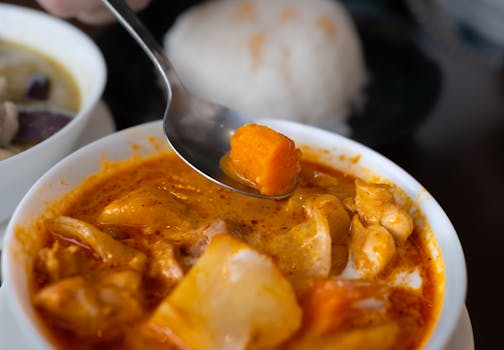
Thai Red Curry Chicken
The diets react (see scores below)
Common Ingredients
- chicken
- coconut milk
- red curry paste
- bamboo shoots
- Thai basil
- fish sauce
- kaffir lime leaves
- palm sugar
Specific recipes may vary.
Incompatible with 5 of 11 diets
Diet Ratings
Thai Red Curry Chicken has a solid keto foundation — chicken provides quality protein, coconut milk delivers high healthy fats, bamboo shoots are low in net carbs, and fish sauce/kaffir lime leaves/Thai basil add negligible carbs. The two problematic ingredients are red curry paste (contains some sugar and starchy components, typically 3-5g net carbs per 2 tbsp serving) and palm sugar, which is a direct added sugar and the main keto disqualifier here. In traditional recipes, palm sugar is used to balance flavors and can add 5-10g of sugar per serving. If palm sugar is omitted or replaced with a keto-friendly sweetener like erythritol, and curry paste is portioned carefully, this dish can fit within keto macros. As typically prepared in restaurants or traditional recipes, the palm sugar pushes it into caution territory rather than a clear approve.
Some strict keto and carnivore-adjacent practitioners would rate this as avoid, arguing that even small amounts of palm sugar represent intentional added sugar that should have zero tolerance on a well-formulated ketogenic diet, and that restaurant versions often use significantly more sugar than home estimates suggest. Conversely, lazy keto practitioners may approve it outright, noting that a single serving's net carbs from curry paste and palm sugar combined rarely exceeds 8-10g, leaving ample room within a 50g daily limit.
Thai Red Curry Chicken contains multiple animal-derived ingredients that are categorically incompatible with a vegan diet. Chicken is poultry (animal flesh), fish sauce is derived from fermented fish, and these alone are sufficient to disqualify the dish entirely. There is no ambiguity or meaningful debate within the vegan community about these ingredients.
Thai Red Curry Chicken is largely paleo-friendly but contains two problematic ingredients that push it into caution territory. Chicken, coconut milk, Thai basil, kaffir lime leaves, and bamboo shoots are all clean paleo foods. Fish sauce is technically fermented fish and salt — strict paleo excludes added salt, but many practitioners accept fish sauce as a natural fermented condiment in small amounts. The bigger concerns are red curry paste and palm sugar. Commercial red curry paste almost universally contains shrimp paste (fermented, generally accepted), but also added salt and sometimes preservatives or sugar — making it a processed product. Palm sugar is a natural sugar but still a refined/concentrated sweetener, placing it in the caution category alongside other natural sugars like honey or maple syrup. A strictly homemade red curry paste with no additives and omitting palm sugar (or substituting a small amount of raw honey) would score closer to 7-8, but as commonly prepared this dish sits firmly in the caution range.
Strict Cordain-school paleo would flag fish sauce for its added salt content and red curry paste as a processed food, pushing this dish toward avoid. Conversely, more permissive practitioners like Mark Sisson and the broader primal community would likely approve this dish, treating fish sauce as a traditional fermented condiment and palm sugar as an acceptable occasional natural sweetener — similar to honey.
Thai Red Curry Chicken contains several elements that partially align with Mediterranean principles but also diverge significantly. Chicken is an acceptable moderate protein (poultry fits within the 'few times per week' category), and the dish includes plant-forward ingredients like bamboo shoots, Thai basil, and kaffir lime leaves. However, coconut milk is the dominant fat source rather than extra virgin olive oil, and coconut milk is high in saturated fat — contrary to the Mediterranean diet's emphasis on monounsaturated fats from olive oil. Palm sugar is an added sugar, which the Mediterranean diet discourages. Red curry paste and fish sauce are moderately processed condiments with high sodium. The dish is not Mediterranean in tradition or composition, though it is not as problematic as red meat or heavily processed foods.
Some modern Mediterranean diet interpreters apply broader 'plant-forward and whole-food' principles globally, noting that coconut milk is a minimally processed plant fat and the dish's vegetable content and lean protein are positives. However, traditional Mediterranean diet frameworks, including the widely cited Oldways pyramid, are explicit that olive oil — not coconut milk — is the defining fat, and most clinical guidelines would not consider this dish a Mediterranean-compatible staple.
Thai Red Curry Chicken is fundamentally incompatible with the carnivore diet. While it contains some animal-derived ingredients (chicken, fish sauce), the dish is overwhelmingly plant-based in its flavoring and composition. Red curry paste is a blend of plant ingredients (chili peppers, lemongrass, galangal, garlic, shallots), coconut milk is a plant-derived fat source, bamboo shoots are a vegetable, Thai basil and kaffir lime leaves are herbs/plant matter, and palm sugar is a plant-derived sweetener. Fish sauce is animal-derived but typically contains added sugar and fermented plant matter. Nearly every defining characteristic of this dish — its flavor, texture, and sauce — comes from excluded plant foods. This is not a dish that can be made carnivore-compliant with minor modifications; it would require replacing essentially every ingredient except the chicken.
This dish contains palm sugar, which is an added sugar and explicitly excluded on Whole30. Additionally, commercial red curry paste typically contains shrimp paste (usually compliant) but often includes added sugar or other excluded ingredients, requiring careful label scrutiny. The palm sugar alone is enough to disqualify this dish as traditionally prepared. All other ingredients — chicken, coconut milk, bamboo shoots, Thai basil, fish sauce, and kaffir lime leaves — are Whole30-compliant. A compliant version could be made by omitting palm sugar and using a Whole30-approved red curry paste with no added sugar or excluded ingredients.
Thai Red Curry Chicken is problematic during the FODMAP elimination phase primarily because of the red curry paste. Commercial red curry paste almost universally contains garlic and shallots/onions as primary ingredients — both are very high in fructans and are among the most significant FODMAP triggers. Even small amounts of these ingredients (as concentrated in a paste) can provoke symptoms. Coconut milk is low-FODMAP at standard serving sizes (up to 1/2 cup per Monash), chicken is safe, fish sauce is generally low-FODMAP in small amounts, kaffir lime leaves are low-FODMAP, Thai basil is low-FODMAP, palm sugar is low-FODMAP in small quantities, and bamboo shoots (canned, drained) are low-FODMAP. However, the red curry paste is essentially unavoidable as the flavor base of this dish and is virtually always high-FODMAP in any commercially available or traditionally prepared form. A low-FODMAP version could theoretically be made using homemade curry paste with garlic-infused oil (no garlic cloves), lemongrass, galangal, and chili — but as typically prepared, this dish must be avoided during elimination.
Some clinical FODMAP dietitians note that if a very small amount of curry paste is used across a large batch (e.g., 1 tsp paste per 4 servings), the per-serve fructan load from garlic/onion may fall below symptomatic thresholds for some individuals. Monash University has not published specific testing of commercial red curry paste as a whole product, making exact cutoffs uncertain — a few practitioners allow homemade low-FODMAP curry paste versions as a compliant substitute during elimination.
Thai Red Curry Chicken is incompatible with the DASH diet primarily due to coconut milk and palm sugar. Coconut milk is extremely high in saturated fat (a single cup contains ~48g saturated fat), and palm sugar is an added sugar — both are explicitly limited by DASH guidelines. Red curry paste and fish sauce add significant sodium, easily pushing a single serving well above DASH sodium thresholds. Palm sugar is also among the tropical-derived sweeteners DASH discourages. Coconut milk itself is a tropical oil derivative that NIH/NHLBI DASH guidelines explicitly restrict. While the chicken and bamboo shoots are DASH-friendly, the overall dish profile — high saturated fat from coconut milk, high sodium from fish sauce and curry paste, and added sugar from palm sugar — places it firmly in the 'avoid' category. No realistic modification short of replacing the coconut milk (with low-fat evaporated milk or low-fat coconut milk) and reducing fish sauce substantially would make this DASH-compatible.
Thai Red Curry Chicken has a solid Zone-compatible protein base (chicken breast) and beneficial low-glycemic vegetables (bamboo shoots, Thai basil), but two ingredients create meaningful tension with Zone principles. Coconut milk is high in saturated fat, which Zone — especially early Sears publications — discourages in favor of monounsaturated fats. A typical serving of full-fat coconut milk can deliver 10-15g of saturated fat, pushing well beyond Zone's fat block targets and skewing the fat profile away from anti-inflammatory monounsaturates. Palm sugar is a direct glycemic concern, as added sugar is firmly unfavorable in Zone terminology, though the small quantities typically used in Thai curry (1-2 tsp for a full pot) keep actual sugar impact modest per serving. Fish sauce adds negligible macro impact. The dish can be Zone-adapted — using light coconut milk, controlling portion size, and pairing with non-starchy vegetables instead of rice — but as traditionally prepared, the saturated fat load from full-fat coconut milk and the added palm sugar make this a 'caution' requiring conscious portioning rather than a straightforward Zone-favorable meal.
Sears' later work (The Anti-Inflammation Zone, Zone Perfect Meals in Minutes) shows a broader acceptance of certain saturated fats in context, particularly when paired with anti-inflammatory omega-3s and polyphenols. Thai basil, kaffir lime leaves, and red curry paste (containing galangal and lemongrass) are rich in polyphenols, which Sears increasingly emphasized. Some Zone practitioners argue that small amounts of coconut milk's medium-chain triglycerides (MCTs) are metabolically neutral or beneficial, and would rate this dish a 6-7 when made with light coconut milk. The anti-inflammatory spice profile partially offsets the saturated fat concern in this more nuanced reading.
Thai Red Curry Chicken presents a genuinely mixed anti-inflammatory profile. On the positive side, the dish contains several strongly anti-inflammatory ingredients: red curry paste typically includes turmeric, galangal, lemongrass, and chili peppers — all well-documented anti-inflammatory spices. Thai basil provides rosmarinic acid and other polyphenols. Kaffir lime leaves contain flavonoids and antioxidants. Bamboo shoots add fiber and phytonutrients. Chicken (lean protein) is a moderate-tier protein on the anti-inflammatory framework. The concerns center primarily on two ingredients: coconut milk and palm sugar. Full-fat coconut milk is high in saturated fat (lauric acid), which is debated but generally lands in the 'limit' category under anti-inflammatory guidelines. Palm sugar, while lower glycemic than refined white sugar, is still an added sugar and should be minimized. Fish sauce, while high in sodium, is used in small quantities and contributes umami without significant inflammatory burden. The overall dish can be made more anti-inflammatory by using light coconut milk, minimizing palm sugar, and pairing with brown rice or cauliflower rice. As prepared with full-fat coconut milk and palm sugar, it sits in caution territory — beneficial spices partially offset by saturated fat and added sugar.
Dr. Weil and some anti-inflammatory practitioners view coconut milk's lauric acid as a medium-chain fatty acid with potential immune-modulating properties, and traditional Thai cuisine is sometimes cited as part of broader anti-inflammatory dietary patterns in epidemiological research. However, mainstream anti-inflammatory guidance (including the IF Rating system) consistently flags high saturated fat from coconut products as a reason for moderation, and AHA guidelines place coconut milk in the 'use sparingly' category.
Thai Red Curry Chicken has a genuinely mixed nutritional profile for GLP-1 patients. The chicken provides solid lean protein (20-25g per serving), which is a clear positive. However, coconut milk — the dish's defining ingredient — is high in saturated fat, typically contributing 15-20g of fat per standard restaurant serving, which can worsen GLP-1 side effects including nausea, bloating, and reflux due to slowed gastric emptying. Red curry paste can be moderately spicy and may irritate the GI tract in sensitive patients. Palm sugar adds modest sugar content. On the positive side, bamboo shoots contribute fiber and the dish is generally not fried or ultra-processed. The verdict is highly preparation-dependent: a home-prepared version using light coconut milk, extra chicken, and a measured portion of curry paste scores meaningfully better than a restaurant version with full-fat coconut milk and generous oil.
Some GLP-1-focused RDs consider coconut milk acceptable in moderate amounts given that its fat is primarily medium-chain triglycerides (MCTs), which digest differently than long-chain saturated fats and may be less likely to trigger severe GI distress. Others maintain that any high-fat sauce significantly increases nausea and reflux risk and should be avoided regardless of fat type, particularly in early weeks on the medication.
*See how scores were generated at our methodology page.
Nutritional profile
Six traits that cut across every diet.
Fiber & Plants
How much whole-plant food and fiber it delivers.
Healthy Fats
The quality of its fats (unsaturated, omega-3).
Whole / Unprocessed
How close it is to its natural, unprocessed form.
Gut Gentle
How easy it is on digestion (low FODMAP, few irritants).
Low Glycemic
How little it spikes your blood sugar.
Protein Density
How much protein it packs per calorie.
Controversy Index
Higher controversy = more disagreement between diets.
Diet-Specific Tips
 Keto — 5/10
View tips
- Coconut milk provides high healthy fats — strongly keto-positive
- Chicken is an excellent keto-compliant protein source
- Palm sugar is an added sugar and the primary keto concern
- Red curry paste contributes moderate carbs and may contain hidden sugars
- Bamboo shoots are low net carb and keto-compatible
- Dish is easily modified by omitting palm sugar and limiting curry paste
- Restaurant versions likely contain more sugar than home-cooked estimates
 Paleo — 5/10
View tips
- Chicken is fully paleo-approved as a clean animal protein
- Coconut milk is a paleo staple and approved fat source
- Commercial red curry paste typically contains added salt, preservatives, and sometimes non-paleo additives — a processed product concern
- Fish sauce contains added salt; strict paleo excludes salt, though many practitioners accept fermented fish condiments
- Palm sugar is a natural but concentrated sweetener — classified as caution alongside honey and maple syrup
- Thai basil, kaffir lime leaves, and bamboo shoots are all unprocessed, paleo-approved plant foods
- Dish can be made more paleo-compliant by using homemade curry paste and omitting or minimizing palm sugar
 Mediterranean — 4/10
View tips
- Chicken is acceptable poultry protein — moderate consumption aligns with Mediterranean guidelines
- Coconut milk replaces olive oil as the primary fat, introducing high saturated fat content not consistent with Mediterranean principles
- Palm sugar is an added sugar, discouraged by Mediterranean diet rules
- Bamboo shoots and Thai basil contribute plant-based nutritional value
- Fish sauce and red curry paste are processed, high-sodium condiments
- Dish is non-Mediterranean in origin and fat profile
 Zone — 5/10
View tips
- Chicken is a lean, Zone-favorable protein source — strong positive
- Full-fat coconut milk is high in saturated fat, conflicting with Zone's monounsaturated fat preference and fat block targets
- Palm sugar adds glycemic load; Zone discourages added sugars as unfavorable carbohydrates
- Bamboo shoots are low-glycemic, high-fiber Zone-favorable vegetables
- Red curry paste and Thai herbs (basil, kaffir lime, galangal) provide polyphenols aligned with Sears' anti-inflammatory focus
- Dish is Zone-adaptable with light coconut milk and careful portioning, but requires modification from traditional preparation
- No carbohydrate block anchor (no rice served here) means the dish is protein+fat heavy, requiring low-glycemic vegetable or fruit sides to hit 40/30/30
 Anti-Inflammatory — 5/10
View tips
- Red curry paste contains turmeric, galangal, lemongrass, and chili — all anti-inflammatory spices
- Thai basil provides rosmarinic acid and polyphenols
- Kaffir lime leaves contribute flavonoids and antioxidants
- Full-fat coconut milk is high in saturated fat — falls in the 'limit' category
- Palm sugar is an added sugar — should be minimized in anti-inflammatory eating
- Chicken is a moderate/approved lean protein
- Fish sauce contributes sodium but used in small amounts — minor concern
- Bamboo shoots add fiber and micronutrients
- Overall dish quality improves significantly with light coconut milk and reduced sugar
 GLP-1 Friendly — 5/10
View tips
- Chicken provides good lean protein (20-25g per serving) supporting the #1 GLP-1 dietary priority
- Coconut milk is high in saturated fat (15-20g per serving full-fat) and is the primary concern for GLP-1 side effects
- Spice level from red curry paste may worsen nausea or reflux in GLP-1 patients with GI sensitivity
- Palm sugar adds unnecessary empty calories with limited nutritional value
- Bamboo shoots contribute fiber and digestive bulk — a positive
- Light coconut milk substitution significantly improves the rating
- Restaurant portions typically use full-fat coconut milk and larger oil quantities than home preparation
- Easy digestibility is compromised by the high fat content of standard preparation