Photo: Nguyen Truong Khang / Pexels
Vietnamese
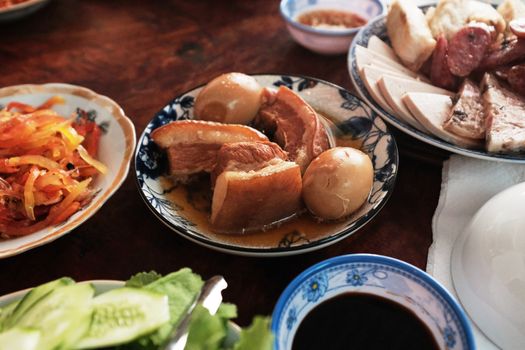
Thịt Kho (Caramelized Pork & Eggs)
The diets react (see scores below)
Common Ingredients
- pork belly
- hard-boiled eggs
- coconut water
- caramel sauce
- fish sauce
- shallots
- garlic
- black pepper
Specific recipes may vary.
Incompatible with 10 of 11 diets
Diet Ratings
Thịt Kho in its traditional form is fundamentally incompatible with keto due to two critical ingredients: coconut water and caramel sauce. Coconut water contains roughly 9g of net carbs per 100ml, and a typical braising recipe uses 500ml or more, contributing 45g+ of carbs from that ingredient alone before accounting for the caramel sauce, which is pure sucrose cooked to high temperature. Together these two ingredients easily push a single serving well above the entire daily keto carb budget of 20-50g. The pork belly and hard-boiled eggs are excellent keto foods individually — high fat, high protein, zero carbs — but the braising liquid is essentially a sugar syrup infused into the meat. Fish sauce, shallots, and garlic add minor additional carbs. This dish would require such radical reformulation (replacing coconut water with broth and eliminating caramel entirely) that the result would no longer be Thịt Kho.
Thịt Kho contains multiple animal products that are unambiguously excluded from a vegan diet. Pork belly is mammalian flesh, hard-boiled eggs are an animal product, and fish sauce is derived from fermented fish — all three are clear disqualifiers. The remaining ingredients (coconut water, caramel sauce, shallots, garlic, black pepper) are plant-based, but the dish as defined is fundamentally built around animal proteins and an animal-derived condiment. There is no version of this specific dish that could be considered vegan without wholesale replacement of its defining ingredients.
Thịt Kho contains several non-paleo ingredients that disqualify it. The caramel sauce is typically made from refined white sugar, which is explicitly excluded from the paleo diet. Fish sauce, while derived from fish, is a processed condiment that almost universally contains added salt — and often sugar or preservatives — making it non-compliant under strict paleo rules. These two ingredients alone are enough to push the dish into 'avoid' territory. The remaining ingredients — pork belly, hard-boiled eggs, coconut water, shallots, garlic, and black pepper — are all paleo-approved or at least uncontroversial. Coconut water is a natural liquid accepted in paleo. Pork belly is a whole, unprocessed meat. However, the dish as traditionally prepared cannot be considered paleo-compliant due to the refined sugar in the caramel and the processed, salted fish sauce.
Thịt Kho is built around pork belly, one of the fattiest cuts of red meat, which the Mediterranean diet restricts to just a few times per month. The dish is also defined by caramel sauce, adding significant refined sugar, and coconut water in large braising quantities contributes additional sugar. These combined factors — high saturated fat from pork belly, added sugar from caramel, and the absence of any plant-forward, whole-grain, or olive-oil-based elements — place this dish firmly in conflict with Mediterranean diet principles. The eggs and aromatics (shallots, garlic) are acceptable ingredients, but they are minor components overwhelmed by the problematic core elements.
Thịt Kho contains pork belly and eggs — both carnivore-compatible — but the dish is fundamentally incompatible with the carnivore diet due to multiple plant-derived and processed ingredients. Coconut water is a plant-based liquid with significant sugar content. Caramel sauce is refined sugar. Fish sauce, while animal-derived, typically contains sugar and fermented plant additives. Shallots and garlic are plant foods explicitly excluded from carnivore. Black pepper is a plant-based spice. The dish is essentially built around a sugar-based braising liquid, making it a avoid regardless of the quality of the pork and eggs at its core.
Thịt Kho contains caramel sauce, which is a critical disqualifying ingredient. Traditional caramel sauce for this dish is made by cooking sugar until it browns — this is added sugar, which is explicitly excluded on Whole30. The remaining ingredients (pork belly, hard-boiled eggs, coconut water, fish sauce, shallots, garlic, black pepper) are individually Whole30-compatible, but the caramel sauce as typically prepared makes the dish non-compliant. Fish sauce should also be label-checked for added sugar or other additives, as many commercial brands include them. The dish could theoretically be adapted by omitting the caramel and relying on coconut water for natural sweetness, but as traditionally prepared it fails Whole30 rules.
Thịt Kho contains two high-FODMAP ingredients that are fundamental to the dish and cannot be omitted without fundamentally changing the recipe: shallots (high in fructans) and garlic (high in fructans). Both are used as core aromatics in the braising base. Coconut water is also high-FODMAP at typical cooking quantities (Monash rates it as high-FODMAP at 250ml due to polyols/fructose; small amounts may be borderline but a full braise typically uses a significant volume). The caramel sauce is typically made from sugar, which is low-FODMAP in small amounts, and fish sauce is generally low-FODMAP at normal serving sizes. Pork belly and hard-boiled eggs are both low-FODMAP proteins. However, the combination of shallots, garlic, and likely high-volume coconut water makes this dish unsuitable during the elimination phase without significant modification.
Thịt Kho is problematic for the DASH diet on multiple fronts. Pork belly is one of the fattiest cuts of meat available, extremely high in saturated fat and total fat — both of which DASH explicitly limits. Red/processed fatty meats are among the foods DASH most strongly discourages. Fish sauce is very high in sodium (a single tablespoon can contain 1,000–1,400mg of sodium), which directly conflicts with DASH's core goal of limiting sodium to under 2,300mg/day (or 1,500mg on the stricter version). The caramel sauce adds significant refined sugar, another category DASH limits. While coconut water itself is DASH-friendly (rich in potassium), it cannot offset the dish's core issues. Hard-boiled eggs add some protein and are acceptable in moderation under modern DASH interpretations, but they are a minor positive in an otherwise DASH-incompatible dish. The combination of high saturated fat from pork belly, high sodium from fish sauce, and added sugars from caramel sauce makes this dish a poor fit for the DASH eating plan.
Thịt Kho presents significant Zone Diet challenges primarily due to its core ingredients. Pork belly is a high-fat cut dominated by saturated fat rather than the lean proteins Zone favors — it's the opposite of skinless chicken or fish. The caramel sauce introduces concentrated sugar (high-glycemic, nutritionally empty calories), and coconut water adds additional natural sugars. Together, the caramel and coconut water create a glycemic spike that disrupts Zone's 40/30/30 balance. The dish is structurally designed around a braising liquid loaded with sugar, making it very difficult to balance into Zone blocks without fundamentally altering the recipe. The hard-boiled eggs are a Zone-favorable protein component, but they're a minor element here. Fish sauce, shallots, garlic, and black pepper are Zone-neutral to positive. The overall macro profile of this dish as prepared — high saturated fat from pork belly, significant added sugars from caramel, moderate-to-high glycemic load — makes it very challenging to incorporate into a Zone meal without major modification (e.g., substituting pork tenderloin, eliminating caramel, reducing coconut water). It scores a 3 rather than 1-2 because the eggs, aromatics, and fish sauce are legitimate Zone-compatible elements, and small portions could theoretically be worked around a Zone plate of vegetables.
Some Zone practitioners note that Sears' later anti-inflammatory writings (The OmegaRx Zone, The Mediterranean Zone) softened the absolute stance on saturated fat, acknowledging that context matters. A small portion of Thịt Kho served alongside a large plate of low-glycemic vegetables could theoretically be worked into a Zone meal — the pork belly provides fat blocks, eggs provide protein blocks, and if caramel is minimized, the glycemic damage is reduced. This dish's score could rise to 4-5 in a context-sensitive reading where portion control compensates for the unfavorable ingredients.
Thịt Kho is a traditional Vietnamese braised dish, but its ingredient profile is significantly pro-inflammatory by anti-inflammatory diet standards. Pork belly is the primary protein — a high-fat cut rich in saturated fat, which is explicitly in the 'limit to avoid' category. The caramel sauce introduces added refined sugar, a major driver of inflammatory markers like CRP and IL-6. Fish sauce contributes high sodium, which at excess levels is associated with inflammatory processes. Coconut water is relatively benign (natural sugars, electrolytes), but doesn't offset the dish's core issues. The eggs are neutral-to-moderate. The positive notes are garlic, shallots, and black pepper — all with genuine anti-inflammatory properties — but they are minor components relative to the dominant pro-inflammatory profile of fatty pork and added sugar. This dish represents precisely the combination (red/processed meat + saturated fat + added sugar) that anti-inflammatory nutrition consistently flags as problematic. Even moderate consumption would be inconsistent with anti-inflammatory eating principles.
Thịt Kho is built around pork belly, one of the fattiest cuts available (roughly 35-40g fat per 100g), making it a poor fit for GLP-1 patients on multiple fronts. High dietary fat significantly worsens the most common GLP-1 side effects — nausea, bloating, and reflux — because slowed gastric emptying means fatty food sits in the stomach far longer than usual. The caramel sauce and coconut water add a meaningful sugar load with little nutritional return, and the overall dish is calorie-dense with low protein density per calorie. The hard-boiled eggs are a genuine positive, contributing clean protein and nutrients, but they are a minor component of the dish rather than the primary protein source. Fish sauce and shallots are fine in small amounts. The black pepper is unlikely to cause issues at typical cooking quantities. There is no meaningful fiber in this dish. In short, pork belly is categorically the type of fatty, heavy protein that GLP-1 clinical guidance consistently flags as likely to cause significant GI distress and is counterproductive to the goals of the medication.
*See how scores were generated at our methodology page.
Nutritional profile
Six traits that cut across every diet.
Fiber & Plants
How much whole-plant food and fiber it delivers.
Healthy Fats
The quality of its fats (unsaturated, omega-3).
Whole / Unprocessed
How close it is to its natural, unprocessed form.
Gut Gentle
How easy it is on digestion (low FODMAP, few irritants).
Low Glycemic
How little it spikes your blood sugar.
Protein Density
How much protein it packs per calorie.
Controversy Index
Higher controversy = more disagreement between diets.
Diet-Specific Tips
 Zone — 5/10
View tips
- Pork belly is very high in saturated fat — Zone strongly prefers lean proteins like chicken, fish, or egg whites
- Caramel sauce is concentrated sugar (high-glycemic, nutritionally empty) — one of the clearest Zone-unfavorable ingredients
- Coconut water adds natural sugars, further elevating the glycemic load of the braising liquid
- Hard-boiled eggs are a Zone-favorable lean protein component, but secondary in this dish
- Fish sauce, garlic, shallots, and black pepper are Zone-neutral aromatics with negligible macro impact
- The dish's macro ratio skews heavily toward fat (saturated) and sugar-derived carbs, far from the 40/30/30 Zone target
- Structural recipe changes (swap pork belly for tenderloin, eliminate caramel) would be required for meaningful Zone compatibility