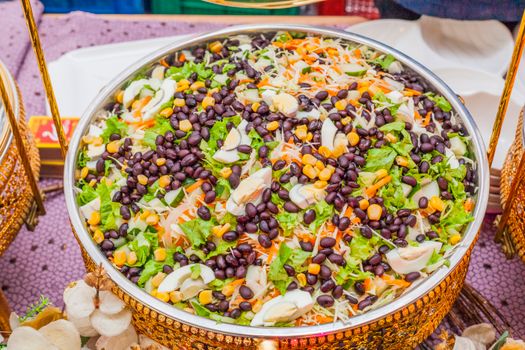
Photo: Shalom Dare / Pexels
American
Three-Bean Salad
The diets react (see scores below)
Common Ingredients
- green beans
- kidney beans
- chickpeas
- red onion
- apple cider vinegar
- sugar
- olive oil
- parsley
Specific recipes may vary.
Incompatible with 5 of 11 diets
Diet Ratings
Three-Bean Salad is fundamentally incompatible with a ketogenic diet. Kidney beans and chickpeas are high-carb legumes — a half-cup of kidney beans contains roughly 17g net carbs, and chickpeas run even higher at ~19g net carbs per half-cup. Together, these two legumes alone can easily consume or exceed the entire daily net carb budget of 20g in a single serving. The dish is further compounded by added sugar in the dressing, which directly spikes blood glucose and disrupts ketosis. Green beans are the only keto-friendly ingredient here (low net carbs, ~3.6g per cup), but they are outnumbered by the high-carb legumes. The olive oil and apple cider vinegar are keto-compatible, but they cannot redeem this dish. Even a small portion would be risky for maintaining ketosis.
Three-Bean Salad is a classic whole-food, plant-based dish. Every ingredient — green beans, kidney beans, chickpeas, red onion, apple cider vinegar, sugar, olive oil, and parsley — is entirely plant-derived with no animal products or animal-derived additives. The dish is built around legumes and vegetables, making it nutritionally strong by whole-food plant-based standards. The small amount of sugar and olive oil are the only minimally processed elements, keeping the score just below a perfect 10 but well within the top tier.
Three-Bean Salad contains multiple non-paleo ingredients that are explicitly excluded from the diet. Kidney beans and chickpeas are legumes, which are universally rejected in paleo due to their lectin, phytate, and antinutrient content. Green beans occupy a gray area (some paleo practitioners allow them as they are eaten pod-and-all before the seed matures), but they are still technically legumes. Sugar is a refined sweetener, firmly excluded. Apple cider vinegar and olive oil are more acceptable, and parsley and red onion are paleo-approved, but the core of this dish — two clear legumes and refined sugar — makes it incompatible with a paleo diet regardless of the other ingredients.
Three-Bean Salad is strongly aligned with Mediterranean diet principles. The base is entirely plant-forward: green beans, kidney beans, and chickpeas provide fiber, protein, and complex carbohydrates central to the Mediterranean pattern. Red onion and parsley add phytonutrients. Olive oil is the fat source, perfectly on-brand. The primary concern is the added sugar, which contradicts the diet's emphasis on minimal added sugars. However, the amount is typically small and balanced by the vinegar, and the overall nutritional profile of the dish remains excellent. This is not a traditional Mediterranean dish by origin, but its ingredient composition maps closely to Mediterranean principles.
Some stricter Mediterranean diet interpretations would flag the added sugar — even in small amounts — as inconsistent with the diet's avoidance of refined sugars, and might lower the score accordingly. Traditional Mediterranean bean salads are dressed simply with olive oil, lemon, and herbs, without sweeteners.
Three-Bean Salad is entirely incompatible with the carnivore diet. Every single ingredient is plant-derived: green beans, kidney beans, and chickpeas are legumes; red onion is a vegetable; apple cider vinegar is a fermented plant product; sugar is a refined carbohydrate; olive oil is a plant-based fat; and parsley is an herb. There are zero animal-derived ingredients. This dish represents the antithesis of carnivore eating — it is a plant-only, sugar-added, plant-oil-dressed salad with no redeeming carnivore-compatible components whatsoever.
This dish contains multiple excluded ingredients. Sugar is explicitly excluded as an added sugar on Whole30. Kidney beans and chickpeas are legumes, which are fully excluded from the Whole30 program (unlike green beans, sugar snap peas, and snow peas, which are the only legume exceptions). Even if the sugar were removed, the kidney beans and chickpeas alone would make this dish non-compliant.
Three-Bean Salad contains multiple high-FODMAP ingredients that make it unsuitable during the elimination phase. Kidney beans are high in GOS (galacto-oligosaccharides) at any standard serving size. Chickpeas are also high-FODMAP at typical serving sizes (high GOS and fructans above ~42g canned). Red onion is one of the highest-FODMAP foods tested by Monash, containing significant fructans even in small amounts. While green beans are low-FODMAP at standard servings (up to ~15 pods), and apple cider vinegar, sugar, olive oil, and parsley are all low-FODMAP, the combination of kidney beans, chickpeas, and red onion creates a dish with a very high cumulative FODMAP load. There is no realistic way to portion this dish to make it safe during the elimination phase without fundamentally changing its composition.
Three-Bean Salad aligns well with DASH dietary principles. The core ingredients — green beans, kidney beans, and chickpeas — are excellent DASH foods: legumes are explicitly emphasized for their fiber, potassium, magnesium, and plant-based protein. Red onion adds phytonutrients, parsley provides potassium and antioxidants, and olive oil is the recommended fat source in DASH. Apple cider vinegar is sodium-free and a good low-sodium flavor enhancer. The primary concern is the added sugar, which DASH limits; however, traditional three-bean salad uses only a modest amount (typically 1-3 tbsp across multiple servings), keeping per-serving sugar relatively low. Sodium is naturally low in this dish when using fresh or rinsed canned beans — if canned beans are used without rinsing, sodium can increase significantly. Overall, this is a fiber-rich, potassium-dense, low-saturated-fat dish that fits comfortably within DASH eating patterns, with the sugar and canned bean sodium as the only notable caveats.
NIH DASH guidelines broadly endorse legumes and non-starchy vegetables with olive oil, which strongly supports this dish. However, some DASH-oriented clinicians note that the added sugar, even in modest amounts, is technically a DASH-limited ingredient, and those following a stricter DASH protocol might prefer eliminating or replacing the sugar with a small amount of honey or simply reducing it — though this is a minor concern at typical recipe quantities.
Three-Bean Salad has a mixed Zone profile. Green beans are a favorable Zone vegetable, but kidney beans and chickpeas are Zone 'unfavorable' carbs — dense legumes with moderate glycemic load and high net carbs per serving. They do provide protein, but the protein-to-carb ratio skews heavily carb-dominant, making it hard to hit the 40/30/30 target without adding a lean protein source. The olive oil dressing is ideal (monounsaturated fat), and apple cider vinegar is anti-inflammatory and Zone-friendly. The added sugar is the main flag — even a small amount tips the glycemic profile in the wrong direction and is unnecessary. Red onion and parsley are favorable Zone vegetables. As a standalone dish, the macro balance is off (too carb-heavy, insufficient protein), but as a side component of a Zone meal paired with lean protein and modest fat, it can work in small portions. The added sugar prevents a higher score.
Some Zone practitioners treat legumes more favorably given their fiber content and relatively lower glycemic impact compared to grains — net carbs after fiber subtraction are more manageable, and Sears' later writings acknowledge legumes as acceptable carb blocks in moderation. In that framing, this salad scores closer to a 6, especially if the sugar is reduced or eliminated.
Three-Bean Salad is a largely anti-inflammatory dish built on a foundation of legumes and vegetables. Kidney beans and chickpeas are excellent sources of plant protein, soluble fiber, and polyphenols that help reduce inflammatory markers like CRP. Green beans contribute vitamins C and K along with antioxidants. Red onion is rich in quercetin, a potent anti-inflammatory flavonoid. Olive oil provides oleocanthal and monounsaturated fats with well-documented anti-inflammatory effects. Parsley contributes flavonoids (apigenin, luteolin) and vitamin C. Apple cider vinegar is generally neutral to mildly beneficial. The one meaningful concern is the added sugar, which is a standard ingredient in traditional three-bean salad recipes. The quantity is typically modest (1-3 tablespoons across a multi-serving dish), which dilutes the pro-inflammatory impact considerably. Overall, the anti-inflammatory benefits of the beans, olive oil, red onion, and parsley substantially outweigh the small amount of added sugar, making this a strong anti-inflammatory salad. Reducing or substituting the sugar (e.g., with a small amount of honey or omitting entirely) would push this closer to a 9.
Most anti-inflammatory frameworks would approve this dish, but stricter interpretations — such as those aligned with the Autoimmune Protocol (AIP) or very low-sugar anti-inflammatory approaches — would flag the added sugar as unnecessary and potentially problematic for those managing blood sugar or autoimmune conditions. AIP practitioners might also caution that legumes contain lectins and phytic acid that could trigger inflammation in sensitive individuals, though mainstream anti-inflammatory nutrition (including Dr. Weil's pyramid) strongly emphasizes beans and legumes as beneficial.
Three-Bean Salad is a solid GLP-1-friendly dish overall. Kidney beans and chickpeas are excellent sources of both plant protein and dietary fiber, supporting the top two nutritional priorities for GLP-1 patients. A standard serving (~1 cup) provides roughly 10-12g protein and 8-10g fiber, contributing meaningfully toward daily targets. The olive oil dressing is an unsaturated fat, which is preferred over saturated fat, and the quantity per serving is modest. Green beans add volume, water content, and micronutrients with minimal calories. The primary concern is the added sugar in the traditional dressing, which introduces empty calories and works against blood sugar stability — though the absolute amount per serving is typically small (1-2 tsp spread across multiple servings). Apple cider vinegar is generally well-tolerated and may support digestion. Red onion can occasionally trigger bloating or GI discomfort in GLP-1 patients sensitive to FODMAPs, given that GLP-1s already slow gastric emptying. The dish is cold, lightly dressed, and portion-friendly — easy to eat in small amounts. Reducing or eliminating the sugar and keeping the olive oil modest would push this closer to a 9.
Some GLP-1-focused dietitians flag legume-heavy dishes with caution for patients in early weeks of GLP-1 therapy, as the high fermentable fiber content (galacto-oligosaccharides in kidney beans and chickpeas) can worsen bloating and gas when gastric emptying is already slowed — individual GI tolerance varies significantly and may warrant starting with smaller portions.
*See how scores were generated at our methodology page.
Nutritional profile
Six traits that cut across every diet.
Fiber & Plants
How much whole-plant food and fiber it delivers.
Healthy Fats
The quality of its fats (unsaturated, omega-3).
Whole / Unprocessed
How close it is to its natural, unprocessed form.
Gut Gentle
How easy it is on digestion (low FODMAP, few irritants).
Low Glycemic
How little it spikes your blood sugar.
Protein Density
How much protein it packs per calorie.
Controversy Index
Higher controversy = more disagreement between diets.
Diet-Specific Tips
 Vegan — 9/10
View tips
- All three bean varieties (green beans, kidney beans, chickpeas) are whole plant foods and excellent protein/fiber sources
- Dressing components (apple cider vinegar, olive oil, sugar) are all plant-derived
- No animal products, dairy, eggs, or animal-derived additives present
- Parsley and red onion add micronutrients and flavor without any compliance concerns
- Qualifies as a whole-food plant-based dish with only minimal processing
 Mediterranean — 8/10
View tips
- Legumes (kidney beans, chickpeas) are Mediterranean staples encouraged daily
- Green beans add vegetable diversity and fiber
- Olive oil as the sole fat source is ideal
- Added sugar is a minor negative in an otherwise clean dish
- No animal products, no refined grains, no processed ingredients
- Red onion and parsley contribute antioxidants and flavor without compromise
 DASH — 8/10
View tips
- Legumes (kidney beans, chickpeas) are core DASH foods — high fiber, potassium, magnesium, plant protein
- Green beans are a non-starchy vegetable, fully DASH-approved
- Olive oil is the preferred fat in DASH guidelines
- Apple cider vinegar adds flavor with zero sodium — excellent DASH strategy
- Added sugar is a DASH-limited ingredient; portion size and quantity matter
- Canned beans must be rinsed to reduce sodium; low-sodium canned beans preferred
- Naturally low in saturated fat and cholesterol
- High potassium and fiber content supports blood pressure reduction
 Zone — 5/10
View tips
- Kidney beans and chickpeas are Zone 'unfavorable' carbs — high net carbs per block, skewing meal ratios carb-heavy
- Green beans are a favorable Zone vegetable
- Added sugar is anti-Zone and should be reduced or eliminated
- Olive oil dressing provides ideal monounsaturated fat
- Dish lacks sufficient lean protein to achieve 40/30/30 balance on its own
- Apple cider vinegar is anti-inflammatory and Zone-compatible
- Best used as a side component paired with lean protein, not as a standalone Zone meal
 Anti-Inflammatory — 8/10
View tips
- Kidney beans and chickpeas: high-fiber legumes with anti-inflammatory polyphenols and protein
- Green beans: source of antioxidants, vitamins C and K
- Red onion: rich in quercetin, a flavonoid with strong anti-inflammatory activity
- Olive oil: provides oleocanthal and heart-healthy monounsaturated fats
- Parsley: contributes flavonoids (apigenin, luteolin) and vitamin C
- Added sugar: minor pro-inflammatory concern, typically used in small amounts in this dish
- Apple cider vinegar: generally neutral to mildly beneficial, may support gut health
 GLP-1 Friendly — 7/10
View tips
- High fiber from kidney beans, chickpeas, and green beans supports digestion and fullness
- Moderate plant protein per serving contributes to daily protein targets
- Olive oil provides preferred unsaturated fat in modest amounts
- Added sugar in traditional dressing is a minor drawback — reduction recommended
- Red onion and legumes contain FODMAPs that may worsen bloating in sensitive GLP-1 patients
- Cold, lightly dressed, and portion-friendly — easy to tolerate in small servings
- High water content from green beans supports hydration