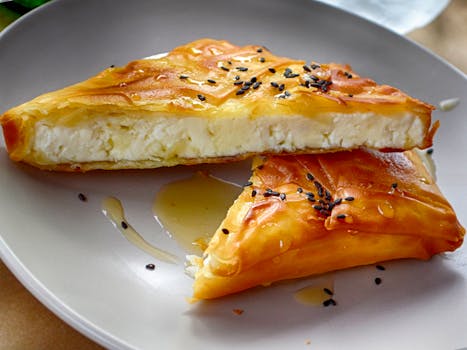
Photo: Daniela Elena Tentis / Pexels
Mediterranean
Tiropita
The diets react (see scores below)
Common Ingredients
- phyllo dough
- feta cheese
- ricotta
- eggs
- butter
- milk
- nutmeg
- parsley
Specific recipes may vary.
Incompatible with 6 of 11 diets
Diet Ratings
Tiropita is fundamentally incompatible with a ketogenic diet due to its phyllo dough wrapper. Phyllo dough is made from refined wheat flour and is extremely high in net carbs — a single sheet contains roughly 4-5g net carbs, and a typical tiropita uses many layers. A standard serving could easily deliver 30-50g of net carbs from the pastry alone, effectively using up or exceeding the entire daily keto carb budget in one snack. The filling itself (feta, ricotta, eggs, butter) is largely keto-friendly, but the phyllo dough is a non-negotiable grain-based wrapper that cannot be reduced to a 'small portion' without fundamentally changing the dish. There is no version of traditional tiropita that fits keto as presented.
Tiropita is a Greek cheese pie that contains multiple animal-derived ingredients, making it entirely incompatible with a vegan diet. Feta cheese and ricotta are dairy products, eggs are an animal product, butter is derived from cow's milk, and milk is a direct dairy ingredient. Every major component of the filling and pastry preparation involves animal products. Phyllo dough and parsley are the only plant-based ingredients in the recipe. There is no meaningful debate within the vegan community about this dish — it is clearly non-vegan.
Tiropita is fundamentally incompatible with the paleo diet. It contains multiple hard-excluded ingredients: phyllo dough is made from refined wheat flour (a grain), feta cheese and ricotta are dairy products, milk is dairy, and butter is a dairy derivative. These are not gray-area items — grains and dairy are among the most clearly and consistently excluded food groups in all mainstream paleo frameworks, including Cordain, Sisson, and Wolf. The only paleo-compliant ingredients in this dish are eggs, nutmeg, and parsley, which are entirely incidental to the dish's identity. There is no version of tiropita that can be considered paleo without replacing virtually every primary ingredient.
Tiropita is a traditional Greek savory pastry made with phyllo dough and a cheese-egg filling. While it is authentically Mediterranean and includes acceptable ingredients like feta (a traditional Mediterranean dairy), eggs, and herbs, several factors temper its rating. Butter is used instead of olive oil, contradicting the Mediterranean diet's primary fat principle. The phyllo dough is a refined grain product, and the combination of multiple dairy products (feta, ricotta, milk) plus eggs and butter results in a relatively high saturated fat content. As an occasional traditional food it is acceptable, but it should not be a dietary staple.
Traditional Greek dietary practice embraces tiropita as a culturally significant food, and some Mediterranean diet authorities argue that whole traditional dishes — even those with refined pastry and dairy — are preferable to modern processed snacks. Regional Greek cuisine incorporates butter and full-fat dairy in baked goods, and the presence of feta (a fermented, lower-fat cheese) and herbs aligns with Mediterranean flavors.
Tiropita is fundamentally incompatible with the carnivore diet. The dish is built on phyllo dough — a grain-based, plant-derived pastry that is strictly excluded from any tier of carnivore eating. While it does contain animal-derived ingredients (feta, ricotta, eggs, butter, milk), these are embedded in a predominantly plant-based structure. Additional disqualifying ingredients include nutmeg (a plant spice) and parsley (a plant herb). Even if the dairy components were individually acceptable to some carnivore practitioners, the grain-based phyllo dough alone is an absolute disqualifier across all carnivore tiers. This dish cannot be modified into a carnivore-compatible version without ceasing to be tiropita.
Tiropita contains multiple excluded ingredients. Phyllo dough is a grain-based product (wheat flour), making it off-limits on Whole30. Feta cheese, ricotta, and milk are all dairy products, which are explicitly excluded. Butter (not ghee or clarified butter) is also excluded dairy. Even if the dairy were swapped for compliant alternatives, the phyllo dough alone disqualifies this dish, and the resulting product would still resemble a baked pastry, violating the 'no recreating baked goods' rule.
Tiropita contains multiple high-FODMAP ingredients that make it unsuitable during the elimination phase. Phyllo dough is made from wheat flour, which is high in fructans — a major FODMAP. Ricotta cheese is high in lactose at standard serving sizes (Monash rates it as high-FODMAP beyond ~2 tablespoons). Milk also contributes significant lactose. While feta cheese is actually low-FODMAP (it is a hard/aged-style cheese with low residual lactose), and eggs, butter, nutmeg, and parsley are all low-FODMAP, the combination of wheat-based phyllo and lactose-containing dairy (ricotta + milk) in a standard serving of tiropita makes this dish clearly high-FODMAP. A single slice or piece would contain enough fructans from phyllo and lactose from ricotta/milk to trigger symptoms in sensitive individuals.
Tiropita is a Greek cheese pie made with phyllo dough, feta cheese, ricotta, eggs, butter, and milk. While it contains some DASH-friendly elements (eggs in moderation, herbs like parsley), it presents several concerns. Feta cheese is high in sodium — a single ounce contains roughly 300-400mg — and a typical serving of tiropita may contain 2-3 oz of feta, pushing sodium intake significantly toward or past DASH daily limits. Butter adds saturated fat, which DASH recommends limiting. The combination of full-fat dairy (feta, ricotta, milk, butter) results in a high saturated fat profile inconsistent with DASH emphasis on low-fat dairy. Phyllo dough itself is relatively low in fat, which is a modest positive. However, the overall dish is calorie-dense, sodium-heavy, and saturated-fat-rich, making it a food to consume only occasionally and in small portions on a DASH plan.
NIH DASH guidelines clearly restrict high-sodium cheeses like feta and emphasize low-fat dairy; however, some updated DASH-aligned clinicians note that emerging research (e.g., de Oliveira Otto et al.) suggests full-fat dairy may not adversely affect cardiovascular risk, and a small portion of tiropita in an otherwise DASH-compliant diet could be permissible — particularly if low-sodium feta is substituted and portion size is carefully controlled.
Tiropita presents multiple Zone Diet challenges but isn't categorically unusable. The phyllo dough is a refined, high-glycemic carbohydrate — an 'unfavorable' Zone carb that spikes insulin rapidly. Feta and ricotta provide protein but come with significant saturated fat, making them less ideal than Zone-preferred lean proteins. Butter further adds saturated fat, pushing the fat profile away from the monounsaturated ideal. The macro balance is heavily skewed: this dish is predominantly refined carbs and saturated fat, with modest protein and minimal fiber or polyphenols to slow glycemic response. However, as a snack category item, a small portion (1-2 phyllo triangles) could theoretically be worked into a Zone day if the surrounding meals are carefully balanced with lean proteins, monounsaturated fats, and low-GI vegetables. The eggs and cheese do provide some protein blocks, and parsley contributes negligible polyphenols. The core problem is the phyllo-to-filling ratio in a traditional tiropita leans too carb-heavy with the wrong kind of carbs, and the fat is predominantly saturated rather than monounsaturated. This is an 'unfavorable' Zone food rather than a forbidden one, hence the caution rating rather than avoid.
Some Zone practitioners argue that small portions of phyllo-based dishes can be incorporated if treated as a carbohydrate block alongside lean protein additions. Dr. Sears' later anti-inflammatory writings (The OmegaRx Zone, The Anti-Inflammation Zone) place greater emphasis on omega-3/omega-6 ratios and polyphenols over strict glycemic control, and feta cheese — being a sheep/goat milk product — has a somewhat more favorable fatty acid profile than cow's milk saturated fat. Under this lens, a single small tiropita piece paired with additional lean protein and vegetables could be a workable Zone snack.
Tiropita is a Greek cheese pie with a mixed anti-inflammatory profile. On the positive side, eggs provide choline and some anti-inflammatory nutrients, parsley offers flavonoids and vitamin C, nutmeg has mild antioxidant properties, and feta cheese — while a full-fat dairy product — is made from sheep/goat milk and contains conjugated linoleic acid (CLA) and some beneficial fatty acids that may be less pro-inflammatory than cow dairy. However, the dish has several concerns from an anti-inflammatory standpoint: butter is a saturated fat that should be limited; full-fat dairy (feta, ricotta, milk) contributes saturated fat and is in the 'limit' category; phyllo dough is a refined carbohydrate with minimal fiber or nutrients; and the overall dish is calorie-dense with no omega-3s, no meaningful polyphenols, and no colorful antioxidant-rich vegetables. There are no strongly pro-inflammatory ingredients (no trans fats, no seed oils, no added sugars, no processed additives), which keeps this out of the 'avoid' category. As an occasional snack in the context of an otherwise anti-inflammatory diet, tiropita is acceptable but not beneficial — it is nutritionally neutral to mildly pro-inflammatory rather than actively supportive of an anti-inflammatory dietary pattern.
Some anti-inflammatory practitioners note that traditional Mediterranean dairy like feta (sheep/goat-based) and moderate egg consumption are compatible with anti-inflammatory eating due to their nutrient density, and Dr. Weil's pyramid does include moderate dairy and eggs. However, stricter anti-inflammatory and autoimmune protocols (e.g., AIP) would flag full-fat dairy and refined phyllo dough as problematic, and would rate this dish lower.
Tiropita is a Greek cheese pie made with phyllo dough, feta, ricotta, eggs, butter, and milk. It offers moderate protein from the cheese and egg filling (roughly 8-12g per serving depending on portion size), but its nutritional profile is dominated by saturated fat from butter, full-fat feta, ricotta, and milk. The phyllo layers are refined carbohydrate with minimal fiber. For GLP-1 patients, the high saturated fat content risks worsening nausea, bloating, and reflux due to slowed gastric emptying. Butter in particular is a concentrated saturated fat that sits heavily in a stomach that is already emptying more slowly. The dish is also calorie-dense relative to its protein yield, which conflicts with the nutrient-density-per-calorie priority. On the positive side, feta and eggs do provide some protein and micronutrients, and the small, pastry-format portion size could align with small-meal eating patterns if strictly limited to one or two pieces. This is not a food to build a meal around but could be a very occasional small-portion snack if GI side effects are well-controlled.
Some GLP-1-focused dietitians allow moderate portions of cheese-based dishes like tiropita because feta and eggs do contribute meaningful protein and calcium in a small volume, which aligns with the small-portion, nutrient-dense eating pattern. Others caution more strongly against it due to the saturated fat load from butter and full-fat dairy, which is consistently linked to worsened GI side effects in clinical practice with GLP-1 patients.
*See how scores were generated at our methodology page.
Nutritional profile
Six traits that cut across every diet.
Fiber & Plants
How much whole-plant food and fiber it delivers.
Healthy Fats
The quality of its fats (unsaturated, omega-3).
Whole / Unprocessed
How close it is to its natural, unprocessed form.
Gut Gentle
How easy it is on digestion (low FODMAP, few irritants).
Low Glycemic
How little it spikes your blood sugar.
Protein Density
How much protein it packs per calorie.
Controversy Index
Higher controversy = more disagreement between diets.
Diet-Specific Tips
 Mediterranean — 5/10
View tips
- Authentic Greek traditional dish with Mediterranean cultural heritage
- Butter used as primary fat instead of extra virgin olive oil
- Phyllo dough is a refined grain, not a whole grain
- Multiple dairy ingredients (feta, ricotta, milk) contribute high saturated fat
- Eggs are acceptable in moderation but add to overall richness
- Feta cheese is a traditional Mediterranean dairy with probiotic benefits
- Parsley adds a modest plant-based element
- Best consumed occasionally, not as a daily snack
 DASH — 4/10
View tips
- Feta cheese is high in sodium (~300-400mg/oz), conflicting with DASH sodium limits
- Butter and full-fat dairy (ricotta, milk) contribute significant saturated fat
- DASH emphasizes low-fat dairy; this dish uses predominantly full-fat dairy products
- Phyllo dough is relatively low in fat, a modest positive
- Parsley provides micronutrient value but negligible impact on overall profile
- Typical serving size results in high combined sodium and saturated fat load
- Acceptable only in small, infrequent portions within a DASH eating plan
 Zone — 4/10
View tips
- Phyllo dough is a refined high-glycemic carbohydrate classified as 'unfavorable' in Zone methodology
- Feta and ricotta provide protein but carry significant saturated fat, not preferred over lean proteins
- Butter reinforces a predominantly saturated fat profile, counter to the monounsaturated fat ideal
- Macro ratio is skewed toward carbs and saturated fat with insufficient lean protein relative to Zone targets
- No fiber-rich or low-GI vegetables to slow glycemic response
- Eggs contribute favorably to the protein content
- Very small portion (1 piece) could technically be assigned Zone blocks but requires careful meal context balancing
 Anti-Inflammatory — 4/10
View tips
- Phyllo dough is refined carbohydrate with low fiber — neutral to mildly pro-inflammatory
- Butter contributes saturated fat (limited category)
- Feta and ricotta are full-fat dairy — 'limit' category but feta has some redeeming qualities as sheep/goat milk cheese
- Eggs contribute choline and some beneficial nutrients
- No omega-3 fatty acids, no colorful vegetables, no polyphenol-rich ingredients
- Parsley and nutmeg provide minor antioxidant benefit
- No trans fats, artificial additives, or high-fructose corn syrup — avoids the worst pro-inflammatory ingredients
- Acceptable occasionally within an overall anti-inflammatory diet pattern
 GLP-1 Friendly — 4/10
View tips
- Moderate protein from feta, ricotta, and eggs (~8-12g per serving), but protein density per calorie is low
- High saturated fat from butter, full-fat feta, ricotta, and milk — likely to worsen nausea and reflux given slowed gastric emptying
- Phyllo dough is refined carbohydrate with negligible fiber — does not support the 25-30g daily fiber target
- Calorie-dense relative to nutritional value — conflicts with nutrient-density-per-calorie priority
- Small pastry format is portion-friendly in theory, but GLP-1 patients may struggle with the fat load even in small amounts
- No significant fiber, minimal micronutrient contribution beyond calcium and some B vitamins